


A new series on legislators trying to virtue-signal consumer protection, starting with Virginia. – The Energy News Beat SubStack.
Not passing the Save America Bill may be one of the primary reasons the Republicans will lose the Midterms if they don’t stop acting like a Uni-party and helping the Democrats more than President Trump and most Americans want.
Other items that are appearing to be a major failure of the Republican Party are not able to articulate why people’s power bills are increasing.
I would recommend that Vice President Vance step up, take control of the Senate, and get the Save America Act passed. He has the constitutional right and authority to pull that lever. Just saying.
California is stealing the mayor and governor elections in real time, and California’s failure will ruin the Trump presidency. We are witnessing in real time what the entire midterm will look like across the U.S., with every seat stolen. The Trump administration will not recover from the loss of trust we, as Americans, have in him, and not Congress. They have failed the U.S. Citizens.
California is such a large part of the US economy that its failure will be a major drag on overall US GDP, further draining the Trump Administration.
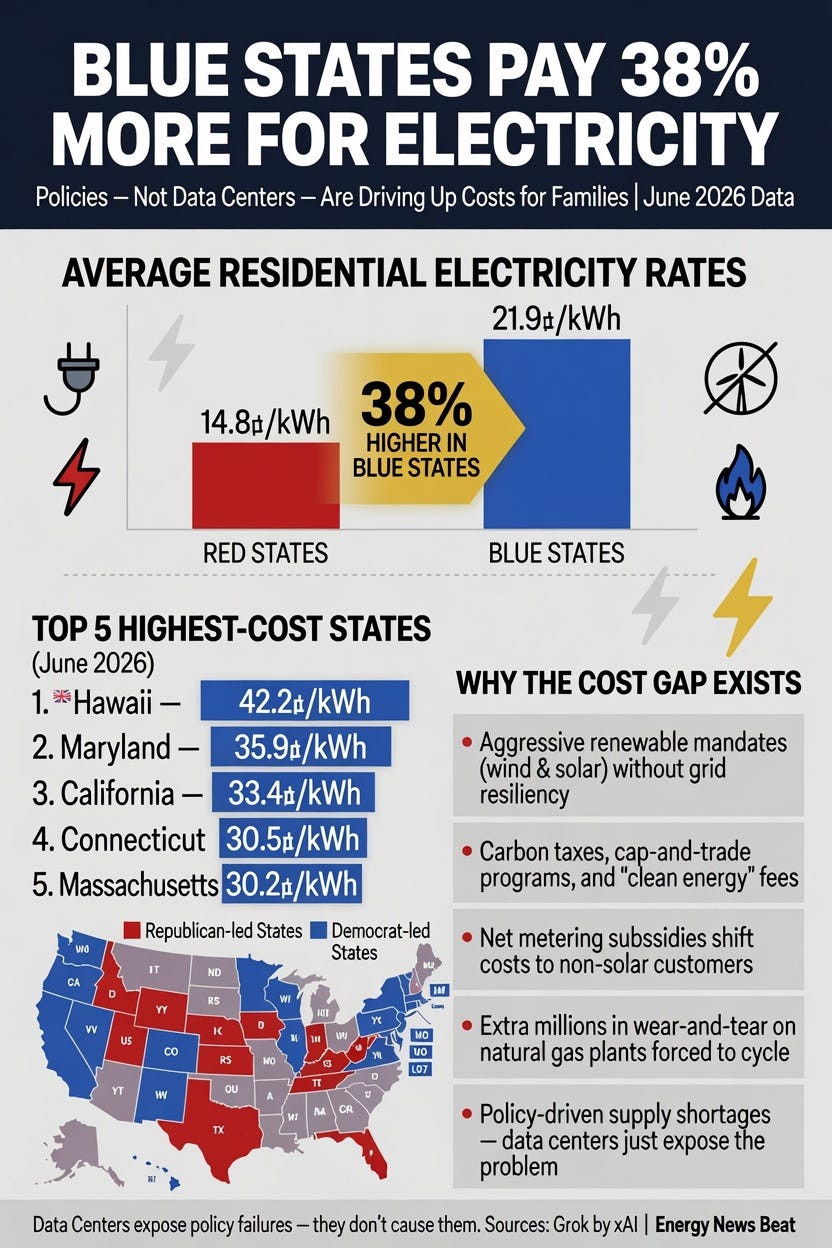
California also just passed more laws extending its climate programs that 17 other states follow, and are a major source of the expenses listed in the infographic below.
California Extends Its Key Climate Programs, Condemning the State to High Energy Prices
U.S. Sen. Mark Warner (D-Va.) is once again positioning himself as a champion for everyday electricity customers.
In remarks tied to the Power for the People Act, Warner stated: “The issue is this: We’re not going to stop artificial intelligence. We have to put guardrails on it. But I also think we need guardrails on data centers.”The bill, co-sponsored by a group of Democrats, targets the more than 600 data centers in Virginia and the 4,300-plus across the U.S.
It argues that these facilities drive up costs for everyone in two ways: by spiking overall electricity demand (sometimes outpacing supply) and by requiring grid expansions whose costs are passed on to all ratepayers, not just data center operators.
To “fix” affordability and reliability, the Power for the People Act would:
Direct states to evaluate new rate classes specifically for data centers (building on the Virginia State Corporation Commission’s approach from last year) and provide technical assistance.
Order the Federal Energy Regulatory Commission (FERC) to require data centers to pay for local transmission upgrades they uniquely trigger.
Push interconnection rules that favor “clean energy,” battery storage, and flexibility while discouraging diesel backup generators.
On the surface, making big tech pay its “fair share” sounds consumer-friendly. But Sen. Warner and his colleagues are missing a critical point before the legislation even leaves the starting gate: the biggest driver of higher electricity bills for American families isn’t data centers — it’s the energy policies enacted in Democrat-run states.
Blue-State Policies, Not Data Centers, Are the Real Cost Driver
Reliable data show that residential electricity rates in Democrat-led (blue) states are approximately 38% higher than in Republican-led (red) states. Analyses consistently put blue-state averages around 21.3¢/kWh compared to roughly 15.4¢/kWh in red states. Over the past decade, prices in blue states have risen 32.4% while red states saw only an 18.5% increase.
This gap isn’t geography or coincidence. It stems directly from policy choices:
Aggressive renewable portfolio standards (RPS) and “clean energy” mandates that force utilities to prioritize intermittent wind and solar.
Carbon taxes and cap-and-trade programs (such as the Regional Greenhouse Gas Initiative) that deliberately raise the cost of reliable natural gas and coal generation to fund pet projects.
Massive subsidies and cost-shifting for solar (net metering) and storage, leaving non-participating ratepayers to foot the bill.
Premature retirement of dispatchable power plants without adequate replacement capacity.
One especially costly side effect is the extra wear and tear on natural gas turbines. Because wind and solar generate power only when the wind blows or the sun shines, gas plants are forced to cycle up and down repeatedly.
Studies from the National Renewable Energy Laboratory (NREL) document how this ramping and cycling increase operations and maintenance costs for fossil-fueled generators by tens of millions of dollars annually in regions with high renewable penetration — costs ultimately passed on to consumers through higher rates.
In short, blue-state energy policies add layer after layer of expense: renewables without grid resiliency, carbon pricing, and regulatory mandates that make reliable power more expensive to operate. Data centers are simply the latest large load, exposing these pre-existing problems.
The Diesel Backup Red Herring
Data centers rely on diesel gensets for true emergencies — when the grid fails. High-tier facilities (Tier 3 and 4 per Uptime Institute standards) are designed for minutes of downtime per year, not hours. Federal regulations already limit non-emergency operation (testing and maintenance) to roughly 100 hours per year, with many facilities running weekly or monthly tests of just 6–30 minutes. Real-world outages triggering full diesel operation are rare. The diesel “boom” at data centers is about backup capacity, not constant runtime.
Banning or heavily restricting diesel doesn’t add firm power to the grid — it just forces operators toward more expensive or less reliable options while the underlying supply shortage remains unaddressed.
If Congress genuinely wants to protect ratepayers amid the AI-driven demand surge, the focus must shift from cost-shifting to supply expansion:
Permitting reform to slash timelines for natural gas plants, nuclear reactors, transmission lines, and pipelines.
All-of-the-above incentives for co-located generation so data centers can bring their own firm, dispatchable power instead of relying on a strained grid.
Reliability-first standards at FERC and NERC that prioritize 24/7 power over intermittent sources. The additional complexity and costs that wind and solar have imposed on US taxpayers are only now being realized. We have an $89 billion liability for wind farm land reclamation coming due soon, and I just read about a solar farm in New York that has to bury the solar panels 3 feet underground to qualify as land reclamation by a Canadian firm. That is not “Clean Energy”; it is theft and a wealth transfer.
Rejection of one-size-fits-all federal mandates that nationalize Virginia-style rate experiments and ignore the proven 38% cost penalty of blue-state policies.
The Power for the People Act treats the symptom — who pays the higher bill — while ignoring the disease: policy-driven supply shortages and cost inflation.
Consumers don’t need more creative accounting to divide a shrinking electricity pie.
They need policymakers to stop shrinking the pie with anti-supply regulations.
As Warner prepares additional data center legislation, Energy News Beat urges a return to basics: abundance through American energy production, not guardrails that punish the very infrastructure powering the future.
We will be tracking these runs by governors and legislators to help consumers, but let’s not forget the wonderful “Inflation Reduction Bill” or other named bills that do the exact opposite of what they are named.
Shout out to Kim Farrington, and hope she can run a great race in Virginia against the Democrat machine. We need great leaders who want to win for America and Americans.
Appendix: Sources and Links
- Original article on Sen. Warner and the Power for the People Act: https://www.fredericksburgfreepress.com/2026/06/05/u-s-sen-warner-data-centers-shouldnt-drive-up-energy-costs-for-consumers/
- Electricity rates by political party control (38% higher in blue states): https://www.electricchoice.com/electricity-prices-by-state/political-analysis/ and https://paylesspower.com/blog/red-vs-blue-which-states-pay-the-most-for-electricity/ (confirming ~37-38% differential).
- “Blue States, High Rates” report (IER / Always On Energy Research): https://www.instituteforenergyresearch.org/the-grid/blue-states-high-rates-policy-matters/ and

- NREL studies on wind/solar-induced cycling costs and wear-and-tear on fossil plants: https://docs.nrel.gov/docs/fy13osti/59064.pdf and https://docs.nrel.gov/docs/fy12osti/53504.pdf
- Data center diesel generator usage, runtime limits, and testing: https://betterdatacenterproject.com/wp-content/uploads/2026/03/Diesel-Generators-at-Data-Centers-Status-Impacts-and-Protective-Practices.pdf ; https://insideclimatenews.org/news/12112025/data-center-diesel-generators-noise-pollution/ ; Uptime Institute standards referenced in industry analyses.
- Additional context on blue-state carbon programs and rate impacts: https://www.americanenergyalliance.org/2026/02/whose-policies-are-increasing-electricity-rates/
Energy News Beat will keep tracking this legislation and the broader data-center energy debate. The AI boom demands real power — not more rules that make it costlier for everyone else.
