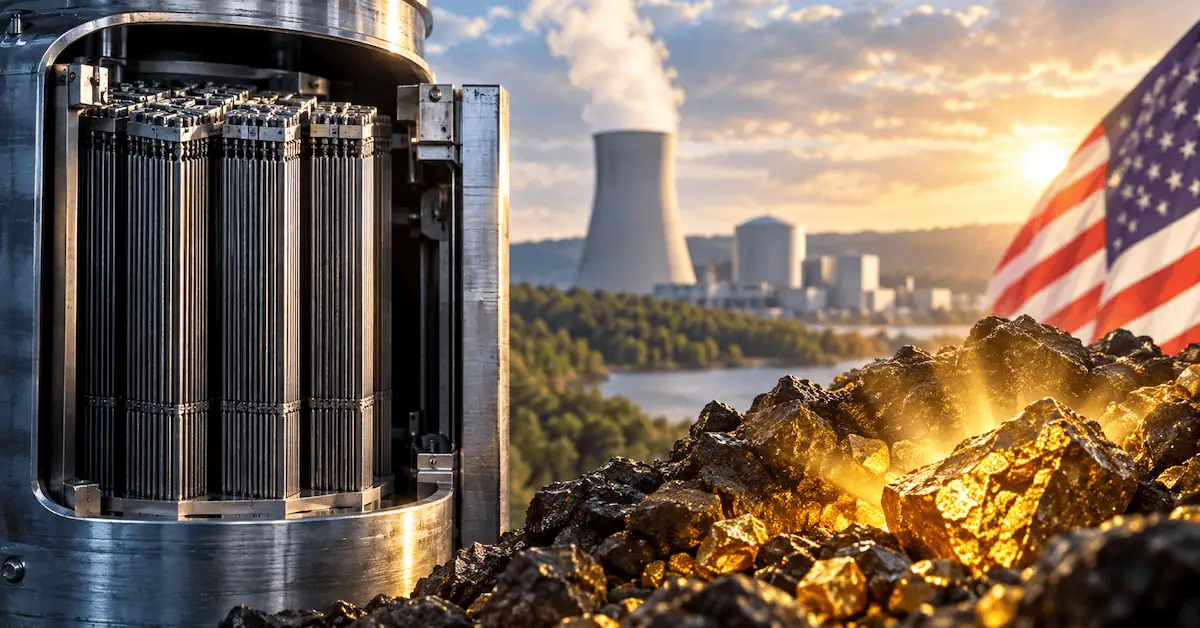
The recent shift in the national conversation around nuclear-generated electricity is encouraging. After decades of political hesitation, federal and state leaders are once again speaking positively about nuclear power’s role in delivering reliable, abundant electricity. That change in tone matters. However, favorable rhetoric alone will not solve one of the industry’s most persistent challenges: what to do with America’s growing inventory of spent nuclear fuel. That “spent” is also referred to as “slightly used nuclear fuel” (SUNF), which still contains about 95% of its unused potential energy after years inside a reactor
The Department of Energy’s Nuclear Lifecycle Innovation Campus initiative is a case in point. The program has generated headlines by identifying five states as potential partners in exploring integrated nuclear fuel cycle facilities. Yet the reality is more modest than many observers assume. Although the states have signed non-binding memorandums of understanding to continue discussions, they have not committed to accepting spent nuclear fuel, nor have final host agreements been executed.
Decades after Congress assigned the federal government responsibility for disposing of commercial spent nuclear fuel, most of that material remains stored at reactor sites around the country. The Government Accountability Office has repeatedly described the nation’s waste management program as being at an impasse and has called for congressional action to move the process forward.
The Limits of a Government-Only Strategy: Federal efforts in recent years have focused heavily on “consent-based siting,” a process intended to identify willing host communities for spent fuel storage facilities. DOE describes this approach as a collaborative, community-centered process that may ultimately lead to negotiated agreements for interim storage facilities.
Consent-based siting is an improvement over past approaches that attempted to impose solutions from Washington. Communities deserve a meaningful voice in decisions that affect their future.
But the challenge is that process alone is not a solution, as evidenced by the fact that no state has “consented to accept” spent nuclear fuel, either as a permanent solution or an interim solution.
Too often, public policy substitutes studies, committees, consultations, and funding announcements for measurable progress. Government can facilitate discussions and establish regulatory frameworks, but it cannot create effective economic incentives necessary to transform spent nuclear fuel from a liability into a valuable resource.
As long as success is measured by meetings held, grants distributed, and reports published, there is little incentive to deliver a commercially sustainable outcome.
Turning a Liability into an Asset: A different approach begins with a simple question: What if spent nuclear fuel were viewed not primarily as waste, but as a valuable energy resource?
Many advanced nuclear technologies, particularly fast reactors, are designed to utilize materials that remain in used nuclear fuel. Supporters of fuel recycling argue that a significant portion of the energy potential contained in spent fuel remains available for future use. In that view, the challenge is not merely disposal but resource recovery.
This is where private enterprise can make the difference because there is huge commercial opportunity in turning spent nuclear fuel into electricity.
Rather than relying indefinitely on federal appropriations and political cycles, policymakers should consider creating conditions that allow private industry to assume greater responsibility for managing and recycling spent fuel. The federal government would still play an essential role by establishing clear rules, enhancing safety, and honoring existing commitments. But innovation, investment, and execution should increasingly come from the private sector.
A Proposal for Partnership: One model would be to use resources already accumulated through the Nuclear Waste Fund and related federal commitments to facilitate the transfer of spent fuel management responsibilities into a commercially driven framework. At the same time, one or more states would need to voluntarily agree to host facilities capable of receiving, processing, recycling, or otherwise managing used nuclear fuel.
Such an arrangement would not simply spend public money. It would seek to leverage public resources to catalyze private investment, job creation, technological development, and long-term industrial growth.
The DOE has promoted Nuclear Lifecycle Innovation Campuses as hubs that could eventually support fuel fabrication, enrichment, recycling of used fuel, and waste management functions. If structured properly, such campuses could become engines of private-sector innovation rather than primarily government-directed programs.
The economic potential could be substantial. DOE has stated that innovation campuses could attract significant private investment and create large numbers of high-paying jobs in host regions.
From Subsidy to Incentive: There is an old saying: give a man a fish, and you feed him for a day; teach him to fish, and you feed him for a lifetime.
The same principle applies here.
Simply distributing government funding without creating strong incentives for performance risks perpetuating the cycle of study, delay, and dependency. By contrast, jump-starting companies to enter the business of successfully recycling, processing, and utilizing spent nuclear fuel aligns economic incentives with public objectives.
When private investors have capital at risk, delays become costly, innovation becomes valuable, efficiency becomes essential, and results become measurable.
That does not mean government disappears from the process. On the contrary, government remains responsible for enhancing public safety, environmental oversight, and policy certainty. But government should create the conditions for success rather than attempting to manage every aspect of implementation.
A Historic Opportunity: The United States may be entering a unique moment, as public attitudes toward nuclear energy have become more favorable, concerns about energy security are increasing, and advanced reactor technologies continue to gain attention.
Federal leaders deserve credit for recognizing the strategic importance of nuclear power and for reopening discussions about the back end of the fuel cycle.
The next step, however, is to move beyond discussion.
America’s spent nuclear fuel challenge will not be solved by rhetoric, grants, or endless study alone. It will be solved when states voluntarily participate, when private industry sees opportunity rather than liability, and when policymakers create incentives that reward actual progress.
The choice is simple. America can continue talking about the problem or build a system that finally solves it. The most promising path forward is one in which government enables, private enterprise leads, and the nation transforms a long-standing burden into a lasting economic opportunity to provide affordable and abundant electricity to its citizens and to the world.
Please share this information with teachers, students, and friends to encourage Energy Literacy conversations at the family dinner table.
Click this Link to Sign up for Energy Literacy from Ronald Stein.