The Energy Realities Team of Dr. Nemeth, David Blackmon, and Stu Turley was in rare form this morning.
In this roundtable discussion, three energy experts examine the perfect storm of policy decisions, geopolitical conflicts, and ideological commitments that have created a global energy crisis. Hosted by Stu Turley of Energy News Beat, with guests Dr. Tammy Nemeth (The Nemeth Report) and David Blackmon (Forbes, Daily Caller), the conversation reveals how decades of environmental regulations, net zero mandates, and refinery closures have left the Western world dangerously dependent on imports—particularly diesel and liquefied natural gas.
As Russia’s refining capacity crumbles from Ukrainian strikes and Europe shuts down its own refineries in pursuit of climate goals, the EU and UK now find themselves bidding against Asia for energy supplies they once produced domestically. The hosts argue this isn’t merely incompetence, but a deliberate strategy of deindustrialization that benefits China while hollowing out Western manufacturing and threatening energy security.
From the diesel shortage and investment crisis to geopolitical threats and the hypocrisy of international climate agreements, this episode unpacks how the world arrived at this precarious moment—and what it means for the future.
Global Energy Crisis - How Did We Get Here? - RoundTable Edition
The hosts explore how the world reached a critical diesel shortage. Key factors include:
Russia’s loss of ~60% refining capacity due to the Ukraine war
Closure of 375,000 barrels per day of refinery capacity in the EU and UK over the past year
Net zero policies making refineries uneconomical in Europe and the UK
Europe now forced to import diesel from Asia (South Korea), bidding against other Asian nations
2. Refinery Closures & Energy Policy
A central theme is how environmental regulations and net zero policies have eliminated refining capacity:
The U.S. hasn’t built a new refinery in ~50 years due to permitting barriers
Seven of California’s refineries are slated to close
EU and UK refineries shutting down, with production offshored to Asia
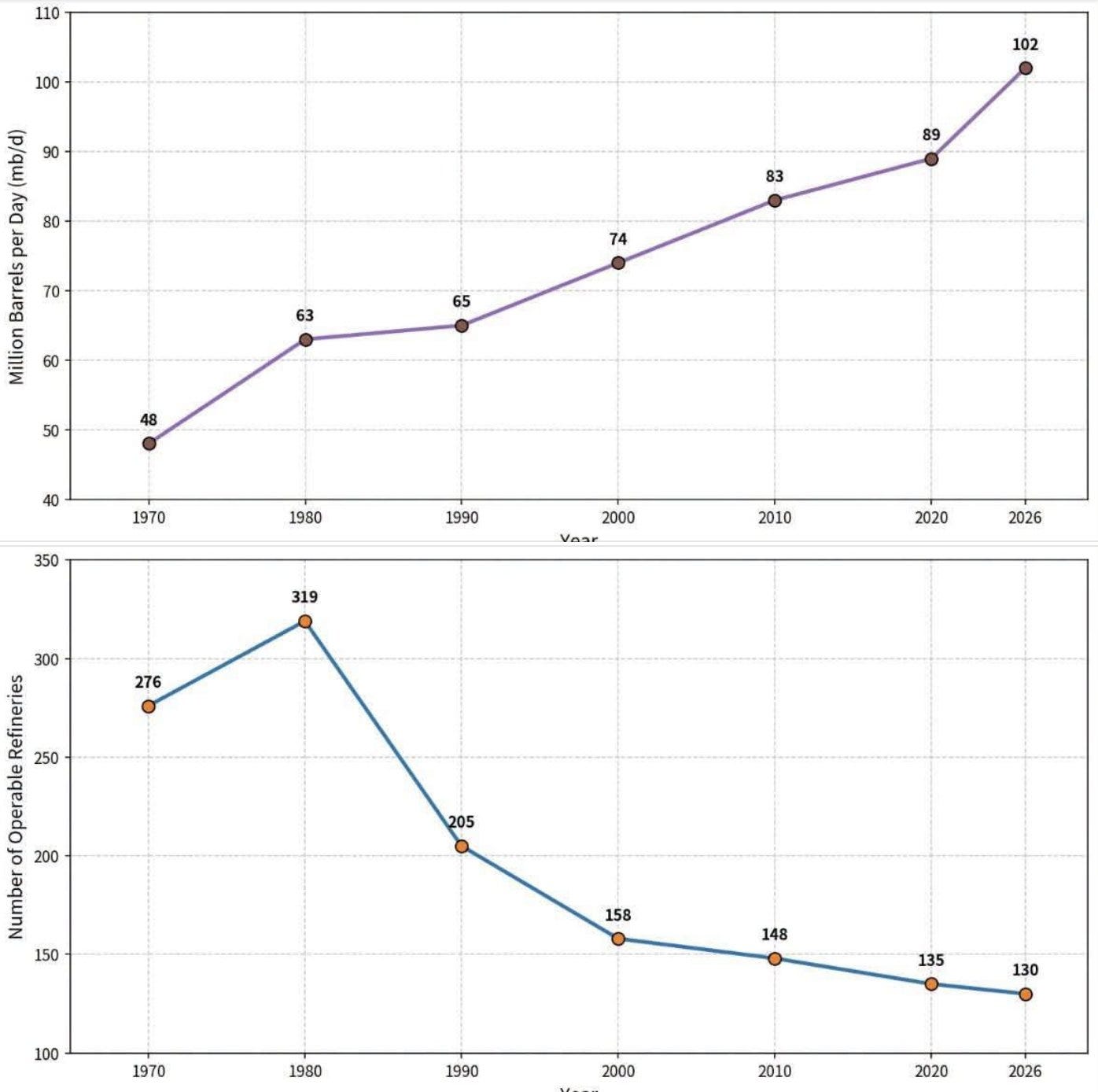
Oil production is up 113% globally since 1970, but refinery capacity has declined
3. Net Zero & Deindustrialization
The hosts argue net zero policies are intentionally destroying manufacturing:
Alignment with net zero is causing job losses (40,000+ already lost in Canada)
Deindustrialization is realigning the EU, Canada, and UK toward China for manufacturing
Higher investment in renewables doesn’t equate to better returns on energy production
4. China’s Strategic Advantage
China is profiting from Western energy instability by:
Controlling supply chains for EV components, solar panels, wind turbines, and batteries
Stealing EV technology from Tesla and Volkswagen
Playing both sides—investing in coal/natural gas while pushing green energy globally
Positioning itself as the supplier for the “green transition”
5. Geopolitical & Security Concerns
Attempted attack on a UK military base by suspected Middle Eastern operatives
Cyber attacks on 32 tankers
Concerns about autonomous vessels being vulnerable to hacking
Energy dependency creating national security vulnerabilities
6. Investment Crisis
The hosts warn of an impending investment crisis because:
Political uncertainty discourages long-term capital investment in energy infrastructure
CEOs lack confidence that projects won’t be canceled by future administrations
Investors are reluctant to fund oil and gas projects due to ESG pressures and climate ideology
7. UN Climate Agreements & International Policy
Nigeria’s hypocrisy: lecturing on climate change while being a major fossil fuel exporter
The $100 billion climate fund and how developing nations game it
Article 6 of the Paris Agreement enabling carbon credit trading
EU energy rationing proposals (thermostats, public lighting cuts)
8. CO2 & Climate Science Debate
The hosts challenge climate narratives:
CO2 is beneficial for plant growth (800-1200 ppm ideal for greenhouses)
The greening of Earth over 30-40 years linked to increased atmospheric CO2
Distinction between real pollution (particulates) vs. CO2 focus
Criticism of conflicted figures like Elon Musk profiting from carbon credits
9. Political & Economic Consequences
Potential formation of new trading blocs based on energy policy alignment
Canada considering EU association membership, which could break ties with the U.S.
Regulatory compliance costs making Canadian businesses uncompetitive with the U.S.
Concerns about Mark Carney’s influence prioritizing UK/EU/China interests over Canada
The overarching narrative is that Western energy policies are creating self-inflicted crises that benefit China while impoverishing and destabilizing their own populations.
We were trying to show the great comments from Secretary Chris Wright, and I included them here.
Secretary Chris Wright is spot on. We have gone – the country has gone after the particulate matter. CO2 is plant food, and we covered that on the podcast.
These closures were not accidents of market forces alone. They followed explicit policy: renewable portfolio standards, carbon pricing that does not apply equally to imports, fuel specifications that fragment markets, and political rhetoric treating refining as a sunset industry. When demand for diesel—used in agriculture, trucking, construction, backup generation for data centers, and industry—did not vanish on schedule, the buffer disappeared.
Total global oil production since 1970 is up 113%. (And U.S. production has nearly tripled since 2008.) Yet the total number of US refineries in 2026 is 130, down from 319 in 1980. During that time, demand for gasoline has increased significantly because our population grew by an additional 100 million people. You can pump all the crude oil you want, but if you can’t convert it into gasoline and diesel, it doesn’t matter, at least not for gas prices. Why did this happen?
Because blue states closed refineries to move toward stupid “Net Zero” and “Green New Deal” goals. And Democrat Presidents from Carter to Biden imposed restrictions on refinery construction so draconian that no one could afford to build…if they could even get a permit. But sure, blame Trump, the first President to actually do something about it. Instead, elect the people who TOLD YOU they wanted to “ban fossil fuels” and push the price of gas over $10/gal., and then relentlessly implemented policies to get us as far in that direction as they could.
Secretary Chris Wright’s Case for Energy Addition
U.S. Energy Secretary Chris Wright has been blunt about the policy record and the required response. For 17 years, he notes, policies attacked hydrocarbons and closed refineries and coal plants. The way to solve a shortage is to grow supply, not restrict it. An outright diesel export ban, he argues, is a “blunt hammer” that would fill domestic tanks, force refiners already running near 98 percent utilization to cut crude runs, and raise prices for gasoline and jet fuel as well. The United States is a structural diesel surplus producer; the world is short. Voluntary adjustments in flows make more sense than a ban that would damage America’s role as an energy supplier.
Wright’s broader framework is energy addition, not subtraction. He supports “all-of-the-above” sources that deliver affordable, reliable power—oil, gas, coal where needed, nuclear (fission and fusion), and renewables that actually perform. Wind and solar, he points out, do not produce when the sun is down or the wind is still; treating them as baseload replacements has raised electricity prices in states with aggressive mandates. The administration’s goal is lower cost and higher performance, re-industrialization, and energy dominance so the United States can supply itself and allies. Climate policies that make energy expensive, he argues, impoverish citizens and shift manufacturing—and emissions—overseas.
Energy Poverty Is Not Abstract
The human cost of scarcity extends far beyond Western pump prices. As of the latest Tracking SDG 7 data, 655 million people still lack electricity and roughly two billion lack access to clean cooking fuels, relying on wood, charcoal, kerosene, or dung. Sub-Saharan Africa accounts for the bulk of the gap; progress has slowed. Indoor air pollution from traditional cooking kills millions annually. Energy access underpins health, education, refrigeration, industry, and escaping extreme poverty. Wright has asked where the equivalent of COP conferences is for this more immediate crisis. Developing countries consume a fraction of the energy of wealthy nations; they need far more, including hydrocarbons, to raise living standards.
We appreciate all of our great Substack subscribers and watchers on YouTube.
There is no ‘Energy Transition’ taking place. Instead, what is taking place is the most massive addition of energy in all its forms in the history of mankind. Learn all about this energy addition and the public policies that drive it here.
The Nemeth Report delivers sharp, evidence-based analysis on energy, environment, and climate policy. Dr. Tammy Nemeth challenges net-zero ideology, green energy myths, and selective environmental activism with realism and common sense.