

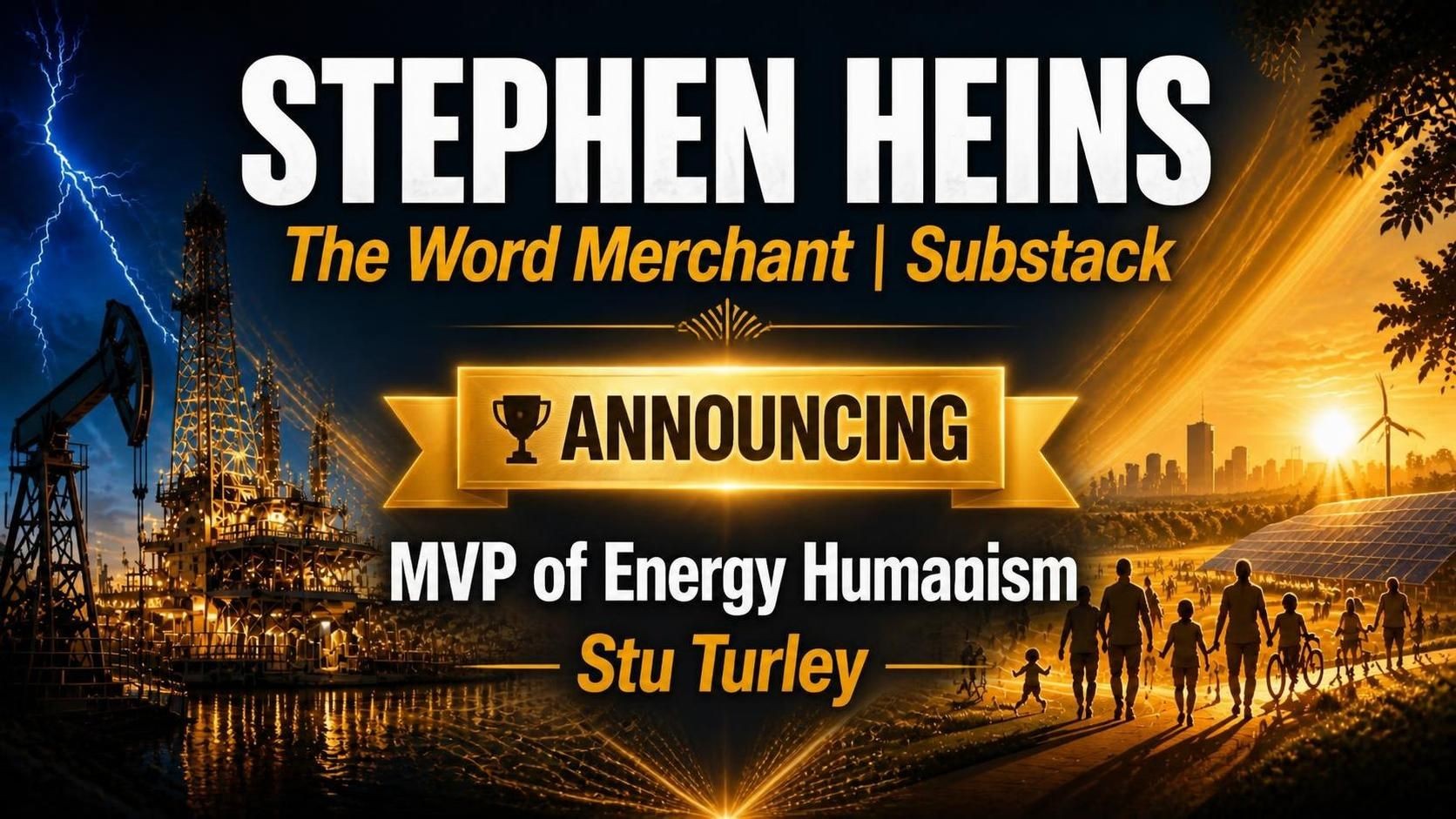
ENB Pub Note: This is from Stephen Heins’s Word Merchant Substack and is an extremely generous take on what we have accomplished at Energy News Beat. We do recommend supporting and subscribing to Stephen’s Substack. We wouldn’t have the highest views, reads, and statistics in the last five years without our great subscribers, paid Substack patrons, and fantastic sponsors. Thank you Stephen for your leadership in Energy – Stu
——————————————————————————————————————————————————————————————————————-
In a business full of slogans, Stu Turley has done something rarer. He built a place where energy people can tell the truth out loud.
He did not arrive from a climate foundation or a government-grant treadmill. He came out of Intel in the Andy Grove years, the “constructive confrontation” shop where a bad argument did not survive the room. The old Intel nickname was Mr. Teflon. It was not a compliment about charm. It meant criticism did not stick, because the work held. Grove’s rule was simple enough for a Midwest shop floor: only the paranoid survive, and only the prepared get to argue. Turley took that with him.
Out of that came the Sandstone Group and Energy News Beat, the Fort Worth operation he runs as president and CEO. The daily standup, the long interviews, and the Energy Realities roundtable with David Blackmon, Irina Slav, and Tammy Nemeth are not another shout-fest. CEOs take the armor off. They laugh. They think out loud.
That only happens when the host has no hidden bill to collect. Turley’s own bio puts the podcast at the top of the U.S. energy rankings and inside the global top tier. The guest list reads like a working energy Who’s Who: operators, refiners, nuclear fuel people, African chamber leaders, grid builders. The point is not celebrity. The point is the molecule, the wire, and the energy market.
That is the substance, and it is where he earns the MVP.
He will say what many people in the sector only say after the microphone is off. Today’s brand of climate alarmism and forced-march Net Zero is not environmentalism. It is anti-humanism in a green jacket. It treats energy poverty as acceptable collateral damage in the pursuit of a Western carbon target. Turley rejects that. His measure is not the number of virtue signals a policy generates. It is whether the lights stay on, the cookstove stops smoking, energy flows and somebody makes a profit doing it.
He is not ideologically opposed to wind or solar. He is opposed to forcing them on the world with trillions in subsidies while pretending they are cheaper and more reliable than the meter says. When a technology can stand up, earn its keep, and stop demonizing every other tool in the box, he will cheer it. Until then, spare us the withered future.
The human toll is the part he will not let slide. On September 30, 2026, he sat down with NJ Ayuk of the African Energy Chamber and Cyrus Brooks of RBAC for an episode called “Africa’s Energy Moment: From Poverty to Abundance.” Ayuk’s numbers, which Turley put on the table without softening them, are the ones that matter: on the order of 600 million Africans without electricity, and on the order of 900 million without clean cooking. LPG and natural gas were discussed as practical tools, not as moral failures.
The Dangote refinery, African gas, and the refusal to keep the continent as a raw-material museum all got a straight hearing. Mothers inhaling wood smoke, girls who cannot study after dark, and finance shops that will fund a panel but not a gas plant are not abstractions to him. Economic development is not optional. Affordable energy is the first step. He refuses to infantilize Africa.
That is energy humanism with the bark still on it. Best of the above, meaning whatever actually delivers: natural gas as bridge and destination, nuclear including the fuel cycle, oil where the world still runs on it, coal where it still keeps factories alive, and renewables when they compete without a sermon.
In September, he also sat down with Christo Liebenberg of LIS Technologies to discuss laser enrichment and America’s nuclear-fuel pinch. A country that talks about SMRs while importing its enriched uranium is not serious. Turley treats that as an engineering problem, not a branding problem.
He is just as plain about the hardware the transition talk skips. In early October 2026, he was writing about transformers, not slogans. U.S. large power transformers average 38 to 40 years old. About 80 percent of new ones are imported. Lead times that used to be weeks are now two to four years. You cannot run an AI data center, a factory, or a hospital on a press release.
Power demand is outrunning the grid because we cannot build and move the equipment, not because we have forgotten how to make electrons. That is Grove-era thinking applied to a sector that has spent a decade applauding itself.
The same eye shows up on refining. Energy Realities, with Blackmon, Nemeth, and guests such as Richard Norris, has been walking through the diesel squeeze: Western refineries shut, new capacity built elsewhere, Russia’s exportable diesel hit by war, Iranian capacity sitting on the wrong side of a fought-over Hormuz, tanker economics gone sideways.
Crude and natural gas in the ground is not gasoline in the tank or electricity for consumers. Turley keeps returning to that distinction because drivers, truckers, and farmers live on the product, not the headline.
In a trade full of tribal flags, he has managed to be pro-human without being anti-anything that works. Pro-profit, because profit is how the next well, the next plant, and the next wire get built. Pro-engineering, because physics does not attend the conference.
Pro-Africa, as a partner with gas, refining, and power, not as a case study. Pro-women who deserve a clean flame. Pro-children who deserve a light to read by. Pro-common sense, which in this business has become a minority position.
The manner matters. Oklahoma-humble, good-humored, allergic to nonsense. He learned at Intel that a relaxed room gets better answers than a hostile one, and he still runs interviews that way. Executives will say the awkward thing if they are not being auditioned for a morality play. That is a craft, and he has it.
Sandstone’s media shop, the Substack, the standup he often shares with the Realities gang are all built on the same bet: people want the numbers as much as the energy narrative. His own note to readers this fall was that the audience is the largest in five years. That is not an accident. The official story has been springing leaks and Stu has been flooding in.
There is a Midwest way to judge a man in this fight. Does he show up every day? Does he name the tradeoffs? Does he treat a mother in Lagos and a roughneck in the Permian as citizens of the same economy, not as props? Turley does. Twenty-five years of arguing for energy plentitude, low cost, and fairness has a short list of people who do the daily work of making that argument audible. He is on it.
The MVP is not a momentary award. It is wide recognition that, right now, Turley is one of the voices doing the most to drag the energy conversation back to human flourishing. Battle-tested. Precise without being pedantic. On the side of abundance.
Here is to Stu Turley: Mr. Teflon, podcast host, and energy humanist. Keep the microphone open. The energy world needs more of that, not less.
Energy Humanist Thinks
Energy policy is a human policy. If it does not shorten poverty, it has failed, whatever the slogan.
Best of the above means best of what works: gas, nuclear, oil, coal where it still carries the load, and renewables when they earn a profit without a mandate.
Africa is a partner, not a museum. Six hundred million people without electricity is an emergency, not a branding opportunity.
The grid is hardware. Transformers, fuel, refineries, and wires decide whether the lights stay on. Models do not.
Profit is not a sin against the climate. It is how the next plant gets built.
A good host gets the energy truth on the table. Stu Turley has made an energy humanist career of it.
