


ENB Pub Note: This article first ran on the Crude Truth Substack, and we recommend subscribing.
The Crude Truth about Diesel and President Trump’s Executive Order.
President Trump signed an executive order on October 5, 2026, temporarily allowing off-road “dyed” diesel for highway use and deferring the federal excise tax through year-end. The move targets relief for truckers, farmers, and other diesel users amid elevated prices driven by constrained global refined-product supply.
The order, titled “Emergency Tax Relief on Diesel Fuel,” directs the Treasury Secretary (in consultation with the Secretary of War) to determine whether relief is authorized under existing tax code provisions and, if so, to defer payment of certain diesel excise taxes incurred from October 5 through December 31, 2026, without interest or penalties. It also instructs the IRS to announce it will not impose penalties for selling or using dyed diesel on highways during that window. Separate sections direct the Transportation and Agriculture secretaries to coordinate with states, industry, labor, and farm groups on access, and urge states to align their own enforcement and tax policies.
What Dyed Diesel Is
The White House fact sheet states the action will put money directly back into the pockets of farmers, truckers, and workers, “for example saving truckers over $100 per refill.” A typical long-haul tractor carries 200–300 gallons total capacity (often ~250–270 usable gallons). At the federal rate alone, 250 gallons equates to about $61; combined federal-plus-average-state tax relief, or larger fills, aligns with the administration’s per-refill example if states follow the federal lead on enforcement discretion and tax treatment. The order also directs Treasury to explore pathways, including legislation, to eliminate the deferred tax obligation entirely.
Who Is Most Affected
Farmers already rely heavily on dyed diesel for tractors, combines, irrigation, and harvest equipment. Recent farm diesel price spikes have added meaningful per-acre costs (Farm Bureau analysis cited roughly $2.60 per gallon year-over-year increases in some benchmarks, translating to several dollars to tens of dollars per acre depending on the crop). The Agriculture Secretary is directed to work with cooperatives and rural distributors to maintain dyed-diesel availability in high-demand areas and to encourage parallel state action. Lower transport costs for inputs and harvested crops provide an indirect benefit.
Construction workers, equipment operators, and other off-road users gain from clearer temporary rules if any of their fuel moves onto public roads. Broader workers and consumers benefit if reduced freight costs flow through to goods prices—diesel powers the trucks, rail, and equipment that move food, building materials, and consumer products. The administration has separately cited a negotiated European release of 100 million barrels of refined diesel over four months as a supply-side complement.
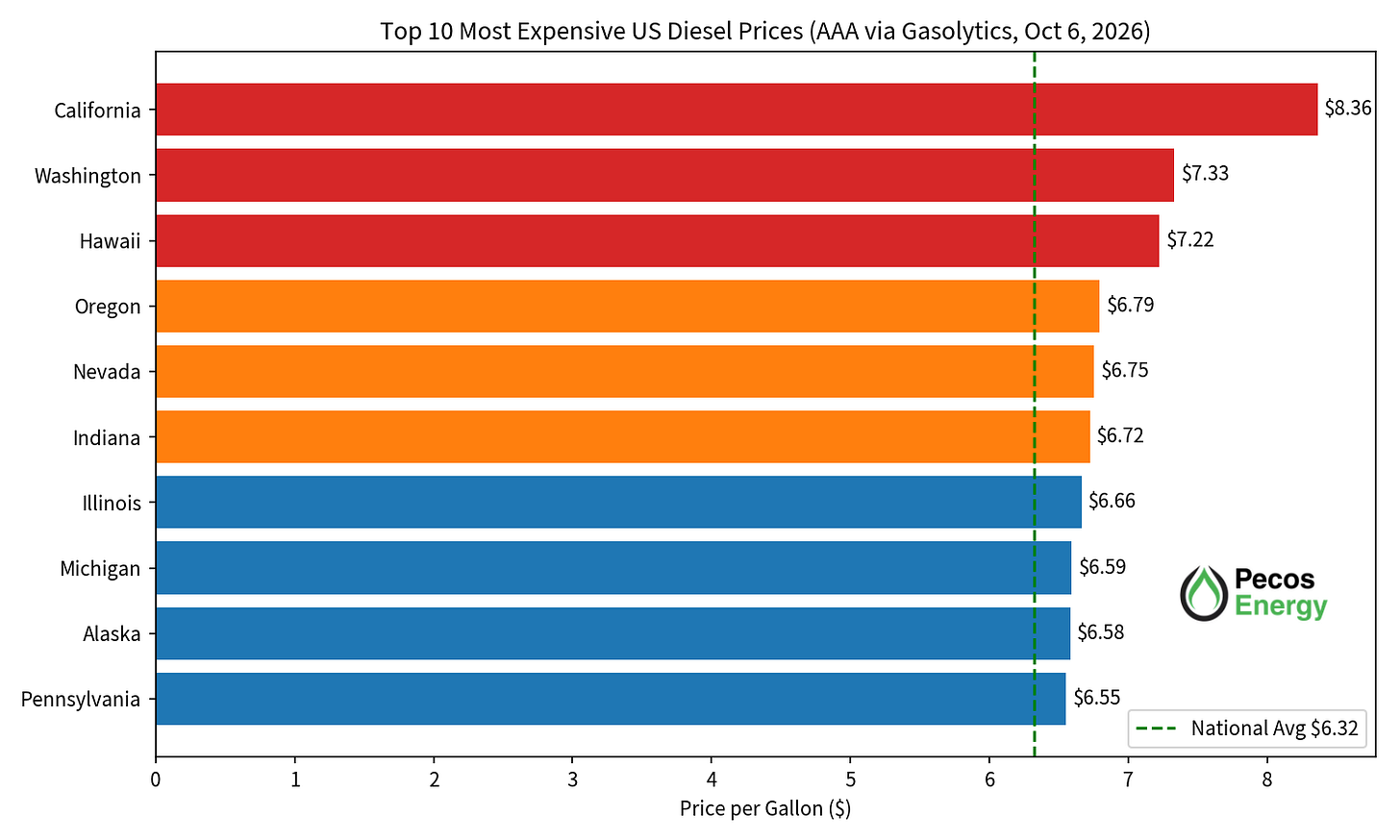
Highest-Price States and Current Averages
- California: $8.36
- Washington: $7.33
- Hawaii: $7.22
- Oregon: $6.79
- Nevada: $6.75
- Indiana: $6.72
- Illinois: $6.66
- Michigan: $6.59
- Alaska: $6.58
- Pennsylvania: $6.55
West Coast states dominate the top of the list, reflecting refining constraints, state taxes and fees, and distribution costs. High-tax Midwest states such as Indiana, Illinois, and Pennsylvania also rank elevated. Agricultural and freight-intensive states across the Plains, Midwest, and South (Texas, Iowa, Nebraska, the Dakotas, and others) stand to see outsized operational relief even where pump prices are closer to or below the national average, because diesel represents a larger share of highway fuel use and farm operating costs there.
A potential near-term impact is a reduction in the tax component of the pump price for users who switch to or continue using dyed diesel on-road under the temporary rules—roughly 24 cents per gallon federally, and more where states match the policy. Full pass-through depends on retailer pricing, state alignment, and whether the deferred amounts are later forgiven. The relief window closes December 31, 2026, unless extended. Underlying supply tightness tied to global refining capacity and geopolitical factors is not directly solved by the tax and enforcement changes, though the administration points to parallel supply measures.
The Cude Truth Bottom line:
You have heard me say this before, and much like the old Knight in Indiana Jones, “You Must Choose Wisely”. – Just saying.
Appendix: Sources and Links
- White House Fact Sheet: President Donald J. Trump Promotes Diesel Affordability (October 5, 2026): https://www.whitehouse.gov/fact-sheets/2026/10/fact-sheet-president-donald-j-trump-promotes-diesel-affordability/
- Executive Order: Emergency Tax Relief on Diesel Fuel (October 5, 2026): https://www.whitehouse.gov/presidential-actions/2026/10/emergency-tax-relief-on-diesel-fuel/
- Related White House release on diesel relief: https://www.whitehouse.gov/releases/2026/10/president-trump-takes-decisive-action-to-lower-diesel-costs-for-american-truckers-farmers/
- AAA state fuel price averages (data as of October 6, 2026): https://gasprices.aaa.com/state-gas-price-averages/
- Gasolytics diesel prices by state (AAA-sourced, October 6, 2026; national average $6.32): https://www.gasolytics.com/diesel-prices-by-state
- U.S. Energy Information Administration FAQ on federal and state fuel taxes (federal diesel 24.4 cents per gallon): https://www.eia.gov/tools/faqs/faq.php?id=10&t=5
- Federal Highway Administration Highway Statistics (diesel share of highway fuel by state, 2023 data): https://www.fhwa.dot.gov/policyinformation/statistics/2023/mf23c.cfm
- Background on federal diesel tax structure: LegalClarity summary citing 26 U.S.C. provisions (rate unchanged since 1993).


