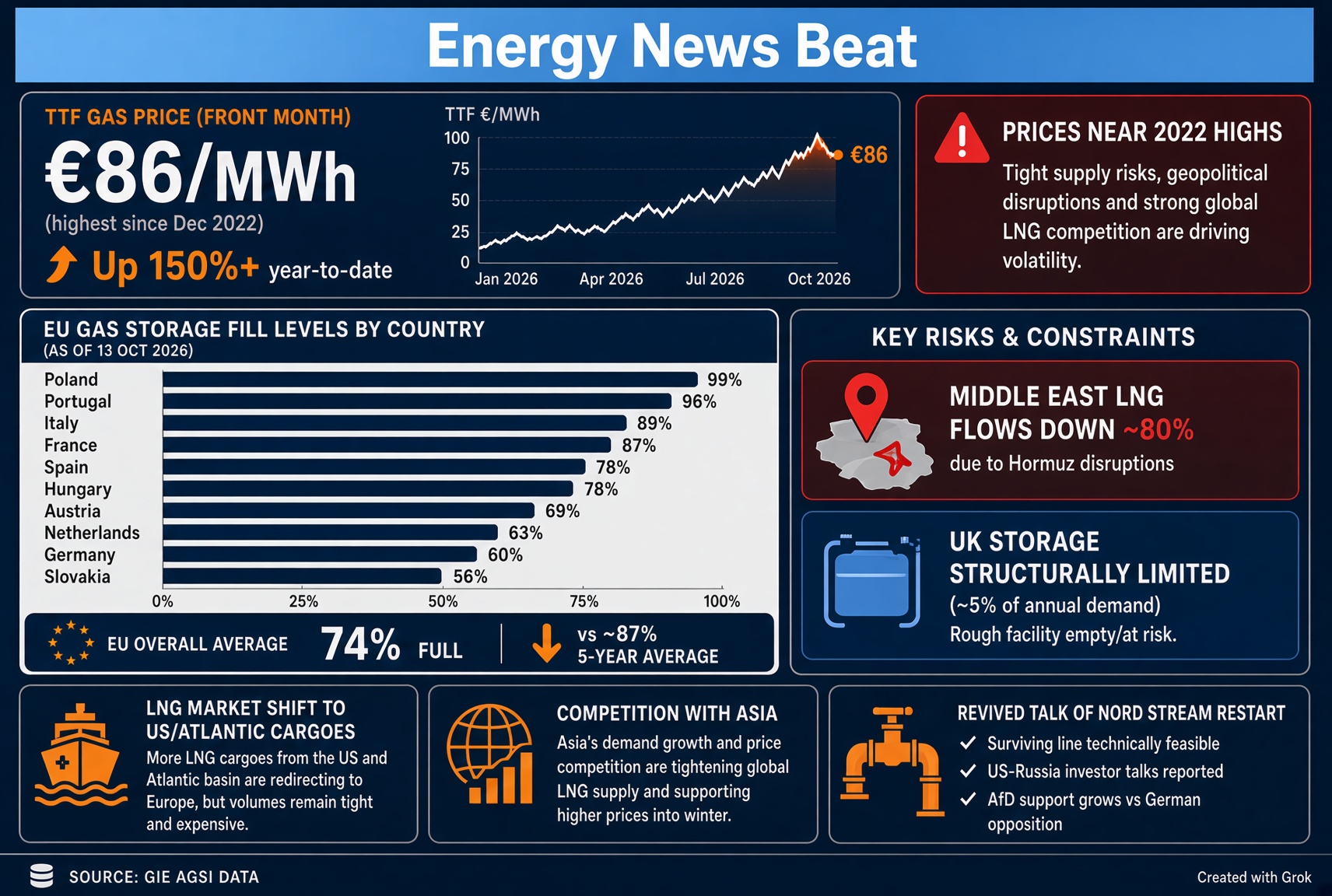
European benchmark natural gas prices remain near multi-year highs in mid-October 2026, approaching levels last seen at the end of 2022. The Dutch Title Transfer Facility (TTF) front-month contract traded around €86 per megawatt-hour (MWh)—roughly $96.50/MWh—after a sharp rally driven by constrained Middle East LNG supplies and historically low storage heading into winter. Prices have risen more than 150% year-to-date from levels near €32/MWh earlier in the year.Oilprice
The primary catalyst is ongoing disruption to LNG flows from Qatar and the UAE through the Strait of Hormuz amid regional conflict. LNG volumes from the Persian Gulf are down roughly 80% year-on-year, according to ING analysts. Unlike oil, these gas flows have not recovered, leaving Europe and Asia competing more intensely for alternative cargoes (especially U.S. LNG). Warren Patterson, Head of Commodities Strategy at ING, noted that markets are increasingly pricing in the possibility that Persian Gulf LNG remains largely absent for much of the Northern Hemisphere winter.Oilprice
EU Gas Storage: Country-by-Country Snapshot
Thin European storage compounds the LNG tightness. Gas Infrastructure Europe (GIE) AGSI data for gas day 13 October 2026 show EU underground storage at 74.02% full (about 837 TWh of roughly 1,131 TWh capacity). This is well below the five-year seasonal average of roughly 86–89% and about 9 percentage points lower than the same period in 2025. Net injections have slowed as power and early heating demand rose.Agsi.gie
Fill rates vary widely (approximate figures as of 13 October 2026, from GIE AGSI / Gasspeicher.app):
- Poland: 99.15% (36.5 TWh)
- Portugal: 95.51% (3.4 TWh)
- Italy: 89.11% (181.3 TWh)
- France: 87.40% (108.3 TWh)
- Romania: 85.87% (29.1 TWh)
- Spain: 77.68% (27.8 TWh)
- Hungary: 77.64% (52.6 TWh)
- Czech Republic: 77.35% (35.0 TWh)
- Austria: ~69.3% (69.5 TWh)
- Netherlands: 63.30% (91.2 TWh)
- Belgium: 61.27% (5.0 TWh)
- Germany: 60.08% (147.3 TWh)
- Slovakia: 55.67% (21.0 TWh)
- Latvia: 49.95% (12.2 TWh)
Northwest Europe (Germany and the Netherlands) is notably weaker, while southern and some eastern countries are better positioned. The overall buffer is limited; even average winter weather could leave stocks low by spring 2027, making the following refill season expensive and challenging. ENTSOG and other analysts have highlighted risks of sharper drawdowns (potentially toward 10–20% or lower in stressed scenarios) if LNG remains constrained or temperatures run cold.Reuters
The UK: Different Storage Profile, Same Price Pressure
The United Kingdom is not subject to the same EU storage targets or capacity norms. UK storage capacity covers only about 5% of annual gas demand (versus an EU average near 29%), equating to roughly 7–12 days of average winter demand. Reports around early October indicated UK underground storage near 48% full, with the major Rough facility (roughly half of UK capacity) effectively empty amid commercial disputes between operator Centrica and the government. Rough’s consent runs to April 2027, and without support (such as a cap-and-floor mechanism for a proposed £2 billion redevelopment), Centrica has signaled potential closure.Thenationalnews
The UK system is designed more around flexible LNG imports, Norwegian pipeline gas, domestic production, and interconnectors than large seasonal storage. It is therefore less dependent on high fill levels for physical security but remains fully exposed to elevated European (TTF-linked) prices and global LNG competition. ENTSOG winter outlooks have noted that UK storage could be drawn very low by spring under tight supply and cold weather.
LNG Market Shift and Economic Impact
Europe’s post-2022 pivot away from Russian pipeline gas toward LNG has increased exposure to global spot markets. With Persian Gulf supply curtailed, Europe has been drawing more U.S. and other Atlantic cargoes while competing with Asia. High prices are already pressuring industrial demand and power generation, but the effects on households and longer-term contracts will likely feed through more fully in 2027. Analysts at various houses (including Goldman Sachs and others) have raised winter TTF forecasts, with scenarios of prolonged Hormuz disruption or colder weather pointing toward peaks above €100/MWh. Even a resolution of Middle East issues would leave Europe needing to rebuild depleted stocks, supporting elevated prices into next year.Reuters
High Prices Revive Nord Stream Restart Talk
Sustained high natural gas costs have renewed discussion of restoring Russian pipeline supplies via Nord Stream. Three of the four strings were damaged in 2022 incidents; the surviving string is reported to be capable of relatively rapid restart (potentially around 25 bcm/year capacity) and is already filled with technical gas.
Recent reporting indicates talks involving U.S. Special Envoy Jared Kushner and Russian official Kirill Dmitriev about a possible U.S. investor in the Nord Stream system as part of broader energy and peace-related discussions. Germany’s federal government has stated it has no plans to relaunch the pipelines, citing the need to avoid renewed dependence on Russia, existing sanctions, and alternative supply arrangements. By contrast, Germany’s Alternative for Germany (AfD) party has advocated reopening Nord Stream for industrial competitiveness and lower bills, with planned discussions involving Dmitriev. Economically, restored Russian pipeline gas could ease prices substantially relative to current LNG-driven levels, but sanctions, legal hurdles, political opposition across much of the EU, and security concerns remain major obstacles.Reuters
Outlook
Europe enters the 2026/27 heating season with the lowest storage buffers in more than a decade for this time of year and ongoing uncertainty over key LNG supply. A cold winter in Europe or Asia, or further supply disruptions, risks sharp further price spikes. Even under milder conditions, the need to refill depleted inventories is likely to keep prices elevated through much of 2027, adding pressure on industry, power costs, and household energy bills. The shift toward LNG has delivered supply diversification since 2022 but has also exposed Europe more fully to global market volatility and geopolitical risk.
Check out the World’s Greatest Podcast Show Notes at EnergyNewsBeat.co or EnergyNewsBeat.com. And subscribe to: The Energy News Beat Substack.
Appendix: Sources and Links
- OilPrice.com, “Europe’s Gas Prices Close to 2022 High as Hormuz LNG Flows Remain Limited” (Michael Kern, 15 October 2026): https://oilprice.com/Latest-Energy-News/World-News/Europes-Gas-Prices-Close-to-2022-High-as-Hormuz-LNG-Flows-Remain-Limited.html
- Gas Infrastructure Europe AGSI platform (data as of gas day 13–14 October 2026): https://agsi.gie.eu/
- Gasspeicher.app Europe country comparison (13 October 2026): https://gasspeicher.app/europa/
- Reuters, “Europe set for another year of high gas prices as reserves hit lows” (12 October 2026): https://www.reuters.com/business/energy/europe-set-another-year-high-gas-prices-reserves-hit-lows-2026-10-12/
- Trading Economics, EU Natural Gas: https://tradingeconomics.com/commodity/eu-natural-gas
- The National, “Britain faces looming energy crisis as gas reserves dwindle” (12 October 2026): https://www.thenationalnews.com/news/uk/2026/10/12/britain-faces-sharp-energy-squeeze-as-european-gas-prices-jump-150-this-year/
- Reuters, “US, Russia explore gas sale to Europe amid Ukraine war” (8 October 2026): https://www.reuters.com/business/energy/us-russia-explore-gas-sale-europe-amid-ukraine-war-say-sources-2026-10-08/
- The Telegraph, “Trump eyes Nord Stream deal with Putin” (8 October 2026): https://www.telegraph.co.uk/world-news/2026/10/08/trump-eyes-nord-stream-deal-with-putin/
- EnergyScan / Engie Europe gas storage tracker and related analysis.
- Additional coverage and analyst notes from WSJ, Bloomberg, ING, Goldman Sachs, ENTSOG winter outlooks, and Voltstack/GEF trackers.
Note: Storage percentages and prices are as of mid-October 2026 and can change daily. Always cross-check the latest AGSI data and market