

Washington has the authority and a $1 billion DPA fund for refinery projects, and it is talking with shut refineries about restarts. Valero’s idled Benicia plant is part of the talks, but the owner is weighing redevelopment and the state is paying for imports.
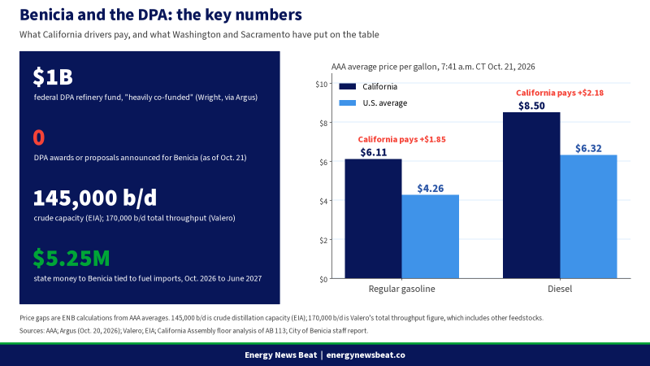
If you drive in California, you pay for the state’s refinery squeeze every time you fill up. AAA puts California diesel at $8.50 a gallon this morning (7:41 a.m. CT), $2.18 above the national average of $6.32. Regular is $6.11 in California versus $4.26 nationally, so a 20-gallon fill costs about $37 more (ENB calculations). Now Washington says it wants to reopen shut refineries, and the plant everyone is asking about is Valero’s Benicia refinery in the Bay Area.
The legal path exists
On April 20, President Trump signed a determination under section 303 of the Defense Production Act (DPA). It found that “domestic petroleum production, refining, and logistics capacity … are industrial resources, materials, or critical technology items essential to the national defense.” It waived the act’s usual section 303 requirements and told the Energy Secretary to make “necessary purchases, commitments, and financial instruments to enable these projects.” In plain English, the Department of Energy can now put federal money behind refining capacity. The memo doesn’t name any refinery.
There’s money, too, though not a lot by refinery standards. Energy Secretary Chris Wright said Tuesday that projects would tap a $1 billion fund Congress created in last year’s tax and energy law and would be “heavily co-funded” with industry (Argus). Argus reports the fund is for expansions; how much remains after DOE’s earlier DPA commitments isn’t public. He said the administration is talking with every refinery shut in the last 10 years “to find what’s the most practical one to get a refinery up and running.” Those talks include Benicia, but “that’s a tough challenge,” Wright said, pointing to California’s business climate.
So far, only one DPA refinery project has been announced. On Oct. 13, Vice President JD Vance said Delek’s refinery in Tyler, Texas, would be expanded under the DPA; no dollar amount or terms have been released. As of this morning, we found no announced DPA award or proposal for Benicia.
Will Valero play along?
Valero finished idling all of Benicia’s processing units in April. It says it will “maintain all required operating permits” and keep the site “in a safe, clean, and idled condition” while it evaluates “potential redevelopment options” (Valero). It expects to keep supplying Northern California customers “through imports or other alternative supply arrangements.” A city staff report says Valero has hired a developer to study the site and expects to file a mixed-use development application by Dec. 31 (City of Benicia). Valero has not announced a restart plan. It reports third-quarter results tomorrow, Oct. 22 (call at 9 a.m. CT).
About size: Valero lists 170,000 barrels a day of throughput capacity, which counts crude plus other feedstocks. EIA and Argus use 145,000 b/d, the crude distillation figure; a 2011 Valero investor exhibit shows both numbers. Before idling, Valero said Benicia made about 10% of the gasoline Californians use.
Will California?
In January, Gov. Gavin Newsom said, “We’re in ongoing discussions with Valero to evaluate options for continued operations at the Benicia refinery” (Governor’s office). What the state has paid for so far is imports. The budget bill AB 113 includes $3.75 million for Benicia city services “as the Valero Benicia Refinery is used for Fuel Import Operations” and $1.5 million in community benefit, $5.25 million in all (Assembly analysis; bill page).
That money backs a two-year “standstill” deal: the city won’t try to block Valero’s fuel imports, which the city says its permits don’t allow and Valero says they do. The $5.25 million covers Oct. 1, 2026, to June 30, 2027, and the city will seek at least $7 million more (City of Benicia; Benicia Bridge). The City Council was set to vote Oct. 20; we couldn’t confirm the result.
| Stu’s Take (opinion)
The legal door is open. The April 20 determination lets DOE put money into refining, and a $1 billion DPA fund exists. But you can’t DPA a refinery back to life if the owner is planning a redevelopment and the state is paying $5.25 million to keep imports moving. Meanwhile, California truckers pay $8.50 for diesel, $2.18 over the national average. Wright himself calls Benicia “a tough challenge,” and restarting it would take real capital. I’d still like to see Sacramento, Valero and DOE price out a restart before the state keeps writing checks for imported fuel. Valero reports tomorrow. I’ll be listening for one word: Benicia. |
More from Energy News Beat
- We Have Hit the Point of No Return for the California Energy Crisis — Stu with refinery veteran Mike Ariza (March 2026)
- Professor Mike Mische, Mike Ariza, David Blackmon, Stu Turley on the Energy News Beat Podcast — YouTube
- Assemblyman Stan Ellis and Mike Ariza Stop by and Talk about California on Empty — with David Blackmon (April 2026)
- The GeoTES Revolution: Solving California’s Energy Crisis with Oil and Innovation — Stu and David Blackmon with Mike Umbro of Californians for Energy & Science (Oct. 2026)
Sources
- The White House: Presidential Determination Pursuant to Section 303 of the DPA on Domestic Petroleum Production, Refining, and Logistics Capacity (April 20, 2026)
- Argus: US seeking to re-open shuttered oil refineries (Oct. 20, 2026)
- Reuters via Union Leader: US coaxing refiners to produce more diesel as prices surge (Oct. 20, 2026)
- Tyler Morning Telegraph: During Tyler stop, JD Vance announces partnership with Delek refinery (Oct. 13, 2026)
- Valero: Benicia Refinery (accessed Oct. 21, 2026)
- Valero: Third-quarter 2026 earnings release date
- S. Energy Information Administration: Today in Energy (Benicia capacity)
- Valero investor exhibit filed with the SEC (2011): refinery throughput and crude capacity
- Office of Gov. Gavin Newsom: Statement on Valero’s Benicia refinery update (Jan. 6, 2026)
- California Assembly floor analysis of AB 113 (Budget Act of 2026)
- California Legislative Information: AB 113 bill page (2025-26 session)
- City of Benicia staff report: Valero Standstill Agreement (via Benicia Bridge)
- Benicia Bridge: Valero imports agreement (Oct. 20, 2026)
- AAA national and California average fuel prices (accessed Oct. 21, 2026, 7:41 a.m. CT)