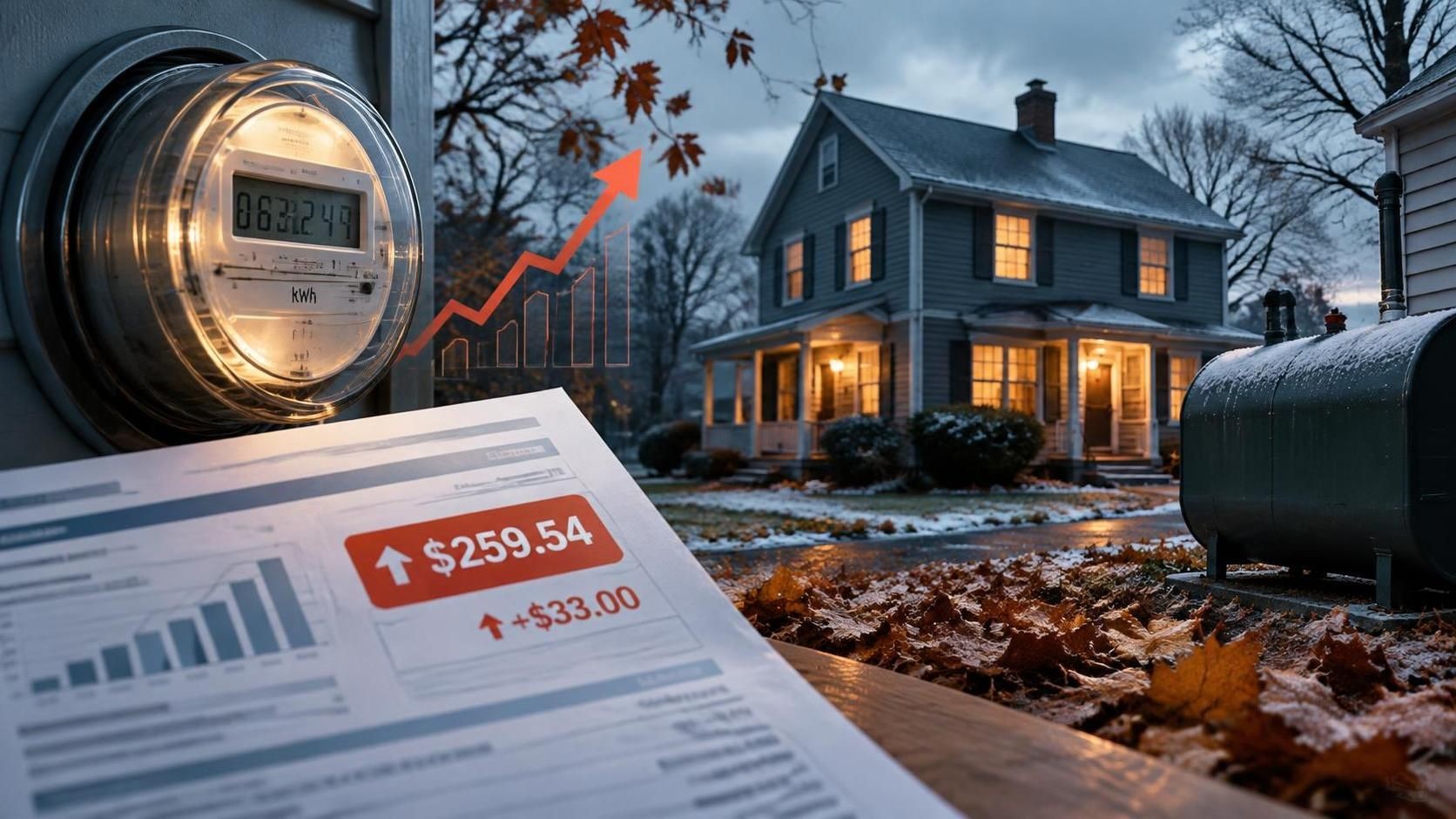
The company’s Basic Service rate is 17.2 cents a kilowatt-hour, up from 15.4 cents. Official heating-oil surveys now sit just under $6, below a $6.21 figure first reported Nov. 9. A one-time state oil benefit of up to $680 opens in December. The rest of federal heating aid depends on a Dec. 11 funding deadline.
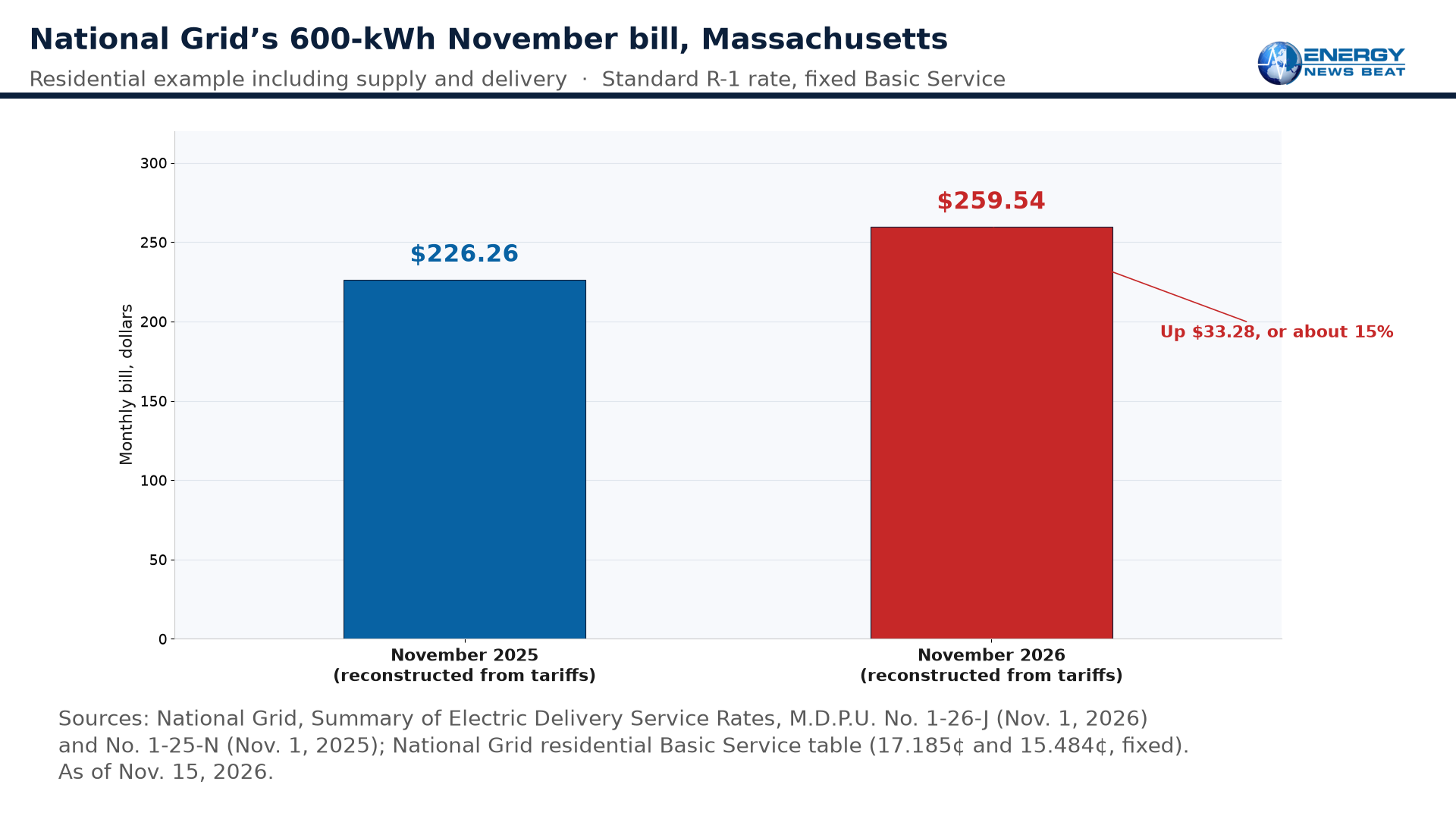
For a customer using 600 kilowatt-hours a month, National Grid’s November bill in Massachusetts is $259.54, up from $226.26 a year earlier, the company told the Athol Daily News. Energy News Beat reconstructed the current figure from the company’s tariffs: a $10 monthly customer charge, a Nov. 1 delivery price of 24.405 cents a kilowatt-hour, and a fixed Basic Service supply rate of 17.185 cents. Those three pieces add up to $259.54.
That is about $33 more than last November on the company’s 600-kilowatt-hour example. Official heating-oil surveys still put Massachusetts near $6 a gallon, far above last fall. A state oil benefit of up to $680 for some middle-income households opens in December. The rest of federal heating-assistance money still depends on Congress acting by Dec. 11.
What is actually on the electric bill
The 17.2 cents and 15.4 cents in Sunday’s local reporting are rounded. National Grid’s residential fixed Basic Service rate for Aug. 1, 2026, through Jan. 31, 2027, is 17.185 cents a kilowatt-hour. The prior six-month fixed rate, Feb. 1 through July 31, 2026, was 15.372 cents. Last November the fixed rate was 15.484 cents. The Department of Public Utilities reviews each solicitation. The utility does not earn a profit on the supply; it passes through wholesale costs, plus renewable-portfolio compliance and administrative charges.
Supply is not the whole $33. On 600 kilowatt-hours, the step from last November’s 15.484-cent fixed rate to today’s 17.185 cents is about $10.21. Delivery charges rose $23.07; the $10 customer charge did not change. Energy News Beat rebuilt the $226.26 year-ago bill from National Grid’s Nov. 1, 2025, delivery summary and that period’s fixed rate.
The delivery side of a standard (R-1) bill is a stack of approved charges. On the Nov. 1 summary, energy-efficiency charges — the Mass Save line — total 2.713 cents a kilowatt-hour, or $16.28 on 600 kilowatt-hours. A net-metering recovery surcharge is 2.451 cents, or $14.71. The SMART solar charge is 0.935 cents, or $5.61. A statutory renewables charge is 0.05 cents. Together those policy lines are about $37 on the example bill, before distribution and transmission. They rose about $4.60 from last November. The biggest year-over-year increase is newer: the charge funding expanded income-eligible discounts jumped to 3.965 cents, or $23.79, from $6.89. Regional Greenhouse Gas Initiative allowance costs are not a separate line on this summary; they typically sit inside the wholesale prices that feed Basic Service.
Why supply costs are high this winter
New England’s winter power price is still a natural-gas story. ISO New England says the region should have enough electricity this winter, with a normal-weather peak forecast of 20,483 megawatts and more than 30,000 megawatts of available capacity. That is a reliability finding, not a cheap-power one. In a Nov. 12 NEPOOL presentation, the grid operator said it assumes about 3,900 to 4,800 megawatts of gas-only generation may be unavailable on the coldest days because of constrained pipelines. Liquefied natural gas from Saint John and Everett can inject up to 1.3 billion cubic feet a day. ISO-NE counts newly commercial offshore wind, including Vineyard Wind and Revolution Wind, and the New England Clean Energy Connect line as in service.
Those constraints show up in the price, even when the lights stay on. National Grid told the Athol Daily News that energy supply in New England “has not kept pace with demand” and that it has no control over wholesale prices. Eversource said it does not expect significant bill changes until Feb. 1, when its next Basic Service rate takes effect, and that the new rate is not yet known, as reported Nov. 9 and Nov. 15.
Households that heat with gas are already paying more than last year. The EIA put Massachusetts residential natural-gas prices at $32.10 per thousand cubic feet in August 2026, up from $28.46 in August 2025 and $21.59 in August 2024.
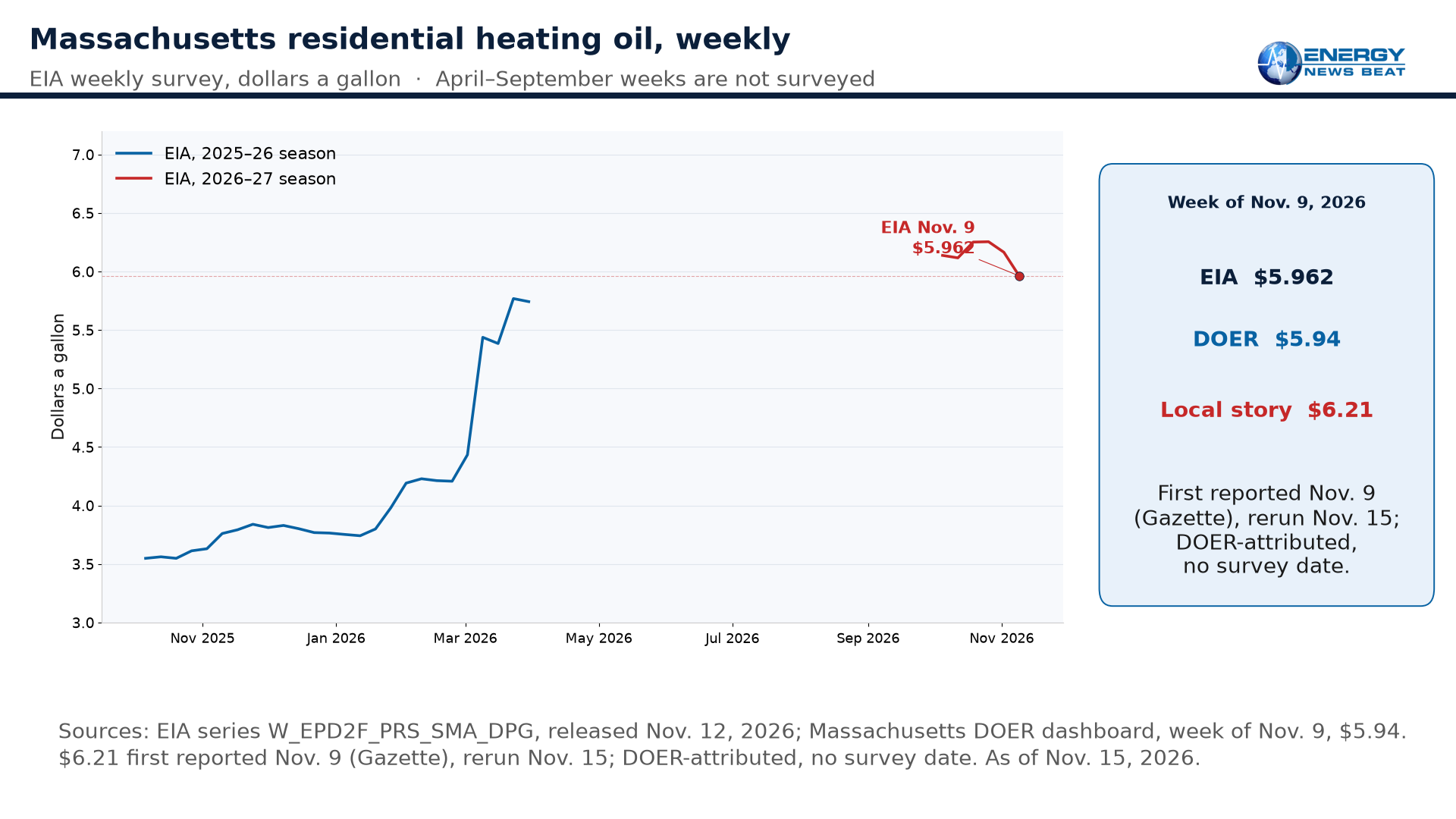
Heating oil is still near $6 — and the $6.21 figure is not the current official survey
Sunday’s Athol Daily News account, which first ran Nov. 9 in the Daily Hampshire Gazette, attributed a Massachusetts average of $6.21 a gallon to the state Department of Energy Resources, with a reported range of $5.77 to $6.75, and cited an EIA figure of $6.18 for the week of Nov. 2 (EIA’s series now shows $6.164). The survey date for the $6.21 average was not stated.
The official numbers as of this article’s access are lower, and they are close to each other. EIA’s weekly residential average for Massachusetts for the week of Nov. 9 was $5.962 a gallon, down 20.2 cents from $6.164 the week of Nov. 2. A year earlier, the week of Nov. 10, 2025, was $3.760; the year-ago $3.63 in the local story matches EIA’s week of Nov. 3, 2025. DOER’s dashboard shows $5.94 for the week of Nov. 9 and $6.17 for the week of Nov. 2. Energy News Beat did not find a current official DOER table posting $6.21. Treat that figure as a DOER-attributed average whose survey date was not given. Oil is still about 59 percent above last year.
The help that is coming — and the deadline attached to it
Community Action Pioneer Valley, the Greenfield agency that runs heating assistance in Franklin and Hampshire counties and the North Quabbin, reported 5,000 applications as of Friday, Nov. 6, Executive Director Lev BenEzra told the Daily Hampshire Gazette, including 557 first-time applicants, up from 429 a year earlier, about 30 percent. Energy News Beat did not separately tally them. Regular HEAP is limited to households at or below 60 percent of state median income — $53,585 for one person and $103,049 for a family of four in fiscal 2027.
On Oct. 5, Governor Maura Healey signed Executive Order 659, declaring an energy emergency and directing a one-time middle-income heating-oil benefit for households earning 60 to 100 percent of state median income. The official Home Energy Assistance page says a family of four earning more than $103,049 and up to $171,749 may receive an estimated one-time benefit of up to $680, and that applications open in December 2026. The local story said applications were already available; the state’s page is the clearer date, and it does not guarantee a December payment.
The same order directs DOER to fund a winter elimination of the SMART “distributed solar charge” for at least three months and to cut Alternative Energy Portfolio Standard costs by half this winter. It does not name the months. Those are temporary steps, not a permanent rate cut.
Federal money is the other lever. On Oct. 9, the Administration for Children and Families released $3,631,860,000 in fiscal 2027 LIHEAP funds, 90 percent of what is available under the current continuing resolution. Massachusetts’ share was $142,330,091. Public Law 119-103 expires on Dec. 11, 2026, unless Congress passes full-year appropriations or another stopgap. The remaining 10 percent has no announced release date.
Consumer and Investor Views
For a National Grid household on the 600-kilowatt-hour example, the identifiable November bill is $259.54, about $33 more than a year earlier. On that usage, Basic Service is $103.11, energy-efficiency charges are $16.28 and SMART is $5.61 until any winter holiday takes effect. Official oil prices are still just under $6 a gallon. The middle-income oil benefit, if they qualify, is a one-time payment of up to $680, with applications opening in December. Regular HEAP has tighter income limits and depends on the Dec. 11 deadline.
For investors, this is a retail-price and credit-support story, not a new Sunday commodity shock. Watch the Feb. 1 Basic Service reset, Eversource’s unannounced February rate, and whether Congress extends LIHEAP past Dec. 11. ISO-NE’s winter outlook is adequate on capacity and tight on pipeline-constrained gas. Temporary SMART and APS relief will show up only for the months the state actually funds. This is not investment advice.
Caveats and Criticism
Both example bills were rebuilt from National Grid’s Nov. 1 delivery summaries for 2025 and 2026. The 600-kilowatt-hour example is the standard residential yardstick, not every household’s use. Town aggregation and competitive supply change the supply price, not delivery. Income-eligible (R-2) customers get a tiered discount.
The $6.21 heating-oil average, first reported Nov. 9 and attributed to DOER without a survey date, does not match the official DOER or EIA figures for the week of Nov. 9 ($5.94 and $5.962). A local propane dealer’s account of a 40-to-50-cent rise over four weeks is one dealer’s statement; DOER’s propane average was $3.99 the week of Nov. 9. The 30 percent rise in first-time applicants is Community Action Pioneer Valley’s count, as Lev BenEzra told the Gazette Nov. 9, not a statewide official total.
ISO-NE’s finding of sufficient winter capacity is not a finding that power will be cheap. Pipeline constraints are a long-running New England condition, not a weekend development. Newly commercial offshore wind is now in ISO-NE’s winter assumptions; it does not set oil prices or, by itself, this winter’s Basic Service rate. Policy charges on the delivery bill are real and large, and they fund programs that have supporters as well as critics. The SMART holiday, the APS cut and the $680 oil benefit are temporary or one-time. None of those steps fills a gas pipeline.
Stu’s Take
A National Grid customer on the 600-kilowatt-hour example is being asked for $259.54 this November, about $33 more than a year ago. Both numbers check out against the tariffs. Basic Service is 17.2 cents, up from 15.4 cents, and delivery went up too. Official heating-oil surveys are just under $6, not the $6.21 first reported Nov. 9, but they are still far above last fall. The drivers are not a mystery: New England still strains its gas pipelines on the coldest days, and the bill also carries efficiency, net-metering and solar charges, plus a low-income discount charge that more than tripled from last November. A one-time state oil benefit of up to $680 opens in December. The rest of federal heating aid depends on a Dec. 11 deadline. Say that plainly. Temporary charge cuts and one-time checks do not fix the supply problem, and they do not make the policy charges disappear in April.
Appendix A — Sources
Primary documents and accounts used for this article. Access date is Sunday, Nov. 15, 2026, unless a different access date is noted. Full excerpts are in Appendix B; data tables are in Appendix C.
- Athol Daily News, Samuel Gelinas, “Feeling the heat: As winter nears, soaring energy prices have residents bracing for bigger bills,” Nov. 15, 2026 (the page also carries a Nov. 13 dateline). Source of National Grid’s $259.54 / $226.26 600-kWh example, the rounded 17.2-cent and 15.4-cent Basic Service figures, Community Action Pioneer Valley’s 5,000 applications and 557 first-time applicants, and the $6.21 DOER-attributed heating-oil average without a survey date. The same account first appeared Nov. 9 in the Daily Hampshire Gazette https://atholdailynews.com/2026/11/15/feeling-the-heat-as-winter-nears-soaring-energy-prices-have-residents-bracing-for-bigger-bills/
- Daily Hampshire Gazette, same Gelinas account, first publication Nov. 9, 2026 https://gazettenet.com/2026/11/09/feeling-the-heat-as-winter-nears-soaring-energy-prices-have-residents-bracing-for-bigger-bills/
- Massachusetts Electric Company d/b/a National Grid, Summary of Electric Delivery Service Rates, M.D.P.U. No. 1-26-J, issued Oct. 20, 2026, effective Nov. 1, 2026. Standard residential (R-1) retail delivery price $0.24405/kWh plus a $10.00 monthly customer charge. Energy-efficiency (net) $0.02713; net-metering recovery $0.02451; SMART $0.00935; renewables charge $0.00050. Net distribution includes a Residential Assistance Adjustment Factor of $0.03965/kWh, last changed Nov. 1, 2026 https://www.nationalgrid.com/document/601611/download
- Massachusetts Electric Company d/b/a National Grid, Summary of Electric Delivery Service Rates, M.D.P.U. No. 1-25-N, issued Oct. 22, 2025, effective Nov. 1, 2025. Standard residential (R-1) retail delivery price $0.20560/kWh plus a $10.00 monthly customer charge. Residential Assistance Adjustment Factor $0.01149/kWh. Fixed Basic Service for 8/1/25–1/31/26 was 15.484 cents/kWh. $10.00 + (600 × $0.20560) + (600 × $0.15484) = $226.26 https://www.nationalgridus.com/media/pdfs/billing-payments/electric-rates/ma/2025/1125meco.pdf
- Department of Public Utilities, Notice of Filing and Request for Comments, D.P.U. 26-132, Oct. 7, 2026, on National Grid’s Residential Tiered Discount Rate compliance filing. Cites the statewide tiered income-eligible Discount Rate (D.P.U. 24-15-B/D/F) for implementation on November 1, 2026, and National Grid’s proposed Residential Assistance Adjustment Provision, M.D.P.U. No. 1653 https://www.nationalgrid.com/document/598936/download
- National Grid, Summary of Basic Service Rates, M.D.P.U. No. 1-26-I, effective Oct. 1, 2026, Sheet 5. Residential (R-1, R-2) Fixed Price Option for the August period: base 16.498 cents/kWh plus a Basic Service administrative cost adjustment factor of 0.687 cents/kWh, totaling 17.185 cents/kWh. The tariff index lists a Nov. 1, 2026, reissue as M.D.P.U. No. 1-26-J; the residential fixed total is unchanged at 17.185 cents https://www.nationalgridus.com/media/pdfs/billing-payments/tariffs/mae/meco_basic_service.pdf
- National Grid, “Basic Service Rates for Customers on the following Residential rate classes: Regular Residential (R-1), Residential Low Income (R-2).” Fixed Price Option: 8/1/26–1/31/27, 17.185 cents/kWh; 2/1/26–7/31/26, 15.372 cents/kWh; 8/1/25–1/31/26, 15.484 cents/kWh https://www.nationalgridus.com/media/pdfs/billing-payments/electric-rates/ma/resitable.pdf
- Massachusetts Department of Public Utilities, “Basic service information and rates.” Basic Service has three cost components: supply, RPS compliance, and administrative costs. The electric company does not make a profit from Basic Service procurement https://www.mass.gov/info-details/basic-service-information-and-rates
- U.S. Energy Information Administration, Heating Oil and Propane Update, residential heating oil, week of Nov. 9, 2026: Massachusetts $5.962/gallon, down 20.2 cents from the prior week, up $2.202 from a year earlier https://www.eia.gov/petroleum/heatingoilpropane/
- EIA, Weekly Massachusetts No. 2 Heating Oil Residential Price, series W_EPD2F_PRS_SMA_DPG, released Nov. 12, 2026. Week of Nov. 9, 2026: $5.962; Nov. 2: $6.164; Nov. 10, 2025: $3.760; Nov. 3, 2025: $3.630 https://www.eia.gov/dnav/pet/hist/LeafHandler.ashx?f=W&n=PET&s=W_EPD2F_PRS_SMA_DPG
- Massachusetts Department of Energy Resources, “Massachusetts Home Heating Fuels Prices.” Week of 11/09/26: heating oil average $5.94 (high $6.76, low $5.35); week of 11/02/26: $6.17. Propane, week of 11/09/26: $3.99; week of 11/02/26: $4.00. Accessed Nov. 15, 2026 https://www.mass.gov/info-details/massachusetts-home-heating-fuels-prices
- EIA, Massachusetts Price of Natural Gas Delivered to Residential Consumers, series N3010MA3, dollars per thousand cubic feet, latest data August 2026, released Oct. 30, 2026. August 2026 $32.10; August 2025 $28.46; August 2024 $21.59 https://www.eia.gov/dnav/ng/hist/n3010ma3M.htm
- EIA, Natural Gas Monthly Table 20, October 2026 issue, confirming Massachusetts August 2026 residential $32.10 and July 2026 $30.57 https://www.eia.gov/naturalgas/monthly/pdf/table_20.pdf
- ISO New England, Seasonal System Outlook, “New England Expected To Have Sufficient Electricity Supplies This Winter.” 50/50 winter peak forecast 20,483 MW; 90/10 forecast 21,457 MW; more than 30,000 MW available capacity; last winter’s peak 20,182 MW on Jan. 25, 2026 (fast facts and the Nov. 12 NEPOOL slide; the same page’s prose also states 20,192 MW). Energy News Beat uses 20,182 MW https://www.iso-ne.com/markets-operations/system-forecast-status/seasonal-system-outlook
- ISO New England, “Winter Outlook and System & Market Operations Report – November 2026,” presented to the NEPOOL Participants Committee, Nov. 12, 2026. Assumes approximately 3,900–4,800 MW of gas-only generation may be unavailable on the coldest days due to constrained natural-gas pipelines; up to 1.3 Bcf/d of LNG injection from Saint John and the Everett Marine Terminal; Vineyard Wind, Revolution Wind and NECEC treated as in service https://www.iso-ne.com/static-assets/documents/100041/system-and-market-ops-report-november-2026.pdf
- Executive Order No. 659, “Proclaiming an Energy Emergency and Providing Immediate Home Energy Assistance and Relief on Energy Bills During the Winter Months,” signed by Governor Maura Healey, Oct. 5, 2026, Mass Register No. 1585, in effect until April 30, 2027. Directs a one-time middle-income oil-heat benefit (60–100% of state median income); SMART charge elimination for at least three months; 50 percent reduction in APS ratepayer costs this winter. The order states that about one in five Massachusetts households relies on heating oil. Section 6 also orders a review of Massachusetts’ own power-plant carbon program (310 CMR 7.74) https://www.mass.gov/executive-orders/no-659-proclaiming-an-energy-emergency-and-providing-immediate-home-energy-assistance-and-relief-on-energy-bills-during-the-winter-months
- Massachusetts Executive Office of Housing and Livable Communities, “Home Energy Assistance Programs” (Mass.gov/HeatingHelp). Applications for the one-time Middle-Income Heating Oil Relief open in December 2026. Family of four: above $103,049 and up to $171,749, estimated one-time emergency benefit up to $680. HEAP fiscal 2027 income cap for a family of four: $103,049; estimated deliverable benefit $870–$1,450; estimated utility benefit $600–$1,000 https://www.mass.gov/HeatingHelp
- Massachusetts HLC, “Learn about Home Energy Assistance – HEAP.” Fiscal 2027 income guidelines: 1 person $53,585; 4 persons $103,049. Heating season Nov. 1–April 30 https://www.mass.gov/info-details/learn-about-home-energy-assistance-heap
- Mass 211, “New Winter Energy Bill Relief for Massachusetts Families” one-pager, describing up to $680 for a family of four earning up to $171,749 and stating that applications for the middle-income heating-oil benefit will open in December 2026 https://www.mass211.org/sites/mass211/files/26-27%20Winter%20Energy%20Bill%20Relief%20One%20Pager.pdf
- U.S. Administration for Children and Families, Office of Community Services, “First Block Grant Funding Release FFY 2027,” published Oct. 9, 2026. Total funding released $3,631,860,000, 90 percent of funding available under the Continuing Appropriations and Extensions Act, 2027 (Pub. L. 119-103). Massachusetts allotment $142,330,091 https://www.acf.gov/ocs/grants-funding/recipients/liheap/first-block-grant-funding-release-2027
- Public Law 119-103, Continuing Appropriations and Extensions Act, 2027, signed Sept. 2, 2026. Division A, Sec. 106(3): appropriations and authority granted pursuant to the Act are available until, among other events, December 11, 2026 https://www.govinfo.gov/content/pkg/PLAW-119publ103/html/PLAW-119publ103.htm
- Community Action Pioneer Valley, fuel-assistance program page. Executive Director Lev BenEzra’s application counts (5,000 as of Friday, Nov. 6, including 557 first-time applicants, up from 429) were reported Nov. 9 in the Daily Hampshire Gazette and rerun Nov. 15. The agency page currently links an Expanded Heating Assistance Interest Form. Energy News Beat did not obtain a separate written tally https://www.communityaction.us/program/fuel-assistance/
- National Grid, Massachusetts electric tariff provisions index, listing the Nov. 1, 2026, delivery and Basic Service summaries as M.D.P.U. No. 1-26-J https://www.nationalgrid.com/us/ma/electric/home/billing-payments/bills-meters-and-rates/tariff-provisions
Appendix B — Key excerpts
National Grid delivery summary, M.D.P.U. No. 1-26-J, effective Nov. 1, 2026, Rate R-1, All kWh: Retail Delivery Price $0.24405; customer charge $10.00. Net Energy Efficiency Charge $0.02713; Renewables Charge $0.00050; Net Metering Recovery Surcharge $0.02451; Distributed Solar (SMART) Charge $0.00935. Net Distribution Rate, All kWh: Base Distribution Charge $0.06777; Residential Assistance Adjustment Factor $0.03965 (last changed Nov. 1, 2026); Winter Relief Recovery Factor $0.00658; Net Distribution Rate $0.12500. Issued by Lisa Wieland, Oct. 20, 2026. Rate R-2 income-eligible discounts are (32%)–(91%); R-2 pays a Residential Assistance Adjustment Factor of $0.00000.
National Grid delivery summary, M.D.P.U. No. 1-25-N, effective Nov. 1, 2025, issued Oct. 22, 2025, Rate R-1, All kWh: Retail Delivery Price $0.20560; customer charge $10.00. Net Energy Efficiency Charge $0.02879; Net Metering Recovery Surcharge $0.01724; Distributed Solar (SMART) Charge $0.00729; Net Transmission Charge $0.05798. Net Distribution Rate, All kWh: Base Distribution Charge $0.06677; Residential Assistance Adjustment Factor $0.01149; Net Distribution Rate $0.09242. Low Income Discount on Rate R-2: (32%)–(71%).
D.P.U. 26-132 notice, Oct. 7, 2026: “On February 17, 2026, the Department issued its Phase I Order on Tiered Discount Rates in Inquiry by the Department of Public Utilities on its own Motion into Energy Burden with a Focus on Energy Affordability for Residential Ratepayers, D.P.U. 24-15-B, laying out the structure of a statewide tiered income-eligible discount rate (‘Discount Rate’) for implementation on November 1, 2026.” National Grid filed revised tariffs, including the Residential Assistance Adjustment Provision (M.D.P.U. No. 1653), “for effect November 1, 2026.”
National Grid residential Basic Service rate table: Fixed Price Option, 8/1/26–1/31/27, 17.185 cents/kWh; 2/1/26–7/31/26, 15.372 cents/kWh; 8/1/25–1/31/26, 15.484 cents/kWh.
Athol Daily News, Nov. 15, 2026: “For a customer using 600 kilowatt-hours a month, the estimated November bill is $259.54, up from $226.26 during the same period last year. That figure includes both supply and delivery charges.” “National Grid’s Basic Service rate for the six-month period beginning Aug. 1, 2026, rose from 15.4 cents to 17.2 cents per kilowatt-hour, following approval from the state Department of Public Utilities.” “The average price of heating oil in Massachusetts is $6.21 per gallon, according to the state Department of Energy Resources, with prices ranging from $5.77 to $6.75 per gallon.” Community Action Pioneer Valley (paraphrase of Executive Director Lev BenEzra), as first reported Nov. 9 in the Daily Hampshire Gazette and rerun Nov. 15: 5,000 heating assistance applications have been filed as of Friday. Of those, 557 are first-time applicants. At this time last year, the number of first-time applicants was 429. The identical text ran Monday, Nov. 9, so the Friday cited is most likely Nov. 6, 2026.
EIA Heating Oil and Propane Update, week of 11/09/26, Massachusetts residential heating oil $5.962, change from week ago −0.202, change from year ago +2.202.
Massachusetts DOER dashboard, accessed Nov. 15, 2026: “This Week: 11/09/26 ($/gallon) Average $5.94, High (90th Percentile) $6.76, Low (10th Percentile) $5.35. Last Week: 11/02/26 Average $6.17.”
ISO-NE NEPOOL presentation, Nov. 12, 2026: “As in past winters, ISO assumes approximately 3,900–4,800 MW of gas-only generation may be unavailable on the coldest days due to constrained natural gas pipelines.” “Up to 1.3 Bcf/d of LNG injection capability from Saint John LNG and the Everett Marine Terminal (EMT).” “Existing resource mix, including Revolution Wind, Vineyard Wind, and New England Clean Energy Connect (NECEC), in-service.” “Sufficient capacity and energy are expected this winter.”
Executive Order 659, Oct. 5, 2026: “HLC shall create a one-time emergency benefit to provide home energy assistance for middle-income households, to be defined as households earning between sixty and one hundred percent of state median income, and relying upon oil for home heating, for this winter season.” “DOER shall provide funds to electric distribution companies to eliminate the ‘distributed solar charge’ line-item associated with the Solar Massachusetts Renewable Target (‘SMART’) program on electric bills for at least three months of this winter heating season.” “DOER shall reduce ratepayer costs attributable to the APS requirements by fifty percent this winter.” The order remains in effect until April 30, 2027.
Mass.gov/HeatingHelp, accessed Nov. 15, 2026: “Applications for the one-time Middle-Income Heating Oil Relief will open in December 2026.” Table: household size 4, above 60% SMI $103,050, 100% SMI $171,749, estimated one-time emergency benefit for heating oil up to $680.
ACF, First Block Grant Funding Release FFY 2027: “Release Date: October 9, 2026. Total Funding Released: $3,631,860,000.” “OCS released 90% of the funding available under the Continuing Appropriations and Extensions Act, 2027 (Pub. L. 119-103).” Massachusetts state allotment in the accompanying table: $142,330,091.
Public Law 119-103, Sec. 106: “appropriations and funds made available and authority granted pursuant to this Act shall be available until whichever of the following first occurs: (1) The enactment into law of an appropriation for any project or activity provided for in this Act. (2) The enactment into law of the applicable appropriations Act for fiscal year 2027 without any provision for such project or activity. (3) December 11, 2026.”
Appendix C — Data tables (with as-of dates)
Tables below support the bill reconstruction, official fuel surveys, assistance rules and winter-reliability figures. As-of date is Sunday, Nov. 15, 2026, Central Time, unless a table states a different close or publication date.
Table C-1. National Grid 600-kWh November bill reconstruction
| Component | Rate or amount | On 600 kWh | Source |
| Customer charge | $10.00 / month | $10.00 | M.D.P.U. No. 1-26-J, Nov. 1, 2026 |
| Retail delivery, R-1 | 24.405¢/kWh | $146.43 | M.D.P.U. No. 1-26-J |
| of which: net distribution | 12.500¢/kWh | $75.00 | Same summary, All kWh |
| within net distribution: residential assistance (discount funding) | 3.965¢/kWh | $23.79 | Same summary, last changed Nov. 1, 2026 |
| energy efficiency (Mass Save) | 2.713¢/kWh | $16.28 | Net Energy Efficiency Charge |
| net-metering recovery | 2.451¢/kWh | $14.71 | Same summary |
| SMART (distributed solar) | 0.935¢/kWh | $5.61 | Same summary |
| net transmission | 5.464¢/kWh | $32.78 | Same summary |
| renewables, EV, ESMP, transition | various | $2.05 | Residual of delivery stack |
| Basic Service, fixed | 17.185¢/kWh | $103.11 | National Grid residential table, 8/1/26–1/31/27 |
| Total, current example | — | $259.54 | Sum of customer charge, delivery and Basic Service |
| Year-ago example, rebuilt | — | $226.26 | $10 + 600×$0.20560 + 600×$0.15484 (M.D.P.U. No. 1-25-N) |
| Year-over-year difference | — | $33.28 | Arithmetic from the two example bills |
Table C-1. Reconstruction of National Grid’s 600-kWh November residential example. Delivery line items are from M.D.P.U. No. 1-26-J, effective Nov. 1, 2026. Basic Service is the published fixed residential total of 17.185 cents. $10.00 + $146.43 + $103.11 = $259.54. The “residual” delivery row ($2.05) is the remainder of 24.405 cents after the named lines (transition is a small credit). The $226.26 year-ago example was rebuilt as $10.00 + (600 × $0.20560) + (600 × $0.15484) from M.D.P.U. No. 1-25-N and the 15.484-cent fixed Basic Service rate then in effect. The Residential Assistance Adjustment Factor is inside net distribution. As of Sunday, Nov. 15, 2026.
Table C-1b. Year-over-year change on the 600-kWh example
| Item | $ on 600 kWh | Notes |
| Basic Service (supply) | +10.21 | 600 × (17.185¢ − 15.484¢) |
| Residential assistance (RAAF) | +16.90 | 1.149¢ → 3.965¢, last changed Nov. 1, 2026 |
| Winter Relief Recovery Factor | +3.95 | New 0.658¢ factor; not on the Nov. 1, 2025, summary |
| Net-metering recovery | +4.36 | 1.724¢ → 2.451¢ |
| SMART (distributed solar) | +1.24 | 0.729¢ → 0.935¢ |
| Energy efficiency (Mass Save) | −1.00 | 2.879¢ → 2.713¢ |
| Net transmission | −2.00 | 5.798¢ → 5.464¢ |
| Long-term renewable contract adjustment | −3.91 | 0.067¢ → −0.584¢ |
| Revenue decoupling | −2.74 | 0.176¢ → −0.281¢ |
| Infrastructure, safety, reliability and electrification | +2.41 | 0.156¢ → 0.558¢ |
| All other delivery factors | +3.86 | Residual after the lines above, including base distribution, transition, EV, pension and other smaller factors |
| Total year-over-year change | +33.28 | $259.54 − $226.26; customer charge unchanged at $10 |
Table C-1b. Year-over-year change on National Grid’s 600-kWh residential example, from M.D.P.U. No. 1-25-N (Nov. 1, 2025) and No. 1-26-J (Nov. 1, 2026) plus the residential Basic Service table. Dollar figures are rounded to the cent; the residual row is set so the named lines plus the residual equal $33.28. As of Sunday, Nov. 15, 2026.
Table C-2. Residential Basic Service fixed rates
| Fixed-price period | Residential fixed rate, cents/kWh | Notes |
| Aug. 1, 2026 – Jan. 31, 2027 | 17.185 | Current period; rounds to 17.2 cents |
| Feb. 1, 2026 – July 31, 2026 | 15.372 | Prior six-month period; rounds to 15.4 cents |
| Aug. 1, 2025 – Jan. 31, 2026 | 15.484 | Rate in force last November |
Table C-2. National Grid Massachusetts residential Basic Service, Fixed Price Option, R-1 and R-2, from the company’s published rate table. Residential Basic Service is a single statewide residential price (no load zones; load zones apply only to industrial G-2/G-3). The 17.185-cent total is the sum of a 16.498-cent base and a 0.687-cent administrative adder on National Grid’s Summary of Basic Service Rates, M.D.P.U. No. 1-26-I, Sheet 5, effective Oct. 1, 2026 (https://www.nationalgridus.com/media/pdfs/billing-payments/tariffs/mae/meco_basic_service.pdf). The tariff index lists a Nov. 1, 2026, reissue as M.D.P.U. No. 1-26-J; the residential fixed total is unchanged at 17.185 cents. The residential rate table used in the article shows totals only. As of Sunday, Nov. 15, 2026.
Table C-3. EIA weekly Massachusetts heating-oil prices
| Week | EIA Massachusetts, $/gal | Notes |
| Nov. 3, 2025 | 3.630 | Matches the “about $3.63 a year ago” figure in the local story |
| Nov. 10, 2025 | 3.760 | Comparable year-ago week for the Nov. 9, 2026, survey |
| Oct. 19, 2026 | 6.251 | |
| Oct. 26, 2026 | 6.254 | |
| Nov. 2, 2026 | 6.164 | Local story cited about $6.18 for the week of Nov. 2 |
| Nov. 9, 2026 | 5.962 | Latest official EIA week, released Nov. 12, 2026 |
Table C-3. EIA weekly residential heating-oil prices in Massachusetts, series W_EPD2F_PRS_SMA_DPG, released Nov. 12, 2026. EIA does not survey April through September. As of Sunday, Nov. 15, 2026.
Table C-4. Official oil surveys versus the $6.21 local figure
| Source | Figure | Coverage | Status |
| EIA, week of Nov. 9, 2026 | $5.962/gal | Official weekly residential average | Current official federal survey |
| DOER dashboard, week of Nov. 9, 2026 | $5.94/gal (range $5.35–$6.76) | Official state dealer survey | Current official state survey, accessed Nov. 15 |
| DOER dashboard, week of Nov. 2, 2026 | $6.17/gal | Official state dealer survey | Prior official week |
| Daily Hampshire Gazette, Nov. 9, citing DOER, rerun Nov. 15 | $6.21/gal (range $5.77–$6.75) | Survey date not stated in the story | First reported Nov. 9; not found on the current official DOER table |
Table C-4. Official heating-oil surveys versus the $6.21 figure first reported Nov. 9 and rerun Nov. 15. Energy News Beat did not find a current official DOER table posting $6.21, and the survey week behind that figure remains unverified. As of Sunday, Nov. 15, 2026.
Table C-5. EIA Massachusetts residential natural-gas prices
| Month | Massachusetts residential, $/Mcf |
| August 2024 | 21.59 |
| August 2025 | 28.46 |
| July 2026 | 30.57 |
| August 2026 | 32.10 |
Table C-5. EIA Massachusetts residential natural-gas prices, dollars per thousand cubic feet, series N3010MA3, released Oct. 30, 2026; latest month is August 2026. Also confirmed in Natural Gas Monthly Table 20, October 2026 issue. As of Sunday, Nov. 15, 2026.
Table C-6. HEAP and middle-income oil benefit
| Program | Income, family of four | Benefit | Timing |
| HEAP (federal/state) | Up to $103,049 (60% SMI) | Estimated $870–$1,450 deliverable; $600–$1,000 utility | Season Nov. 1, 2026–April 30, 2027 |
| Middle-Income Heating Oil Relief | More than $103,049 and up to $171,749 (60–100% SMI) | Estimated one-time emergency benefit up to $680 | Applications open December 2026 |
Table C-6. Official Massachusetts assistance figures from Mass.gov/HeatingHelp and the HEAP income page, accessed Nov. 15, 2026. The $680 cap and $171,749 income example are on the official page; Executive Order 659 authorizes the benefit but does not itself state the dollar cap. As of Sunday, Nov. 15, 2026.
Table C-7. Federal LIHEAP funding and the Dec. 11 deadline
| Item | Amount or date | Source |
| First FY2027 LIHEAP release | $3,631,860,000 (90% of CR availability) | ACF, Oct. 9, 2026 |
| Massachusetts allotment, first release | $142,330,091 | ACF state table |
| Current CR expiration | Dec. 11, 2026 | Pub. L. 119-103, Sec. 106(3) |
| Remaining 10 percent | No announced release date; depends on Congress | ACF release; CR text |
Table C-7. Federal LIHEAP funding status. The Dec. 11 date is the statutory expiration in Sec. 106 of Public Law 119-103, not a separate LIHEAP-only deadline. As of Sunday, Nov. 15, 2026.
Table C-8. ISO-NE winter 2026–27 outlook figures
| Item | Figure | Source |
| 50/50 winter peak forecast | 20,483 MW | ISO-NE Seasonal System Outlook; Nov. 12 NEPOOL presentation |
| 90/10 winter peak forecast | 21,457 MW | Same |
| Available capacity (outlook page) | More than 30,000 MW | ISO-NE Seasonal System Outlook |
| Last winter peak | 20,182 MW, Jan. 25, 2026 | ISO-NE Seasonal System Outlook and Nov. 12 presentation |
| Gas-only generation possibly unavailable on coldest days | About 3,900–4,800 MW | Nov. 12 NEPOOL presentation |
| LNG injection capability, Saint John and Everett | Up to 1.3 Bcf/d | Nov. 12 NEPOOL presentation |
Table C-8. ISO New England winter 2026–27 outlook figures. Sufficient capacity is a reliability finding, not a finding that wholesale power will be cheap. The Seasonal System Outlook page’s prose also states a last-winter peak of 20,192 MW; this table uses 20,182 MW from the same page’s fast facts and the Nov. 12 NEPOOL slide. As of Sunday, Nov. 15, 2026.
Appendix D — Background
New England’s winter electricity price has long been tied to constrained natural-gas pipelines. Gas utilities hold firm pipeline contracts for home heating, and gas-only power plants can be left short on the coldest days. ISO New England’s 2026–27 winter outlook, presented Nov. 12, again assumes thousands of megawatts of gas-only generation may be unavailable in those conditions, even as the grid operator says overall capacity and energy should be sufficient. Liquefied natural gas from Saint John and Everett is the usual mitigant. Newly commercial offshore wind and the New England Clean Energy Connect line are now in ISO-NE’s winter assumptions; they do not set delivered heating-oil prices. About one in five Massachusetts households relies on heating oil, according to Executive Order 659, especially in the west of the state. Basic Service is the default utility supply product, reset every six months for residential customers, and is separate from regulated delivery charges, which include energy-efficiency (Mass Save), net-metering recovery, SMART and other approved factors. On Oct. 5, 2026, Governor Healey declared an energy emergency and ordered a one-time middle-income oil benefit, a temporary SMART-charge holiday and a 50 percent winter cut in Alternative Energy Portfolio Standard costs. Federal LIHEAP money for fiscal 2027 began flowing on Oct. 9 under a continuing resolution that expires Dec. 11, 2026.
Appendix E — Methodology and limits
The current $259.54 National Grid example was reconstructed as $10.00 + (600 × $0.24405) + (600 × $0.17185). The $226.26 year-ago example was reconstructed as $10.00 + (600 × $0.20560) + (600 × $0.15484). Inputs were read from primary National Grid tariffs: the Nov. 1, 2026, delivery summary (M.D.P.U. No. 1-26-J), the Nov. 1, 2025, delivery summary (M.D.P.U. No. 1-25-N) and the residential Basic Service rate table. The year-over-year change is supply +$10.21 and delivery +$23.07; the $10 customer charge did not change. The largest single delivery increase is the Residential Assistance Adjustment Factor (1.149¢ to 3.965¢, +$16.90), which funds the statewide tiered income-eligible discount (D.P.U. 24-15; National Grid filing D.P.U. 26-132). The 17.2-cent and 15.4-cent figures in local reporting are the rounded published totals of 17.185 and 15.372 cents. The 17.185-cent total is the sum of a 16.498-cent base and a 0.687-cent administrative adder on M.D.P.U. No. 1-26-I, Sheet 5.
Heating-oil comparisons use EIA’s official weekly residential series for Massachusetts and DOER’s public dashboard, both accessed Nov. 15, 2026. The $6.21 average, first reported Nov. 9 and rerun Nov. 15, is reported as a DOER-attributed figure whose survey date was not stated; it is not treated as the current official weekly survey. Natural-gas prices are EIA’s monthly residential series, latest month August 2026.
Assistance figures are taken from official Mass.gov pages and Executive Order 659. Where the local story and the state page differ on whether middle-income oil applications are already available, the official HeatingHelp page (“will open in December 2026”) is used. Community Action Pioneer Valley’s website currently links an Expanded Heating Assistance Interest Form, which may be why the local story said applications were already available. The agency’s application counts are attributed to Executive Director Lev BenEzra as reported Nov. 9 in the Daily Hampshire Gazette and rerun Nov. 15; they were not independently tallied. The Friday cited in that account is treated as Nov. 6, 2026, because the first publication was Monday, Nov. 9. Eversource’s comment that it does not expect significant bill changes until Feb. 1 is the company’s statement as reported Nov. 9 and Nov. 15; no Eversource February filing was reviewed.
ISO-NE capacity and pipeline-constraint figures are from the Seasonal System Outlook page and the Nov. 12, 2026, NEPOOL presentation. The outlook page’s prose also states a last-winter peak of 20,192 MW; this article uses 20,182 MW from the fast facts and the NEPOOL slide. RGGI is not a separate line on the National Grid delivery summary; the article treats allowance costs as typically sitting inside wholesale prices that feed Basic Service, not as a named delivery charge. Executive Order 659, Section 6, also orders a review of Massachusetts’ own power-plant carbon program (310 CMR 7.74), another cost typically embedded in wholesale prices. This article is an original Energy News Beat report. It is not investment advice.