Net Zero is the root cause of deindustrialization as Germany’s Volkswagen cuts 100K jobs

Volkswagen’s board has approved the largest restructuring in the company’s 89-year history: about 100,000 jobs gone by 2030, a slashed model lineup, and four German plants—Emden, Zwickau, Hanover, and Audi’s Neckarsulm—facing a phased wind-down between 2031 and 2034. That is not a cyclical downturn. It is what happens when energy policy prices a manufacturing nation […]

Continue Reading

Beyond Coal? India, Indonesia, and Vietnam Didn’t Get the Memo. Should Someone Tell Michael Bloomberg That Coal Is Not Quite Dead Yet?

Michael Bloomberg has poured more than $1 billion into campaigns to retire coal plants in the United States and globally. In 2019, his philanthropies committed $500 million to the Beyond Carbon effort. In 2021, he launched a drive to close a quarter of the world’s remaining coal plants and cancel all proposed ones by 2025. […]

Continue Reading

UK refineries are being killed off by high carbon costs. How U.S. Blue States are following the same playbook

Britain’s downstream oil sector is shrinking in real time. Two refineries closed in 2025—Grangemouth in April and Lindsey in August—leaving only four operating sites: Fawley, Humber, Pembroke, and Stanlow. Liquid fuels still account for 47 percent of UK final energy consumption. There are no scalable near-term substitutes for diesel in freight, agriculture, and construction or […]

Continue Reading

Kathryn Porter sounds the practical alarm on the UK Grid

Energy consultant Kathryn Porter, founder of Watt-Logic, has issued one of the clearest practical warnings yet about the United Kingdom’s electricity system. In her recent Daily Mail piece, she describes a nightmare scenario in which the National Grid collapses under the weight of Net Zero policies: supply-demand imbalance triggers cascading failures, plunging homes, businesses, hospitals, […]

Continue Reading

HF Sinclair posts a profit and closes its only Canadian lubricant (base oil) refinery. Not because of no profits, but it is not worth doing business with Net Zero Leadership

HF Sinclair Corporation (NYSE: DINO) just delivered its strongest quarterly results in years while simultaneously announcing it will retire the base oil refining assets at its Mississauga, Ontario facility—Canada’s largest (and essentially only significant) producer of Group II and Group III base oils. The decision comes amid a highly profitable lubricants segment, not losses. The […]

Continue Reading

Global Focus on Energy Security

In this episode of the Energy Realities podcast, hosts Stu Turley, Dr. Tammy Nemeth, and David Blackmon tackle the most pressing energy security challenges facing the Western world today. From the UK’s crumbling electrical grid infrastructure to record-breaking diesel price spikes that threaten global supply chains, the conversation reveals a troubling pattern: energy crises are […]

Continue Reading

Britain Doubles Down on Wind by Moving to Floating Wind Farms for More Expensive Energy

Britain is running out of shallow waters suitable for fixed-bottom offshore wind turbines and is now pivoting aggressively to floating wind farms in deeper seas around Scotland, Wales, and Cornwall. According to recent reporting, the government aims for roughly 3,000 new floating turbines over the next 10–15 years (about 500 by 2030), adding around 30 […]

Continue Reading

EU’s CBAM will cripple the ability to Re-Arm the EU in a Post Russia/Ukraine war

As Europe contemplates a post-Russia/Ukraine war landscape, the imperative to re-arm and rebuild credible conventional deterrence has never been clearer. Tanks, artillery systems, armored vehicles, munitions, and supporting infrastructure all demand vast quantities of high-quality steel—often 50–60 tonnes for a main battle tank and up to 100 tonnes for certain self-propelled artillery pieces. Yet the […]

Continue Reading

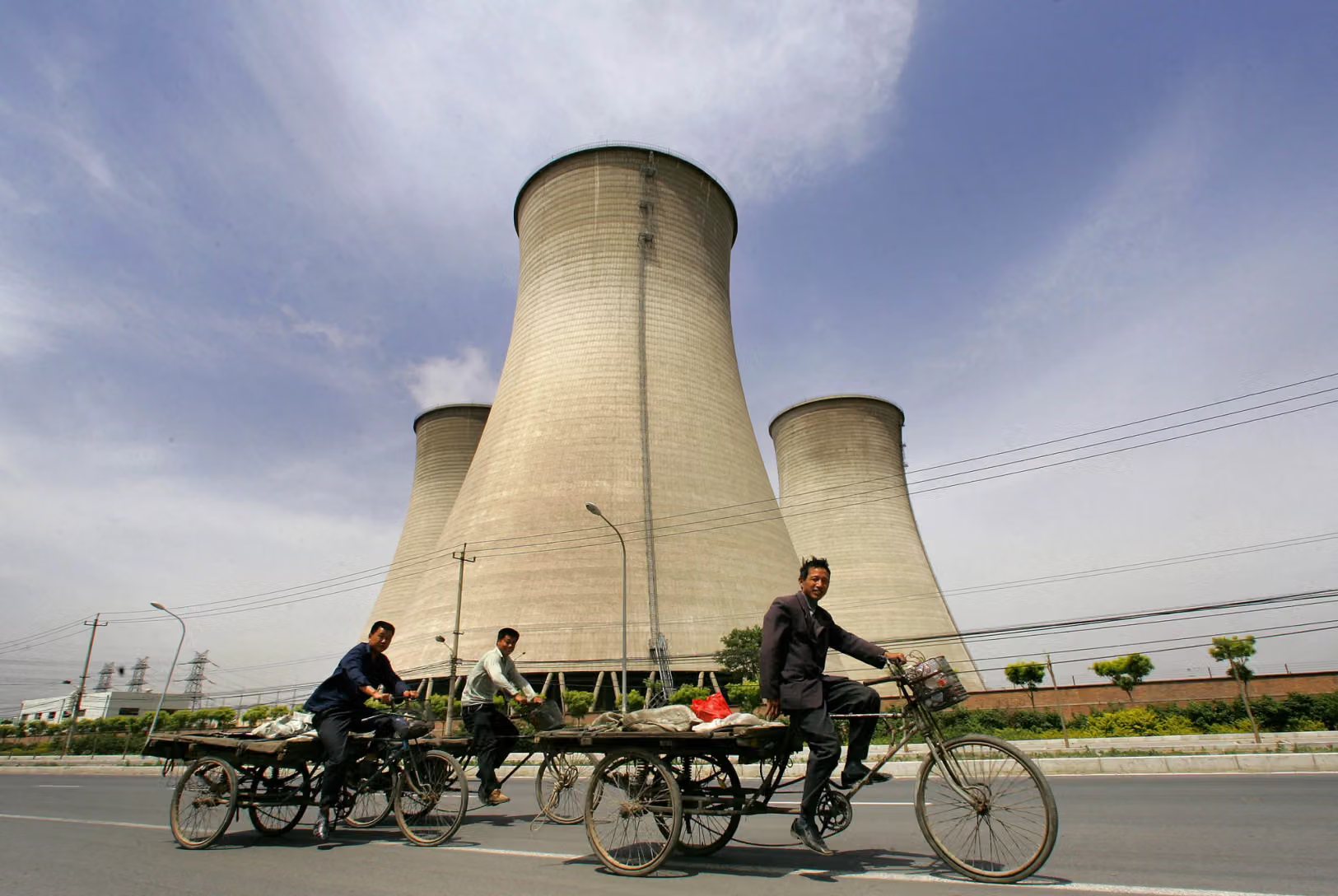
Net Zero has hit the Bank of England, and they cut all support for coal. But the rest of the world increases use of coal and low-cost energy.

The Bank of England is moving further away from thermal coal. From October 2026, it will no longer accept bonds issued by companies deriving revenue from thermal coal mining as eligible collateral in its lending operations. Commercial banks borrowing from the Bank (including major UK institutions) will not be able to post those bonds. The […]

Continue Reading