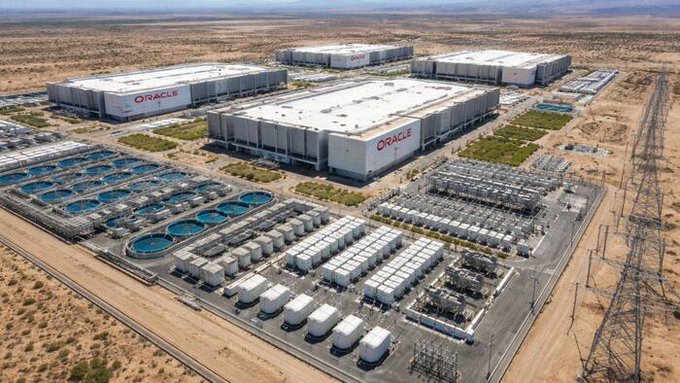
On Thursday, September 24, 2026, Bloomberg reported that Oracle sent a force majeure notice to the developer of Project Jupiter — the 1,400-acre AI campus in Doña Ana County, New Mexico — in an effort to defer payments if the facility misses its planned 2028 in-service date. Shares of Oracle fell about 4–5%. Blue Owl Capital, owner of Stack Infrastructure, the developer, said the notice does not change the project’s financial commitments.
Oracle’s public line was unchanged and carefully worded: “Project Jupiter remains on our planned schedule. We are fully committed to New Mexico and confident in our path forward.” The company added that it is “reimagining” the project’s power plan. That combination — legal hedge plus “still on schedule” — is the sound of a hyperscale tenant protecting its balance sheet while construction, permits, and community opposition grind on.
Force majeure is not a shutdown. It is a warning flare. In AI infrastructure contracts, it is becoming a core risk-allocation tool: when power, permits, pipelines, or courts slip, tenants try to stop the meter from running on rent, take-or-pay power, and milestone payments. The rest of the market should treat Project Jupiter as a stress test, not an isolated legal footnote.
Project Jupiter: scale, money, and friction
Project Jupiter is not a routine colocation hall. It is a 1,400-acre campus near Santa Teresa / Sunland Park, designed for roughly 2.45 gigawatts, tied to Oracle Cloud and OpenAI’s Stargate buildout. Developers have discussed as much as $165 billion in industrial-revenue-bond and related investment if the full vision is realized. A consortium of banks provided about $18 billion in loans. Those loans have already traded at distressed levels, reported in the high-80s to low-90s cents on the dollar. Bloom Energy fuel cells are now the centerpiece of the on-site microgrid after Oracle dropped the earlier gas-turbine-and-diesel design.
Oracle and partners have pitched large local benefits: hundreds of millions in tax and community payments, closed-loop cooling, no public drinking water for cooling or generation, Oracle paying its own power so ratepayers are not asked to fund the campus, and 100% carbon-free matching by 2031. Construction on the data-center buildings has been underway since late 2025; county updates in September put the campus around 26% complete. The microgrid and air-quality permit have been the political and legal choke point — environmental groups challenged notices and water use; the New Mexico Supreme Court lifted some stays in mid-September while the power plan continues to evolve.
That is the pattern across the sector: steel in the ground is real, the power and permit path is not locked, and the tenant is already writing letters that assume 2028 may not hold.
Costs, overruns, delays — and actual shutdowns
This is not just New Mexico.
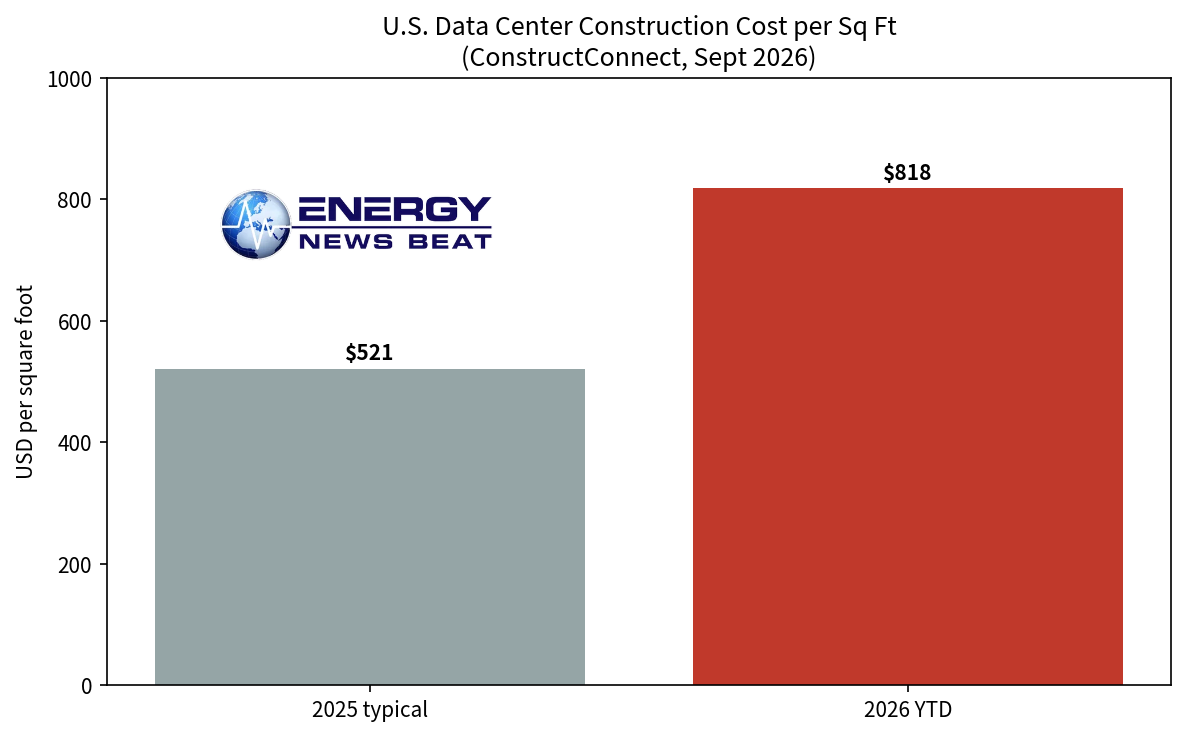
U.S. data-center construction costs have jumped. ConstructConnect’s September 2026 data put average cost at about $818 per square foot, up 57% from 2025. Typical tracked projects have swollen to roughly $1.06 billion and 701,000 square feet. Transformers, switchgear, memory, labor, and “bring your own power” requirements are driving the sticker shock. A one-year delay on a representative 100 MW U.S. AI facility has been modeled at roughly $500–550 million in lost lifecycle value — more damaging, in some studies, than a doubling of electricity prices or the loss of typical state incentives.
Hyperscalers have already pruned. Microsoft canceled or paused hundreds of megawatts of leases and some site work in 2025 when power and space did not line up. Other campuses have been paused “at the customer’s request,” delayed by third-party developers, or pushed from 2026/2027 into 2028–2029. Goldman and JPMorgan have both flagged that a large share of capacity scheduled for 2027 has not even started vertical construction, and that on-time delivery for AI halls is running well below the industry’s historical ~72% rate. Data Center Watch and Bloomberg tallied nearly $200 billion of projects blocked or delayed in the first half of 2026 alone.
Full “shutdowns” of operating halls remain rare. What is proliferating is pre-operational death: withdrawn rezonings, voided hearings, expired options, customer pauses, and force-majeure letters. That is how a boom looks when it hits the grid, the aquifer, and the county commission at the same time.
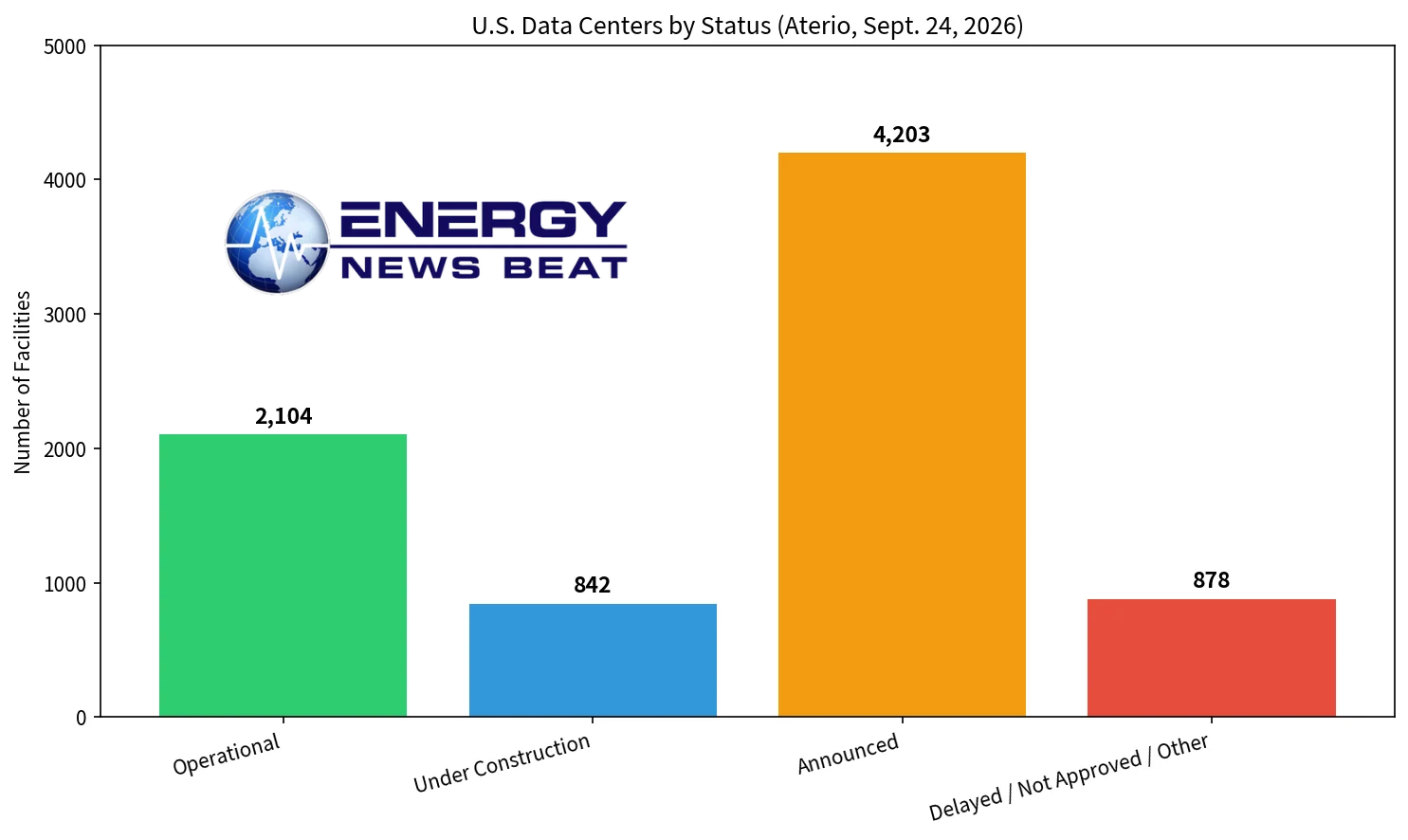
|
Status
|
Facilities
|
|---|---|
|
Operational
|
2,104
|
|
Under construction
|
842
|
|
Announced
|
4,203
|
|
Delayed
|
87
|
|
Land bank
|
64
|
|
Not approved
|
717
|
|
Cancelled
|
10
|
That is 8,027 facilities tracked and a 7,149-facility “active pipeline.” Under-construction sites represent on the order of 77 GW of power capacity in that database.
The announced pile is enormous. The energized pile is not. The gap is the risk.
Holds, moratoriums, and what is actually delayed
Local government has become a co-equal constraint with transformers.
Trackers now list 300-plus local data-center moratoriums in one SemiAnalysis map and more than 1,000 instruments in force across 47 states in the broader Moratorium Nation inventory (data centers dominate that list). New York’s Executive Order 62 (July 14, 2026) is the first statewide pause: DEC is holding discretionary permits for hyperscale facilities of 50 MW and above while the state writes a generic environmental impact statement. Texas, Pennsylvania, Oregon, and others have added interconnection audits, fast-track removals, or freezes on state land. Michigan and Ohio lead local ordinance counts.
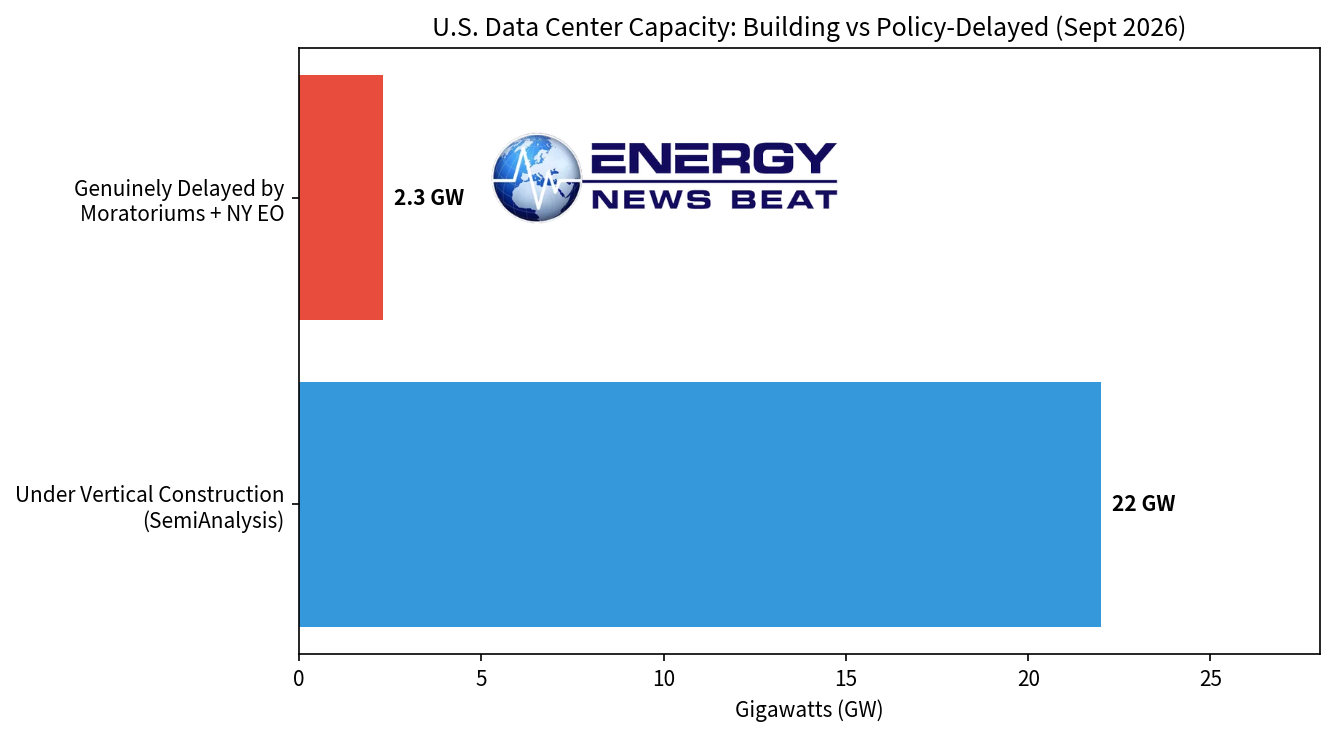
Here is the important nuance: volume of ordinances is not the same as gigawatts killed. SemiAnalysis estimates about 20 GW of announced capacity sits inside a restricted local boundary, but only ~1.5 GW is genuinely delayed at the local level, rising to about 2.3 GW when New York’s order is included. Most moratorium towns do not have a live campus inside the line. The political signal is still loud. Gallup in March 2026 found 71% of Americans opposed a data center in their area — higher than opposition to a local nuclear plant. A later Heatmap/Embold poll put nearby support at 15% and opposition at 75%.
Farmland is the flashpoint. Pew found about two-thirds of planned U.S. data centers targeting rural counties. Projects that try to rezone working farms, battlefields, or subdivision edges — Prince William’s Digital Gateway, Indiana farm sites, Iowa ag belts — are the ones dying in court or at the podium. Projects that reuse industrial ground, retired plants, and existing substations are the ones that survive.
Data centers done right is not a slogan
Energy News Beat has been running this argument for months, and the September conversation with Jon Brewton, CEO and founder of Data2, and Kyle Koss, president of ATCO Ventures, put steel on it.
Stu Turley’s line is simple: Data Centers Done Right are a good thing. Done wrong, and we get problems. The Edgeworks episode makes the engineering case. Mega-campuses that drag multi-gigawatt loads onto congested transmission, greenfield farmland, and ratepayer-funded upgrades are the projects communities are killing. Modular, right-sized nodes placed next to existing power — stranded gas, geothermal, industrial hosts, flared-gas sites — cut the transmission bill, the water fight, and the eminent-domain story. ATCO’s Edgeworks pitch is distributed compute that scales with controls instead of betting the county on a 2.5 GW single point of failure. Brewton’s overlay is mesh-networked smaller halls that can shrink footprint, capex, and energy intensity on the order of 90% versus the greenfield hyperscale template — not as a marketing number, but as a design target when you stop treating “bigger” as the only architecture.
The playbook Energy News Beat has documented from Quincy, Washington; Loudoun County, Virginia; Los Lunas, New Mexico; Hammond, Indiana; and other industrial reuse sites is consistent:
- Industrial land first, not prime soils and not the city-limit cornfield.
- Developer-paid power and interconnection — behind-the-meter gas, nuclear, geothermal, or storage — so residential bills do not become the subsidy.
- Closed-loop or air cooling where water is scarce.
- Cash that shows up in the school budget, not just a construction spike and a handful of technicians.
- No NDAs. Secrecy is now a project-killer.
Quincy is the counter-example the industry should study: data centers became about 65% of property-tax revenue and residential rates fell on the order of 70% from pre-industry levels. That is what “sized with controls” looks like when the community keeps the surplus. Digital Gateway and the Indiana farm rezonings are what it looks like when the grid and the aquifer are treated as someone else’s problem.

AI with validation is invaluable. AI with no validation is worthless.
That sentence is not decoration. It is the same discipline applied to software that “done right” applies to concrete.
On the Energy News Beat podcast, Brewton’s standing line is that AI without validation and cross-checking is worthless. Data2’s pitch is a patented trust layer: explainable, auditable outputs you can lift the hood on — the opposite of a hallucination that looks confident on a slide deck. After Brewton presented behind Microsoft’s head of AI in energy, that presenter reportedly said the talk “dispelled everything I said that there is no accountability in AI.” That is the standard the physical buildout should copy. Infrastructure forecasts based on promised demand rather than production-grade load are how you get $165 billion campuses and force-majeure letters in the same year. Accountability for models and accountability for megawatts are the same problem: if you cannot verify the assumption, the capex is a bet, not a plan.
Oracle invoking force majeure does not mean Stargate is dead or that New Mexico will lose the campus. It means the largest tenants now assume delay is a base case, not a tail risk. Cost per foot is up more than half in a year. Hundreds of local governments have hit pause. Two-plus gigawatts are already slipped by ordinance and executive order. Nearly $200 billion of announced work hit a wall in six months.
The first warning sign is not that one lawyer sent one letter. The first warning sign is an industry that still sites 2.45 GW halls on contested desert and farmland while the modular, validated, behind-the-meter alternative is sitting on the table.
Data centers done right will save communities, investments, and farmland. Data centers done as press releases will keep generating force majeure notices. The market just got one.
Making Appendices Great Again
Check out the World’s Greatest Podcast Show Notes at EnergyNewsBeat.co or EnergyNewsBeat.com.
Appendix: Sources and links
- Reuters: https://www.reuters.com/business/oracle-cites-force-majeure-shield-itself-controversial-data-center-bloomberg-2026-09-24/
- Bloomberg / Yahoo Finance: https://finance.yahoo.com/technology/ai/articles/oracle-cites-force-majeure-shield-122536420.html
- CNBC: https://www.cnbc.com/2026/09/24/oracle-data-center-force-majeure.html
- Oracle — Project Jupiter community benefits: https://www.oracle.com/news/announcement/project-jupiter-2026-07-28/
- Oracle — updated power plan / public review: https://www.oracle.com/news/announcement/public-review-opens-for-updated-project-jupiter-power-plan-2026-06-03/
- Oracle — construction permitting statement: https://www.oracle.com/news/announcement/project-jupiter-statement-on-construction-permitting-2026-09-14/
- Albuquerque Journal coverage of county update and Supreme Court: https://www.abqjournal.com/news/oracle-provides-upbeat-report-on-project-jupiter/3117641
- DCD on Oracle as tenant: https://www.datacenterdynamics.com/en/news/oracle-revealed-as-tenant-of-project-jupiter-data-center-campus-in-new-mexico/
U.S. inventory and capacity
- Aterio U.S. Data Center Database (Sept. 24, 2026 snapshot): https://www.aterio.io/insights/us-data-centers
- SemiAnalysis moratorium mapping: https://newsletter.semianalysis.com/p/everyone-says-datacenter-moratoriums
- Pew Research (rural siting): https://www.pewresearch.org/short-reads/2026/04/13/most-new-data-centers-in-the-us-are-coming-to-rural-areas/
- CNN on construction vs. announcements: https://www.cnn.com/2026/08/06/business/ai-data-center-construction
Moratoriums and opposition
- N.Y. Executive Order 62: https://www.governor.ny.gov/executive-order/no-62-establishing-temporary-moratorium-data-centers-new-york-while-state-develops
- NYT on Hochul order: https://www.nytimes.com/2026/07/14/nyregion/new-york-data-center-moratorium-hochul.html
- Moratorium Nation tracker: https://mjbommar.github.io/moratorium-data-2026/
- Gizmodo / Data Center Watch on ~$200B delayed H1 2026: https://gizmodo.com/nearly-200-billion-worth-of-data-center-projects-have-been-blocked-or-delayed-this-year-2000815054
Costs and delays
- ConstructConnect / Bricks & Bytes on $818/sf: https://bricks-bytes.com/news/data-center-cost-per-square-foot-818-constructconnect/
- Carnegie Endowment on cost of delay: https://assets.carnegieendowment.org/files/Phillips-Robins%20et%20al._Compute_final.pdf
- Quinn Emanuel client alert on force majeure in AI DC contracts: https://www.quinnemanuel.com/the-firm/publications/client-alert-force-majeure-and-the-ai-data-center-buildout-allocating-risk-in-ai-data-center-contracts/
Energy News Beat — data centers done right and AI validation
- Edgeworks episode (Stu Turley with Jon Brewton and Kyle Koss): https://energynewsbeat.co/ai/edgeworks-revolution-bringing-ai-compute-to-where-power-lives/
- “The backlash is real…”: https://energynewsbeat.co/ai/the-backlash-is-real-bipartisan-and-already-killing-projects/
- “AI with Accountability”: https://energynewsbeat.co/ai/ai-with-accountability-why-validation-matters-more-than-hype/
- Data2: https://www.data2.ai/
- Jon Brewton LinkedIn: https://www.linkedin.com/in/jon-brewton-datasquared/
- Kyle Koss LinkedIn: https://www.linkedin.com/in/kyle-koss-3bbb1927/
Charts compiled from Aterio (facility counts as of Sept. 24, 2026), SemiAnalysis (construction vs. policy-delayed GW), and ConstructConnect (cost per square foot). Facility-count methodologies differ across vendors; treat announced MW as a pipeline, not a completion forecast.