

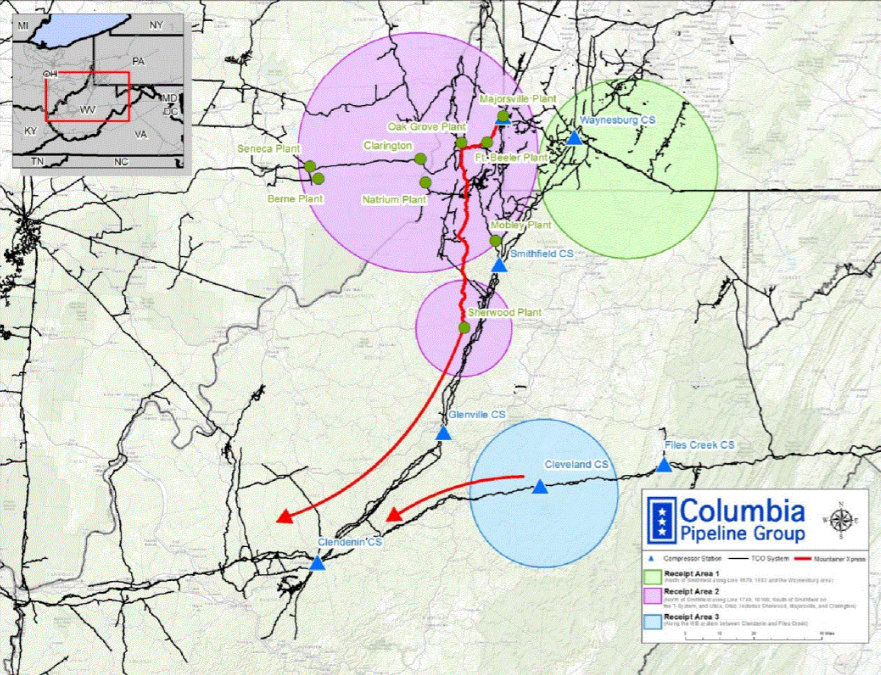
TC Energy’s Columbia Gas Transmission (TCO) declared force majeure Thursday after an unexpected mechanical issue on the Mountaineer XPress (MXP) system forced an immediate pressure reduction on Line 100 between the Mt. Olive Compressor Station in Jackson County and the Saunders Creek Regulator Station in Cabell County, West Virginia.
The restriction takes the MXPSEG MA42 constraint to zero beginning with the September 25 Timely Cycle. TCO estimates about 1.8 million dekatherms per day of firm service will be affected — roughly matching the 1.88 MMDth/d recently scheduled through that segment.
Mountaineer XPress is a 2.7 Bcf/d Appalachian takeaway system. The core line, MXP-100, is a 36-inch pipe running about 164 miles from Marshall County south through West Virginia into Cabell County. It moves Marcellus and Utica supply into Columbia’s broader TCO system and toward the Leach interconnection in Kentucky, a key gateway to the Southeast and Gulf Coast. The project entered service in 2019.
October natural gas futures jumped on the news. ZeroHedge reported the contract up 4.5%, or 13.6 cents, to $3.159 per MMBtu as of 11:00 a.m. ET Thursday, after a move of more than 12% since early Wednesday. Other market snapshots later Thursday showed front-month prices in the $3.28–$3.39 range, with day-over-day gains of roughly 8–9%. Henry Hub spot prices heading into the session had been closer to $2.90.
The market reaction is familiar. A 2020 force majeure on MXP near Leach cut Appalachian production by more than 2.2 Bcf/d in a single day and lifted NYMEX prices. Criterion Research noted that upstream MXP receipts had not yet fallen materially Thursday — Sherwood about 714 MDth/d, Corral about 267 MDth/d, Viking about 5 MDth/d — but the full restriction should show up in Friday nominations. If the 1.8 Bcf/d cannot find alternate paths, producers may have to reroute or shut in.
A separate constraint is already in play. On September 23, DT Midstream declared force majeure at the Stonewall Gas Gathering delivery into TCO’s West Braxton meter, cutting maximum capacity there to 400,000 Dth/d with no estimated return date. That is another hit to Appalachian receipts into Columbia.
States, shippers, and consumers
The physical problem is in Jackson and Cabell counties, West Virginia. The commercial footprint is larger.
Columbia Gas Transmission spans roughly 11,900 miles across about 10 states, including West Virginia, Ohio, Pennsylvania, Kentucky, Virginia, Maryland, New York, New Jersey, Delaware, and North Carolina. It feeds LDCs, industrials, power generators, and other pipelines. Historic large firm customers have included Columbia Gas of Ohio, Washington Gas Light, and Columbia Gas of Pennsylvania. West Virginia local distribution includes Mountaineer Gas and Hope Gas. Gas that would have moved south on MXP can also reach Midwest, Mid-Atlantic, Southeast, and Gulf Coast markets through TCO’s pool and the Leach header.
No utility has reported residential or commercial outages tied to this event. Firm transportation customers on MXP face curtailed capacity. Whether that becomes a consumer problem depends on how quickly gas can be rerouted, how much storage and linepack TCO can use, and how other Appalachian pipes absorb the volumes.
Power plants
There is no public confirmation that any power plant has lost natural gas supply.
Columbia does serve electric generators as well as LDCs. Plants in the Ohio River Valley, Mid-Atlantic, and parts of the Southeast can take gas off the Columbia system or interconnects. Late September is shoulder season: heating load is low, and cooling demand is fading. Many generators have dual-fuel capability, firm contracts on more than one pipe, or access to storage. Nothing in TCO’s description or market commentary so far says a plant is offline for lack of gas.
That can change if the outage lasts, if weather turns, or if multiple constraints stack. It has not been reported yet.
How soon does it come back?
TCO has not given a restoration date. Criterion said an update was expected Friday morning. Until then, the operational assumption is zero capacity on the affected MXPSEG MA42 constraint starting with Friday’s Timely Cycle.
Mechanical issues on large-diameter transmission lines can be short — a compressor, valve, or regulator problem that is isolated and repaired in days — or they can require pressure reductions, inspections, and PHMSA coordination that last weeks. Columbia has a recent history of both. The 2023 Line VB rupture in Virginia produced a long force majeure and later FERC litigation over how long the company kept restrictions in place. Other 2025–2026 TCO force majeure events at compressor stations were described as unexpected mechanical failures with limited or no commercial impact. This one is already commercially material.
Is it a cyber attack?
No public source has suggested a cyber attack. TCO and Criterion describe an unexpected mechanical issue and a required pressure reduction on a defined West Virginia segment. That language matches how pipelines report physical equipment problems.
Columbia’s tariff defines force majeure as an event creating an inability to serve that could not be prevented or overcome by due diligence, including mechanical or physical failure. Cyber incidents can theoretically fall under some force majeure clauses, but nothing in the notices, market notes, or secondary reporting points that way. PHMSA and FERC treat physical pipeline incidents and cyber events under different reporting and investigative tracks. Absent evidence, the working description is mechanical.
What to watch Friday
- TCO’s promised morning update and any capacity posting for MXPSEG MA42
- Friday nominations and Appalachian receipt volumes at Sherwood, Corral, and related meters
- Whether producers shut in or shift gas to Rover, MVP, Transco, TETCO, or other takeaway
- Basis at Columbia Gas Appalachia versus Henry Hub
- Any LDC or generator notices, which have not appeared so far
A 1.8 Bcf/d hole in a 2.7 Bcf/d pipe is large enough to move prices. It is not automatically large enough to leave homes or power plants without gas in late September — unless the outage stretches and alternative routes fill up. The next official notice will matter more than the first day’s futures spike.
Making Appendices Great Again
Check out the World’s Greatest Podcast Show Notes at EnergyNewsBeat.co or EnergyNewsBeat.com.
Appendix: Sources and links
- ZeroHedge, “NatGas Spikes As Major West Virginia Pipeline Declares Force Majeure,” Sept. 24, 2026 — https://www.zerohedge.com/energy/natgas-spikes-major-west-virginia-pipeline-declares-force-majeure
- Criterion Research client update, quoted in ZeroHedge, Sept. 24, 2026 — https://criterionrsch.com/
- FERC, Final EIS, Mountaineer XPress and Gulf XPress Projects — https://www.ferc.gov/final-environmental-impact-statement-mountaineer-xpress-and-gulf-xpress-projects
- Offshore Technology, Mountaineer Xpress Project overview — https://www.offshore-technology.com/projects/mountaineer-xpress-project-west-virginia/
- Global Energy Monitor, Mountaineer XPress Gas Pipeline — https://www.gem.wiki/Mountaineer_XPress_Gas_Pipeline
- TC Energy, Columbia Gas Transmission operations page — https://www.tcenergy.com/operations/natural-gas/columbia-gas-transmission/
- Enercast, Columbia Gas Transmission (TCO) critical notices, including DT Midstream Braxton force majeure (Sept. 23, 2026) and other TCO operational notices — https://enercast.com/pipeline/tco/
- S&P Global, July 7, 2020 MXP force majeure and Appalachian production cut — https://www.spglobal.com/energy/en/news-research/latest-news/natural-gas/070720-nymex-prompt-hits-two-month-high-as-force-majeure-cuts-appalachian-production
- FERC order, Baltimore Gas and Electric Co. and Washington Gas Light Co. v. Columbia Gas Transmission, LLC, Docket RP25-740-000 (Oct. 16, 2025) — https://ferc.gov/sites/default/files/2025-10/RP25-740-000.pdf
- FERC rehearing order, Docket RP25-740-001 (March 19, 2026) — https://www.ferc.gov/sites/default/files/2026-03/RP25-740-001.pdf
- Reuters, TC Energy Line VB force majeure, July 25, 2023 — https://www.reuters.com/business/energy/tc-energy-isolates-columbia-gas-line-section-virginia-declares-force-majeure-2023-07-25/
- PHMSA Corrective Action Order re: Columbia Gas Transmission / TC Energy, July 28, 2023 — https://www.phmsa.dot.gov/news/phmsa-corrective-action-order-tc-energy-corp-re-columbia-gas-transmission-llc
- Trading Economics, natural gas price snapshot, Sept. 24, 2026 — https://tradingeconomics.com/commodity/natural-gas
- World Oil Monitor / NYMEX NG close reference, Sept. 24, 2026 — https://worldoilmonitor.com/natural-gas
- FRED, Henry Hub Natural Gas Spot Price — https://fred.stlouisfed.org/series/DHHNGSP
- East Daley, Columbia Gas Midwest expansion and system description, May 2026 — https://eastdaley.com/daley-note/midwest-demand-growth-drives-1-5b-columbia-gas-expansion
- Global Energy Monitor, Columbia Gas Transmission — https://www.gem.wiki/Columbia_Gas_Transmission
- PipeRiv example TCO force majeure notice format (prior events) — https://www.piperiv.com/ip/columbia/notice/25933308
- Nuttall Legal, Mountaineer XPress pipeline map context — https://www.nuttalllegal.com/2015/06/25/mountaineer-xpress-pipeline/