

A forecast is not a plan. A storage target is not a molecule. And a press release about “diversified supply” does not fill a cavern in Bavaria when the cargo is sitting in the Pacific because Seoul or Dhaka paid more.
As of late September 2026, the European Union is heading into the heating season with underground gas storage around 71% full — about 805 TWh of working gas against roughly 1,132 TWh of capacity. That is 11 points below the same date in 2025 and 15 points below the recent five-year seasonal average of about 87%. StorageCurve’s weekly AGSI sample puts the deficit versus the five-year curve at −18.7%, or 185 TWh. The physical balance is described as “very tight,” at the 0th percentile of the five-year sample.
Germany, which holds the EU’s largest storage system, is the problem child: about 58% full. The Netherlands is in the same neighborhood. France and Italy are healthier, in the low-to-mid 80s. Poland is essentially full. The average hides a split that matters in a cold snap, because German and Dutch inventories are the ones the northwest European system leans on when TTF spikes.
The United Kingdom is in a worse structural position. GB storage is a rounding error by continental standards. Rough is empty. Humbly Grove is effectively empty. Country-level readings in late September have printed in the 30–50% range depending on the tracker and whether LNG tank inventory is mixed in with caverns, with Catalyst’s market reports showing the GB figure sliding through the 40s as sites drew down and few cargoes booked UK terminals. Britain does not “do winter” on storage the way Germany does. It does winter on Norway, the UK Continental Shelf, interconnectors, and LNG. That is a strategy only if those four legs all show up.
Official language still talks as if a refill trajectory plus a demand forecast equals energy security. It does not. The last ten years of storage data show why.
Ten years of storage: the buffer was rebuilt, then spent, then politicized
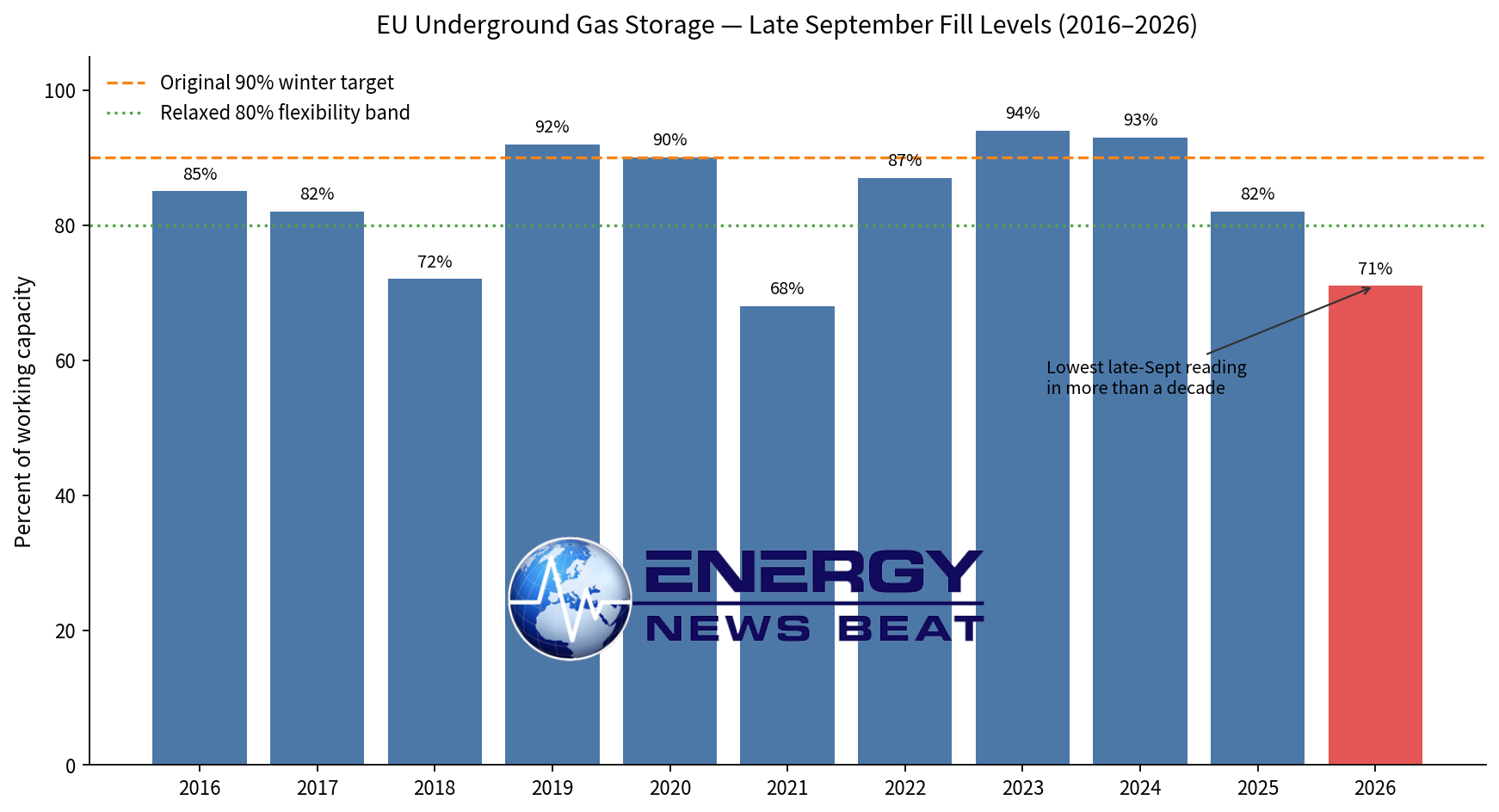
Before 2022, European storage was a commercial seasonal tool. Operators injected when summer was cheap and withdrew when winter was expensive. Fill rates in late September typically sat in the 80s and 90s in comfortable years and sagged after hard winters (2018) or when Russia tightened the screws (2021). The 2021 pre-crisis squeeze left Europe around 68% heading into autumn — the last time late-September inventories looked this thin.
Then policy took over. After the 2022 cutoff of most Russian pipeline gas, Brussels imposed mandatory fill targets: 90% by 1 November, with intermediate waypoints. It worked, at a price. 2023 and 2024 went into winter near the ceiling. 2025 did not. A harder winter, weaker injection economics, and a lower starting stock left November 2025 around 82%, not the mid-90s of the year before. The 2026 injection season started from an even thinner base — inventories in the high-20s to low-30s of capacity at the start of the year, well below the nine-year average.
The EU then did what governments do when a target collides with physics: it moved the target. The 90% rule was extended through 2027, but the hard 1 November deadline became “anytime between 1 October and 1 December.” A 10-point deviation is allowed in “difficult conditions,” and the Commission can add another 5 points. In plain language, 75% can now be declared a success. That is not strategy. That is a forecast with an escape clause.
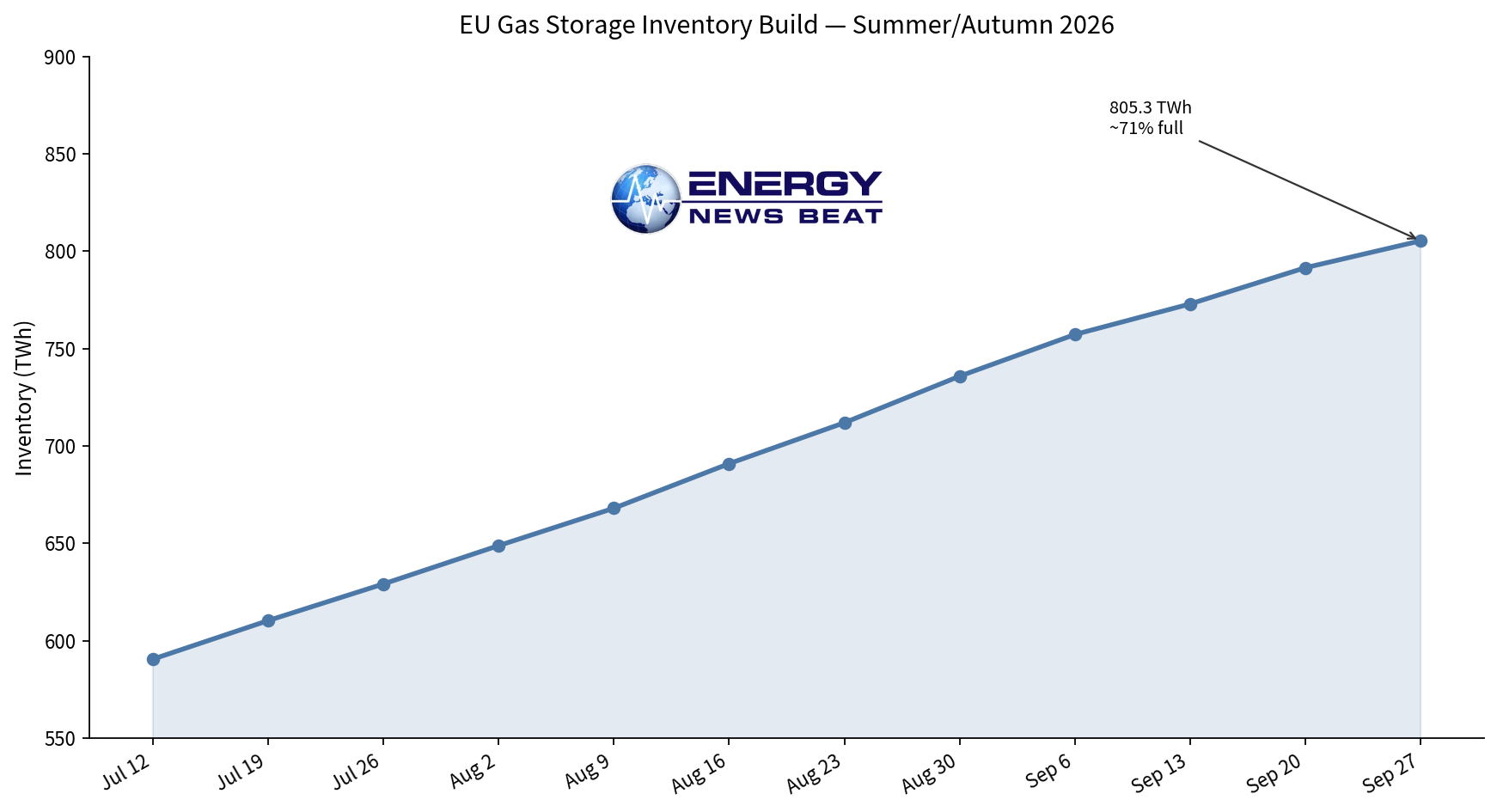
The 2026 build itself has not been a collapse. Inventories rose from 590 TWh in mid-July to 805 TWh by the week of 27 September. The problem is the starting hole and the missing cargoes, not the slope of the last eight weeks.
Qatar’s force majeure is not a footnote. It is the missing fifth of the seaborne market.
The Iran war that erupted in March 2026 did what every energy-security paper said a Hormuz crisis would do. Qatar’s Ras Laffan complex was hit. Two of fourteen LNG trains and a GTL unit were damaged. QatarEnergy’s CEO said 17% of export capacity — 12.8 million tonnes a year — would be offline for three to five years, with force majeure on long-term contracts to Italy, Belgium, South Korea, and China. The Strait of Hormuz, which normally handles about one-fifth of global LNG, ceased to be a reliable transit lane.
The operational result is stark. By late August, Qatar had loaded 18 cargoes against 509 in the same period a year earlier — an export collapse on the order of 96%, according to Reuters calculations from ICIS data. Neighboring oil exporters found workarounds. LNG, which needs purpose-built ships and intact liquefaction trains, did not.
QatarEnergy has been rolling force majeure month by month. As of 28–29 September 2026, notices to Pakistan and Bangladesh run through November. At least one Indian buyer was told the same. Italy’s Edison, a flagship European contract, was told deliveries remain suspended until early December, with another six cargoes canceled and a running total of 35 undelivered shipments. Edison has been replacing what it can, mostly from the United States. That is not “Qatari supply with a delay.” That is a winter without Qatar.
Forecasts that still treat Gulf LNG as a swing volume available by December are writing checks the war has already bounced.
The Asia–Europe bidding war is back, and Asia’s pain threshold has moved
Spot LNG has more than doubled since the war began. Platts JKM printed near $30/MMBtu in mid-September and was still around $25 late in the month. European delivered prices sat in the mid-20s. TTF has seen its highest prints since 2022. Analysts have sketched $35 if Hormuz stays shut and $40 in a cold dual-hemisphere winter.
The 2022 playbook was that price-sensitive Asian buyers — Pakistan, Bangladesh, India, and parts of China — would simply walk away and burn coal. Some of that is happening. Kpler’s September Asian arrivals were tracking around 20.1 million tonnes, the weakest September in eight years, which freed some cargoes for Europe. That is the only reason Europe is injecting at all.
It is not a durable advantage. Japanese and Korean buyers have a different mandate than they did four years ago: pay more, avoid blackouts, and lock in term supply so they never have to fight this fight again. South Asian utilities that were “priced out” in 2022 have now lifted cargoes at $25. Morgan Stanley’s Martijn Rats called that a regime change. When heating demand arrives in North Asia, and a cold snap hits Europe in the same week, the Atlantic Basin’s flexible U.S. cargoes will go to the highest bid, not to the jurisdiction with the nicest storage regulation.
Europe can win that auction. Households and industry will pay for the privilege. That is not an energy strategy. That is a transfer from European consumers to U.S. Gulf Coast liquefaction trains, with Asian utilities setting the reserve price.
Russia is being phased out on a calendar, not on a balance sheet
The political story is that Europe is “done with Russian gas.” The contractual story is that it is being done with Russian gas on a timetable written for 2027.
Short-term Russian LNG purchases have been banned since 25 April 2026. Pipeline gas under short-term contracts was banned from 17 June 2026. Long-term LNG contracts are scheduled to expire on 1 January 2027. Long-term pipeline contracts follow on 30 September 2027, with a possible slip to 1 November if storage targets are missed. Russian gas still accounted for around 12% of EU demand in ACER’s 2026 monitoring, and Russian LNG imports actually rose in early 2026 — up 16% year on year in Q1 — landing in France, Spain, Belgium, the Netherlands, and Portugal. Yamal remains a real volume. TotalEnergies, SEFE, and Naturgy still hold the paper. The Commission has clarified that from 2027 EU operators cannot even market that LNG to third countries.
So the winter of 2026–27 is the awkward year: Russia is no longer a reliable planning assumption, but it has not yet vanished from the meters. Forecasts that subtract Russian molecules and add “other LNG” as if the two were interchangeable ignore both the Qatar hole and the Asian bid. You cannot terminate a 20-year Yamal contract and a Qatari Ras Laffan contract in the same twelve months and assume the U.S. and Norway will quietly absorb the residual without a price.
The UK is on a parallel track. Maritime-services restrictions on Russian LNG and a long-term-contract runway to 1 January 2027 mean London is not a spare dock for diverted Yamal cargoes either.
Can Europe and the UK fill winter without Russian gas and without Qatar?
Short answer: they can avoid running out. They cannot recreate the 2023–24 buffer. And they cannot do it cheaply.
What is still available
Norway remains the backbone of northwest European pipeline supply, subject to maintenance and field decline.
U.S. LNG is the global swing supplier. IEEFA had the U.S. at 63% of Europe’s LNG in Q1 2026; six countries took more than 70% of their LNG from America. The UK took 81%. That dependence is now the strategy, whether ministers say so or not.
Algeria, Azerbaijan, and residual pipeline flows still matter at the margin.
Demand destruction is a supply source. It is also an industrial policy failure.
What is not available
- Qatari winter cargoes through December, and a slice of Qatari capacity for years.
- Russian “just in case” volume after January 2027, and a shrinking one before that.
- Cheap summer-to-winter storage spreads. At one point in March, buying summer gas to sell in winter lost more than €8/MWh before storage fees. Traders do not fill caverns as a public service.
The arithmetic of November
EU working capacity is about 107 bcm / 1,130 TWh. Ninety percent is ~96 bcm. Eighty percent is ~85 bcm. Seventy-five percent is ~80 bcm. Late-September inventories near 71% leave a steep October. Equinor has talked about 75% by 1 November. Oxford Institute work earlier in the year showed that matching last year’s injection pace would still leave November stocks below 2025. Several trackers now call a print near 77–78% by 1 November the base case — inside the political flexibility band, outside any definition of comfortable. Germany’s own path points closer to the mid-60s to high-60s if the current pace holds.
The UK question is different. National Gas has long treated Rough as optional. Storage supplied under 8% of GB winter gas as recently as 2024/25. The system can clear a normal winter on Norwegian pipes, UKCS, and LNG sendout of 175 mcm/d after Grain and South Hook expansions — if the cargoes come. An empty Rough plus a Hormuz-closed Qatar plus an Asian bid for U.S. molecules is not a normal winter. Britain will not “run out” in the tabloid sense. It will import the price. Centrica has already said Rough stays empty through winter without a regulatory support model. That is a policy choice dressed up as a market outcome.
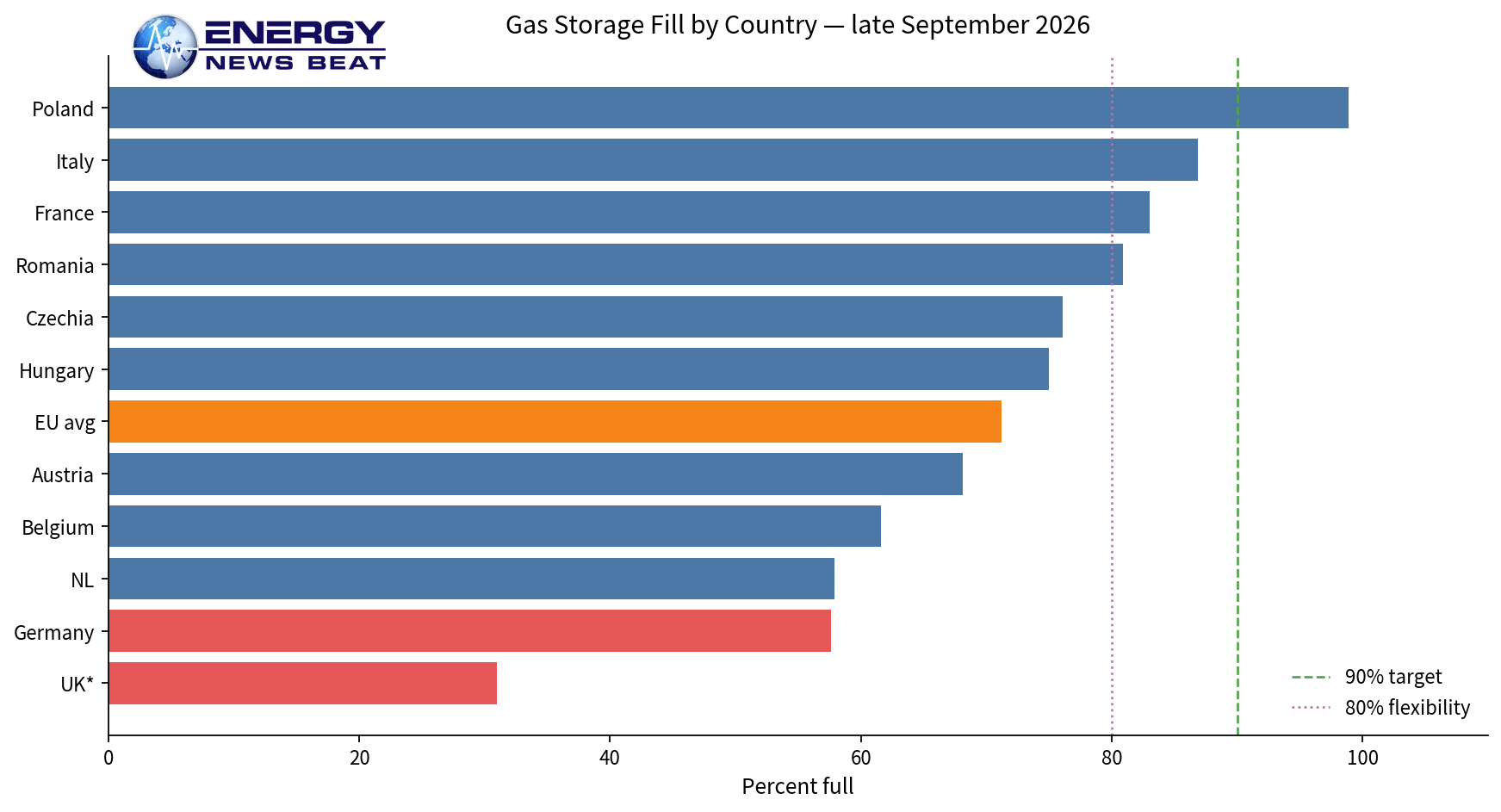
UK figure is an AGSI/tracker estimate with incomplete site coverage; cavern-level reports in late September showed a higher GB average still well below the continent, with Rough at zero.
Forecasts without molecules are public relations
The EU’s storage regulation was the right emergency tool in 2022. Using it in 2026 as a substitute for supply is the error. You cannot regulate gas into a salt cavern. You can only buy it, produce it, or do without it.Three conclusions follow.
First, winter 2026–27 is a just-in-time LNG winter. The buffer that made 2023 and 2024 politically boring is gone. Weather, wind droughts, and a single missed U.S. wave will show up in TTF within days, not weeks.
Second, the bidding war with Asia is the price-setting mechanism. Europe will get cargoes if it outbids Japan, Korea, and the South Asian utilities that have learned to pay $25. That is a wealth transfer and a competitiveness problem for energy-intensive industry. It is not “security.”Third, terminating Russian contracts on a legal calendar while Qatar is under force majeure through December is a stacked risk, not a transition plan. The honest strategy would say out loud: the residual winter stack is Norway plus America, priced at the Asian margin, with storage 10–20 points light and Germany half-empty. Anything softer is a forecast.
Energy News Beat has a simpler test. If the plan still works when Qatar does not sail, Russia does not deliver, Asia does not blink, and January is cold, it is a strategy. If it only works in the model, it is a briefing note.
Making Appendices Great Again
Check out the World’s Greatest Podcast Show Notes at EnergyNewsBeat.co or EnergyNewsBeat.com.
Appendix: Sources
Storage data and historical fill levels
- Gas Infrastructure Europe, AGSI transparency platform: https://agsi.gie.eu/
- AGSI filling-level visualisation: https://agsi.gie.eu/data-visualisation/filling-levels/EU
- StorageCurve, EU Gas Storage Chart (data through 27 Sept 2026): https://storagecurve.com/natural-gas/europe/storage/
- European Council infographic, “How much gas have the EU countries stored?”: https://www.consilium.europa.eu/en/infographics/gas-storage-capacity/
- Bruegel, European natural gas imports and storage dataset: https://www.bruegel.org/dataset/european-natural-gas-imports
- Voltstack, European gas & power statistics / EU storage tracker: https://voltstack.energy/insights/european-gas-power-statistics-2026 and https://voltstack.energy/insights/eu-gas-storage-tracker-winter-2026
- MacroMicro, European countries storage percent full: https://en.macromicro.me/charts/57402/eu-european-countries-natural-gas-storage-percent-full
- gas-risiko.de country comparison: https://gas-risiko.de/en/markets
- Gasspeicher.app (Germany): https://gasspeicher.app/en/
- Global Energy Flow storage trajectory: https://global-energy-flow.com/storage/trajectory/
- ACER LNG Market Monitoring Report 2026: https://www.acer.europa.eu/sites/default/files/documents/Publications/ACER-LNG-Monitoring-Report-2026.pdf
- Oxford Institute for Energy Studies, “LNG and Europe Storage” (June 2026): https://www.oxfordenergy.org/wpcms/wp-content/uploads/2026/06/Comment-LNG-and-Europe-Storage.pdf
- OIES Quarterly Gas Review, Issue 33 (July 2026): https://www.oxfordenergy.org/wpcms/wp-content/uploads/2026/07/OIES-Quarterly-Gas-Review-Issue-33-.pdf
- Columbia SIPA CGEP, “European Gas Storage: The World’s Winter Buffer Is Dwindling”: https://www.energypolicy.columbia.edu/european-gas-storage-the-worlds-winter-buffer-is-dwindling/
- bne IntelliNews storage analyses: https://www.intellinews.com/eu-faces-winter-tug-of-war-with-asia-as-gas-stores-hit-lowest-for-date-since-2011-471381/ and https://www.intellinews.com/intellinews-lambda-eu-gas-storage-is-emptier-than-in-the-2022-crisis-gas-prices-doubles-465347/
- Japan Times / Bloomberg, “Europe’s LNG stores depleted ahead of winter”: https://www.japantimes.co.jp/business/2026/09/29/economy/europe-lng-shift-gas-storage/
- Eurostat stock levels dataset nrg_stk_gas: https://ec.europa.eu/eurostat/databrowser/view/nrg_stk_gas/default/table?lang=en
United Kingdom
- Digest of UK Energy Statistics (DUKES), natural gas: https://www.gov.uk/government/statistics/natural-gas-chapter-4-digest-of-united-kingdom-energy-statistics-dukes
- National Gas, Gas Winter Review 2025/26: https://www.nationalgas.com/sites/default/files/documents/Gas%20Winter%20Review%202026.pdf
- Catalyst Commercial UK Energy Market Reports (7–29 Sept 2026): https://www.catalyst-commercial.co.uk/works/uk-energy-market-report-29-september-2026/
- Global Energy Network / HEA, “Britain won’t run out of gas this Winter. It will pay for it.”: https://globalenergynetwork.net/news-item/britain-wont-run-out-of-gas-this-winter-it-will-pay-for-it/
- PreparedBritain, UK storage explainer: https://www.preparedbritain.co.uk/guides/uk-gas-storage-days
- Hansard, UK LNG maritime services and sanctions timeline (15 June 2026): https://hansard.parliament.uk/pdf/commons/2026-06-15/7da55a24-8b98-4862-a6f6-21ecbffb2107
Qatar force majeure and the Iran / Hormuz war
- Bloomberg, “Qatar Extends LNG Force Majeure as Hormuz Disruptions Drag On” (28 Sept 2026): https://www.bloomberg.com/news/articles/2026-09-28/qatar-extends-lng-force-majeure-as-hormuz-disruptions-drag-on
- World Energy News / Edison notices: https://www.worldenergynews.com/news/qatar-extends-lng-force-majeure-edison-some-778763
- OilPrice, same extension: https://oilprice.com/Latest-Energy-News/World-News/Qatar-Extends-LNG-Force-Majeure-as-Hormuz-Crisis-Drags-On.html
- Reuters via Dawn: https://www.dawn.com/news/2033427
- Reuters exclusive, 19 March 2026, 17% capacity loss: https://www.reuters.com/business/energy/iran-attack-damage-wipes-out-17-qatars-lng-capacity-three-five-years-qatarenergy-2026-03-19/
- WAM / QatarEnergy CEO remarks: https://www.wam.ae/en/article/174oe2d-qatari-minister-state-for-energy-affairs-iranian
LNG bidding war, prices, and flows
- Financial Times, “Europe braces for LNG tug of war with Asia”: https://www.ft.com/content/474ced6c-b6ba-4d03-af41-bab5fbb6d7e9
- Reuters, “Global LNG prices could spike this winter on low European gas stocks”: https://www.reuters.com/business/energy/global-lng-prices-could-spike-this-winter-low-european-gas-stocks-2026-09-17/
- OilPrice, “Europe Outbids Asia for LNG as Prices Surge 150%”: https://oilprice.com/Energy/Natural-Gas/Europe-Outbids-Asia-for-LNG-as-Prices-Surge-150.html
- Reuters/Clyde Russell via World Energy News and Baird Maritime on weak Asian September imports: https://www.bairdmaritime.com/shipping/tankers/gas/opinion-asia-balks-at-soaring-spot-lng-prices-handing-a-lifeline-to-europe
- Energy Connects / Bloomberg, “Europe Faces Winter Gas Reckoning”: https://www.energyconnects.com/news/gas-lng/2026/july/europe-faces-winter-gas-reckoning-as-global-fight-for-lng-brews/
- IGU World LNG Report 2026: https://www.datocms-assets.com/146580/1783403747-igu-world-lng-report-2026.pdf
- IEEFA European LNG Tracker: https://ieefa.org/european-lng-tracker
- IEEFA data summary (May 2026): https://ieefa.org/sites/default/files/2026-05/IEEFA_European%20LNG%20Tracker%20data%20summary_May%202026.pdf
Russian contract phase-out
- Reuters, Commission letter on 2027 Russian LNG trade ban: https://www.reuters.com/business/energy/eu-commission-clarifies-all-russian-lng-trade-is-banned-2027-eu-operators-letter-2026-06-18/
- ACER, remaining Russian gas contracts: https://www.acer.europa.eu/news/acer-tracks-remaining-russian-gas-contracts-eu-during-phase-out-russian-gas-imports
- Selectra explainer of Regulation (EU) 2026/261 timetable: https://selectra.info/energie/actualites/marche/gaz-russe-interdit-janvier-2027-facture
- Razom We Stand on remaining long-term LNG offtake: https://razomwestand.com/europe-can-legally-quit-russian-lng-today-it-keeps-choosing-not-to/
- Skadden, 21st Russia sanctions package: https://www.skadden.com/-/media/files/publications/2026/08/eu_adopts_21st_russia_sanctions_package.pdf
Other market context
- GECF Monthly Gas Market Report, June 2026: https://www.gecf.org/Portals/0/xBlog/uploads/2026/6/18/GECFMonthlyGasMarketReport-June2026.pdf
- Energy News Beat channel home for house style and running coverage: https://energynewsbeat.co/
Chart notes: Late-September historical fill rates in Chart 1 are compiled approximations from GIE AGSI-based secondary trackers and contemporaneous reporting (2016–2026), intended to show the decade arc rather than a single official vintage series. 2026 weekly TWh figures in Chart 2 are StorageCurve’s AGSI weekly sample. Chart 3 uses late-September 2026 country prints from AGSI-based dashboards; the UK bar is an incomplete-coverage estimate and is marked as such.
