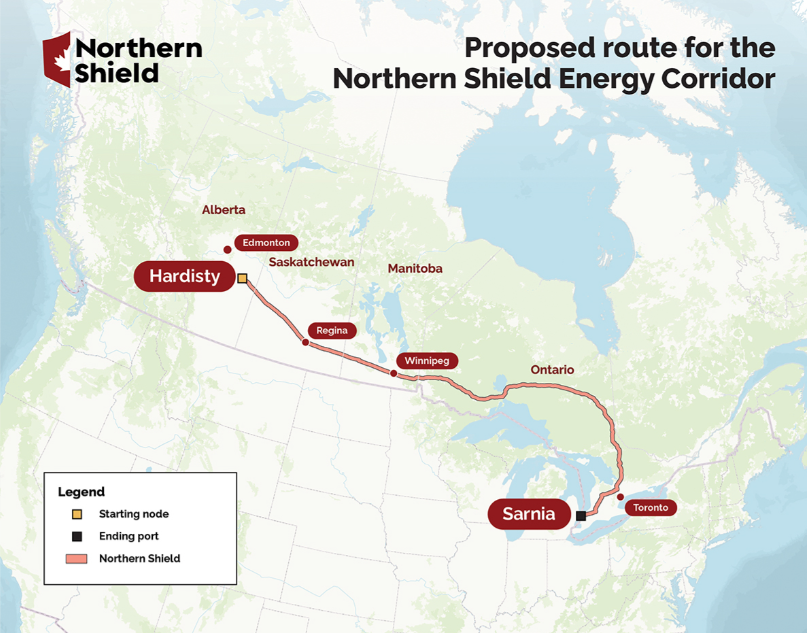
Announced in July 2026 and still at the feasibility-study stage, it would initially move 500,000 barrels per day (expandable to 800,000) of Western Canadian crude to Sarnia’s refining hub. Ontario is leading the study, due by the end of 2026, and Ford has said the province is prepared to provide “patient capital” while seeking private investors. No official cost or full construction schedule exists yet.
The odds it is never built are high—likely 60-80% based on Canada’s recent pipeline record. History, missing private-sector shipper commitments, difficult terrain, Indigenous and provincial consultation still in early stages, and the need for federal approvals all point to a long, expensive, politically vulnerable path. Even optimistic construction estimates of under 4.5 years ignore years of permitting that have killed or delayed similar projects.
The official proposed route starts at Hardisty, heads southeast through Saskatchewan near Regina, crosses Manitoba near Winnipeg, enters Ontario at Kenora, travels through northern Ontario (north of Thunder Bay toward Kapuskasing/Cochrane), then south near the Quebec border through North Bay before swinging west around Georgian Bay to Sarnia. It stays entirely in Canada and avoids Quebec. A possible later spur to Churchill, Manitoba, has been floated.
Why an eastbound all-Canadian line?
The pitch is energy security and redundancy. Existing Enbridge Mainline infrastructure that supplies Sarnia dips into the United States; Line 5 (Superior, Wisconsin, to Sarnia) carries up to 540,000 bpd of light crude and natural-gas liquids and is repeatedly threatened by Michigan legal and political action. Ford has explicitly tied Northern Shield to reducing reliance on “decisions made in another country.” Sarnia is already a major refining and petrochemical cluster with connections to product pipelines serving Ontario. The corridor is also framed as a potential future export or strategic-reserve route and a way to use Canadian steel and labor.
It deliberately sidesteps the Quebec opposition that helped sink Energy East. That earlier 4,600-km, 1.1-million-bpd proposal (much of it converted gas pipeline plus new pipe to New Brunswick) was canceled by TC Energy in 2017 amid low oil prices, regulatory expansion to include upstream/downstream emissions, Quebec resistance, and Indigenous concerns. Cost estimates at cancellation were about $15.7 billion. Northern Shield is shorter, ends at Sarnia instead of the Atlantic, and is being advanced by provincial governments rather than a single pipeline company.
Canada’s canceled-pipeline track record
Ottawa and changing market/regulatory conditions have a long list of unbuilt or abandoned oil-pipeline projects:
- Northern Gateway (Enbridge, Alberta to Kitimat, B.C.): ~$7.9 billion. Federal permits canceled by the Trudeau government in 2016 after court findings on inadequate Indigenous consultation.
- Energy East (TC Energy): canceled in 2017 as described above.
- Keystone XL: repeatedly delayed and ultimately canceled on the U.S. side; Canadian political and regulatory friction contributed.
- Trans Mountain Expansion: the rare project that reached operation (May 2024). Original estimates were in the $5–7 billion range; final cost was about $34 billion after federal purchase, court-ordered re-consultation, terrain, inflation, and other overruns. Construction itself stretched far longer than first planned.
Ford’s Ontario government has not canceled major oil pipelines; it canceled many renewable and cap-and-trade-related projects after 2018. The pattern that matters for Northern Shield is federal and court processes plus lack of committed private capital.
Cost, timeline, and whether it can actually be built
No official price tag exists. Analysts and comparisons are sobering. Trans Mountain Expansion was far shorter yet cost $34 billion. Northern Shield’s 3,300 km through Prairie rights-of-way and Canadian Shield rock and muskeg in northern Ontario would be expensive. Rough industry ballparks put similar new-build long-haul lines in the tens of billions; $25–50 billion is a plausible range once detailed engineering is done. Ford has offered Ontario capital but insists it would be a minority “kick-start” stake, not the whole bill. No major producer or midstream company has publicly committed barrels or equity.
Ford and Smith have called a construction period of less than 4.5 years “aggressive but doable,” citing older TC Energy Mainline work. That figure is construction only. Feasibility finishes at the end of 2026. Then come detailed engineering, federal Impact Assessment, Canada Energy Regulator review, Indigenous consultation and potential equity talks (already started), Manitoba Premier Wab Kinew’s still-pending full buy-in, and possible court challenges. Realistic in-service, if the project survives, is more likely the mid-to-late 2030s than the early 2030s. Experts have suggested late-2030s timing if it proceeds at all.
Manitoba is on the route but has not signed the same memorandum as Alberta, Saskatchewan, and Ontario. Terrain, labor, and steel-supply constraints that inflated TMX would apply here too.
Line 5, Sarnia refining, and refined products
Line 5 is the flashpoint. It delivers roughly 400,000–460,000 bpd of light crude plus ~80,000 bpd of NGLs (propane/butane feedstock) to Sarnia. Combined with Line 78, Enbridge’s system supplies the majority of crude that feeds Ontario and Quebec refineries. A shutdown would force rail, tanker, or other workarounds and raise costs; Enbridge and others have published estimates of large regional fuel shortfalls.
Sarnia-area crude refining capacity is approximately 290,000–300,000 bpd:
- Imperial Oil Sarnia ~121,000–123,000 bpd
- Suncor Sarnia ~85,000–92,000 bpd
- Shell Corunna ~85,000 bpd
- Imperial’s nearby Nanticoke refinery adds another ~112,000–113,000 bpd.
- Ontario’s four main refineries total around 400,000 bpd; Quebec adds more.
These plants produce gasoline, diesel, jet fuel, asphalt, and petrochemical feedstocks. Refined products leave Sarnia on systems such as the Sun-Canadian Pipeline (Suncor/Shell ownership) to London, Hamilton, and Toronto, plus Imperial’s Sarnia Products Pipeline serving the GTA. Line 9 moves crude (and historically products) east from Sarnia toward Montreal.
Northern Shield would deliver crude, not finished gasoline or diesel. It would give Sarnia refineries a large, all-Canadian feedstock source that does not depend on the U.S. loop. Excess volumes beyond local refining capacity could move east on existing lines, support possible refinery expansions, or feed a strategic reserve. It would not instantly “replace” every barrel currently moving on Line 5 or product pipelines; it would add redundancy and Canadian-origin crude so the same refineries can keep making the same products. Full displacement of Line 5 volumes plus growth would require the higher 800,000-bpd expansion case plus downstream infrastructure.
Implementation of the entire vision (pipeline + possible port extensions + product-system integration) would take a decade or more even in a best-case political environment. The crude line itself is the first, hardest piece.
Bottom line
Northern Shield is a politically timely response to Line 5 risk and a revival of the west-to-east idea that died with Energy East. Premier Doug Ford cannot manage his mouth; how do you think he will get this pipeline built in decades, even if the money were available? Canada is broke and in financial collapse, so getting funding will be next to impossible, let alone with a loose cannon like Doug Ford involved. As my grandad always said, people like Doug have the brain power of a potato bud.
It has two ambitious premiers, a defined route that dodges Quebec, and Ontario money on the table. It still lacks a price, a private-sector champion with committed volumes, completed Indigenous agreements, or Manitoba’s enthusiastic participation. Canada’s last decade of pipeline politics—cancellations, court resets, and massive cost overruns on the one project that finished—suggests the default outcome is delay or abandonment. The feasibility study due at year-end 2026 will be the first real test of whether the numbers and the politics can close.
Making Appendices Great Again
Check out the World’s Greatest Podcast Show Notes at EnergyNewsBeat.co or EnergyNewsBeat.com.
Appendix: Sources
- Ontario Newsroom: Ontario Unveils Proposed Route for Northern Shield Energy Corridor – https://news.ontario.ca/en/release/1007698/ontario-unveils-proposed-route-for-northern-shield-energy-corridor
- Ontario.ca project page and PDF map – https://www.ontario.ca/page/northern-shield-energy-corridor and https://ontario.ca/files/2026-06/moi-northern-shield-energy-corridor-en-2026-06-30.pdf
- CBC: Ford, Smith unveil plan for new ‘Northern Shield’ oil pipeline – https://www.cbc.ca/news/canada/calgary/bakx-northern-shield-ontario-alberta-oil-9.7259820
- Globe and Mail: Doug Ford commits to footing part of the bill – https://www.theglobeandmail.com/business/article-ontario-alberta-northern-shield-pipeline-ford-smith/
- Calgary Herald / Toronto Sun: Smith, Ford eye ‘aggressive’ timeline – https://calgaryherald.com/news/smith-ford-eye-aggressive-timeline-for-alberta-ontario-northern-shield-pipeline
- Financial Post: Ford says Ontario willing to bankroll pipeline – https://financialpost.com/commodities/energy/oil-gas/doug-ford-ontario-alberta-pipeline
- The Narwhal: Ford pitches Canadian pipeline as Michigan halts Line 5 update – https://thenarwhal.ca/doug-ford-line-5-new-pipeline/
- Reuters: Canada’s cancelled oil pipeline projects – https://www.reuters.com/business/energy/canadas-cancelled-oil-pipeline-projects-2025-02-26/
- Wikipedia / contemporaneous coverage of Energy East cancellation
- Enbridge Line 5 fact sheets and economic-impact documents
- CAPP and company refinery capacity data; Suncor and Shell Sarnia descriptions; Sun-Canadian Pipe Line site
- Additional reporting from The Logic, London Free Press, Pipeline Online, and ConstructConnect on route, history, and skepticism.