

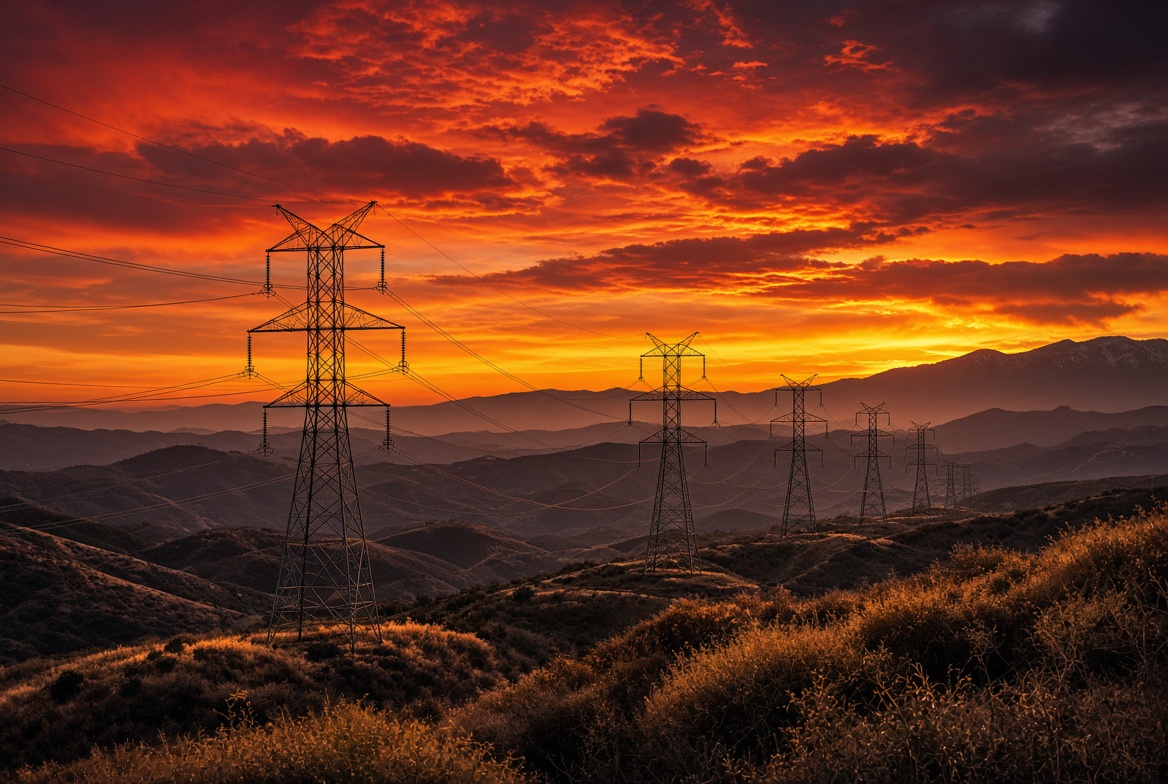
Southern California utilities are warning tens of thousands of customers that power may be cut this weekend as a late-season heat wave and elevated fire weather follow the second-hottest September on record in a key energy-trading metric for the U.S. West.
Edison International’s Southern California Edison (SCE) is considering preventive Public Safety Power Shutoffs (PSPS) on Friday and Saturday for 9,990 customers in Riverside County, south of the San Bernardino National Forest. Sempra’s San Diego Gas & Electric (SDG&E) has notified more than 35,000 customers in foothill and mountain communities that shutoffs could begin as early as Friday morning and run into Monday. Together, nearly 45,000 customer accounts are under notice. These are deliberate de-energizations meant to keep utility equipment from sparking a wildfire in dry, windy conditions—not resource-adequacy blackouts—but they land on the same customers already facing triple-digit heat.
Areas on notice
Bloomberg reported October 1 that SCE is reviewing shutoffs for the Riverside County circuits south of the San Bernardino National Forest for Friday and Saturday. SCE’s public PSPS page has at times shown zero customers under active consideration as forecasts shift, which is normal for these events: scope can expand or shrink with wind and humidity updates, and notices often go out 24 to 72 hours ahead.
SDG&E’s seven-day outlook posted PSPS warnings for October 2, 3, and 4. Local reporting listed communities that received notices, including Alpine, Boulevard, Campo, Descanso, El Cajon, Fallbrook, Jamul, Julian, Lakeside, Pala, Pauma Valley, Pine Valley, Poway, Ramona, Ranchita, Santa Ysabel, Valley Center, and Warner Springs, plus several tribal communities. SDG&E said the measure is aimed at reducing wildfire risk during the heat wave and Santa Ana wind potential. An extreme heat watch covers San Diego County coastal areas and valleys from Friday into mid-week, with the National Weather Service expecting about 90 degrees near the coast and upper 90s to 100s in the valleys.
Separately, residents in parts of Santa Barbara County have also received SCE notices about possible intentional shutoffs during high winds and fire weather earlier in the week, underscoring that PSPS risk is spread across SCE’s high-fire-threat territory, not limited to one county.
Weather backdrop
Bloomberg’s October 1 piece, “US West Stays Warm After Second-Hottest September on Record,” ties the shutoff watch directly to the heat. The West is opening October well above normal after September ranked as the second-hottest on record in a temperature metric widely used by energy traders and meteorologists. Triple-digit readings are expected across parts of Southern California this weekend, drying fuels and raising the chance that wind-blown debris contacts lines. A separate PRISM analysis cited by The Washington Post ranked September 2026 as the warmest September for the contiguous United States since at least 1895, so the ranking depends on the dataset—but both point in the same direction for late-season fire weather in the Southwest.
California’s generation mix
The shutoffs are a wildfire-mitigation tool, not a statement that the grid is short of megawatts. Still, the state’s fuel mix shapes how heat waves stress the system when power stays on, and how customers experience outages when it does not.
California Energy Commission in-state generation data for 2025 (about 205,132 GWh) show:
- Natural gas: 73,750 GWh (roughly 36 percent)
- Solar PV: 53,642 GWh, plus 1,886 GWh solar thermal (about 27 percent combined)
- Large and small hydro: 27,542 GWh (about 13 percent)
- Nuclear (Diablo Canyon): 17,575 GWh (about 9 percent)
- Wind: 15,172 GWh (about 7 percent)
- Geothermal: 10,908 GWh (about 5 percent)
- Biomass and other: remainder, with coal under 0.2 percent
- A rolling 12-month view through mid-2026 (US Power Gauge, August 2025–July 2026) puts natural gas at 33.8 percent, solar at 28.7 percent, hydro at 13.1 percent, nuclear at 9.2 percent, and wind at 8.1 percent, with renewables near 57 percent and carbon-free sources (renewables plus nuclear) near 67 percent of in-state generation. Imports still cover a large share of California consumption—on the order of one-fifth in recent tallies—so the in-state mix is not the full supply picture.
Gas remains the largest single source and the main flexible resource when solar drops in the evening. Solar’s rise has cut daytime fossil burn, but a multi-day heat event with possible PSPS in the foothills still leaves coastal and valley load centers dependent on gas, hydro, nuclear, storage, and imports. Diablo Canyon’s federal licenses were renewed in 2026 through the mid-2040s, while state law currently caps operation at 2030.
How many people could be affected?
The immediate notice covers about 9,990 SCE accounts and more than 35,000 SDG&E accounts—roughly 45,000 customer accounts. That is a small slice of SCE’s roughly 5 million accounts (about 15 million residents) and of SDG&E’s base, but it is concentrated in high-fire-risk foothill and mountain circuits where alternatives are limited.
SCE has said more than a quarter of its service area, about 14,000 of 50,000 square miles, sits in high-fire-risk territory, covering about 1.3 million accounts and roughly 3.9 million residents on circuits that can be in scope for PSPS. The utility’s 2026 pre-season materials warned that events could start earlier, last longer, and reach more customers, including some with little prior experience. A customer account is not a headcount: households, small businesses, medical-baseline customers, and tribal communities are all in the notice pool. If shutoffs are called, duration often runs more than 24 hours because lines must be patrolled before re-energization.
How U.S. consumers should prepare for more blackouts
PSPS-style shutoffs are most common in California, but deliberate de-energization for fire risk has also appeared in other Western states, and weather-driven outages are rising nationally. Preparation is local and practical.
- Alerts first. Enroll in utility outage and PSPS notifications by text, email, and voice. In SCE territory, that is sce.com/pspsalerts; SDG&E customers should confirm contact data in their account. Do not rely on a single channel.
- Medical and access needs. If someone in the home uses powered medical equipment, register as a medical-baseline or access-and-functional-needs customer and identify a backup site (family, cooling center, or hospital plan). Keep a paper list of medications and device settings.
- 72-hour home kit. Water (one gallon per person per day), non-perishable food, flashlights, batteries, a battery- or hand-crank radio, phone power banks, cash, and prescriptions. Refrigerators stay cold longer if left closed; freeze water bottles ahead of a warned event to extend cooler time.
- Backup power with clear rules. Portable power stations cover phones, CPAP machines, and routers for a day or two. Fuel-powered generators must stay outdoors, away from windows, with carbon-monoxide alarms inside. Never back-feed a panel without a transfer switch. Solar-only systems without batteries do not run during a grid shutoff.
- Heat-specific planning. In a PSPS that coincides with extreme heat, identify community cool zones before the power goes out. Charge devices and pre-cool the house if a shutoff window is announced.
Know the difference. A PSPS is a planned safety cut on specific circuits. A grid emergency is a shortage of supply. Both can leave you dark; only the first usually comes with a day or two of notice. Treat every warned event as if it will be called.
Utilities continue to harden lines—covered conductor, selective undergrounding, vegetation clearance, and weather stations—but SCE and regulators have been clear that equipment risk will not go to zero. For customers in the wildland-urban interface, backup power and a notification habit are now part of the summer and fall routine.
Making Appendices Great Again
Check out the World’s Greatest Podcast Show Notes at EnergyNewsBeat.co or EnergyNewsBeat.com.
Appendix: Sources and Links
- Bloomberg, “US West Stays Warm After Second-Hottest September on Record” (October 1, 2026), including Southern California shutoff details: https://www.bloomberg.com/news/articles/2026-10-01/us-west-stays-warm-after-second-hottest-september-on-record?srnd=phx-industries-energy
- FOX 5 San Diego, “Extreme heat wave brings potential power shutoffs to San Diego communities” (October 1, 2026), community list and SDG&E notice count: https://fox5sandiego.com/news/local-news/san-diego/sdge-potential-power-shutoffs-heat-wave/
- SDG&E Public Safety Power Shutoff information and seven-day outlook: https://www.sdge.com/wildfire-safety/psps-more-info
- SCE Public Safety Power Shutoff page: https://www.sce.com/outages-safety/outage-preparedness/outage-types/public-safety-power-shutoff-psps
- SCE 2026 PSPS customer newsletter (high-fire-risk areas): https://www.sce.com/sites/default/files/outage-safety/PSPS/G26-000%202026%20SCE%20PSPS%20Newsletter%20HFRA_060326_WCAG.pdf
- California Energy Commission, Electric Generation Capacity and Energy (in-state generation by fuel, 2025): https://www.energy.ca.gov/data-reports/energy-almanac/california-electricity-data/electric-generation-capacity-and-energy
- US Power Gauge, California electricity generation by source (12 months ending July 2026): https://uspowergauge.com/fuel-mix/california
- The Washington Post, contiguous U.S. warmest September on record (PRISM, October 1, 2026): https://www.washingtonpost.com/weather/2026/10/01/us-just-experienced-its-warmest-most-humid-september-record/
- Yahoo News summary of SCE Santa Barbara-area notices and customer reaction (October 1, 2026): https://www.yahoo.com/news/us/articles/california-residents-warning-intentional-sce-074700695.html