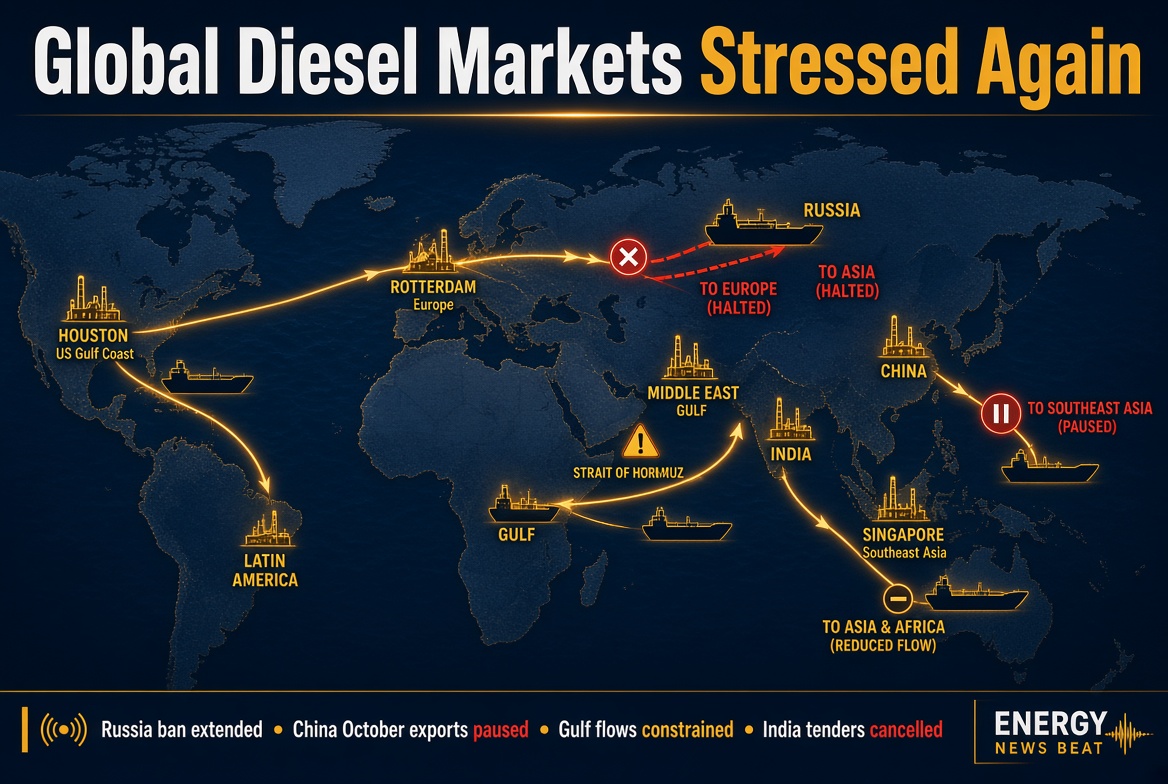
China is once again withholding refined products from the global market, layering fresh stress onto an already strained diesel complex. On October 1, 2026, trade sources reported that Chinese refiners have suspended oil-product exports for October to destinations other than Hong Kong and Macau, pending new guidance from Beijing.
State-owned major PetroChina has canceled planned gasoline and jet-fuel cargoes. The move coincides with Russia’s extension of its producer diesel-export ban through October 31, constrained Middle East product flows, and a deadly fire at an Indian export refinery that has already prompted canceled tenders.
The sequence was flagged the same day by commodity analyst Jack Prandelli, who noted that the major swing suppliers of products are holding back at once: Russia’s ban remains in force, Gulf product exports are running well below pre-war levels, and China has paused again. Gasoline and diesel stocks inside China have fallen to multi-year lows, according to market consultants cited in the discussion.
Global Diesel Demand by Key Regions
Diesel and gasoil account for roughly 28–30 percent of global oil demand and remain the workhorse fuel for freight, agriculture, industry, and, in some markets, heating. OECD gasoil/diesel demand has hovered near 13 million barrels per day (mb/d) in recent IEA tallies, with the Americas near 5.3 mb/d, Europe near 5.9 mb/d, and OECD Asia-Oceania near 1.8 mb/d. Non-OECD demand is greater and more growth-oriented in normal years, led by Asia.
China’s road-fuel demand is an exception in 2026. Kpler estimates Chinese gasoline and diesel demand will fall by roughly 440 thousand barrels per day (kb/d) this year, with electric vehicles and LNG/NEV heavy trucks displacing about 650 kb/d of gasoline and 680 kb/d of diesel. High prices have accelerated that shift. India’s diesel demand, by contrast, has been strong enough to push domestic refiners to prioritize diesel over jet fuel. Europe and the United States remain large absolute consumers; U.S. distillate product supplied has stayed near seasonal norms even as prices ration some discretionary use. OPEC’s longer-term outlook still shows gasoil/diesel as one of the larger sources of incremental oil demand through 2050, concentrated outside the OECD.
Who Can Still Export Diesel
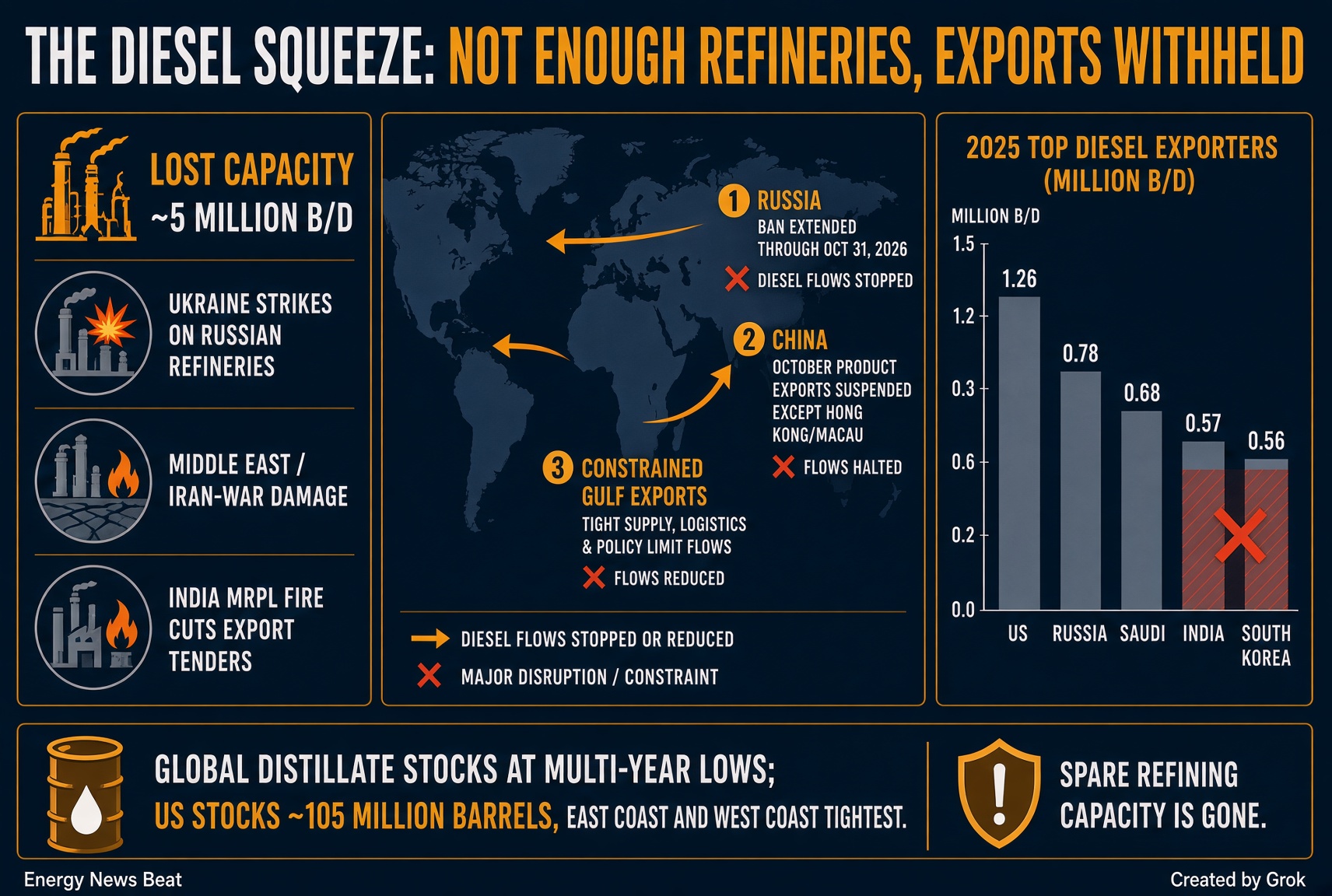
In 2025, before the current round of bans and outages, global diesel exports averaged about 8.2 mb/d, according to JODI/OPEC data compiled by Visual Capitalist. The top suppliers were:
- United States: 1.26 mb/d (15.4 percent)
- Russia: 783 kb/d (9.5 percent)
- Saudi Arabia: 678 kb/d (8.3 percent)
- India: 567 kb/d (6.9 percent)
- South Korea: 561 kb/d (6.8 percent)
- The Netherlands, Singapore, Kuwait, Belgium, and Germany rounded out the next tier. Europe as a region accounted for about 35 percent of exports (Russia supplying more than a quarter of that total), Asia-Pacific 29 percent, North America 18 percent, and the Middle East 15 percent.
Those rankings are now heavily distorted. Russia, normally the second-largest seaborne supplier, has repeatedly extended export restrictions. On September 30, the government prolonged the ban on diesel, marine fuel, and gasoil exports by producers through October 31, citing domestic harvest demand and the need to rebuild stocks after Ukrainian strikes on refineries. A separate ban on non-producer exports runs into early 2027. Pre-ban, Russian diesel represented roughly 10 percent of global seaborne supply. Middle East product exports have fallen due to refinery damage and shipping constraints linked to the Iran conflict; industry estimates place Gulf product flows well below pre-war levels. The United States remains the largest exporter, but East and West Coast inventories are tight and political discussion of export limits has intensified. South Korea, Singapore, and remaining Middle East plants with operable capacity are the clearest incremental suppliers, yet freight rates and crude availability limit how quickly they can fill the gap.
China’s October Pause
Beijing restricted clean-product exports in March after the Iran war disrupted Middle East crude flows, then eased controls from July. August shipments of refined products reached 6.01 million tonnes, up 12.7 percent year-on-year, with diesel exports at 1.33 million tonnes (up 42 percent) and jet fuel at a monthly record of 2.55 million tonnes. September loadings were still substantial—trade estimates cited roughly 1.4 million tonnes of diesel—before the October suspension.
Sources told Reuters and other outlets that refiners received no green light for October exports beyond Hong Kong and Macau as the Golden Week holiday began. PetroChina canceled cargoes it had committed in recent weeks. Commercial diesel and gasoline inventories sit below the levels Beijing has previously treated as a precondition for freer exports (Kpler has put the diesel shortfall near 20 million barrels relative to that threshold). Asian diesel cracks rebounded toward $75 per barrel on the news, with October–November spreads widening. Whether the halt is only a holiday pause or a policy extension into the fourth quarter will determine how much additional length China can offer a market already missing Russian and Middle Eastern barrels.
India’s High Runs and the MRPL Fire
Indian refiners have been operating at 105–108 percent of nameplate capacity for much of the past six months, according to a Mangalore Refinery and Petrochemicals (MRPL) official speaking at APPEC, prioritizing diesel. That utilization left little spare capacity when an incident hit MRPL’s complex.
On September 30, a high-pressure cold separator ruptured in the coker hydrotreater unit at MRPL’s Mangaluru refinery, triggering a fire that killed one contract worker and injured others. The unit was isolated, and the fire was extinguished within about two and a half hours. Bloomberg and Indian business media reported that MRPL subsequently lowered rates at a 60,000 b/d crude distillation unit while damage was assessed and canceled spot export tenders for diesel, jet fuel, and reformate in order to prioritize domestic supply. The company has said the rest of the refinery continues to run and that overall impact is limited, but any prolonged loss of export barrels removes another supplier from an already short Asian and global pool. A reply to Prandelli’s post noted that India had also moved to cancel diesel and jet exports in the immediate aftermath.
U.S. PADD Inventories and Prices
EIA data for the week ending September 25, 2026, showed U.S. distillate stocks at 105.2 million barrels, about 13 percent below the five-year average for the week and among the lowest seasonal readings in decades. Regional breakdown:
- East Coast (PADD 1): 21.9 million barrels, roughly 31 percent below the five-year norm and near historic lows for the date. All three sub-regions (New England, Central Atlantic, Lower Atlantic) are tight.
- Midwest (PADD 2): 25.9 million barrels, about 14 percent below the five-year average; a sizable weekly draw left stocks lean heading into harvest.
- Gulf Coast (PADD 3): 43.9 million barrels, essentially in line with or slightly above the five-year average—the only large buffer and the source of most U.S. diesel exports.
- Rocky Mountain (PADD 4): 3.2 million barrels, about 12 percent below normal; the region is small and pipeline-constrained.
- West Coast (PADD 5): 10.2 million barrels, about 14 percent below normal and among the lowest readings in years.
On-highway diesel prices for the week of September 28 (EIA) reflected that split. The national average was $6.382 per gallon, up more than $2.60 from a year earlier. Regional averages: - Lower Atlantic $5.953, Gulf Coast $5.955, East Coast $6.137 (New England $6.510, Central Atlantic $6.531), Rocky Mountain $6.407, Midwest $6.526, West Coast $7.357, and California $8.181. The coasts, which rely more on imports or long-haul movements, carry the largest premiums.
Summary: Analyst Views on U.S. Diesel Prices by Region
The EIA’s September Short-Term Energy Outlook projected U.S. distillate inventories to fall below 100 million barrels and remain below the five-year low through the end of 2026 and most of 2027. It estimated average retail diesel at $5.07 per gallon for 2026, and $4.40 in 2027, with crack spreads above $2 per gallon from August through November before easing—assuming a relatively prompt normalization of Strait of Hormuz traffic and a gradual return of Middle East distillate exports. Those assumptions look optimistic against the October China pause, the extended Russian ban, and ongoing refinery outages; realized pump prices in late September already sat well above the annual average implied by the outlook.
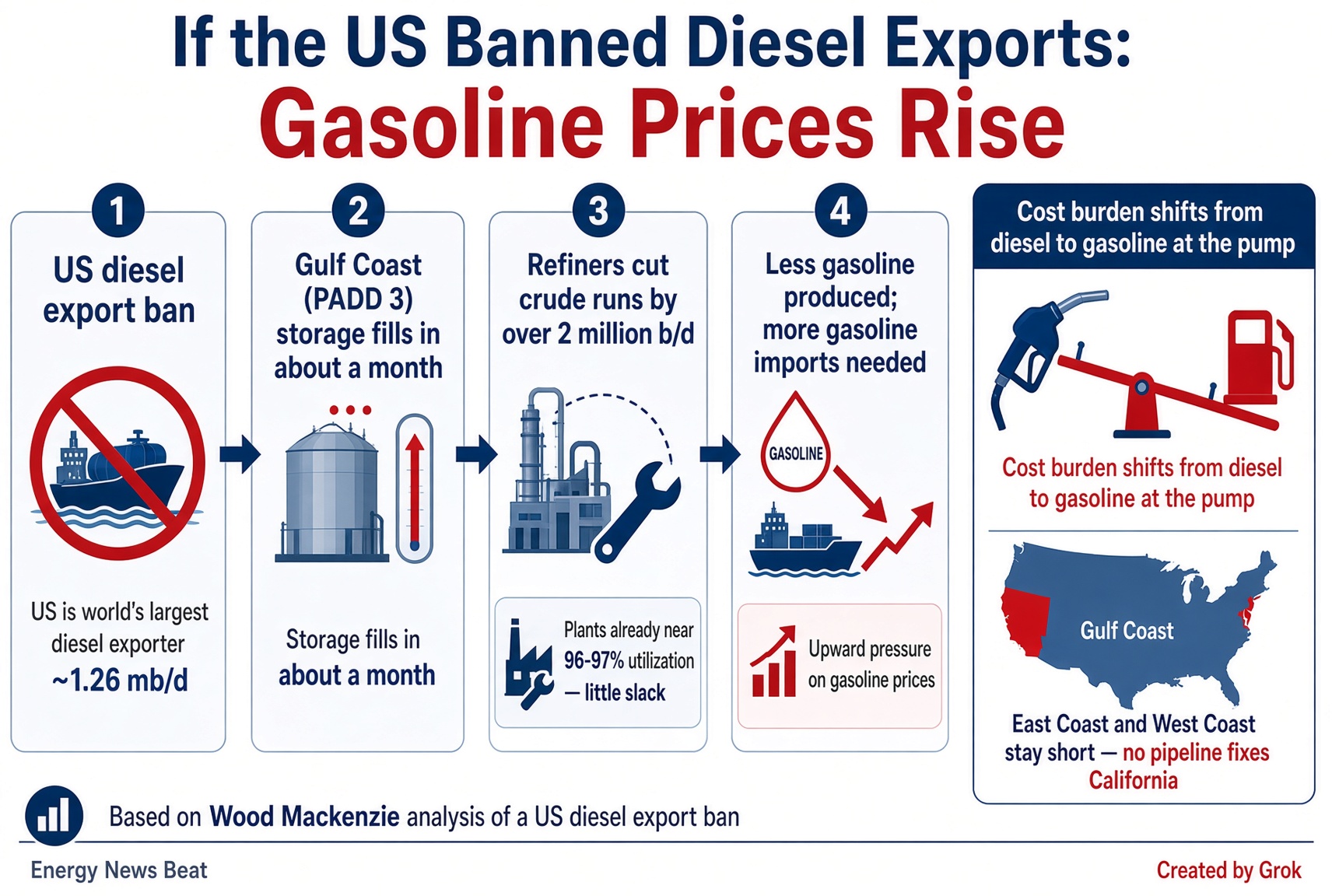
Regional differentials are expected to persist. East Coast stocks are the structural weak point; New York Harbor ULSD futures have priced a decline into 2027, but the curve still embeds a premium while inventories remain near record seasonal lows. Midwest prices have tracked the national spike and face harvest demand against lean stocks, though the region is better supplied than the coasts on a year-ago basis. Gulf Coast prices are the lowest among the major PADDs and would be the first to soften if exports were restricted—Wood Mackenzie has warned that a U.S. diesel export ban would quickly fill PADD 3 storage, force crude-run cuts, and risk shifting the cost burden onto gasoline. West Coast and California prices remain the highest, widened by isolation from Gulf refining capacity and local inventory tightness; no pipeline link means export policy cannot readily relieve California. Analysts broadly see the global diesel shortage extending into 2027 unless Russian refining capacity is restored, Middle East flows normalize, and China resumes meaningful exports. Until then, U.S. regional prices are likely to stay elevated, with the East Coast and West Coast most exposed to further supply shocks.
What if the US were to listen to the incompetent political leaders asking for a ban on diesel?
They do not realize that it would backfire and cost consumers more money, and negatively impact the Energy Dominance messaging and even so far as the U.S. Dollar. The shift goes from diesel to gasoline and jet fuel. This also raises the real economic problem. The Fed. The Fed raised rates, and historically, in energy crises, when they raise rates to curb inflation, recessions happen. They need to lower rates to offset the supply problems. They have it 100% backward. Buckle up. Just Saying.
Making Appendices Great Again
Check out the World’s Greatest Podcast Show Notes at EnergyNewsBeat.co or EnergyNewsBeat.com.
Appendix: Sources
- Jack Prandelli post on China’s October export suspension: https://x.com/jackprandelli/status/2105540326521729286
- Reuters, “Russia extends diesel export ban until end of October” (Sept. 30, 2026): https://www.reuters.com/business/energy/russia-extends-diesel-export-ban-until-end-october-2026-09-30/
- Bloomberg, “Russia Extends Diesel-Export Ban as Global Supply Squeezed” (Sept. 30, 2026): https://www.bloomberg.com/news/articles/2026-09-30/russia-extends-diesel-export-ban-by-a-month-through-october
- OilPrice.com, “Russia Extends Diesel Export Ban Through Oct. 31”: https://oilprice.com/Latest-Energy-News/World-News/Russia-Extends-Diesel-Export-Ban-Through-Oct-31.html
- MarketScreener / Reuters reporting, “Chinese refiners suspend October fuel exports, one cancels cargoes” (Oct. 1, 2026): https://hk.marketscreener.com/news/chinese-refiners-suspend-october-fuel-exports-one-cancels-cargoes-sources-say-ce785ad3dd8efe24
- Reuters, “China maintains stable refined fuel exports under relaxed controls” (Sept. 2, 2026): https://www.reuters.com/business/energy/china-maintains-stable-refined-fuel-exports-under-relaxed-controls-sources-say-2026-09-02/
- Reuters, “China’s August refined fuel exports exceed pre-Iran war levels” (Sept. 18, 2026): https://www.reuters.com/business/energy/chinas-august-refined-fuel-exports-exceed-pre-iran-war-levels-jet-fuel-exports-2026-09-18/
- Energy Connects / Bloomberg, “Shrinking China Fuel Stockpiles Raise Chance of Export Curbs” (Sept. 16, 2026): https://www.energyconnects.com/news/oil/2026/september/shrinking-china-fuel-stockpiles-raise-chance-of-export-curbs/
- Kpler, “China’s road fuel demand displacement reaches 1.3 Mbd in 2026”: https://www.kpler.com/blog/chinas-road-fuel-demand-displacement-reaches-1-3-mbd-in-2026-as-high-prices-accelerates-technology-shift
- Visual Capitalist / JODI-OPEC, top diesel exporters 2025: https://www.visualcapitalist.com/ranked-countries-that-use-the-most-diesel-per-capita/ (related export ranking coverage)
- Economic Times / Reuters, India’s refineries at 105–108 percent (Sept. 2026): https://m.economictimes.com/industry/energy/oil-gas/indias-refineries-operating-at-105-to-108-of-capacity-mrpl-official-says/articleshow/133954441.cms
- OilPrice.com, “India’s Refineries Run at Up to 108% as Diesel Demand Surges”: https://oilprice.com/Latest-Energy-News/World-News/Indias-Refineries-Run-at-Up-to-108-as-Diesel-Demand-Surges.html
- BusinessToday, “MRPL cuts processing rate at one CDU after fire” (Oct. 1, 2026): https://www.businesstoday.in/markets/stocks/story/mrpl-cuts-processing-rate-at-one-cdu-after-fire-damages-refinery-unit-report-558974-2026-10-01
- OilPrice.com, “Deadly Blast Hits Major Indian Refinery”: https://oilprice.com/Latest-Energy-News/World-News/Deadly-Blast-Hits-Major-Indian-Refinery-as-Fuel-Markets-Tighten.html
- Sahi Markets, “MRPL Cancels Export Tenders After Fire Incident” (Oct. 1, 2026): https://www.sahi.com/news/mrpl-cancels-export-tenders-after-fire-incident-sees-no-significant-impact
- EIA Weekly Petroleum Status Report, distillate stocks by PADD (week ending Sept. 25, 2026): https://www.eia.gov/dnav/pet/pet_sum_sndw_a_epd0_sae_mbbl_w.htm and https://ir.eia.gov/wpsr/table4.csv
- EIA weekly on-highway diesel prices by PADD (week of Sept. 28, 2026): https://agtransport.usda.gov/Fuel/Weekly-On-Highway-Diesel-Fuel-Prices/x88w-atzp and https://weeklydiesel.com/
- EIA Short-Term Energy Outlook, distillate inventories and diesel price forecast (September 2026): https://www.eia.gov/outlooks/steo/report/petro_prod.php
- Reuters, “Global diesel shortage likely to last into 2027” (Sept. 21, 2026): https://www.reuters.com/business/energy/global-diesel-shortage-likely-last-into-2027-storage-tanks-drain-2026-09-21/
- Wood Mackenzie analysis of a potential U.S. diesel export ban (via Tanks and Terminals, Oct. 1, 2026): https://www.tanksterminals.com/storage-tanks/25092026/wood-mackenzie-us-diesel-export-ban-would-trigger-global-stock-drawdowns-cut-us-refinery-utilisation-and-risk-driving-gasoline-prices-higher/
- IEA Oil Market Report commentary on the diesel squeeze (summarized via World Ports Organization): https://www.worldports.org/iea-intensifying-diesel-squeeze-reflects-disruptions-to-oil-product-supplies/