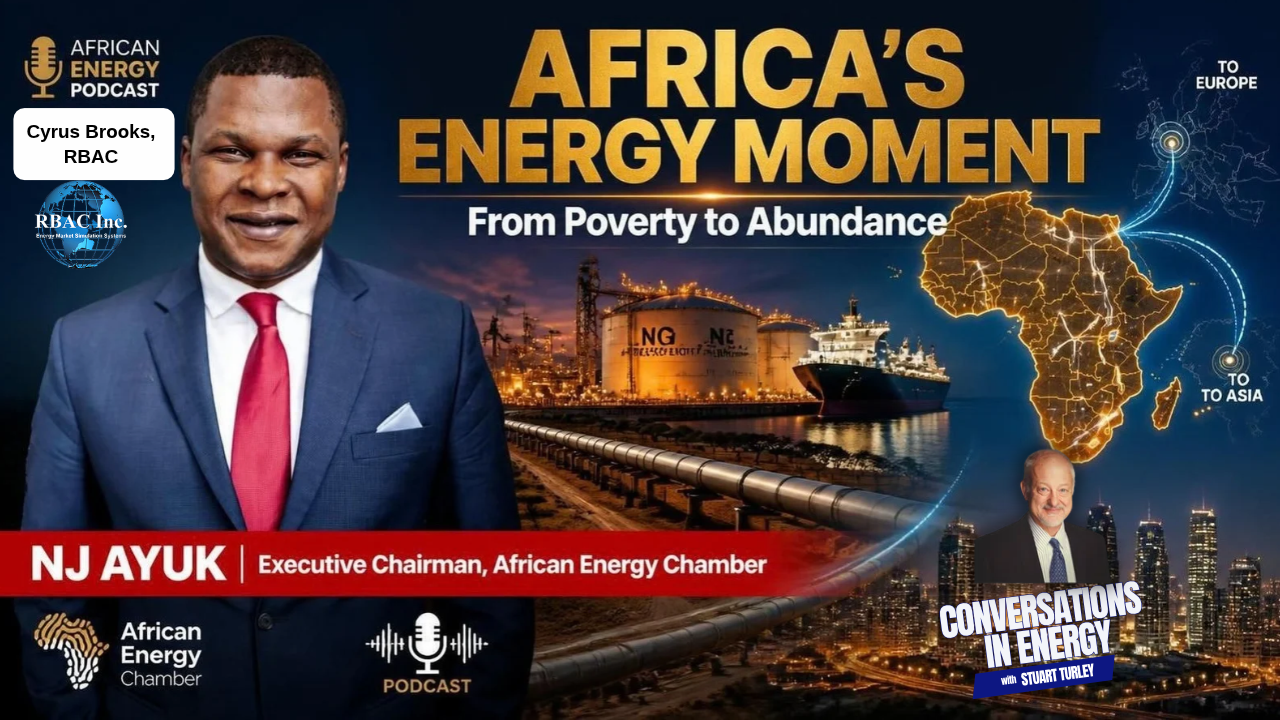
Cyrus Brooks of RBAC and NJ Ayuk, Executive Chairman of the African Energy Chamber, stopped by the Energy News Beat podcast.
In this episode of the Energy News Beat Podcast, host Stu Turley sits down with two influential voices in global energy: Cyrus Brooks of RBAC and NJ Ayuk, Executive Chairman of the African Energy Chamber. Against the backdrop of unprecedented global energy market disruptions—from geopolitical tensions in the Strait of Hormuz to Europe’s energy crisis and California’s refinery collapse—the conversation pivots to an often-overlooked opportunity: Africa’s potential to reshape global energy security.
NJ Ayuk makes a bold case for why Africa must move beyond simply exporting raw resources and instead build refining capacity, power data centers, and leverage its vast natural gas reserves to lift 600 million people out of energy poverty. The discussion challenges conventional climate narratives, exposes the barriers created by regulatory overreach and ideological financing restrictions, and outlines a vision for African energy abundance that benefits not just the continent, but the entire world. This is a conversation about pragmatism, market-driven solutions, and the urgent need for Africa to seize its moment on the global energy stage.
Check out the African Energy Chamber here: https://energychamber.org/
Buy his latest book here: https://a.co/d/0cQzxcLD
Check out RBAC: https://rbac.com/
Connect with Cyrus on his LinkedIn: https://www.linkedin.com/in/cyrus-brooks-03274713/

1. Global Energy Market Disruptions & Geopolitical Impacts
2. Africa’s Emerging Role in Global Energy Security
3. Underinvestment in Oil, Gas & Refineries
4. Regulatory Overreach & Permitting Delays
5. Energy Poverty & Clean Cooking Crisis
6. Natural Gas as a Bridge Fuel & Peace Tool
7. Data Centers & AI as Economic Leapfrog Opportunity
8. Financing Challenges & World Bank Ideology
9. Market-Driven Policies vs. Socialist Approaches
10. Africa Energy Week & Continental Integration
11. Lawfare & Climate Activism as Barriers
12. Intra-African Trade & Private Capital
This podcast presents a compelling case for Africa’s energy sovereignty and economic development through pragmatic energy policies.
Show Notes from Cyrus Brooks At RBAC.
Structurally, the world is moving into its largest liquefaction expansion cycle. The IEA identified about 345 bcm per year of post-FID capacity due online from 2025 through 2030, climbing from roughly 35 bcm of additions in 2025 toward a peak near 95 bcm in 2028. More than 100 bcm per year of capacity was sanctioned in 2025 alone. Golden Pass has begun producing in Texas; LNG Canada has now approved a second phase that would double capacity from 14 to 28 mtpa; U.S. developers continue building and sanctioning capacity. [8]
The disrupted market is almost the opposite. In its third-quarter 2026 gas report, the IEA estimated that from March through June, Qatar and UAE LNG loadings were about 35 bcm lower year-on-year. Increased LNG from outside the Gulf offset about three-quarters of that loss, but global LNG production still fell around 4% during that period. For full-year 2026, the IEA projected combined Qatari/UAE LNG supply roughly 54 bcm below 2025, largely offset by North American, African and Australian growth. [9]
There is an important caveat for the podcast: the IEA baseline assumed normalization of Hormuz during the third quarter. It is September 29, and that normalization has not happened. The downside to Gulf supply is therefore greater than the comfortable reading of the IEA forecast might suggest. [10]
Qatar matters enormously because it was simultaneously expected to be one of the principal sources of the next global supply wave. QatarEnergy now says conflict-related damage could delay portions of North Field East, and repair work on damaged LNG capacity may take years. That does not eliminate Qatar as a formidable competitor, but it changes the risk perception around concentration of supply in the Gulf. [11]
Oil is less central to Cyrus’s role but provides context. Gulf producers have demonstrated more ability than LNG producers to bypass Hormuz: Saudi Arabia restarted its East-West Pipeline and increased loadings through Yanbu on the Red Sea, helping Middle Eastern oil exports recover toward pre-conflict levels. LNG cannot so easily reroute pipeline-fed Qatari production to another ocean terminal. [12]
The implication for Africa is subtle: Hormuz makes geographically diversified African LNG more valuable now, while the 2028–2032 global capacity wave makes high-cost, late African LNG less attractive later. The projects with the best prospects are therefore those that are already sanctioned, use existing infrastructure, employ repeatable floating-LNG designs, have strong resource economics, or can generate value in domestic markets as well as exports.
That is why a project such as Coral North looks qualitatively different from a greenfield $40-billion-plus LNG complex. Eni is repeating a proven floating design in an existing basin and targets 2028. Tanzania, by contrast, is attempting a huge greenfield development into a market that may look very different when it finally starts producing. [13]
The projects that actually matter
Tanzania shows the other side of the equation. It has roughly 47 trillion cubic feet of gas behind a proposed $42 billion LNG development, but the project is still pre-FID, with important fiscal and legal work unfinished. Even with near-term agreements, the briefing sees a realistic start around 2034 or later. That matters because Tanzania wouldn’t be entering today’s LNG market—it would be entering a future market potentially crowded with new supply. Nigeria’s challenge is different. NLNG Train 7 is designed to lift capacity from roughly 22 to 30 million tonnes per year, but the newly sanctioned Ima development will provide 350 million cubic feet of gas per day, only about a third of Train 7’s feed requirement. That makes Nigeria a great example of why enormous reserves and liquefaction capacity aren’t enough: the upstream fields, pipelines, and LNG plant all have to arrive in sync.
Then there are projects where the development story may be even more interesting than the LNG story. Angola’s New Gas Consortium is already producing, marking the country’s first non-associated-gas development and creating opportunities not only for Angola LNG but for domestic uses such as fertilizer. Congo LNG Phase 2 is also operating, bringing the project to roughly three million tonnes per year, while gas simultaneously supports a power plant that represents around 70 percent of the country’s generation capacity. And Côte d’Ivoire may be the clearest domestic-gas case of all. Baleine Phase 3 was sanctioned in May 2026 and is designed to raise gas production to 200 million cubic feet per day—and 100 percent of that gas is intended for the domestic market. That is a very different development model from simply producing LNG and putting it on a ship.
The broader takeaway is that Africa has substantial gas capacity moving forward, but the timing matters enormously. Greater Tortue Ahmeyim is already operating off Senegal and Mauritania, while Libya’s Structures A&E project still faces execution and political risk. Meanwhile, the really giant unsanctioned projects—especially Rovuma and Tanzania—could arrive only after a major wave of new global LNG supply. So the question isn’t simply which country has the most gas. It’s which projects can move quickly enough, manage security and financing risk, secure the necessary infrastructure and customers, and—most importantly—turn those molecules into something more than export revenue: reliable electricity, fertilizer, industry, jobs and broader economic development.
Three projects deserve special attention.
First, Mozambique may become the defining African gas story of the next decade because three development models are running side-by-side: TotalEnergies’ giant conventional onshore plant, Eni’s repeatable FLNG, and ExxonMobil’s very large modular onshore concept. This gives NJ a perfect real-world basis for discussing security, scale, financing and sequencing.
Second, Nigeria’s problem is increasingly a full-value-chain problem rather than simply an LNG-plant problem. Ima will deliver 350 MMcf/d yet TotalEnergies says that represents only about one-third of Train 7’s feed requirement. Nigeria can have liquefaction hardware and enormous reserves and still underperform if upstream supply, pipelines, contracts and domestic markets are mismatched. [24]
Third, Côte d’Ivoire is arguably the most interesting development case, even though Baleine is not principally an LNG story. Eni says 100% of its gas goes into the local market, with Phase 3 taking output to 200 MMcf/d. In February 2026, Eni also announced Calao South, with preliminary estimates of up to 5 Tcf of gas plus substantial condensate. Côte d’Ivoire therefore has the possibility of building an expanding domestic-gas system rather than merely an export enclave. [25]
Two other countries belong in the discussion but for different reasons. Egypt has become a warning about resource decline: it has excellent LNG and gas infrastructure yet has had to procure large LNG volumes because domestic output fell. Eni’s just-sanctioned Cronos development in Cyprus—more than 3 Tcf, 500 MMcf/d targeted for 2028—will use Zohr infrastructure and Damietta LNG, demonstrating the value of existing infrastructure even when the molecule comes from another country. [26]
South Africa is the opposite: strong industrial demand but insufficient gas infrastructure. The proposed Zululand LNG terminal is estimated around $1 billion and ultimately 5 mtpa, but Vopak pushed its expected FID to the first quarter of 2028 after legal trouble surrounding Eskom’s proposed 3-GW gas power project. Since then Eskom has signed a supply agreement and ExxonMobil a preliminary LNG-supply agreement, so demand formation is progressing even while sanction remains distant. [27]
For oil, one Angola item is worth remembering: Azule sanctioned Greater PAJ in June 2026, targeting first oil in the first half of 2029, 95,000 barrels per day of FPSO capacity and 70 MMcf/d of gas exported into the Angola LNG system. It nicely illustrates why “oil versus gas” is often a false distinction in African infrastructure planning. [28]
From molecules to manufacturing
For gas-to-power, the resource can be the easiest component. A viable chain requires wells, gathering lines, processing, transportation, a power plant, transmission, paying customers and a utility or offtaker able to sign a credible long-term contract. A break anywhere in that sequence can make an otherwise attractive field uneconomic. South Africa’s current terminal/power sequencing problem is a useful example; Nigeria’s feedgas challenge is another. [29]
That is where the RBAC lens is genuinely useful. GPCM represents production, pipelines, storage, demand, capacity and prices in an integrated market framework; G2M2 extends that idea globally across LNG supply, liquefaction, shipping, regasification, contracts and spot trade. RBAC’s Gas4Power work also explicitly links gas prices with power-sector behavior. [30] The useful question for a government is therefore not simply, “Should we build this pipeline?” It is, “Under what combination of domestic demand, LNG prices, plant utilization, power-sector credit, competing infrastructure and delays does this pipeline still create value?”
For industrial development, Côte d’Ivoire, Nigeria, Angola and Egypt currently have the strongest combinations of gas, infrastructure and existing economic demand. Côte d’Ivoire’s advantage is explicit domestic gas allocation. Nigeria has enormous market scale, LNG, petrochemicals, fertilizer and LPG infrastructure, but also chronic execution and feedgas problems. Angola now has non-associated gas, Angola LNG and a policy objective to develop fertilizer and other domestic uses. Egypt has by far the deepest existing gas-processing and industrial infrastructure of the group, although declining domestic supply is now a major constraint. [31]
Mozambique and Tanzania offer larger transformational upside but greater “enclave risk.” A 13- or 18.6-mtpa LNG plant can generate taxes, foreign exchange, local procurement and jobs without necessarily creating a broad domestic gas market. The policy challenge is to connect the export project to affordable domestic molecules, transmission, fertilizer, industry and skills—without imposing obligations so onerous that the upstream/LNG project never gets financed.
Congo offers an interesting middle path. Eni has built export LNG while also supplying the Congo Power Plant, which it says represents around 70% of the country’s generation capacity. That does not prove the same model works everywhere, but it is exactly the example worth asking NJ to dissect. [32]
LPG deserves more airtime because it solves a different development problem. Nearly one billion Africans still lack clean-cooking access. LPG does not require waiting for a nationwide power grid or multi-billion-dollar transmission backbone; the infrastructure unit is storage, cylinders, distribution and working capital. At the 2025 Mission 300 summit, TotalEnergies described a $400 million clean-cooking/LPG initiative intended to reach 85 million Africans, illustrating the potential scale. [33]
Check out the World’s Greatest Podcast Show Notes at EnergyNewsBeat.co or EnergyNewsBeat.com, and the Energy News Beat Substack at:

A shout-out to Steve Reese and the Reese Energy Consulting group for sponsoring the Podcast https://reeseenergyconsulting.com/.
Data2 if you have any business systems, can you trust A? Well, they have the patent on validation. . https://data2.zoholandingpage.com/energy
And we have WellDatabase rolling, and we use their tools for the Energy News Beat weekly Rig Reports: https://welldatabase.com/
Also entering Sponsor Rey Trevino, Pecos Operating https://pecos.energy/