

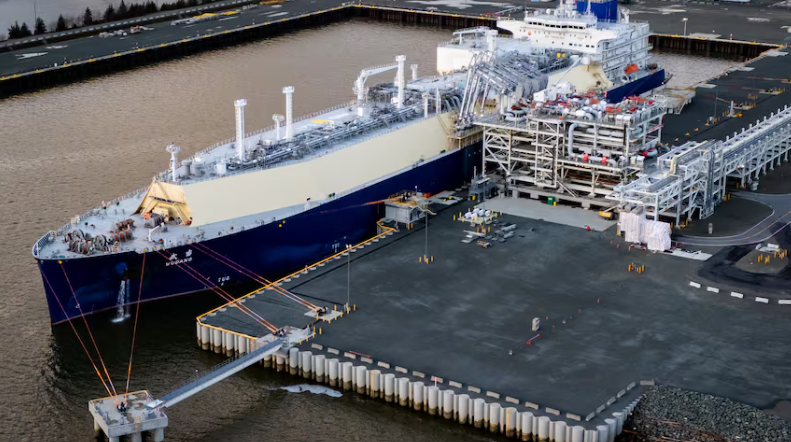
LNG Canada will again source major modules from a Chinese state-owned fabricator for its $33 billion Phase 2 expansion in Kitimat, B.C., even as Canadian primary steel producers idle lines and issue layoff notices under U.S. tariffs and persistent import pressure. Prime Minister Mark Carney has left the steel decision to the project owners while tightening quotas on foreign steel elsewhere and pursuing closer ties with the EU.
On September 28–29, 2026, the LNG Canada joint venture—Shell (40 percent), PETRONAS (25 percent), PetroChina (15 percent), Mitsubishi (15 percent), and KOGAS (5 percent)—took a final investment decision on Phase 2. The expansion adds two liquefaction trains, storage, and a loading berth, doubling nameplate capacity from 14 to 28 million tonnes per year. The federal government and project partners put the private investment at about $33 billion (roughly US$23 billion). Carney called it nation-building and said peak construction could support up to 4,000 jobs at the Kitimat site, with additional work on Coastal GasLink compressor stations. Permanent operating additions are far smaller: roughly 90 full-time roles and 150 contractor positions once complete, targeted for the early 2030s.
CBC News reported on October 2 that the joint venture will again buy large modules from China Offshore Oil Engineering Co. (COOEC), a unit of state-owned CNOOC. COOEC fabricated the Phase 1 process modules—35 modules totaling about 179,000 tons, delivered from its Qingdao yard. LNG Canada spokesperson Paul Hagel said the constraint is specialized fabrication capacity, not a preference for offshore steel: no Canadian yard can manufacture and deliver modules of this scale and complexity, and only five yards worldwide meet the requirements for space, quality systems, and marine access. Hagel added that new compressor stations on the pipeline are “targeting almost 15,000 tonnes of steel from Canadian suppliers or mills, representing approximately 70 per cent of the steel required for that work.”
Before the 2018 Phase 1 final investment decision, the project received a remission from anti-dumping and countervailing duties on fabricated industrial steel components from China. Officials at the time cited the absence of Canadian capacity and the risk that duties would affect the investment. Those duties later expired and were not renewed, so the same supplier path is open again. When asked at the announcement whether Phase 2 would use Canadian or Chinese steel, Carney said it was “a great question for the proponents” and that “there will be full opportunities to buy Canadian steel,” while adding that the choice was theirs.
Canadian mills under simultaneous pressure
The Kitimat decision lands while Canadian primary producers are losing their main export market. Canadian mills have historically sent more than half their output—and often over 90 percent of exports—to the United States. U.S. Section 232 tariffs on steel reached 50 percent in 2025. The Bank of Canada’s April 2026 Monetary Policy Report noted that steel exports have fallen by about half. A November 2025 Prime Minister’s Office backgrounder stated that employment in the steel sector had already dropped by roughly 1,000 jobs since the tariffs, against a base of about 23,000 direct steel jobs.
Concrete notices followed. In December 2025, Algoma Steel issued approximately 1,000 layoff notices tied to an accelerated shutdown of blast-furnace and coke operations in Sault Ste. Marie as it shifts to electric-arc production; the company had received substantial government financing partly to limit job losses. On September 28, 2026, Stelco (owned by Cleveland-Cliffs since a 2024 acquisition) said it would indefinitely idle cold-rolled and coated operations at Hamilton Works beginning around October 9, affecting up to 500 employees (union estimates put the Hamilton figure near 350). The company cited a nearly 25 percent drop in demand for those products in the second quarter of 2026 versus the 2024 quarterly average, plus continued import penetration. Carney called the Stelco move a betrayal of workers and pointed to employment-maintenance conditions attached to the Investment Canada Act approval of the Cleveland-Cliffs takeover. Energy News Beat covered the Stelco idling in detail on September 30.
Broader manufacturing payroll employment fell by 40,600 between December 2024 and December 2025, according to Statistics Canada, with durable-goods losses concentrated in Ontario. Earlier Energy News Beat reporting cited more than 51,000 manufacturing jobs shed in the twelve months after the first tariff wave, concentrated in Ontario’s auto and steel corridor, and economist Trevor Tombe’s estimate that the 50 percent tariffs put roughly 87,000 Canadian jobs at risk (about 52,000 direct).
Canada has responded with tighter tariff-rate quotas (non-free-trade-agreement partners cut to 20 percent of 2024 volumes, with a 50 percent surtax above quota), a 25 percent tariff on certain steel-derivative products, and melt-and-pour measures aimed at Chinese-origin content. Those steps have reduced some import volumes but have not restored the lost U.S. market.
Was the dumping and transshipment claim accurate?
Chinese steel overcapacity is long-standing and well documented. State-supported Chinese mills produce far more than domestic demand absorbs; the surplus is exported at prices that undercut producers in higher-cost jurisdictions, including Canada and the United States. OECD and industry data have repeatedly flagged global excess capacity measured in the hundreds of millions of tonnes, with China the largest source.
The narrower claim that Canada systematically served as a backdoor for Chinese steel into the United States is more contested. The Trump administration and U.S. industry witnesses have accused Canadian firms of transshipment or origin concealment. A May 2026 Justice Department settlement of $19 million with two Canadian companies resolved allegations (denied by the defendants) of failing to pay duties on steel from Asia and Europe, including China, and of alleged label removal. A White House report described a broader “Great Transshipment Scam” routing Chinese goods through third countries. Canadian Steel Producers Association representatives have rejected the premise that Canada is a dumping ground or transshipment hub, citing data that about 95 percent of steel shipped from Canada to the United States was melted and poured inside the USMCA region, and pointing to Canada’s own anti-dumping orders and surtaxes. Snopes reviewed the circulating social-media version of the claim and found company-level accusations and one settlement, but no court finding that the Canadian government itself ran a resale scheme.
Both things can be true at once: Chinese overcapacity and subsidized exports have pressured North American prices for years, isolated origin-fraud cases have occurred, and the integrated Canada–U.S. steel trade (largely North American melt-and-pour) has been disrupted by the 50 percent U.S. tariffs, producing measurable Canadian job losses and idled finishing capacity. The tariffs have also coincided with new U.S. mill investment announcements.
Carney’s alignment and the domestic gap
Carney’s government has advertised Buy Canadian preferences, quota tightening, and liquidity support for steel and lumber while simultaneously celebrating the LNG Canada expansion and pursuing deeper arrangements with the European Union, including discussion of an “associate” status built on CETA. On the flagship West Coast LNG project, the commercial decision remains with a consortium that includes a 15 percent PetroChina stake and that has already demonstrated it can obtain large modules from COOEC. The permanent operating jobs created in Kitimat are modest compared with the construction peak and the steel-sector losses already recorded in Ontario. Pipeline steel offers a partial offset; the core process modules do not.
LNG Canada’s capability argument is specific: Canada lacks yards that can build and load out modules of this size. That gap is real today. It is also the same gap cited for the Phase 1 duty remission. Whether policy treats that as a reason to keep importing finished modules from a Chinese state yard, or as a reason to build domestic heavy-fabrication capacity for the next round of energy projects, is the practical test of “Canada first” procurement on a $33 billion file.
Making Appendices Great Again
Check out the World’s Greatest Podcast Show Notes at EnergyNewsBeat.co or EnergyNewsBeat.com.
Appendix: Sources
- CBC News, Janyce McGregor, “LNG Canada to use Chinese steel on $33-billion expansion project in Kitimat, B.C.,” October 2, 2026: https://www.cbc.ca/news/politics/lng-expansion-chinese-steel-9.7366745
- Prime Minister of Canada, LNG Canada Phase 2 welcome, September 29, 2026: https://www.pm.gc.ca/en/news/news-releases/2026/09/29/prime-minister-carney-welcomes-lng-canada-phase-2-second-largest
- LNG Canada Phase 2 FID release, September 28, 2026: https://www.lngcanada.ca/news/lng-canada-announces-phase-2-final-investment-decision/
- LNG Prime, COOEC completion of Phase 1 modules (35 modules, 179,000 tons), March 2023: https://lngprime.com/contracts-and-tenders/chinas-cooec-wraps-up-lng-canada-module-job/75612/
- CBC News, Stelco Hamilton idling, September 28, 2026: https://www.cbc.ca/news/canada/hamilton/stelco-tariffs-trump-9.7361216
- CBC News, Algoma 1,000 layoff notices, December 2025: https://www.cbc.ca/news/canada/sudbury/northern-ontario-steel-mill-issues-layoff-notices-to-1-000-workers-9.6998768
- Prime Minister’s Office backgrounder on steel measures (≈1,000 steel jobs lost; quota changes), November 26, 2025: https://www.pm.gc.ca/en/news/backgrounders/2025/11/26/prime-minister-announces-new-measures-protect-and-transform-canadas
- Bank of Canada, Monetary Policy Report April 2026, steel export decline: https://www.bankofcanada.ca/publications/mpr/mpr-2026-04-29/in-focus-2/
- Statistics Canada, manufacturing payroll employment decline to December 2025: https://www.statcan.gc.ca/o1/en/plus/9099-manufacturing-labour-2025-losses-down-line-amid-trade-headwinds
- Energy News Beat, Stelco idling analysis, September 30, 2026: https://energynewsbeat.co/exports/what-is-the-real-story-on-the-stelco-plant-idling-and-job-losses-in-canada/
- Energy News Beat, manufacturing job losses and EU alignment context, September 16, 2026: https://energynewsbeat.co/manufacturing/canada-may-be-slow-walking-off-the-pirates-plank/
- Snopes, review of Canada–China steel transshipment claims, September 4, 2026: https://www.snopes.com/news/2026/09/04/canada-chinese-steel-us-tariffs/
- Fastmarkets, Canadian Steel Producers Association comments on transshipment, February 19, 2026: https://www.fastmarkets.com/insights/canada-not-a-dumping-ground-ortransshipment-hub/
- AP, Carney response to Stelco layoffs, September 29, 2026: https://apnews.com/article/carney-stelco-steel-layoffs-clevelandcliffs-trump-9cc6e6fdf2b5f8c2ee6f260c1547c45f

