

When the lights flicker, the bills spike, and the largest customer turns hostile, politicians who spent a decade blocking pipelines suddenly discover the language of urgency. That pivot is on full display this week in Massachusetts and Ottawa. Energy News Beat reported today that Massachusetts Governor Maura Healey has asked the Trump administration to accelerate a natural gas expansion she once treated as a résumé item. In Canada, Prime Minister Mark Carney is wordsmithing a West Coast oil line and a diplomatic hedge toward China and the European Union, while Premiers Doug Ford and Danielle Smith pitch an all-Canadian eastbound corridor that history suggests may never leave the feasibility stage.
The pattern is the same on both sides of the border. Pipelines were politically useful to oppose until the trade-and-reliability arithmetic stopped working.
Massachusetts asks the feds to step on the gas
On October 1, Healey wrote Energy Secretary Chris Wright urging federal agencies to clear reviews of Enbridge’s Algonquin Reliable Affordable Resilient Enhancement project, known as Project RARE, without delay. The roughly $300 million looping project would add about 75 million cubic feet a day in existing corridors in southeastern Massachusetts and Rhode Island. Eversource has ten-year contracts, approved by the state Department of Public Utilities in January, to buy the gas on behalf of customers. The developer, not ratepayers, funds the build. Planned in-service is 2028. Healey’s office puts the customer benefit at about $40 million a year, or roughly $400 million over a decade, by displacing higher-priced imported LNG at Everett.
The letter is framed as shared purpose. Healey reminded Wright of their “mutual desire to get more U.S. natural gas into New England to reduce reliance on higher-cost imported fuel and lower costs for customers.” She cast the request as part of an “all-of-the-above” mix.
The record is less flexible. As attorney general, Healey commissioned work arguing the state did not need new gas capacity and successfully challenged the Baker administration’s attempt to have electric ratepayers underwrite pipeline capacity. At a 2022 WBUR event, she said, “Remember, I stopped two gas pipelines from coming into this state.” The projects she opposed included Kinder Morgan’s Northeast Energy Direct and Spectra’s Access Northeast. In a December 2025 interview, she still called those earlier deals a “lousy deal” because ratepayers would have paid. Conservation Law Foundation responded to this week’s letter by calling the savings claim a “false narrative.”
The physical system has not changed its mind. Massachusetts generates far less electricity than it consumes. In-state utility-scale generation remains overwhelmingly natural gas. ISO New England still leans on gas for about half of net energy, and winter constraints force LNG sendout and oil-fired generation when pipelines are full, serving heating load. Residential prices in the state have run well above the U.S. average. The request landed about a month before the November 2026 election, against a Republican opponent arguing for more pipeline capacity. Energy News Beat’s October 2 write-up is the cleanest short account of the reversal: https://energynewsbeat.co/electrical-generation/massachusetts-gov-healey-to-feds-step-on-the-gas-after-years-of-bragging-she-stopped-the-pipelines/
Canada’s decade of canceled steel
Canada’s producers have lived this movie longer. Of the major oil lines proposed in the last decade and a half, only the Trans Mountain Expansion reached service, and only after Ottawa bought it.
Northern Gateway, Enbridge’s line to Kitimat, died in 2016 after a Federal Court of Appeal found consultation inadequate and the Trudeau government declined to appeal, then formally rejected the project while imposing a northern tanker moratorium. Energy East, TC Energy’s roughly C$15.7 billion Alberta-to-New Brunswick proposal, was canceled by the company in 2017 after regulatory scope expanded, Quebec opposition hardened, and crude prices weakened. Keystone XL was rejected by the Obama administration, revived under Trump, and had its presidential permit revoked by Biden on day one in 2021. Trans Mountain itself was estimated in the mid-single-digit billions when Ottawa bought the project for about $4.5–5 billion; the expansion finished near $34 billion, with some estimates still creeping higher. Court-ordered re-consultation, route changes, floods, labor, and compliance costs did most of the damage.
That history is the baseline for any new Canadian pipe, not a footnote.
Carney’s wording, and the customer he still needs
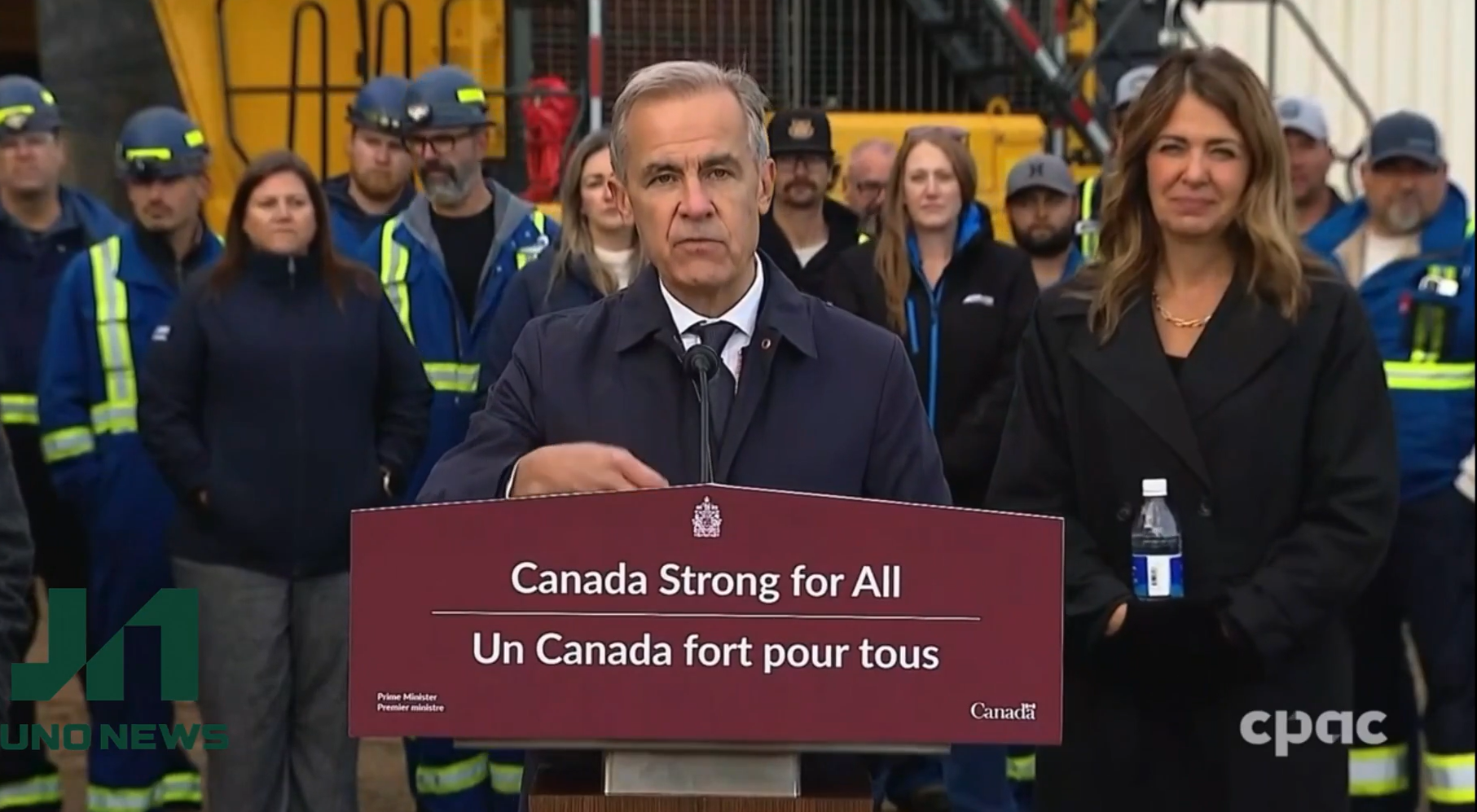
Carney’s response to the rupture with Canada’s largest energy customer has been a careful split. On October 1 he designated a new million-barrel-a-day line from the Edmonton area to a port near Delta, British Columbia — now named Pacific Link — a project of national interest under the Building Canada Act. The pitch is strategic autonomy: roughly 90 percent of Canadian oil exports still go to the United States, and a Pacific outlet plus Trans Mountain optimization could cut fixed pipeline dependence on the U.S. market. Approvals are supposed to be settled by September 1, 2027, with a target in-service around 2032–33. Cost estimates run about C$35.2 billion to C$43.7 billion. Ownership, as announced, is heavily public: Alberta and the federal Trans Mountain Corporation at 45 percent each through construction, Pembina at 10 percent, with Indigenous equity offered via loan guarantees. The climate language is attached rather than abandoned. Carney tied the line to the Pathways carbon-capture network, described as capable of storing on the order of 16 million tonnes a year. Private capital did not fully underwrite it. Government did.
At the same time, he has spent 2026 reopening channels with Beijing and Brussels. The January China package was a narrow tariff swap — lower Canadian tariffs on a limited volume of Chinese electric vehicles in exchange for relief on canola — branded a “strategic partnership,” not a free-trade agreement. Carney has repeatedly said a full FTA with China is not under consideration. That distinction is not rhetorical decoration. Article 32.10 of the USMCA, the 2018 “non-market economy” clause, requires a party to notify the others before launching free-trade negotiations with a non-market economy, to share negotiating objectives, and to give notice before signing. Another party may then withdraw from USMCA on six months’ notice. Trump has already threatened a 100 percent tariff on Canadian goods if Ottawa signs a trade deal with China. Carney has called that threat positioning ahead of the USMCA review and has pointed to the notice rule himself. A limited sectoral arrangement is easier to defend as outside Article 32.10 than a comprehensive FTA. An EU push is politically safer and, by Carney’s own telling, more complementary to the Canadian economy than China. Neither replaces the U.S. market for oil, autos, or integrated manufacturing.
The wordsmithing is the point. Pacific Link is sold as nation-building and emissions-intensity progress, not as a reversal of the decade that killed Northern Gateway and Energy East. The China file is sold as a partnership, not a deal that would hand Washington a USMCA exit ramp. Both phrasings keep options open. Neither removes the regulatory, fiscal, or treaty constraints.
Northern Shield: the corridor that still has to clear the same wall
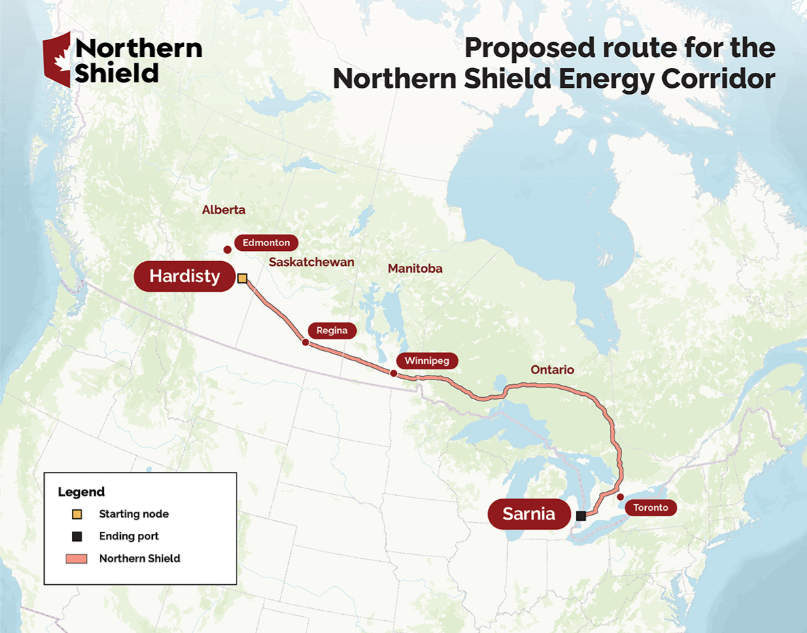
Energy News Beat’s September 29–October 1 treatment of the Northern Shield Energy Corridor is the sober counterpoint to the Pacific announcement. Ford and Smith unveiled the concept at the Calgary Stampede in July 2026: a 3,300-kilometer all-Canadian crude line from Hardisty, Alberta, to Sarnia, Ontario, initially 500,000 barrels a day, expandable to 800,000. The route runs through Saskatchewan and Manitoba, across northern Ontario, and down to Sarnia, deliberately avoiding Quebec. A later Churchill spur has been floated. Ontario is leading a feasibility study, due by the end of 2026, with GHD, EY, AtkinsRéalis, Wood, and others on the advisory team. On September 28–29 in Calgary, Ford said Ontario would supply “patient capital” so the line gets built, later clarifying it would be a minority stake and that outside investors are expected. He invoked the pre-Confederation railway and talked about less than four and a half years. No official cost exists. Independent ranges cited in coverage run roughly $40–50 billion; Energy News Beat’s piece put a plausible engineering range at $25–50 billion once detailed work is done.
The commercial and legal obstacles are concrete.
Sarnia and Ontario refineries already take Western Canadian crude, largely via the Enbridge Mainline and Line 5. Line 5, which moves on the order of 540,000 barrels a day of light crude and natural gas liquids from Superior, Wisconsin, to Sarnia, is the political rationale: it crosses Michigan and has been under repeated legal and political threat. An all-Canadian spare line is an insurance policy. It is not, on present evidence, a market that is short barrels. Richard Masson, former head of the Alberta Petroleum Marketing Commission, told Canada’s National Observer in July that the project had “no chance of success” and that Sarnia already gets the oil it needs. Kent Fellows at the University of Calgary has flagged the toll problem: a new multi-tens-of-billions line has to land crude at a price Ontario refiners will pay. University of Toronto’s Danny Harvey has questioned the demand case if oil use declines. Dan McTeague of Canadians for Affordable Energy has argued the project’s credibility with capital depends on fewer regulatory roadblocks than British Columbia imposed on earlier lines.
No producer or midstream company has publicly committed volumes or equity. Manitoba has not joined the Alberta–Saskatchewan–Ontario memorandum. Indigenous consultation is early. Federal Impact Assessment and Canada Energy Regulator review would still apply, and court challenges of the kind that reset Trans Mountain and killed Northern Gateway remain available to climate and community litigants. Terrain through the Canadian Shield and muskeg is not the easy Prairie portion of the route. Energy News Beat’s own bottom line put the odds the line is never built at roughly 60–80 percent, with a realistic in-service date in the mid-to-late 2030s if it proceeds at all. The year-end 2026 feasibility study is the first hard test. Ford’s railway analogy skips the decade of permitting that now sits between a press conference and a weld.
Pacific Link, by contrast, already has a national-interest designation, a named private minority partner, and an explicit public backstop. Even that line still faces B.C. politics, a route that touches already sensitive corridors, a carbon-capture linkage that has its own cost and schedule, and the same cost-overrun history that turned Trans Mountain into a taxpayer project. Northern Shield has none of those anchors yet.
What the record actually says
Analysts who have watched Canadian pipes do not treat announcements as construction. The projects that died shared missing shipper commitments, expanding regulatory scope, Indigenous litigation that courts treated as fatal process errors, and a federal government willing to trade pipelines for other political goods. The one that was finished required nationalization and a sixfold cost increase. Blue-state gas politics in the U.S. Northeast followed the same arc at a smaller scale: block the large greenfield lines, then, when LNG and power prices bite, ask Washington to hurry a modest loop on an existing system.
Trade wars make the hypocrisy harder to hide. Canada cannot replace U.S. demand with a China EV-for-canola swap or an EU memorandum, and Article 32.10 limits how far the China file can go without handing the United States a treaty lever. Massachusetts cannot run a winter grid on the pipelines it bragged about stopping. Patient capital and national-interest labels are attempts to route around that record. They don’t repeal it.
Making Appendices Great Again
Check out the World’s Greatest Podcast Show Notes at EnergyNewsBeat.co or EnergyNewsBeat.com.
Appendix: Sources
Energy News Beat, “Massachusetts Gov. Healey to feds: Step on the gas — after years of bragging she stopped the pipelines,” October 2, 2026.
https://energynewsbeat.co/electrical-generation/massachusetts-gov-healey-to-feds-step-on-the-gas-after-years-of-bragging-she-stopped-the-pipelines/
Energy News Beat, Northern Shield Energy Corridor analysis, published around September 29–October 1, 2026.
https://energynewsbeat.co/diesel/doug-ford-and-danielle-smiths-northern-shield-energy-corridor-is-a-3300-kilometre-all-canadian-crude-oil-pipeline-proposal-from-hardisty-alberta-to-sarnia-ontario/
Boston Herald, “Healey to feds: Step on the gas!,” October 1, 2026.
https://www.bostonherald.com/2026/10/01/healey-to-feds-step-on-the-gas/
Boston Globe, “Healey supports fast review of gas pipeline for consumer savings,” October 2, 2026.
https://www.bostonglobe.com/2026/10/02/business/healey-supports-gas-pipeline-enbridge-algonquin/
Rhode Island Current, “Healey wants Trump administration’s help on bringing more gas into Massachusetts,” October 2, 2026.
https://rhodeislandcurrent.com/2026/10/02/healey-wants-trump-administrations-help-on-bringing-more-gas-into-massachusetts/
Conservation Law Foundation statement on the Healey letter, October 1, 2026.
https://www.clf.org/newsroom/clf-challenges-gas-pipeline-push/
Ontario government release, Northern Shield route, July 6, 2026.
https://news.ontario.ca/en/release/1007698/ontario-unveils-proposed-route-for-northern-shield-energy-corridor
Financial Post, “Ford says Ontario willing to bankroll pipeline from Alberta to Sarnia,” September 29, 2026.
https://financialpost.com/commodities/energy/oil-gas/doug-ford-ontario-alberta-pipeline
Calgary Herald / Chris Varcoe, Ford and Northern Shield public capital, September 29, 2026.
https://calgaryherald.com/opinion/columnists/varcoe-ready-to-rock-and-roll-ford-eyes-northern-shield-pipeline-investment-as-governments-get-more-involved-in-energy-projects
Canada’s National Observer, Ford public money and expert doubts, September 28–29, 2026, and July 7, 2026 Masson comments.
https://www.nationalobserver.com/2026/09/29/news/doug-ford-public-money-east-west-pipeline
https://www.nationalobserver.com/2026/07/07/news/northern-shield-pipeline-expert-reacts
The Hub, Northern Shield versus Pacific Link designation, October 1, 2026.
https://thehub.ca/2026/10/01/ottawa-set-to-fast-track-northern-shield-pipeline-as-ford-pledges-ontario-capital/
CBC News, Pacific Link designated a project of national interest, October 1, 2026.
https://www.cbc.ca/news/politics/west-coast-pipeline-national-interest-9.7365037
New York Times, Carney, the Pacific pipeline, and trade diversification, October 1 and September 25, 2026.
https://www.nytimes.com/2026/10/01/world/canada/carney-alberta-british-columbia-oil-pipeline.html
https://www.nytimes.com/2026/09/25/world/canada/carney-canada-european-union-china-india.html
CTV / BNN video of the October 1 Carney–Smith Pacific Link announcement.
https://www.youtube.com/watch?v=k5M0Z4Hzfr0
https://www.bnnbloomberg.ca/video/~1170595/
Politico, Carney rules out a China FTA and cites the USMCA notice rule, January 26, 2026.
https://www.politico.com/news/2026/01/26/canada-china-free-trade-deal-00746663
Globe and Mail, Trump 100 percent tariff threat and Article 32.10, January 24, 2026.
https://www.theglobeandmail.com/politics/article-trump-tariff-canada-china/
Reuters, cancelled Canadian oil pipeline projects (Energy East, Northern Gateway, Keystone XL), February 26, 2025.
https://www.reuters.com/business/energy/canadas-cancelled-oil-pipeline-projects-2025-02-26/
USMCA Article 32.10 text (non-market economy clause), USTR.
https://ustr.gov/trade-agreements/free-trade-agreements/united-states-mexico-canada-agreement/agreement-between