

Politicians, Permitting Reform, and the Collapse of Energy Logic
In this episode of the Energy Realities podcast, hosts Dr. Tammy Nemeth, Stu Turley, and David Blackmon tackle the rampant contradictions plaguing modern energy policy across North America and beyond. From Massachusetts Governor Maura Healey’s sudden reversal on natural gas pipelines to Canada’s conflicting signals on oil sands development, the trio exposes how political expediency and ideological inconsistency are undermining energy security, driving up consumer costs, and creating regulatory chaos.
With electricity rates soaring, refining capacity collapsing under decades of restrictive policies, and a critical Supreme Court case threatening to reshape the entire oil and gas industry, the hosts argue that the real crisis isn’t energy itself—it’s the hypocrisy of leaders who claim to champion climate goals while implementing policies that achieve neither environmental nor economic benefits. This roundtable discussion reveals how permitting reform, geopolitical maneuvering, and institutional compromise are reshaping the global energy landscape in ways most people don’t understand.
YouTube Ad-Free for our Substack Subscribers

1. Pipeline Hypocrisy in Massachusetts
2. Permitting Reform & Global Energy Policy
3. Energy Costs & Grid Reliability
Massachusetts has the 3rd highest electricity rates in the US, partly due to previous anti-pipeline policies. The hosts emphasize that wind and solar on the grid become “parasitic” at scale, increasing consumer costs rather than reducing them.
4. Canadian Energy Projects
LNG Canada’s Phase 2 investment decision
Pacific Link oil pipeline proposal to move oil sands crude to the Pacific coast
Concerns about China’s involvement and potential diversion of Canadian oil away from the US
5. Diesel Export Ban Threat
Discussion of Trump’s threatened diesel export ban (now reportedly abandoned). The hosts explain why such a ban would backfire, increasing gasoline and jet fuel prices across the US.
6. Refining Capacity Crisis
7. Supreme Court Boulder County Case
8. Political Hypocrisy & Institutional Compromise
9. African Energy Development
The overarching theme is energy hypocrisy: politicians and institutions claiming environmental goals while implementing policies that harm consumers, increase costs, and weaken energy security.

Yes, Canada is using Canadian Steel: LNG Canada to use Chinese Steel on $33B expansion project in Kitimat, B.C.
LNG Canada will again source major modules from a Chinese state-owned fabricator for its $33 billion Phase 2 expansion in Kitimat, B.C., even as Canadian primary steel producers idle lines and issue layoff notices under U.S. tariffs and persistent import pressure. Prime Minister Mark Carney has left the steel decision to the project owners while tightening quotas on foreign steel elsewhere and pursuing closer ties with the EU.
On September 28–29, 2026, the LNG Canada joint venture—Shell (40 percent), PETRONAS (25 percent), PetroChina (15 percent), Mitsubishi (15 percent), and KOGAS (5 percent)—took a final investment decision on Phase 2. The expansion adds two liquefaction trains, storage, and a loading berth, doubling nameplate capacity from 14 to 28 million tonnes per year. The federal government and project partners put the private investment at about $33 billion (roughly US$23 billion). Carney called it nation-building and said peak construction could support up to 4,000 jobs at the Kitimat site, with additional work on Coastal GasLink compressor stations. Permanent operating additions are far smaller: roughly 90 full-time roles and 150 contractor positions once complete, targeted for the early 2030s.
CBC News reported on October 2 that the joint venture will again buy large modules from China Offshore Oil Engineering Co. (COOEC), a unit of state-owned CNOOC. COOEC fabricated the Phase 1 process modules—35 modules totaling about 179,000 tons, delivered from its Qingdao yard. LNG Canada spokesperson Paul Hagel said the constraint is specialized fabrication capacity, not a preference for offshore steel: no Canadian yard can manufacture and deliver modules of this scale and complexity, and only five yards worldwide meet the requirements for space, quality systems, and marine access. Hagel added that new compressor stations on the pipeline are “targeting almost 15,000 tonnes of steel from Canadian suppliers or mills, representing approximately 70 per cent of the steel required for that work.”
Before the 2018 Phase 1 final investment decision, the project received a remission from anti-dumping and countervailing duties on fabricated industrial steel components from China. Officials at the time cited the absence of Canadian capacity and the risk that duties would affect the investment. Those duties later expired and were not renewed, so the same supplier path is open again. When asked at the announcement whether Phase 2 would use Canadian or Chinese steel, Carney said it was “a great question for the proponents” and that “there will be full opportunities to buy Canadian steel,” while adding that the choice was theirs.
Canadian mills under simultaneous pressure
The Kitimat decision comes as Canadian primary producers lose their main export market. Canadian mills have historically sent more than half their output—and often over 90 percent of exports—to the United States. U.S. Section 232 tariffs on steel reached 50 percent in 2025. The Bank of Canada’s April 2026 Monetary Policy Report noted that steel exports have fallen by about half. A November 2025 Prime Minister’s Office backgrounder said employment in the steel sector had already dropped by roughly 1,000 jobs since the tariffs, from a base of about 23,000 direct steel jobs.
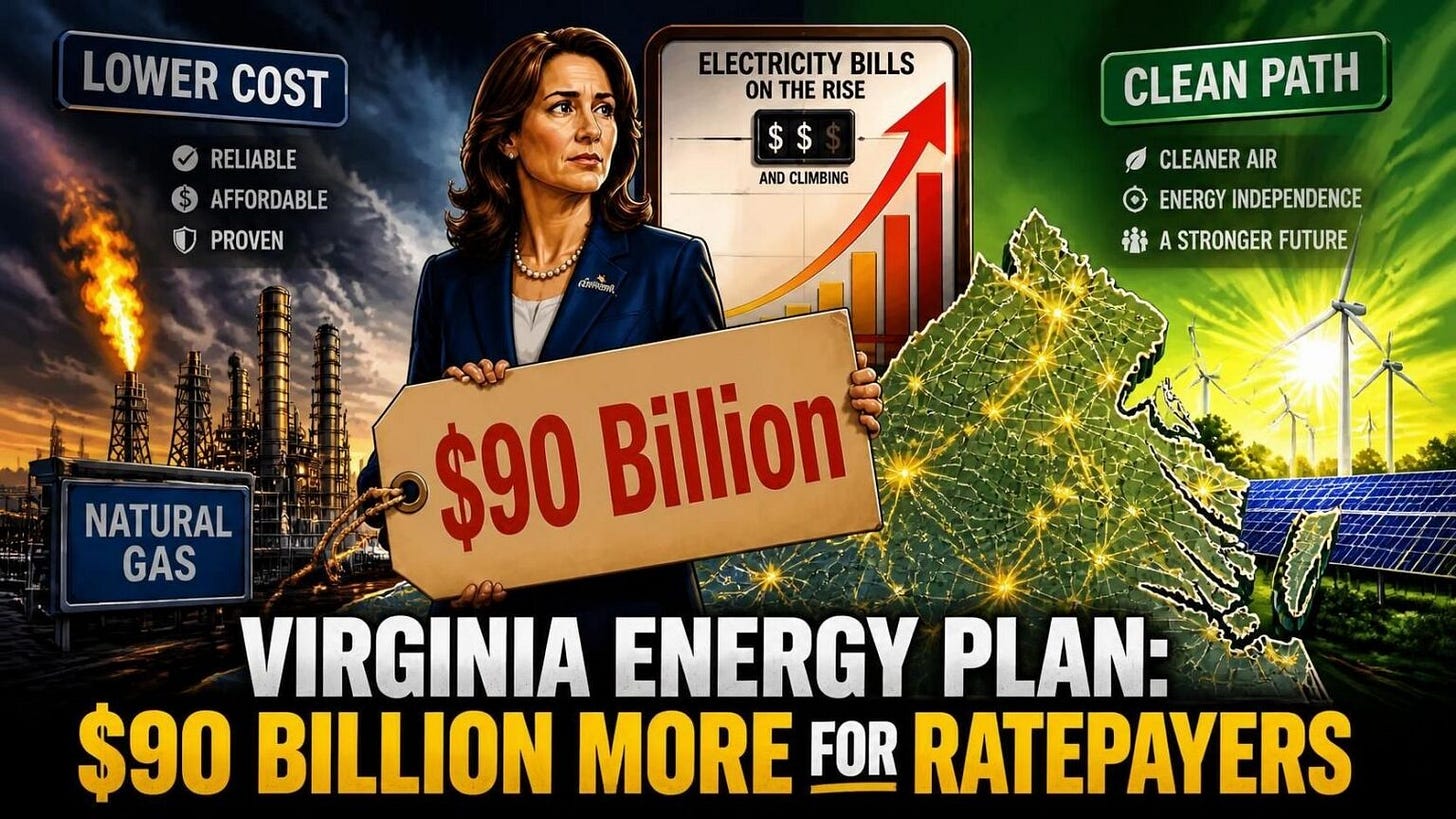
By Her Own Math, Spanberger’s Energy Plan Costs Ratepayers an Extra $90 Billion
The 2026 Virginia Energy Plan’s cheapest system-cost path is the one that allows new gas. Every clean pathway costs more on the bill, then wins only after a carbon adder.
Governor Abigail Spanberger released the 2026 Virginia Energy Plan on October 1 and called it a path to affordable, reliable, local clean power. The modeling underneath that claim tells a narrower story. On the costs that show up in rates, every pathway that keeps the Virginia Clean Economy Act and stays out of new gas plants is more expensive than the alternative the plan itself labels “No Policy.” The affordability ranking only flips after the administration adds a social cost of carbon and a monetized health bill that never appears on a Dominion or Appalachian Power statement.
Virginia is already a high-import, gas-and-nuclear state staring at the fastest load growth in 80 years, almost all of it from data centers. The plan’s answer is more solar, more storage, more offshore wind, a 2045 fossil retirement, and, in one modeled case, no new natural gas at all. That is the combination that has raised system costs everywhere it has been tried at scale.
What the Governor’s office actually released
Spanberger unveiled the plan at the Capitol as the required four-year update under state law. The Governor’s office said public input — more than 3,000 survey responses, six regional meetings, a town hall, and 20 industry sessions — was paired with system modeling, and that Virginia has “multiple pathways to a net-zero power system by 2050” while staying reliable and affordable.
The press release organizes the plan around seven moves: accelerate the “lowest cost, fastest, and cleanest” resources; make data centers advance state energy goals; realign utility incentives; build “clean firm” resources; cut emissions from gas infrastructure; push cleaner transportation; and grow an in-state workforce. Chief Energy Officer Josephus Allmond called it a “Clean-First, Least-Cost approach.”
The statutory spine is unchanged. The Virginia Clean Economy Act still declares 16,100 MW of solar and onshore wind and 5,200 MW of offshore wind to be in the public interest, still drives Dominion toward a carbon-free portfolio by 2045, and still retires fossil generation by 2045 unless reliability is threatened. Storage targets were raised again in 2026: Dominion must pursue 4 GW of short-duration storage by 2030 and 16 GW by 2045, plus 4 GW of long-duration storage by 2045. Appalachian Power has smaller but still large mandates. As of mid-2026 the state had about 231 MW of batteries and roughly 450 MW of offshore wind installed, against a 2,600 MW Coastal Virginia Offshore Wind project whose cost has climbed to about $11.7 billion.
Current mix versus the build the plan requires
In-state generation and the power Virginians actually consume are different things. Virginia is the nation’s largest net electricity importer. The plan’s own supply snapshot puts natural gas at 41.2 percent, imports at 30.6 percent, nuclear at 19.6 percent, and solar at 4.7 percent.
In-state utility-scale generation in 2025 was still a firm-power system:
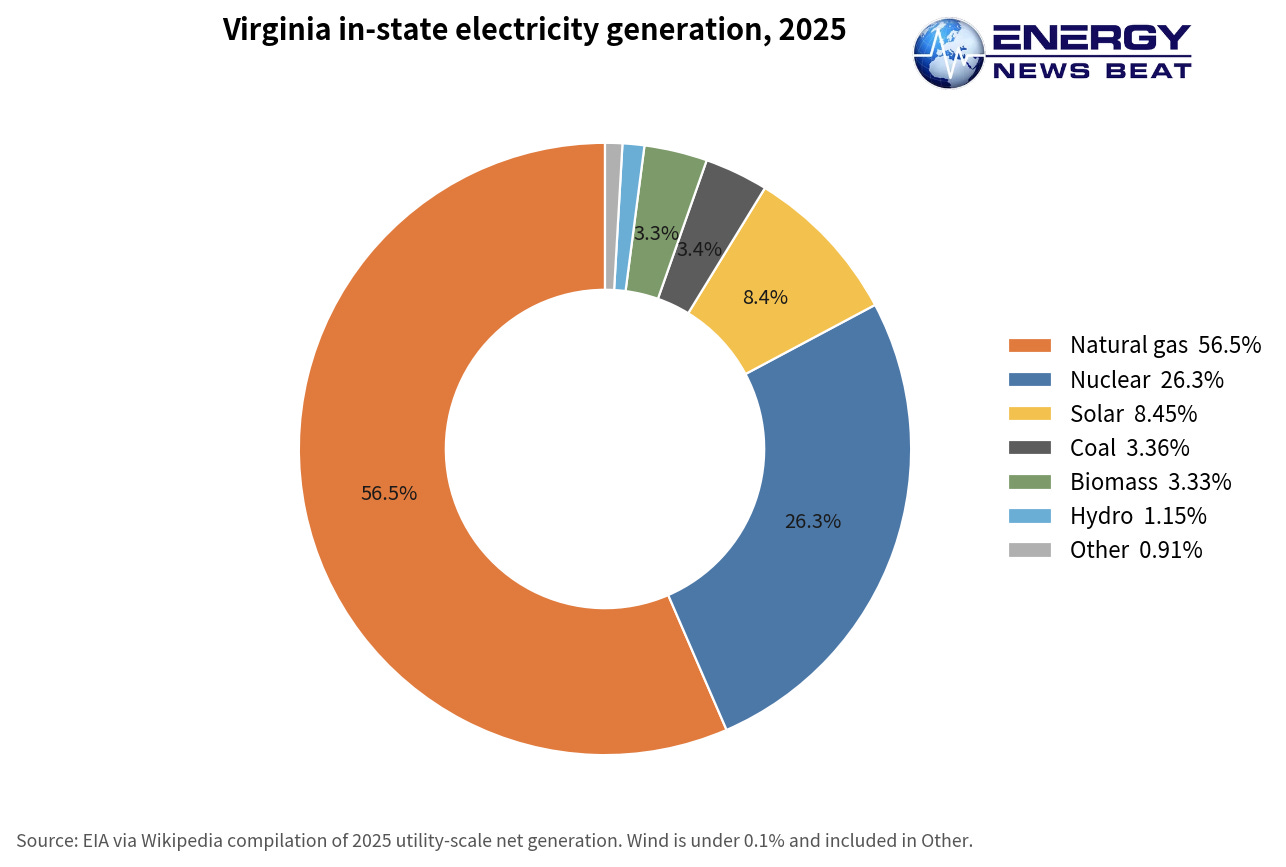
Natural gas produced 56.5 percent, nuclear 26.3 percent, solar 8.5 percent, coal 3.4 percent, biomass 3.3 percent, and hydro 1.2 percent. Wind was effectively zero. North Anna and Surry are the carbon-free backbone. Gas combined-cycle plants carry the rest of the hours solar cannot.
The plan says that under a moderate load forecast — signed data-center agreements, most utility-approved projects built — peak demand rises 98 percent from 2026 to 2050. Across the net-zero cases, Virginia must more than double installed capacity and add roughly 1.2 to 1.8 GW of solar and 1 to 2 GW of storage every year for two decades. Offshore wind lands between about 2,600 and 9,700 MW depending on the case. Advanced nuclear is 1,000 to 5,800 MW. One case, “No New Gas,” builds none.
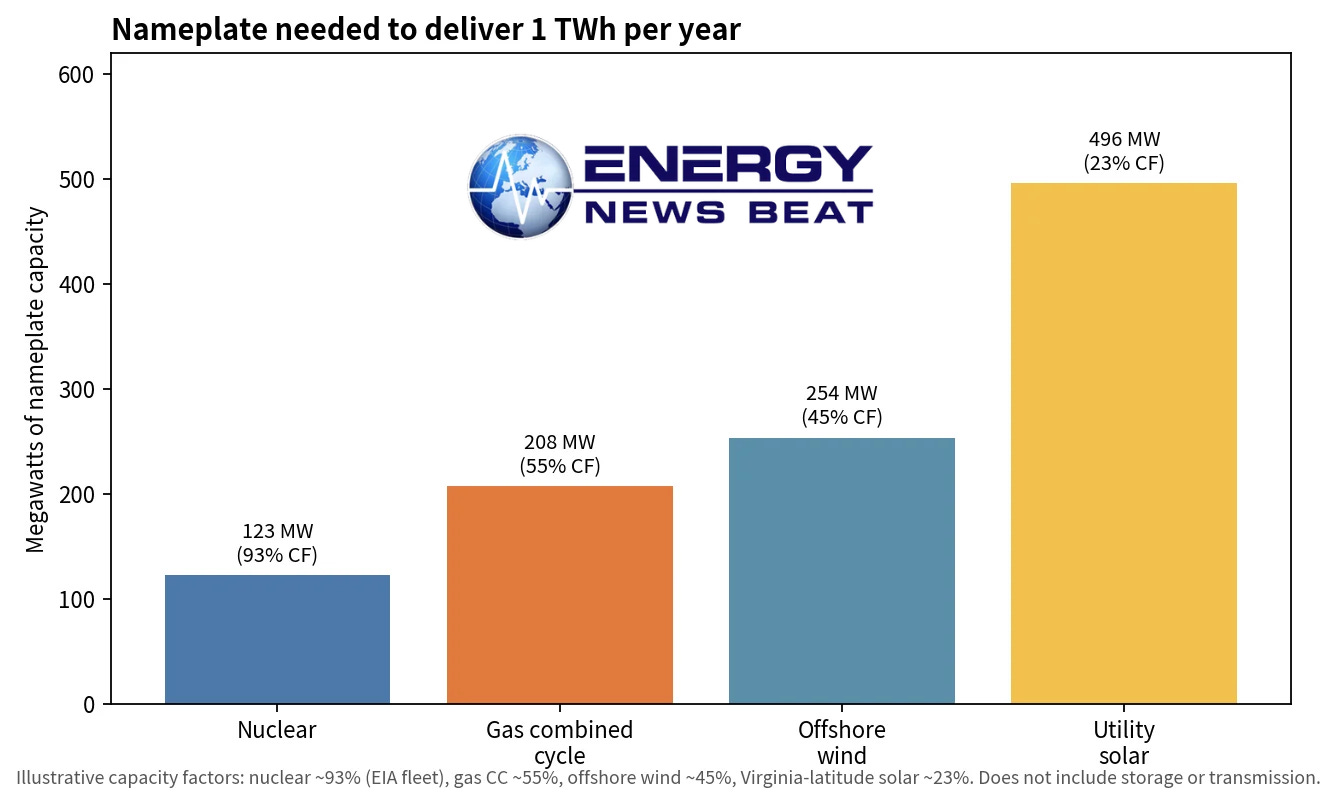
That is not a substitution of like for like. A nuclear unit runs near a 93 percent capacity factor. Virginia-latitude solar runs near 23 percent. Delivering the same annual energy from solar takes about four times the nameplate, and still nothing after dark, which is why the storage mandate exists.
Nameplate is what gets celebrated in press releases. Megawatt-hours, and megawatts at the winter peak, are what keep a data center online.
The cost table the announcement does not lead with
The executive brief’s moderate-load cost table is the whole argument.
PathwaySystem costSocial cost of carbonHealth impacts“Total”No Policy (VCEA and RGGI off, gas allowed)$295B$285B$145B$725BCurrent Policies$422B$53B$35B$510BDistributed Flexibility$385B$71B$19B$475BModerate solar / in-state priority$405B$75B$20B$500BNo new gas$398B$64B$22B$484B
Figures are in billions of dollars, 2026–2050. Source: 2026 Virginia Energy Plan modeling tables.
System cost is generation, storage, transmission, and the rest of the hardware and fuel customers fund. On that measure, the gas-allowed case is $90 billion to $127 billion cheaper. Distributed Flexibility, the administration’s preferred “lowest total cost” path, still costs $90 billion more in system cost than No Policy. No New Gas costs $103 billion more. Current Policies, which is the law as written, costs $127 billion more.
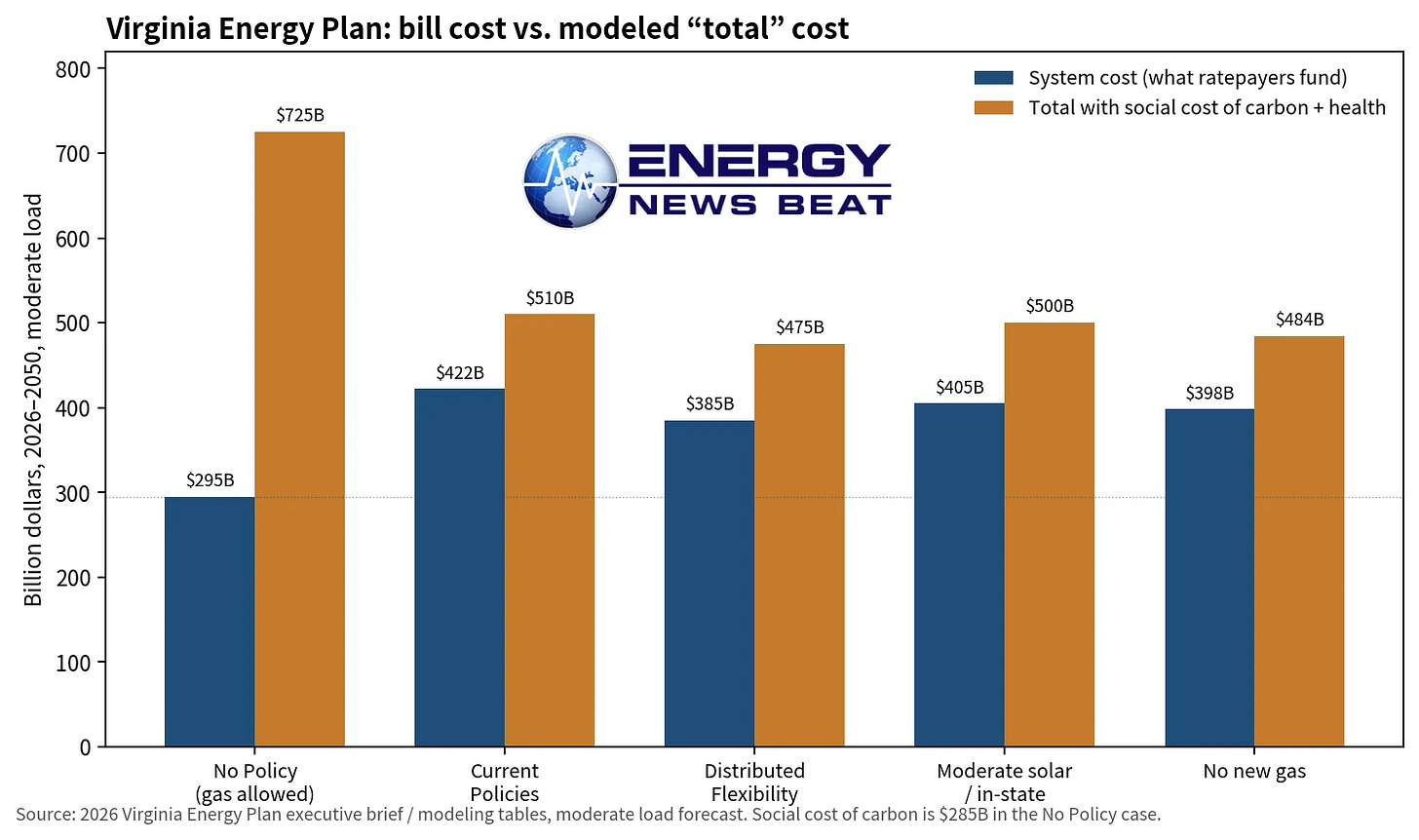
The ranking reverses only after the model assigns a $285 billion social cost of carbon and a $145 billion health-impact cost to the gas case. Those are modeling choices, not line items on a bill. Republican legislators made the same point this week: by the plan’s own math, serving the load is more than $100 billion cheaper without the clean-energy constraints, and the Governor’s path becomes “affordable” only after social costs are added.
Two other plan figures belong next to that table. Data-center load is about half of incremental system cost under Current Policies, on the order of $200 billion, and the plan says new data centers could pay about $265 billion in electricity revenue through 2050 if cost causation holds. And the status-quo bill path the plan itself cites is roughly a 60 percent increase for a typical Dominion customer over the next decade, versus about 17 percent for Appalachian Power. Residential rates are already moving. EIA data put Virginia’s average residential price at 17.55 cents per kWh in July 2026, up about 11 percent from a year earlier and about 39 percent over five years.
Coastal Virginia Offshore Wind is the early warning on “clean firm” cost. Dominion now puts the 2.6 GW project at about $11.7 billion, up from a $9.8 billion budget, and a levelized cost around $84 per MWh. That is before the storage and transmission required to make a variable resource behave like the nuclear and gas it is supposed to help replace.
What other grids already showed
Solar is cheap at noon. A solar-heavy system is not cheap across the year, because the utility still has to buy or build the other 20 hours, plus the wires.
California is the U.S. case. In 2024 the state’s average residential price was 31.97 cents per kWh, nearly double Virginia’s and the highest of any large state. CAISO has added solar and batteries at extraordinary speed — utility-scale solar around 25 GW and batteries around 16 GW by spring 2026 — and gas burn has fallen sharply in shoulder months. Wholesale prices collapse at midday and spike in the evening. Retail bills have not followed wholesale down. Customers pay for the solar, the batteries, the remaining gas fleet that covers the net load peak, and a distribution system built for a different load shape. Batteries shift energy. They do not create it, and four-hour batteries do not cover a week of low wind and low sun.
Germany and the United Kingdom ran the same experiment earlier. Household prices in both countries sit near 40 U.S. cents per kWh, more than twice the American average. Germany kept coal and gas on the system for adequacy after shutting down nuclear, paid renewable subsidies and grid-expansion costs on top of energy prices, and watched energy-intensive industry move load or move plants. The European lesson for a state that wants semiconductor fabs, data centers, and shipyards is not that renewables cannot generate. It is that retiring firm capacity before firm replacements exist shows up as higher industrial rates and lost load.
The plan’s own No New Gas and Moderate Solar cases reproduce that structure: large solar and storage adds, offshore wind, limited or zero new gas, and a heavier call on imports. Imports are already 30 percent of Virginia supply. PJM’s capacity market has already repriced scarcity. Betting the residual on neighbors who are running the same retirement schedule is not a reliability plan.
Recommendations the plan should have led with
- The data-center cost-causation pieces are the strongest part of the document and should be enforced, not softened. Everything else should be reordered around bills and winter peak.
- Publish system cost as the primary metric. Report the social cost of carbon and health adders in an appendix. Do not let a $285 billion carbon adder decide which power plants get built.
- Freeze fossil retirements until accredited replacement capacity is in service. A 2045 mandate that outruns the build schedule is a reliability waiver waiting to happen.
- Treat existing nuclear as the clean firm resource the state already owns. Uprate North Anna and Surry, and run a competitive solicitation for small modular reactors at sites with transmission, with a hard cap on ratepayer exposure. The plan’s own high-nuclear cases exist because the model needs something that runs when solar does not.
- Allow new high-efficiency gas, including at data-center campuses, as a bridge under cost-causation rates. The No Policy case is $90 billion cheaper in system cost for a reason. Non-combustion fuel cells at a 20 percent capacity factor are not a substitute for combined-cycle plants.
- Put a customer cost cap on further offshore wind. CVOW at $11.7 billion and roughly $84 per MWh is the number legislators should see before any path to 5,200 or 9,700 MW is treated as settled.
- Tie storage targets to measured peak reduction, not to a statutory megawatt count. Sixteen gigawatts of short-duration batteries by 2045 is a blank check unless each tranche clears a capacity-value test.
- Keep the data-center rules: large-load tariffs, collateral, transmission paid by the load that causes it, and a real demand-flexibility obligation. Households should not finance a $200 billion incremental system for customers who can site in another state.
- Rejoin the industrial question to the energy question. Virginia cannot hold manufacturing, ship repair, and the next wave of factories if its modeled “affordable” path is the one that costs ratepayers an extra $90 billion to $127 billion before anyone counts carbon.
Spanberger is right that demand is rising faster than at any time in 80 years, and right that data centers should pay their way. The plan’s own tables say the rest. A grid built on more solar, mandatory storage, offshore wind, and a closed door to new gas is the expensive path. Calling it the cheap path requires a carbon price the General Assembly has not put on the bill. If you are reading this, the key numbers are the social program numbers and carbon taxes.
For all of the links to the appendices, go to the full article.
For Stu Turley on The Energy News Beat Substack:

For David Blackmon

For Tammy Nemeth

