

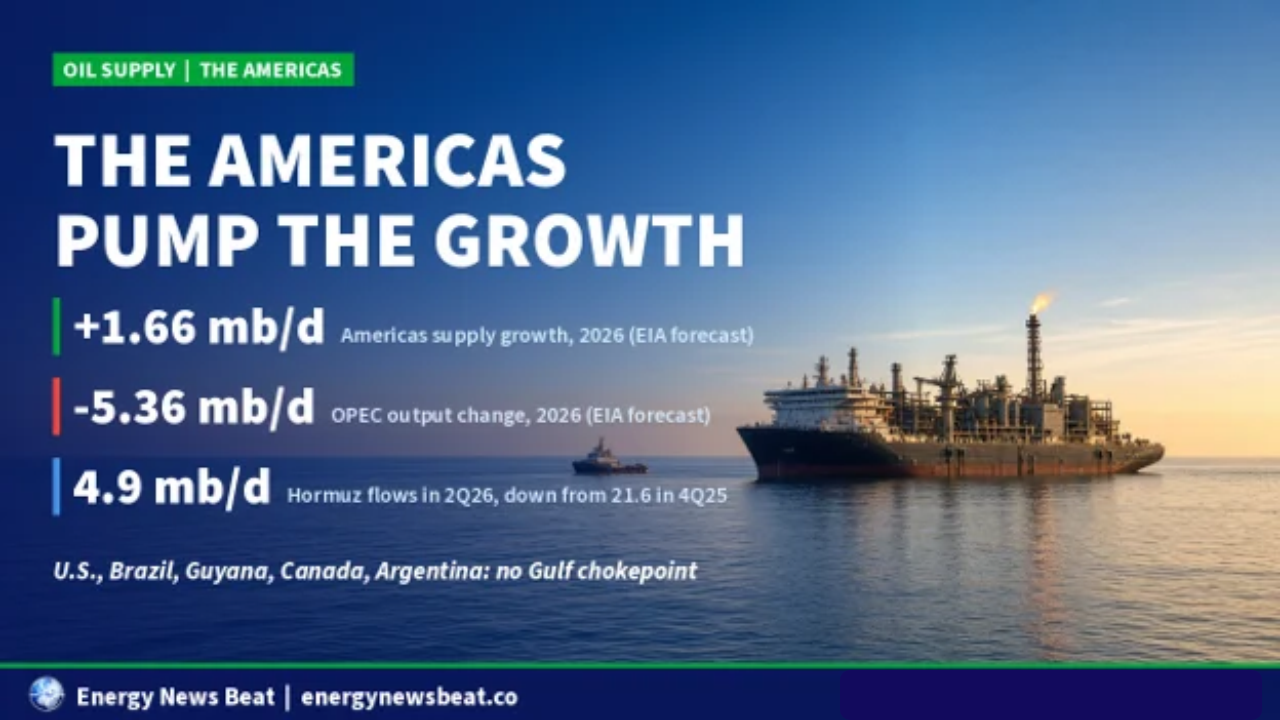
EIA’s October outlook has the U.S., Brazil, Guyana, Canada and Argentina adding barrels with no Gulf chokepoint in the way, while Hormuz flows collapsed and OPEC supply is forecast to drop by nearly a fifth.
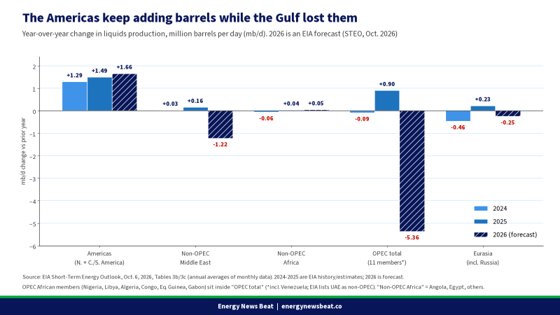
For consumers, the growth in supply is coming from this hemisphere. In its October Short-Term Energy Outlook, the U.S. Energy Information Administration has liquids supply from North, Central and South America growing by 1.29 million barrels per day (mb/d) in 2024, 1.49 mb/d in 2025 and a forecast 1.66 mb/d in 2026 (EIA Table 3b).
Over the same 2026 forecast, EIA has OPEC production falling 5.36 mb/d (EIA STEO data), and output from non-OPEC Middle East producers (including Qatar, the UAE and Oman) falling 1.22 mb/d (EIA Table 3b). The Americas are growing while Gulf output falls.
Why chokepoints matter so much this year
Before the war, about 20 mb/d of oil, around a quarter of seaborne trade, moved through the Strait of Hormuz (IEA factsheet). EIA estimates Hormuz flows dropped from 21.6 mb/d in 4Q25 to 4.9 mb/d in 2Q26, while Saudi barrels rerouted via the East-West Pipeline to the Red Sea pushed Bab el-Mandeb flows to 8.1 mb/d in 2Q26 (EIA; Rigzone). Bab el-Mandeb also faces risk: the IEA cites renewed attacks at Bab el-Mandeb (IEA, Sept.) and the Sept. 11 bombing of Saudi Arabia’s East-West Pipeline (IEA, Oct.).
Qatar is the starkest example. Iranian strikes knocked out about 17% of its LNG export capacity for three to five years (Reuters; CNBC; QNA), and EIA now forecasts Qatar’s liquids output at 0.87 mb/d in 2026, down from 1.88 mb/d in 2025 (EIA Table 3b). The IEA says September Hormuz flows recovered to 10.9 mb/d, but calls the rebound “fragile” (IEA, Oct.).
Chart 2. Oil flows through Hormuz and Bab el-Mandeb, 1Q25-2Q26 (EIA).
Country by country: who is adding barrels
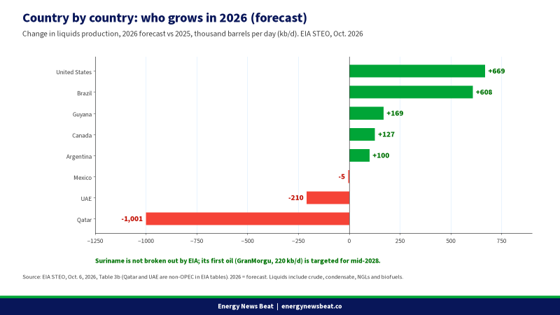
United States. Still the giant: EIA has U.S. liquids rising 0.67 mb/d to 24.39 mb/d in 2026 (forecast). In the Gulf of America, the August “Big Beautiful Gulf 3” lease sale drew $82.7 million in high bids on 59 blocks (BOEM).
Brazil. Forecast to add 0.61 mb/d in 2026, the biggest gain after the U.S. (EIA). Petrobras started the 180,000 b/d P-79 on May 1, three months early, lifting Búzios capacity to about 1.33 mb/d (Petrobras), after the 180,000 b/d P-78 began production on Dec. 31, 2025 (Petrobras).
Guyana. From zero in 2019 to about 900,000 b/d today from four Exxon-operated FPSOs (Guyana DPI). The fifth, the 250,000 b/d Errea Wittu at Uaru, is targeted for 4Q26 start-up; the 250,000 b/d Jaguar FPSO for Whiptail (2027) and the 150,000 b/d Hammerhead project (2029; Exxon is aiming for 2028, per Reuters) follow, taking capacity toward 1.46 mb/d by 2029 (Industrial Info).
Canada. EIA forecasts +0.13 mb/d in 2026. The expanded Trans Mountain pipeline, open since May 2024, reported record throughput of 840,000 b/d in Q2 2026, 94% of its roughly 890,000 b/d capacity (Trans Mountain).
Argentina. EIA has Argentina at 1.08 mb/d in 2026, up 0.10 mb/d. YPF says its net Vaca Muerta shale output hit 248,000 b/d, nearly its year-end goal of 250,000 (Bloomberg Línea). The Vaca Muerta Oil Sur export pipeline is designed for up to 550,000 b/d, expandable to about 700,000 (VMOS). Its early start-up has slipped to December 2026, with the first export cargo expected in March 2027 (EnergyIA).
Suriname and Mexico. TotalEnergies’ 220,000 b/d GranMorgu project is on track for first oil in mid-2028 (Reuters). Mexico is flat: EIA has it at 1.86 mb/d in 2026, versus 1.87 in 2025 and 2.01 in 2024 (EIA).
The other side of the ledger: Middle East and Africa
The Gulf still has enormous capacity; the problem is getting it out. Aramco said in Oct. 2025 that it can sustain 12 mb/d of maximum capacity (Reuters). The UAE, which quit OPEC effective May 1 (Reuters; WAM), has an ADNOC target of 5 mb/d of capacity by 2027, per EIA (EIA), and is fast-tracking a pipeline to bypass Hormuz (Reuters). Iraq, Kuwait and Qatar have no comparable bypass (IEA). In Africa, Nigeria averaged 1.72 mb/d of crude and condensate in September, or 1.53 mb/d of crude alone (NUPRC; Punch), well below its 2.5 mb/d 2026 target (Punch).
Inside OPEC’s falling total are Africa’s members too. EIA’s non-OPEC African producers, led by Angola (which left OPEC effective Jan. 1, 2024; ANGOP) and Egypt, grow just 0.05 mb/d in 2026 (EIA Table 3b). Compare that with Guyana alone at +0.17 mb/d. Nigeria’s output remains below its 2.5 mb/d target (Punch).
EIA expects OPEC output to rebound by about 5.2 mb/d in 2027 if flows normalize (EIA STEO data).
What the three agencies agree on
All three monthly reports point the same way, even though they measure differently. OPEC’s October report names Brazil, the U.S., Canada and Argentina as the main drivers of non-DoC (non-OPEC+) liquids growth of about 0.6 mb/d in 2026 (OPEC MOMR). The IEA’s September report said its “Americas Quintet” adds 1.4 mb/d in 2026 (IEA), and its October report projects world supply falling 5.8 mb/d this year (IEA).
| What it means for consumers
EIA forecasts regular gasoline averaging $3.90/gal in 2026 versus $3.10 in 2025, and diesel $5.20 versus $3.66 (EIA STEO). Relief is forecast, not promised: EIA has Brent falling from $96 in 2026 to $84 in 2027 (EIA), but that assumes Gulf flows keep recovering. |
| What it means for investors
The growth sits with operators in Guyana’s Stabroek block (ExxonMobil 45%, Chevron 30%, CNOOC 25%; Guyana DPI), Petrobras, YPF and Vaca Muerta partners, Canadian oil sands producers and pipelines, and TotalEnergies in Suriname. Watch execution dates (Errea Wittu first oil, VMOS start-up now targeted for December 2026, first VMOS export cargo in March 2027, GranMorgu in 2028), pipeline capacity and Gulf de-escalation, which could pull prices down fast. This is not investment advice. |
Caveats
- 2026 figures are forecasts from EIA STEO (Oct. 6, 2026), IEA OMR (Oct. 14) and OPEC MOMR (Oct. 13). They will be revised.
- The agencies define regions differently: OPEC’s “non-DoC,” the IEA’s “Americas Quintet” and EIA’s regions are not interchangeable. Chart numbers are EIA only.
- Liquids include crude, condensate, NGLs and biofuels; much of U.S. growth is NGLs, per OPEC (OPEC/IMFC).
- Venezuela is an OPEC member in the Americas and sits in EIA’s OPEC total. Africa’s OPEC members (Nigeria, Libya, Algeria and others) are also in that total.
Stu’s Take
I have been saying it for years: energy security is national security. Look at the 1.66 mb/d of Americas growth EIA forecasts for 2026 next to the 5.36 mb/d drop in OPEC output, and you see why.
When Hormuz went from 21.6 mb/d to 4.9 mb/d, barrels from Houston, Búzios and Stabroek kept sailing. Guyana went from nothing to about 900,000 b/d in seven years. Brazil’s P-79 came online three months early. That is execution.
The Gulf is not finished, but in a year when the shipping lanes broke, the dependable growth came from places where a tanker never has to pass a hostile coastline. Without the Americas’ extra barrels, prices at the pump would likely be worse.
Consumers are paying for this war at the pump, with diesel forecast at $5.20 this year. The answer is to keep building pipelines like Trans Mountain and VMOS, keep leasing the Gulf of America, and stop treating producers in our own hemisphere as the problem. Have a great day, and God bless.
Check out the World’s Greatest Podcast Show Notes at EnergyNewsBeat.co or EnergyNewsBeat.com. And subscribe to: The Energy News Beat Substack.
Appendix: Sources and Links
A. Data tables (EIA STEO, Oct. 6, 2026; forecast completed Oct. 1)
| Liquids, mb/d | 2023 | 2024 | 2025 | 2026F | YoY 24 | YoY 25 | YoY 26F |
| Americas (N.+C./S.) | 36.99 | 38.28 | 39.77 | 41.43 | +1.29 | +1.49 | +1.66 |
| United States | 22.00 | 22.88 | 23.73 | 24.39 | +0.87 | +0.85 | +0.67 |
| Canada | 5.76 | 6.00 | 6.25 | 6.38 | +0.24 | +0.26 | +0.13 |
| Mexico | 2.12 | 2.01 | 1.87 | 1.86 | -0.11 | -0.14 | -0.00 |
| Brazil | 4.28 | 4.28 | 4.65 | 5.26 | -0.00 | +0.37 | +0.61 |
| Guyana | 0.39 | 0.62 | 0.75 | 0.92 | +0.23 | +0.13 | +0.17 |
| Argentina | 0.82 | 0.89 | 0.98 | 1.08 | +0.07 | +0.09 | +0.10 |
| Colombia | 0.81 | 0.80 | 0.78 | 0.76 | -0.01 | -0.03 | -0.02 |
| Non-OPEC Middle East | 7.36 | 7.38 | 7.54 | 6.32 | +0.03 | +0.16 | -1.22 |
| Qatar | 1.83 | 1.85 | 1.88 | 0.88 | +0.03 | +0.03 | -1.00 |
| UAE | 4.18 | 4.24 | 4.34 | 4.13 | +0.06 | +0.09 | -0.21 |
| Non-OPEC Africa | 2.61 | 2.55 | 2.58 | 2.63 | -0.06 | +0.04 | +0.05 |
| OPEC total | 28.52 | 28.43 | 29.33 | 23.97 | -0.09 | +0.90 | -5.36 |
| World | 102.53 | 103.15 | 106.27 | 101.14 | +0.62 | +3.12 | -5.14 |
Annual values are simple averages of EIA monthly values in STEO_m.xlsx (Tables 3b/3c), which closely match (within 0.04 mb/d) the annual columns in the PDF tables. 2023-2025 are history/estimates; 2026 combines estimates through Sept. with forecasts. F = forecast.
B. Chokepoint flows (EIA, published Aug. 12, 2026), mb/d
| Chokepoint | 1Q25 | 2Q25 | 3Q25 | 4Q25 | 1Q26 | 2Q26 |
| Strait of Hormuz | 20.9 | 21.0 | 21.3 | 21.6 | 14.9 | 4.9 |
| Bab el-Mandeb | 3.9 | 4.5 | 4.6 | 5.4 | 5.6 | 8.1 |
C. Development programs (as of Oct. 24, 2026)
| Project | Capacity | Status / timing | Source |
| Guyana: 4 FPSOs (Liza 1/2, Payara, Yellowtail/ONE GUYANA) | 810 kb/d nameplate; ~900 kb/d output | Producing | Industrial Info, DPI |
| Guyana: Uaru / Errea Wittu | 250 kb/d | First oil targeted 4Q26 | Industrial Info |
| Guyana: Whiptail / Jaguar | 250 kb/d | 2027 | Industrial Info |
| Guyana: Hammerhead | 150 kb/d | 2029 (Exxon aiming for 2028) | Industrial Info, Reuters, Guyana Standard |
| Brazil: P-78 (Búzios) | 180 kb/d | Started Dec. 31, 2025 | Petrobras 6-K |
| Brazil: P-79 (Búzios 8) | 180 kb/d | Started May 1, 2026 | Petrobras |
| Argentina: VMOS pipeline | Up to 550 kb/d (about 700 kb/d expandable) | Early start-up slipped to December 2026; first export cargo expected March 2027 (EnergyIA, Oct. 23, 2026) | VMOS, EnergyIA |
| Argentina: YPF shale | 248 kb/d net | Target 250 kb/d by end-2026 | Bloomberg Línea |
| Canada: Trans Mountain (TMX) | ~890 kb/d | ~840 kb/d record, Q2 2026 | Trans Mountain |
| U.S.: BBG3 Gulf lease sale | $82.7M high bids, 59 blocks | Held Aug. 12, 2026 | BOEM, OGJ |
| Suriname: GranMorgu (Block 58) | 220 kb/d | First oil mid-2028 | Reuters, OER |
| Saudi Arabia: Aramco | 12 mb/d max. sustainable capacity | Exports constrained by Hormuz/Red Sea risk | Reuters, IEA |
| UAE: ADNOC | 5 mb/d capacity target | By 2027; Hormuz bypass pipeline fast-tracked | EIA, Reuters |
| Nigeria | 2.5 mb/d target | 1.72 mb/d crude+condensate (1.53 crude), Sept. 2026 | NUPRC, Punch, Punch |
D. Background
The 2026 Iran war disrupted Gulf production and shipping from March onward. Hormuz flows fell to 4.9 mb/d in 2Q26 (EIA) before recovering to 10.9 mb/d in September (IEA). Qatar lost about 17% of LNG capacity (Reuters, Mar. 19). The UAE left OPEC and OPEC+ effective May 1, 2026 (Reuters, Apr. 28). Western Hemisphere supply reaches markets via the Gulf of America, the Atlantic and the Pacific (TMX to Burnaby) without transiting a Middle East chokepoint.
E. Methodology
Regional and country YoY growth = EIA annual average (year) minus annual average (prior year), from the October 2026 STEO workbook. “Americas” = EIA North America (U.S., Canada, Mexico) + Central and South America (excludes Venezuela, which EIA counts within OPEC). EIA lists the UAE and Qatar as non-OPEC. IEA and OPEC figures are quoted as published, not recomputed. Chokepoint data from EIA’s Global Energy Security table. Prices: EIA STEO Table 2 annual averages. All URLs accessed Oct. 24, 2026. Charts: Energy News Beat. OPEC 2026 change uses the workbook monthly average (-5.36); the Table 3a PDF shows -5.40 on a day-weighted basis. Cover image AI-generated and illustrative.
F. Not verified / omitted
Vaca Muerta basin total omitted pending official data. Iraq capacity targets omitted for lack of a primary source. Company production guidance beyond the projects listed is not used.
G. Sources (accessed Oct. 24, 2026)
- EIA STEO home, Oct. 6, 2026
- EIA STEO Table 3b, non-OPEC liquids (Oct. 2026)
- EIA STEO Table 3a, world liquids (Oct. 2026)
- EIA STEO Table 3d, crude by country (Oct. 2026)
- EIA STEO monthly workbook STEO_m.xlsx (Oct. 2026)
- EIA Global Energy Security data (Aug. 12, 2026)
- IEA Oil Market Report, Oct. 14, 2026
- IEA Oil Market Report, Sept. 11, 2026
- IEA Strait of Hormuz factsheet (Feb. 2026)
- OPEC MOMR, Oct. 13, 2026
- OPEC statement to IMFC (Oct. 17, 2026)
- Reuters: Iran attack wipes out 17% of Qatar LNG capacity (Mar. 19, 2026)
- Reuters: UAE quits OPEC (Apr. 28, 2026)
- EIA Today in Energy: UAE 2027 capacity goal
- Reuters: UAE pipeline to bypass Hormuz (May 15, 2026)
- Reuters: Aramco 12 mb/d capacity (Oct. 13, 2025)
- NUPRC: Nigeria September 2026 output
- Punch: Nigeria 2.5 mb/d target
- Industrial Info: ExxonMobil Guyana (Oct. 2026)
- Guyana DPI: arrival of fifth FPSO
- OilNOW: Guyana nears 1 mb/d
- Petrobras: P-79 start-up (May 1, 2026)
- Petrobras 6-K: P-78 start-up (Jan. 2, 2026)
- Petrobras 2Q26 production report (6-K, Jul. 28, 2026)
- Bloomberg Línea: YPF 248,000 b/d (Oct. 22, 2026)
- VMOS project site
- EnergyIA: VMOS first tanker slips to March 2027 (Oct. 23, 2026)
- Rigzone: EIA chokepoint flows in 2Q26 (Aug. 12, 2026)
- Punch: Nigeria output 1.72m barrels in Sept.
- Reuters: Exxon accelerates Guyana projects (Mar. 19, 2026)
- Guyana Standard: Hammerhead 2028 aim (Mar. 23, 2026)
- ANGOP: Angola formalizes OPEC withdrawal
- CNBC: Iran attack on Qatar LNG capacity (Mar. 19, 2026)
- QNA: 17% of gas export capacity disrupted (Mar. 19, 2026)
- WAM: UAE exits OPEC and OPEC+
- Trans Mountain Q2 2026 results
- Reuters: Trans Mountain running nearly full (Mar. 25, 2026)
- BOEM: BBG3 lease sale
- OGJ: BBG3 $82.7 million
- Reuters: GranMorgu on track for mid-2028 (Sept. 19, 2026)
- Ocean Energy Resources: GranMorgu 50% (Oct. 4, 2026)
