
There is no evidence prices were held high for the election. The slide started with the winter-blend switch and refineries coming back from maintenance; another drop came when oil fell on de-escalation. Diesel is the real squeeze, a refining shortage that may last into 2027. Cheap winter heating gas is the bright side.
If you have been watching the pump since Election Day, it is easy to see why a story took off on X: gasoline looks cheaper, and some people say that means it was kept expensive until the midterms were over. Bo Loudon asked whether “gas companies intentionally hiked gas prices to get voters to blame President Trump and vote Democrat.” A still more viral post claimed, without publishing any documents, that Chuck Schumer coordinated with OPEC to keep prices high.
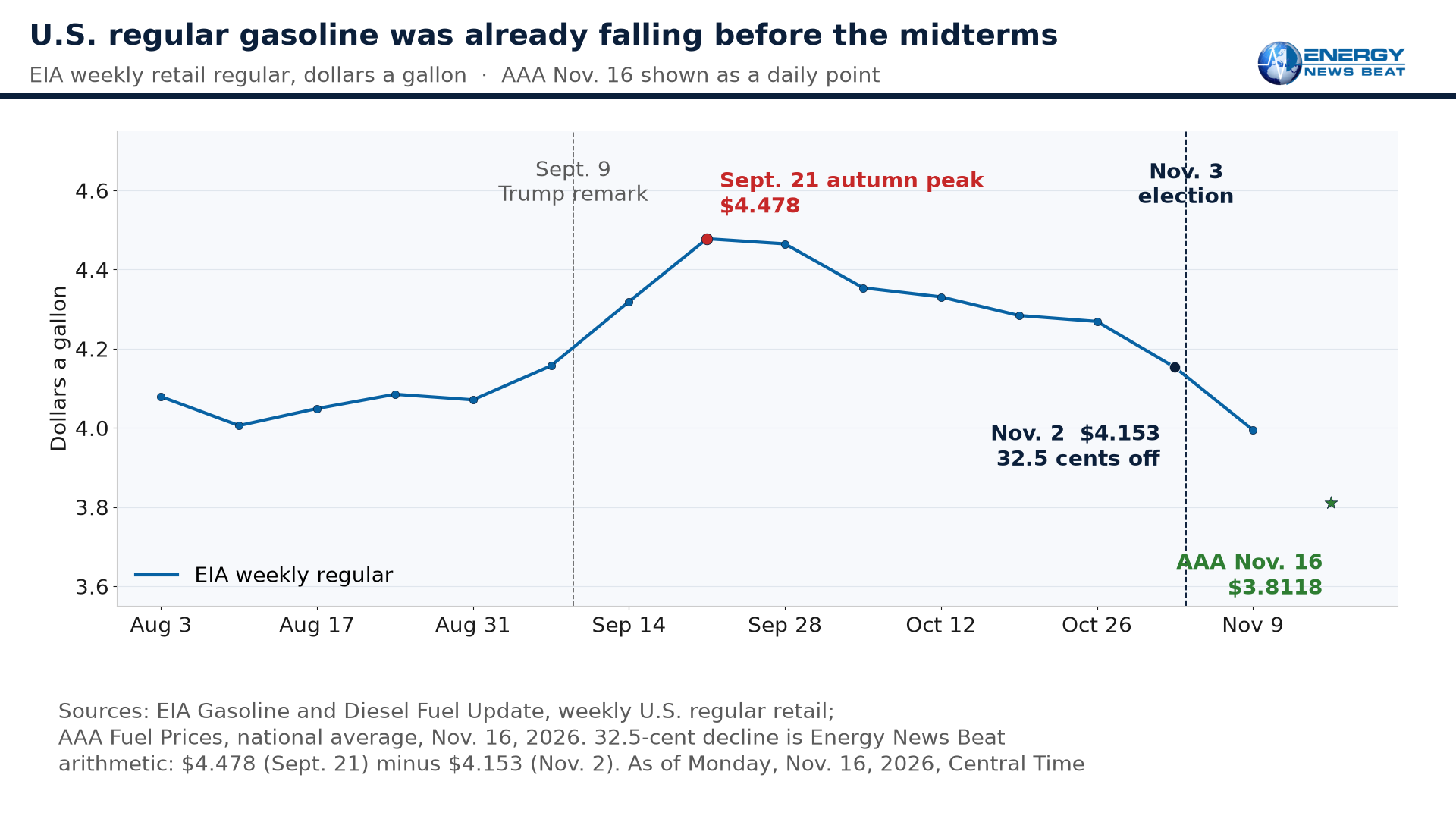
The numbers do not support a hold-back. The Energy Information Administration’s weekly survey shows regular gasoline at a September peak, $4.478, on Sept. 21 and falling every week after that, to $4.153 on Nov. 2, the Monday before the vote. That is 32.5 cents off before anyone cast a ballot. Today’s AAA national average is $3.8118. Diesel is the hangover: $5.9989, under $6 for the first time since September, and still about $2.23 higher than a year ago.
Were prices kept high on purpose?
The drop started when it usually starts: after summer driving season, stations switch to a cheaper winter blend, and refineries return from fall maintenance. The EPA allowed that winter-blend switch from Sept. 1, earlier than usual. From the September peak to the week of Nov. 9, EIA regular gasoline was down 48.3 cents, or 10.8 percent, smaller than 2014’s 16.3 percent and 2023’s 13.6 percent.
There is a kernel of truth in the frustration. Pump prices came down more slowly than wholesale. The retail-wholesale gap — retail regular minus the New York Harbor spot, including about 52 cents of taxes plus freight — widened 45 cents, from about 94 cents on Sept. 21 to $1.39 on Nov. 9, Energy News Beat calculates from EIA weekly prices. Analysts call that “rockets and feathers”: the pump jumps fast and eases slowly. The wider gap was there before and after the vote, so the pump can still fall if wholesale stays soft.
PolitiFact rated False on Nov. 11 the claim that gas companies raised prices so you’d blame Trump. Patrick De Haan of GasBuddy told the fact-checker there was no reason to believe gas companies purposely inflated prices, and that the industry has little incentive to help the party that usually regulates it more. No Schumer-OPEC emails have been published. Energy News Beat did not independently confirm whether those posts carry a Community Note.
If someone had been sitting on supply until Nov. 3, diesel should have broken the same way gasoline did. It has not. AAA diesel is down only 4.6 percent since Election Day, from $6.288 to $5.9989, versus 8.1 percent for regular, because the shortage is in refining. Politics did move oil, but through the war premium: Brent fell sharply on Nov. 2, when Iran signaled more talks and President Trump said “No” to post-midterm strikes, and again on Nov. 4, when markets read the Democratic sweep as a constraint on the war. That is a risk-premium story, not evidence that barrels were withheld.
Why diesel is still high — and may stay higher longer
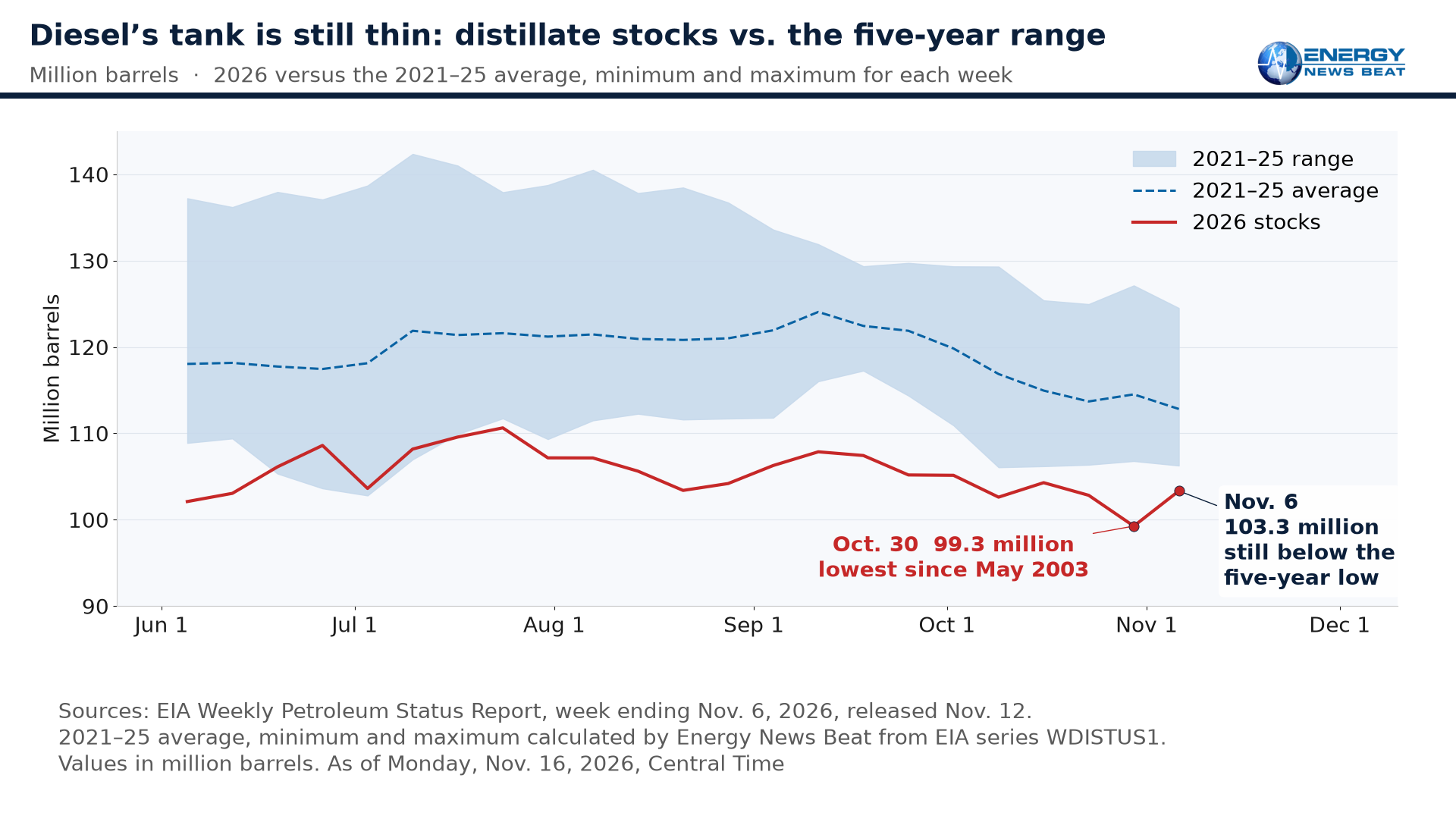
EIA distillate stocks, the tank that feeds both diesel and heating oil, fell to 99.3 million barrels in the week of Oct. 30, the lowest since May 2003. They recovered to 103.3 million in the week of Nov. 6, still about 8 percent below the 2021–25 average for that week and below the five-year low. U.S. refiners have less capacity after the closures of LyondellBasell’s Houston plant, Phillips 66’s Los Angeles refinery and Valero’s Benicia refinery. Russian export curbs and damaged Gulf product exports have tightened the global pool at the same time.
The cracks tell the same story. In the week of Nov. 9, the diesel crack against WTI was about $2.33 a gallon; the gasoline crack was about 32 cents, Energy News Beat calculates from EIA spot prices. Those are two products from the same plants. When one margin collapses and the other stays huge, that is a product shortage, not a political timetable.
In its November Short-Term Energy Outlook, released Nov. 10, EIA raised its 2027 retail diesel forecast 12 percent, to $5.03 a gallon, because it now assumes refined-fuel markets stay tight through 2027. It sees diesel at $6.10 in November and $5.79 in December. Goldman Sachs, as reported by Reuters, has U.S. wholesale diesel averaging $150 a barrel in 2027. The International Energy Agency said on Nov. 13 that “severe tightness in product supply, especially for diesel, remains the overriding concern.” Observed global inventories rose 1.7 million barrels a day in October, the first build since June, from 86 million barrels of oil on water; on-land stocks kept falling to their lowest since at least 2016. The agency sees a return to surplus in the fourth quarter.
How did Trump “know” prices would fall?
On Sept. 9, at Joint Base Andrews, he said, “Right after the election, oil prices are going to be tumbling downward,” and that the war would end “immediately after the election because they can’t hold out any longer,” according to CNBC and the BBC. He also said, “we’ll get them below $2,” which CNBC paraphrased as prices falling below $2 a gallon after the midterms. The election-motive line in those remarks was aimed at Iran, not at oil companies or Democrats.
That same Sept. 9, EIA published its September outlook, with inputs locked Sept. 3. It already had retail regular at $4.17 in October, $4.01 in November and $3.67 in December — a 50-cent fall from October to December — with most of the move in wholesale gasoline, from $3.71 in September to $2.77 in December. The Brent crude futures curve was already backwardated, Petroleum Economist reported on Sept. 7, near $95 for November, $88 for January and $80 for April as of Sept. 4. EIA’s November weekly average so far, $4.07, is roughly on that September forecast of $4.01, even though crude ran far hotter than EIA assumed, because gasoline cracks collapsed.
He was right on direction, and he tied the drop to the war ending, a lever a president can move. He was not supported on “below $2.” AAA is $3.81, and in the November STEO EIA’s lowest monthly regular-gasoline forecast through December 2027 is $3.14. De-escalation signals can take a risk premium out of oil. That is not evidence that prices were rigged.
The heating-gas bright spot
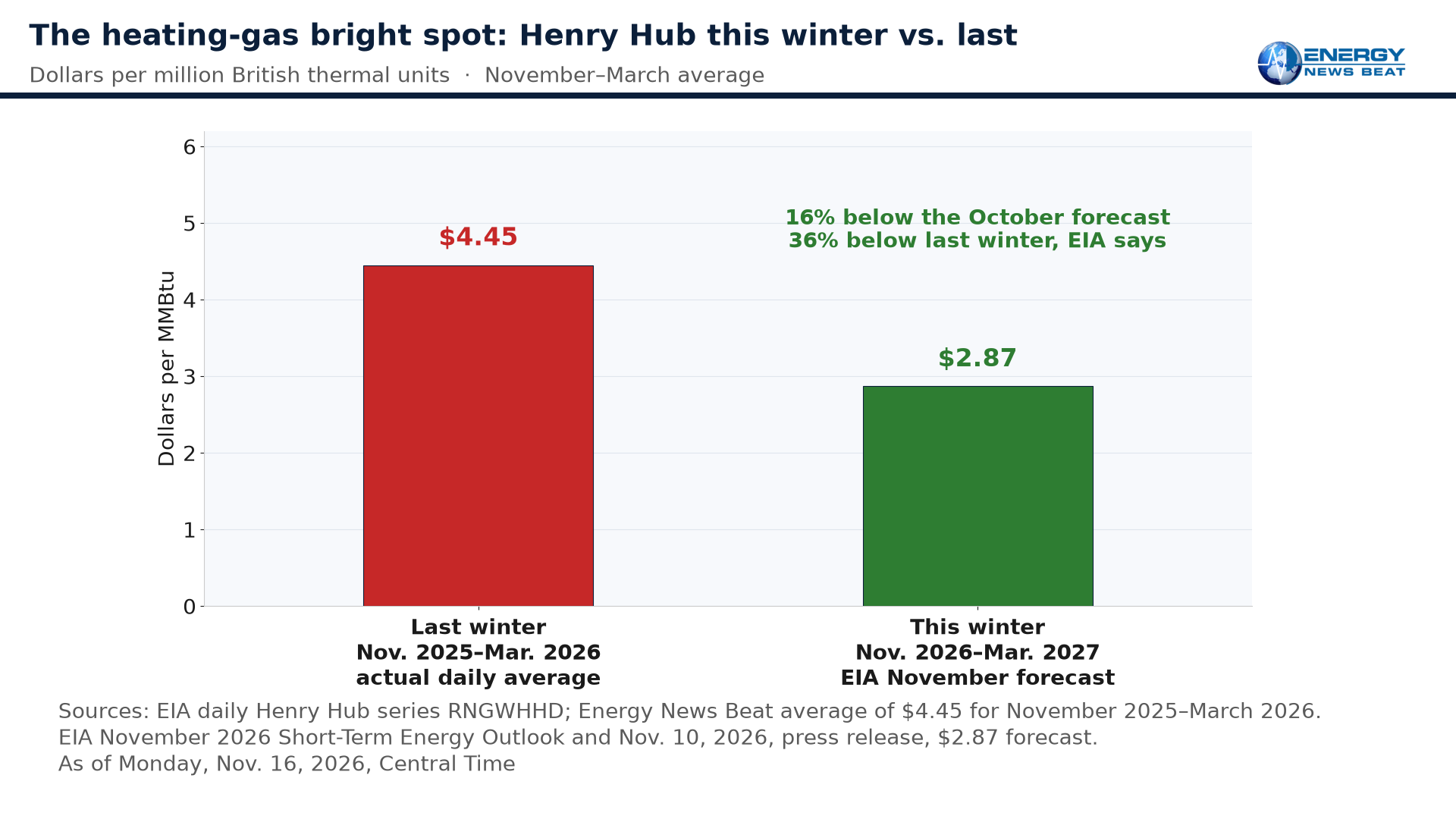
The good news for gas-heat households is in the same November outlook. EIA now sees the Henry Hub spot price averaging $2.87 per million British thermal units from November through March, 16 percent below its October forecast and, EIA says, 36 percent below last winter. Last winter, November 2025 through March 2026, the daily Henry Hub average was $4.45, including a $7.72 January during the winter storm. A lower wholesale price will not show up dollar-for-dollar on a utility bill, because delivery charges remain. Northeastern homes that heat with oil are in a different market: EIA’s residential heating-oil average was $5.915 in the week of Nov. 9.
Consumer and Investor Views
For drivers, today’s regular gasoline is $3.81, down from EIA’s $4.48 September peak, but still about 74 cents above a year ago. If you fill a diesel pickup or pay for freight in food and deliveries, $6 diesel is the bill that has not broken. The wider retail-wholesale gap, up 45 cents, is the one piece of the viral story that shows up in the data, and it is a reason the pump can still fall. Households heating with gas are looking at a much cheaper winter than last year’s; oil-heat homes are not.
For investors, this is a refined-product tightness story more than a crude story. Watch EIA’s next weekly inventory report, the diesel crack, and whether EIA or the IEA walk back the idea that product markets stay tight through 2027. A political de-escalation can take more premium out of Brent; it does not rebuild distillate tanks by itself. This is not investment advice.
Caveats and Criticism
Weekly EIA retail prices are Monday national averages; a $3 or $2.66 price on one corner does not describe the country. The 32.5-cent drop uses EIA’s Sept. 21 and Nov. 2 weeks; AAA is a daily survey. Retail-wholesale gaps and cracks are Energy News Beat arithmetic on EIA Harbor spots and WTI, not national racks, and include about 52 cents of taxes plus freight. Weekly EIA figures here are for Nov. 9; the next update is due Nov. 17.
We cannot see individual station pricing decisions and are not saying no one overcharged. We found no FTC, Justice Department or state attorney-general finding since Nov. 3 of election-timed gasoline pricing. How much of the post-Nov. 4 crude drop was the election, Iran talks, or the president’s remarks is a judgment; those events overlap within days.
The cited WSJ live card could not be verified. CNBC paraphrased “below $2” as prices falling below $2 a gallon after the midterms; Indy100 prints “below $2 a gallon.” We do not lean on “take a little bit longer than the midterm,” which CNBC and CNN attach to different claims. The IEA labels 1.7 million barrels a day as October’s observed build. Goldman’s $150 is wholesale diesel, about $3.57 a gallon (Reuters).
Stu’s Take
Drivers have every right to be angry about diesel near $6 and a year of expensive gasoline. What they do not have is evidence that oil companies or Democrats parked prices until after the midterms. EIA’s weekly numbers show regular gasoline falling every week from a Sept. 21 peak, 32.5 cents before anyone voted, which is the usual winter-blend and maintenance pattern, plus a war premium that shrank when talks and de-escalation signals arrived. The same-day September outlook already had gasoline coming down, and so did the oil futures curve. Trump was right on direction and tied it to the war; “below $2” was never in the forecasts. Diesel is the tell: it lagged gasoline, because tanks are thin and refining is short, and EIA now has it staying expensive into 2027. The bright spot is heating gas, at $2.87, well below last winter. Watch the retail-wholesale gap, too — up about 45 cents since September, there is still room for the pump to fall.
What people forget, is that energy policies impact their pocketbook more than they realize. We got to this point due to the Net Zero, climate change fear mongering that even the UN admitted they had lied about. So do your homework and trust no news story and research articles. That is why we are so big on listing our sources and being transparent. We waste cycles fact checking ourselves before we publish articles or show notes. It is better that we try to find errors so that you can at least feel comfortable that we do not have an agenda.
Appendix A — Sources
Primary documents and accounts used for this article. Access date is Monday, Nov. 16, 2026, unless a different access date is noted. Full excerpts are in Appendix B; data tables are in Appendix C.
- AAA, Fuel Prices, national averages as of Nov. 16, 2026: regular $3.8118 (yesterday $3.8242, week ago $4.0093, month ago $4.3271, year ago $3.0723, record $5.0165 on June 14, 2022); diesel $5.9989 (yesterday $6.0198, week ago $6.1723, month ago $6.3261, year ago $3.7682, record $6.5276 on Sept. 22, 2026) https://gasprices.aaa.com/
- AAA national averages on Election Day, Nov. 3, 2026, as reported the same morning: regular $4.149 (also printed $4.1493 / $4.14) and diesel $6.288 (also printed $6.28). Contemporaneous accounts include Energy News Beat, “Voters Head to the Polls With the Highest Election Day Gas Price on Record in Dollar Terms,” Nov. 3, 2026, which recorded the AAA page at about 6 a.m. Central; AL.com / MLive, Nov. 3, 2026; and WIBW, Nov. 3, 2026 https://energynewsbeat.com/diesel/voters-head-to-the-polls-with-the-highest-election-day-gas-price-on-record-in-dollar-terms/
- U.S. Energy Information Administration, Gasoline and Diesel Fuel Update, weekly U.S. retail regular and on-highway diesel. Week of Sept. 21, 2026: regular $4.478, diesel $6.529. Week of Nov. 2: regular $4.153, diesel $6.292. Week of Nov. 9: regular $3.995, diesel $6.127. New York Harbor conventional gasoline and ultra-low-sulfur diesel spots are from the same weekly update. Weekly retail prices and New York Harbor spots are from the same EIA update https://www.eia.gov/petroleum/gasdiesel/
- EIA, Weekly Petroleum Status Report, week ending Nov. 6, 2026, released Nov. 12, 2026. Distillate fuel oil stocks 103.3 million barrels, up 4.1 million from 99.3 million in the week of Oct. 30, down 6.8 percent from 110.9 million a year earlier. The Oct. 30 level is the lowest since May 2, 2003, on EIA’s weekly series WDISTUS1 https://www.eia.gov/petroleum/supply/weekly/
- EIA, Short-Term Energy Outlook, September 2026, current forecast Sept. 9, 2026, forecast date Thursday, Sept. 3, 2026. Retail regular gasoline: September $4.05, October $4.17, November $4.01, December $3.67, January 2027 $3.54. Wholesale gasoline $3.71 in September to $2.77 in December. September 2026 STEO, Table 2 https://www.eia.gov/outlooks/steo/
- EIA, Short-Term Energy Outlook, October 2026, and November 2026 (released Nov. 10, 2026; forecast date Thursday, Nov. 5, 2026). November vintage retail regular: November $4.06, December $3.79, December 2027 $3.14 (the lowest monthly regular-gasoline forecast in that outlook through December 2027). Retail diesel: November $6.10, December $5.79, 2027 annual average $5.03, up 12 percent from the October forecast of $4.49. November 2026 STEO, Table 2 https://www.eia.gov/outlooks/steo/
- EIA press release, “EIA raises November natural gas storage forecast after warm start to month,” Nov. 10, 2026. Henry Hub spot price averaging $2.87 per million British thermal units from November through March, 16 percent less than the October forecast. Diesel 2027 average $5.03, gasoline $3.73, because EIA now expects global supplies of refined fuels to remain tight through the end of 2027. The November STEO text also says the $2.87 figure is 36 percent less than last winter https://www.eia.gov/pressroom/releases/press594.php
- EIA daily Henry Hub natural gas spot price, series RNGWHHD. Energy News Beat average of daily values for November 2025 through March 2026 is $4.45. January 2026 monthly average is $7.72. Daily WTI (RWTCd) and Brent (RBRTEd) spots: Brent $120.15 on Oct. 30, $107.39 on Nov. 2, $91.84 on Nov. 4, $90.16 on Nov. 10, 2026 https://www.eia.gov/dnav/ng/hist/rngwhhdD.htm
- EIA Heating Oil and Propane Update, U.S. residential heating oil, week of Nov. 9, 2026: $5.915 a gallon https://www.eia.gov/petroleum/heatingoilpropane/
- U.S. Environmental Protection Agency, in consultation with the Department of Energy, expanded gasoline supply by allowing the winter-blend switch from Sept. 1, 2026, earlier than the usual mid-September date https://www.epa.gov/newsreleases/epa-consultation-doe-expands-gasoline-supply-lower-prices-pump
- PolitiFact, Caleb McCullough, “Falling gas prices aren’t proof gas companies inflated prices to hurt Trump,” Nov. 11, 2026. Rates the social-media claim False. Interview with Patrick De Haan, GasBuddy, Nov. 10, 2026 https://politifact.com/factchecks/2026/nov/11/social-media/gas-prices-election-trump-iran-war/
- CNBC, “Trump says oil and gas prices won’t fall until ‘right after’ midterm election,” Sept. 9, 2026. Source, with the BBC, of the Joint Base Andrews remarks: “Right after the election, oil prices are going to be tumbling downward,” and that the war would end “immediately after the election because they can’t hold out any longer.” CNBC also paraphrased, in free text, that he “claimed … gas prices will fall below $2 per gallon, but not until after the early November midterms” https://www.cnbc.com/2026/09/09/trump-oil-gas-prices-midterm-elections.html
- BBC, coverage of the same Sept. 9, 2026, Joint Base Andrews remarks https://www.bbc.com/news/articles/c5ydld0gykpo
- The Wall Street Journal, live-coverage card, “Oil and gas prices will fall after midterms, Trump says,” Sept. 9, 2026. Cited in earlier drafts for a “below $2 per gallon” wording. The live card could not be verified from this environment (the page returned an error). This article quotes only “we’ll get them below $2” and relies on CNBC’s free paraphrase and Indy100 https://www.wsj.com/livecoverage/vance-trump-midterm-elections-2026-rnc/card/oil-and-gas-prices-will-fall-after-midterms-trump-says-3phleZFTgPDEoJ8q3JPI
- Indy100, matching secondary report of the Sept. 9 “below $2 per gallon” remark https://www.indy100.com/politics/trump/trump-iran-war-oil-midterms
- Reuters, via The Hindu, “Trump reiterates that he sees Iran war ending after US midterm elections,” on the Sept. 13, 2026, Doonbeg, Ireland, remark: “Gasoline’s going to drop like a rock” https://www.thehindu.com/news/international/trump-reiterates-that-he-sees-iran-war-ending-after-us-midterm-elections/article71463852.ece
- Donald J. Trump, Truth Social, Nov. 2, 2026, archived at Trump’s Truth: “Oil Prices are DROPPING LIKE A ROCK, down almost $10 a Barrel, A RECORD, because people feel that there will not be a War with Iran…” NBC News reported the same day that, asked about strikes after the midterms, he said “No” twice https://www.trumpstruth.org/statuses/43202
- NBC News, “Oil prices slide in biggest drop since July on hope for more Iran talks,” Nov. 2, 2026, for the “No” to post-midterm strikes https://www.nbcnews.com/business/energy/oil-prices-slide-trump-hope-iran-talks-rcna607107
- International Energy Agency, Oil Market Report, November 2026, issued Nov. 13, 2026. “Severe tightness in product supply, especially for diesel, remains the overriding concern.” The IEA labels the October move as observed: “Observed oil inventories rebounded by 52 mb (+1.7 mb/d) in October, the first increase since June, as oil on water surged by 86 mb.” On-land stocks continued to fall to their lowest since at least 2016; OECD stocks fell 47 mb. Balances suggest a return to surplus in the fourth quarter https://www.iea.org/reports/oil-market-report-november-2026
- Goldman Sachs, Nov. 15, 2026, note, as reported by Reuters via Zawya: “US wholesale diesel averaging $150 a barrel in 2027.” The $150 figure is wholesale diesel, not the retail pump https://www.zawya.com/en/business/goldman-sees-brent-easing-to-78-a-barrel-by-end-2027-as-markets-adapt-2277950
- Bo Loudon, X, Nov. 6, 2026, asking whether “gas companies intentionally hiked gas prices to get voters to blame President Trump and vote Democrat.” Quoted in the article; engagement counts change by the hour and are not restated here as live figures https://x.com/BoLoudon/status/2118910996622475727
- TruePatriotVox, X, claiming Chuck Schumer coordinated with OPEC to keep prices high. No such emails have been published. Independent fact checks: MEAWW and View from the Gallery https://x.com/TruePatriotVox/status/2119312917158109278
- MEAWW, fact check, “Did Chuck Schumer coordinate with OPEC to blame Trump for rising gas prices?” Finds no evidence of such emails https://news.meaww.com/fact-check-did-chuck-schumer-coordinate-with-opec-to-blame-trump-for-rising-gas-prices
- View from the Gallery, “Gas drop, OPEC emails,” noting that no Schumer-OPEC emails have surfaced https://viewfromthegallery.com/breakdown/gas-drop-opec-emails
- Petroleum Economist, “The stories that matter, 7 September 2026,” Sept. 7, 2026. On the Sept. 4 Brent crude curve: “steeply backwardated: November 2026, near $95/bl; January 2027, around $88/bl; April 2027, closer to $80/bl.” This is a crude curve, not a gasoline curve. PE also framed the curve as pricing a war that “does not end soon” https://www.petroleum-economist.com/magazine/2026/augustseptember-2026/digital-exclusives/the-stories-that-matter-7-september-2026/
- U.S. Energy Information Administration, Today in Energy, on U.S. refinery closures, including LyondellBasell’s Houston plant (closed March 2025), Phillips 66’s Los Angeles refinery (October 2025) and Valero’s Benicia refinery (ceased refining in early 2026, removed from capacity in March 2026 and fully idled in April) https://www.eia.gov/todayinenergy/detail.php?id=67807
- S&P Global, “What could come next for the US oil market following the Democratic Party sweep?” Nov. 4, 2026. Oil futures fell sharply after Democratic victories were seen as lowering the risk of U.S.-Iran escalation https://www.spglobal.com/energy/en/news-research/latest-news/crude-oil/110426-what-could-come-next-for-the-us-oil-market-following-the-democratic-party-sweep
- Reuters, via CNA, “Oil slumps after midterm election rebuke to Trump raises bets on Iran war exit,” Nov. 4, 2026. Brent futures settled 8.7 percent lower at $94.62 a barrel; WTI fell 8.3 percent to $88.12 https://www.channelnewsasia.com/business/oil-slumps-after-midterm-election-rebuke-trump-raises-bets-iran-war-exit-6519506
- AL.com / MLive, Matt Durr, “Gas prices for 11/03/26: Gas has never been more expensive on Election Day,” Nov. 3, 2026. Independent same-day account of AAA national averages: regular $4.14 and diesel $6.28. Complements Energy News Beat’s same-morning AAA read of $4.149 and $6.288 https://www.al.com/news/2026/11/gas-prices-for-110326-gas-has-never-been-more-expensive-on-election-day.html
- U.S. Energy Information Administration, Frequently Asked Questions, “How much tax do we pay on a gallon of gasoline and on a gallon of diesel fuel?” January 2026. Federal gasoline tax is 18.40 cents a gallon and the average of total state taxes is 33.27 cents, about 52 cents in total. The figure excludes county and local taxes. Cited for the article’s “about 52 cents of taxes” in the retail-wholesale gap https://www.eia.gov/tools/faqs/faq.php?id=10
Appendix B — Key excerpts
EIA press release, Nov. 10, 2026. “In its November Short-Term Energy Outlook (STEO), EIA forecasts more U.S. natural gas in storage throughout this winter, resulting in the Henry Hub natural gas spot price averaging $2.87 per million British thermal units from November through March, 16% less over that period than forecast last month.” “EIA raised both [gasoline and diesel] forecasts from October because it now expects global supplies of refined fuels to remain tight through the end of 2027. EIA forecasts that diesel will average $5.03 per gallon, up from $4.49 per gallon in the October forecast, and gasoline will average $3.73 per gallon, up from $3.56 per gallon.”
EIA, November 2026 Short-Term Energy Outlook, natural-gas discussion. “The Henry Hub spot price in our forecast averages $2.87 per million British thermal units (MMBtu) from November through March, 16% less than last month’s forecast and 36% less than last winter.”
EIA, Weekly Petroleum Status Report highlights, week ending Nov. 6, 2026, released Nov. 12. Distillate fuel oil stocks were 103.3 million barrels, compared with 99.3 million barrels the prior week, an increase of 4.1 million barrels, and compared with 110.9 million barrels a year earlier, down 6.8 percent. (Wording from the official weekly highlights.)
PolitiFact, Caleb McCullough, Nov. 11, 2026. “U.S. gas prices peaked Sept. 21 before falling every week leading up to the Nov. 3 election.” “There’s no reason to believe gas companies purposely inflated prices, De Haan said.” “We rate the claim False.”
President Trump, Joint Base Andrews, Sept. 9, 2026, as reported by CNBC and the BBC. “Right after the election, oil prices are going to be tumbling downward.” “I think the war’s going to end immediately after the election because they can’t hold out any longer.” He also said, “we’ll get them below $2.” CNBC’s free paraphrase reported that he claimed prices would fall below $2 per gallon after the midterms. The cited WSJ live card could not be verified. Indy100 prints “below $2 a gallon.”
President Trump, Doonbeg, Ireland, Sept. 13, 2026, Reuters via The Hindu. “Gasoline’s going to drop like a rock.”
President Trump, Truth Social, Nov. 2, 2026, archived at Trump’s Truth. “Oil Prices are DROPPING LIKE A ROCK, down almost $10 a Barrel, A RECORD, because people feel that there will not be a War with Iran…”
International Energy Agency, Oil Market Report, November 2026, Nov. 13, 2026. “Severe tightness in product supply, especially for diesel, remains the overriding concern.” “Observed oil inventories rebounded by 52 mb (+1.7 mb/d) in October, the first increase since June, as oil on water surged by 86 mb.” On-land stocks continued to fall, to their lowest since at least 2016. Balances suggest a return to surplus in 4Q26.
Petroleum Economist, Sept. 7, 2026, on the Sept. 4 Brent crude curve. “steeply backwardated: November 2026, near $95/bl; January 2027, around $88/bl; April 2027, closer to $80/bl.”
Goldman Sachs, Nov. 15, 2026, as reported by Reuters via Zawya. “US wholesale diesel averaging $150 a barrel in 2027.”
Appendix C — Data tables (with as-of dates)
Figures below are as of Monday, Nov. 16, 2026, Central Time, unless a table states a different as-of date. Energy News Beat arithmetic is labeled where it is used. Dollar figures are left unrounded when the source published them that way.
C1. AAA national averages, Nov. 16, 2026
| Series | Nov. 16, 2026 | Yesterday | Week ago | Month ago | Year ago | Record |
| Regular | $3.8118 | $3.8242 | $4.0093 | $4.3271 | $3.0723 | $5.0165 (June 14, 2022) |
| Diesel | $5.9989 | $6.0198 | $6.1723 | $6.3261 | $3.7682 | $6.5276 (Sept. 22, 2026) |
Source: AAA Fuel Prices, gasprices.aaa.com, as of Monday, Nov. 16, 2026. Election Day (Nov. 3) AAA averages: Energy News Beat’s same-morning read was regular $4.149 and diesel $6.288; AL.com independently reported regular $4.14 and diesel $6.28 the same day. AAA diesel is down 4.6 percent since Election Day (6.288 to 5.9989), versus 8.1 percent for regular (4.149 to 3.8118). AAA does not publish a public daily archive.
C2. EIA weekly U.S. retail gasoline and diesel
| Week (Monday) | Retail regular, $/gal | Retail diesel, $/gal | Notes |
| Sept. 21, 2026 | 4.478 | 6.529 | September peak week for regular; 2026 weekly high was $4.500 on May 11 |
| Sept. 28, 2026 | 4.465 | 6.382 | First weekly decline |
| Oct. 5, 2026 | 4.354 | 6.199 | |
| Oct. 12, 2026 | 4.331 | 6.179 | |
| Oct. 19, 2026 | 4.284 | 6.276 | |
| Oct. 26, 2026 | 4.269 | 6.352 | |
| Nov. 2, 2026 | 4.153 | 6.292 | Monday before the Nov. 3 election |
| Nov. 9, 2026 | 3.995 | 6.127 | First weekly regular average below $4 since July |
Source: EIA Gasoline and Diesel Fuel Update, weekly U.S. averages. 32.5-cent pre-election drop is Energy News Beat arithmetic: 4.478 − 4.153 = 0.325. Peak-to-Nov. 9 regular decline: 4.478 − 3.995 = 0.483, or 10.8 percent. As of Nov. 16, 2026.
C3. Retail-wholesale gaps and cracks (Energy News Beat arithmetic on EIA prices; gap includes taxes)
| Week (Monday) | Retail minus NYH gasoline, $/gal | Gasoline crack vs. WTI, $/gal | Diesel crack vs. WTI, $/gal |
| Sept. 21, 2026 | 0.936 | 1.077 | 2.758 |
| Oct. 19, 2026 | 1.313 | 0.591 | 2.648 |
| Oct. 26, 2026 | 1.344 | 0.373 | 2.649 |
| Nov. 2, 2026 | 1.249 | 0.390 | 2.243 |
| Nov. 9, 2026 | 1.387 | 0.323 | 2.333 |
Energy News Beat arithmetic on EIA weekly retail regular, New York Harbor conventional gasoline and ULSD spots, and the prior-week WTI average. These are proxies, not national rack prices. The retail-wholesale gap includes about 52 cents of fuel taxes plus freight (EIA FAQ, January 2026: federal 18.40 cents plus the 33.27-cent average of state taxes, excluding county and local taxes). The signal in the article is the widening: 1.387 − 0.936 = 45.1 cents from Sept. 21 to Nov. 9, which the article rounds to 45 cents. The article rounds the Sept. 21 gap to about 94 cents and the Nov. 9 gap to $1.39, the gasoline crack to about 32 cents, and the diesel crack to about $2.33. As of Nov. 16, 2026.
C4. U.S. distillate stocks versus the 2021–25 range
| Week ending | 2026 stocks, million bbl | 2021–25 average | 2021–25 minimum | vs. average |
| Oct. 23, 2026 | 102.8 | 113.7 | 106.4 | Below average |
| Oct. 30, 2026 | 99.3 | 114.5 | 106.8 | Lowest since May 2, 2003 |
| Nov. 6, 2026 | 103.3 | 112.8 | 106.3 | About 8.4% below average; below the five-year low |
Source: EIA Weekly Petroleum Status Report and series WDISTUS1. Five-year comparison is Energy News Beat arithmetic on the same week in 2021–25. Highlights print 103.3 and 99.3 million barrels; the underlying weekly series is 103,330 and 99,259 thousand barrels. Year-ago stocks in the week of Nov. 6 were 110.9 million, down 6.8 percent. As of the Nov. 12, 2026, release.
C5. EIA STEO vintages, retail regular gasoline and diesel, $/gal
| Month | Sept. STEO gasoline | Nov. STEO gasoline | Sept. STEO diesel | Nov. STEO diesel |
| Sept. 2026 | 4.05 | 4.35 (actual) | 5.60 | 6.29 (actual) |
| Oct. 2026 | 4.17 | 4.31 (actual) | 5.72 | 6.25 (actual) |
| Nov. 2026 | 4.01 | 4.06 | 5.60 | 6.10 |
| Dec. 2026 | 3.67 | 3.79 | 5.31 | 5.79 |
| Jan. 2027 | 3.54 | 3.68 | 5.08 | 5.55 |
| Dec. 2027 | 2.87 | 3.14 | 3.93 | 4.72 |
Source: EIA STEO Table 2, September and November 2026 outlooks. September STEO released Sept. 9, 2026, forecast date Sept. 3. November STEO released Nov. 10, 2026, forecast date Nov. 5. November STEO 2027 annual diesel average is $5.03, up from $4.49 in the October outlook. The $3.14 December 2027 regular-gasoline figure is the lowest monthly regular forecast in the November outlook through December 2027 (printed 3.136). AAA Nov. 16 regular $3.8118 is a daily average, not a monthly EIA actual.
C6. Henry Hub, last winter versus this winter’s forecast
| Period | Henry Hub, $/MMBtu | Source |
| Nov. 2025–Mar. 2026, daily average | 4.45 | Energy News Beat average of EIA series RNGWHHD |
| January 2026 monthly average | 7.72 | EIA daily series, monthly mean during the winter storm |
| Nov. 2026–Mar. 2027 forecast | 2.87 | EIA November 2026 STEO and Nov. 10 press release |
| Change vs. October STEO forecast | −16% | EIA press release and STEO text |
| Change vs. last winter | −36% | EIA November STEO text. EIA’s basis is not stated; on ENB’s daily average the decline is 35.5 percent |
As of the Nov. 10, 2026, STEO. A lower wholesale gas price will not show up dollar-for-dollar on a utility bill. EIA residential heating oil, week of Nov. 9, 2026, was $5.915 a gallon.
C7. EIA daily WTI and Brent spots around the election
| Date | WTI spot, $/bbl | Brent spot, $/bbl | Notes |
| Oct. 30, 2026 | 107.56 | 120.15 | Friday before the Nov. 2 drop |
| Nov. 2, 2026 | 100.06 | 107.39 | Iran talks / Trump “No” to post-midterm strikes |
| Nov. 3, 2026 | 99.64 | 107.03 | Election Day |
| Nov. 4, 2026 | 91.73 | 91.84 | Markets also read the Democratic sweep |
| Nov. 10, 2026 | 89.62 | 90.16 | Latest full EIA daily print in the series extract used for this article |
Source: EIA daily spots, series RWTCd and RBRTEd, compiled from EIA daily series RWTCd and RBRTEd. These are EIA official spots, not futures settlements. Some secondary accounts quoted different one-day percentage changes on futures; this article therefore describes the Nov. 2 and Nov. 4 moves as sharp declines without attaching a single percentage in the body. As of Nov. 16, 2026.
C8. Autumn regular-gasoline declines, selected years
| Year | Sept. peak week, regular | Mid-November week | Change |
| 2014 | $3.459 (Sept. 1) | $2.894 (Nov. 17) | −16.3% |
| 2023 | $3.878 (Sept. 18) | $3.349 (Nov. 13) | −13.6% |
| 2025 | $3.192 (Sept. 8) | $3.062 (Nov. 17) | −4.1% |
| 2026 | $4.478 (Sept. 21) | $3.995 (Nov. 9) | −10.8% |
Energy News Beat arithmetic on EIA weekly U.S. regular retail, each year’s September peak week to a mid-November week. 2026 is compared with the week of Nov. 9; the other years use weeks of Nov. 13–17, one week later. 2026’s 10.8 percent decline is smaller than 2014’s 16.3 percent and 2023’s 13.6 percent, and sits between 2025’s 4.1 percent and 2014. As of Nov. 16, 2026.
Appendix D — Background
U.S. retail gasoline usually eases after Labor Day. Summer-grade fuel, which is more expensive to make, gives way to winter blend; driving demand falls; and refineries come back from autumn maintenance. The EPA, in consultation with DOE, allowed that winter-blend switch from Sept. 1, 2026, earlier than the usual mid-September date. That seasonal pattern is the baseline against which this year’s 10.8 percent peak-to-mid-November decline is compared. A “crack” is the difference between a refined-product spot price and a crude benchmark; this article uses New York Harbor spots versus WTI, in dollars a gallon, as a consistent weekly proxy. “Rockets and feathers” is the industry shorthand for pump prices that rise quickly and come down slowly, which can widen the retail-minus-wholesale gap even when crude is falling. The midterm election was Tuesday, Nov. 3, 2026. EIA’s Short-Term Energy Outlook is, by law, independent of other federal agencies; the September 2026 outlook was published the same day as President Trump’s Joint Base Andrews remarks, with inputs locked on Sept. 3. Distillate fuel oil is the stock that supplies both on-highway diesel and heating oil. This article does not treat a claimed Nov. 15, 2026, drone attack on a U.S. facility in Bahrain, or unverified claims of mines in the Strait of Hormuz, as established facts; those reports were not used in the body. Community Notes on the quoted X posts were not independently confirmed and are not characterized as present or absent.
Appendix E — Methodology and limits
Retail gasoline and diesel in the body use two official surveys that do not match day for day: EIA’s weekly Monday national average and AAA’s daily national average. The 32.5-cent pre-election decline uses only EIA’s Sept. 21 and Nov. 2 weeks. The 4.6 percent diesel decline since Election Day (versus 8.1 percent for regular) uses AAA’s Nov. 3 prints of $6.288 and $4.149, as recorded that morning by contemporaneous accounts, and AAA’s Nov. 16 prints of $5.9989 and $3.8118, which we rechecked on gasprices.aaa.com. Retail-minus-spot gaps and cracks are Energy News Beat calculations on EIA prices, not a published EIA table; they use New York Harbor spots and WTI, not a national rack, and they include typical fuel taxes in the retail leg. Distillate five-year averages and ranges are Energy News Beat calculations from EIA weekly stocks for the same week in 2021–25. The last-winter Henry Hub average of $4.45 is an Energy News Beat average of EIA daily spots from November 2025 through March 2026; the $2.87 forecast and the 16 percent and 36 percent comparisons are EIA’s. Autumn percentage declines by year use each year’s September peak week and the mid-November week on EIA’s weekly regular series. We did not invent dates, quotes, or figures. The cited WSJ live card could not be verified. The article quotes only “we’ll get them below $2” and cites CNBC’s free paraphrase and Indy100 (“below $2 a gallon”). We found no FTC, Justice Department, or state attorney-general finding after Nov. 3 of election-timed gasoline pricing; that is a statement about what we found, not a proof that no local overcharge occurred. We cannot see individual station or chain pricing decisions. How much of the post-Nov. 4 crude drop was the election, Iran talks, or the president’s remarks is a judgment; those events overlap within days. The IEA labels 1.7 million barrels a day as October’s observed inventory build; that build came from 86 million barrels of oil on water, while on-land stocks fell to their lowest since at least 2016. Goldman’s $150 a barrel is wholesale diesel, about $3.57 a gallon, as reported by Reuters, not the retail pump. AAA does not publish a public daily history, so “under $6 for the first time since September” is consistent with EIA weekly diesel but cannot be fully verified from an AAA archive. EIA’s next Gasoline and Diesel Fuel Update after the week of Nov. 9 is due Nov. 17, 2026. Engagement counts on X change by the hour and are not treated as live figures in the article.