
The plant can process about 10 million tons a year and accounts for about 2.7 percent of Russian refining throughput, The Moscow Times says. Regional officials say plants are running normally; the damage is unconfirmed. The IEA, as reported by Oil & Gas Journal, does not see meaningful diesel relief before the second half of 2027.
Ukrainian drones struck Gazprom Neftekhim Salavat, one of Russia’s largest oil refining and petrochemical complexes, in the republic of Bashkortostan, The Moscow Times reported Tuesday. The plant sits about 1,200 kilometers, or 746 miles, from the border with Ukraine. Ukraine’s General Staff confirmed the strike later Tuesday and said the complex is “capable of processing about 10 million tons of oil a year.” The Moscow Times said the refinery accounts for 2.7 percent of Russia’s refining throughput and produces gasoline, diesel and kerosene. That share reflects actual runs, which are below the plant’s capacity.
Bashkortostan’s emergency situations committee said the Defense Ministry, security guards and mobile air-defense groups had repelled more than 50 drones and wrote, “All factories are operating as normal and there’s no critical damage.” The exiled outlet Astra, cited by The Moscow Times, identified the plant from eyewitness footage of fires and black smoke. The damage itself has not been independently confirmed.
This is a new hit, not a new supply balance. The AAA national average for diesel is $5.959 a gallon this morning, Wednesday, Nov. 18, a few cents below Tuesday and still under $6 after this week’s dip. That print is real money for a truck or a tractor. It is not the same thing as relief.
Why relief is a 2027 story
The International Energy Agency still sees a tight diesel market. In its November Oil Market Report, published Nov. 13, the agency called “severe tightness in product supply, especially for diesel,” the “overriding concern,” and pointed to continued attacks on Russian energy infrastructure. Oil & Gas Journal, reporting on that same review, said high prices and strong refinery runs have slightly eased the tightness, but that low inventories and supply disruptions mean relief is unlikely before the second half of 2027. The Journal also said the IEA flagged renewed Ukrainian attacks on Russian refineries in early November as one of the developments that could delay an easing.
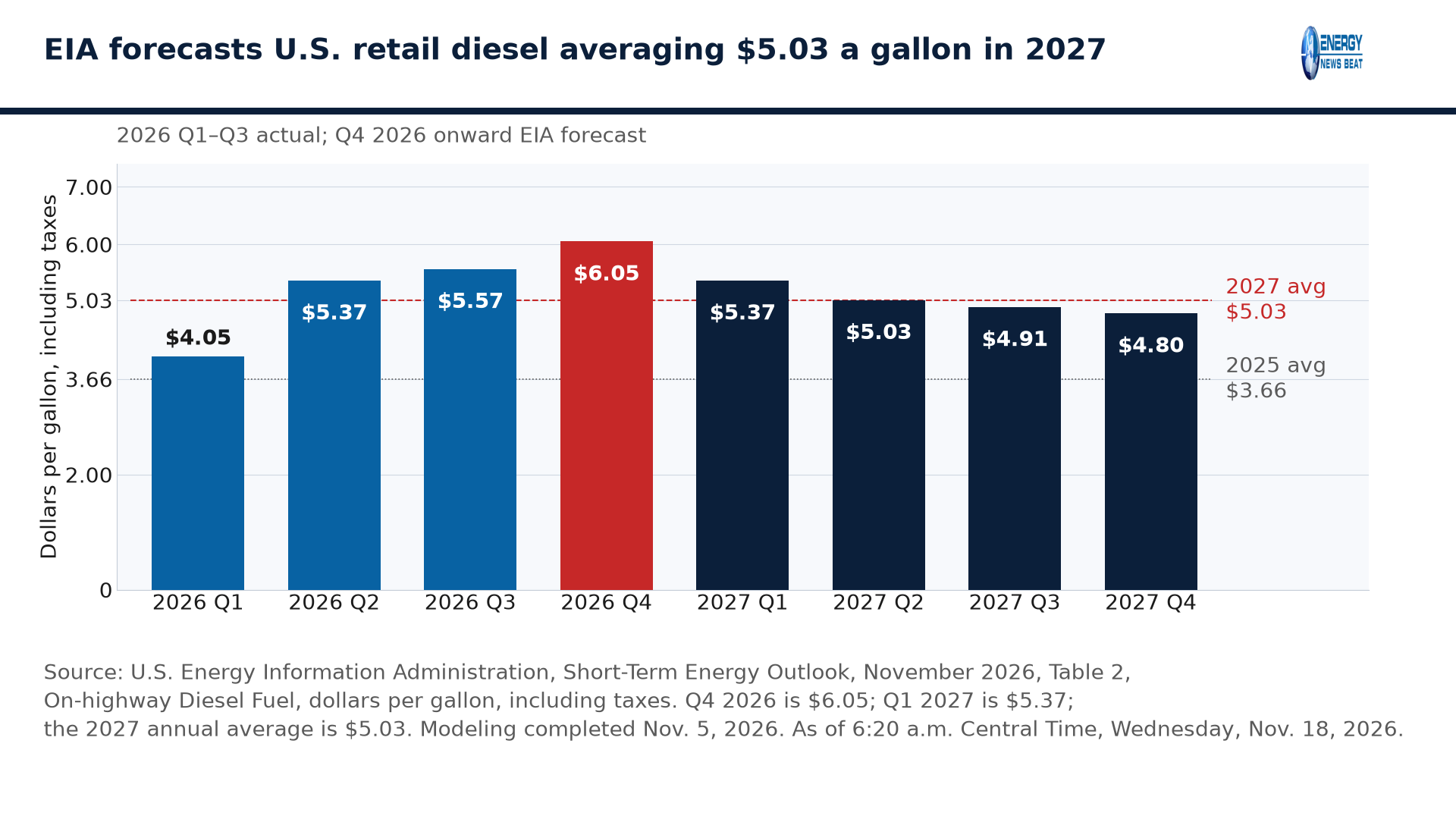
The U.S. pump forecast points the same way. The Energy Information Administration’s November Short-Term Energy Outlook puts on-highway diesel, including taxes, at $6.05 a gallon in the fourth quarter of 2026, $5.37 in the first quarter of 2027, and $5.03 for 2027 as a whole. That 2027 average is 12 percent higher than EIA’s prior outlook, and it is still well above the 2025 average of $3.66.
The official inventory picture is a week old, and it is still tight. EIA’s latest Weekly Petroleum Status Report, for the week ended Nov. 6 and released Nov. 12 after the Veterans Day delay, put U.S. distillate stocks at 103.3 million barrels, up 4.1 million on the week but 6.8 percent below a year earlier. The next weekly report, covering the week ended Nov. 13, is scheduled for about 9:30 a.m. Central Time today and was not out as of 6:20 a.m. Central Time. GasBuddy and Sparta Commodities, both citing that Nov. 6 report, said distillate stocks were about 8 percent below the five-year seasonal average. That five-year comparison is theirs, not a figure EIA published in Table 6.
Heating oil is moving with diesel. EIA’s Heating Oil and Propane Update put the U.S. residential average at $5.915 a gallon for the week of Nov. 9, about $5.92, down 22 cents on the week but $2.19 higher than a year earlier. The next weekly update, normally posted after 1 p.m. Eastern Time, was not out as of this morning.
A confirmed outage at a plant that makes diesel and kerosene would matter. So would a finding that Salavat is, in fact, running normally. Neither has been independently established. What is established is the calendar: the IEA, as reported, sees relief at best in the second half of 2027, and EIA’s own forecast still has U.S. retail diesel averaging $5.03 next year.
Stu’s Take
The break under $6 was real, and $5.959 is a little cheaper than yesterday. It is not the all-clear. Distillate stocks are still tight, heating oil is still about $5.92, and another major Russian refinery was hit. Bashkortostan officials say plants are running normally; the damage is unconfirmed, so treat it as a risk, not as barrels already gone. Drivers will feel a cheaper gallon this week. They should not confuse it with a rebuilt market. The IEA and EIA are both pointing at 2027 — and the IEA, as reported, at the second half of that year — not at the rest of this heating season.
We will be watching the refineries, their CapEx budgets for repairs, and demand destruction kicking in. How much the big oil companies will be allocating to repairs will be critical for the US Markets. For the global markets, they need to pray for an end to the wars.
Sources
- The Moscow Times, “Ukrainian Drones Hit Gazprom Refinery in Bashkortostan in Second Record Overnight Attack,” Nov. 17, 2026 https://www.themoscowtimes.com/2026/11/17/ukrainian-drones-hit-gazprom-refinery-in-bashkortostan-in-second-record-overnight-attack-a94282
- International Energy Agency, Oil Market Report — November 2026, published Nov. 13, 2026, including the “overriding concern” language on diesel tightness https://www.iea.org/reports/oil-market-report-november-2026
- Conglin Xu, Oil & Gas Journal, “IEA: High diesel prices ease demand, supply constraints persist,” Nov. 17, 2026, reporting the IEA conclusion that relief is unlikely before the second half of 2027 https://www.ogj.com/general-interest/economics-markets/news/55419515/iea-high-diesel-prices-ease-demand-supply-constraints-persist
- U.S. Energy Information Administration, Short-Term Energy Outlook, November 2026, Table 2, on-highway diesel fuel, including taxes. Modeling completed Nov. 5, 2026 https://www.eia.gov/outlooks/steo/archives/nov26.pdf
- AAA Fuel Prices, national averages as of Nov. 18, 2026: diesel $5.9594, regular $3.7502 https://gasprices.aaa.com/
- EIA Weekly Petroleum Status Report, Table 6, week ended Nov. 6, 2026, released Nov. 12, 2026 (Veterans Day delay). Distillate fuel oil stocks 103.3 million barrels. The Nov. 18 report had not been released as of 6:20 a.m. Central Time https://www.eia.gov/petroleum/supply/weekly/pdf/table6.pdf
- GasBuddy, “Gas Prices Fall in All 50 States…,” Nov. 16, 2026: distillate inventories in the week ended Nov. 6 “are about 8% below the five-year seasonal average” https://www.gasbuddy.com/go/gas-prices-fall-in-all-50-states-and-could-hit-their-lowest-level-since-march-this-week
- Sparta Commodities, “Rotterdam diesel arbs reopen, but winter supply risks remain,” Nov. 18, 2026: distillate stocks built 4.1 million barrels to 103.3 million in the week ended Nov. 6 but “remain 8% below their five-year average” https://www.spartacommodities.com/market-outlook/rotterdam-diesel-arbs-reopen-winter-risks/
9. EIA Heating Oil and Propane Update, U.S. residential heating oil average $5.915 a gallon for the week of Nov. 9, 2026. The Nov. 18 weekly update had not been posted