

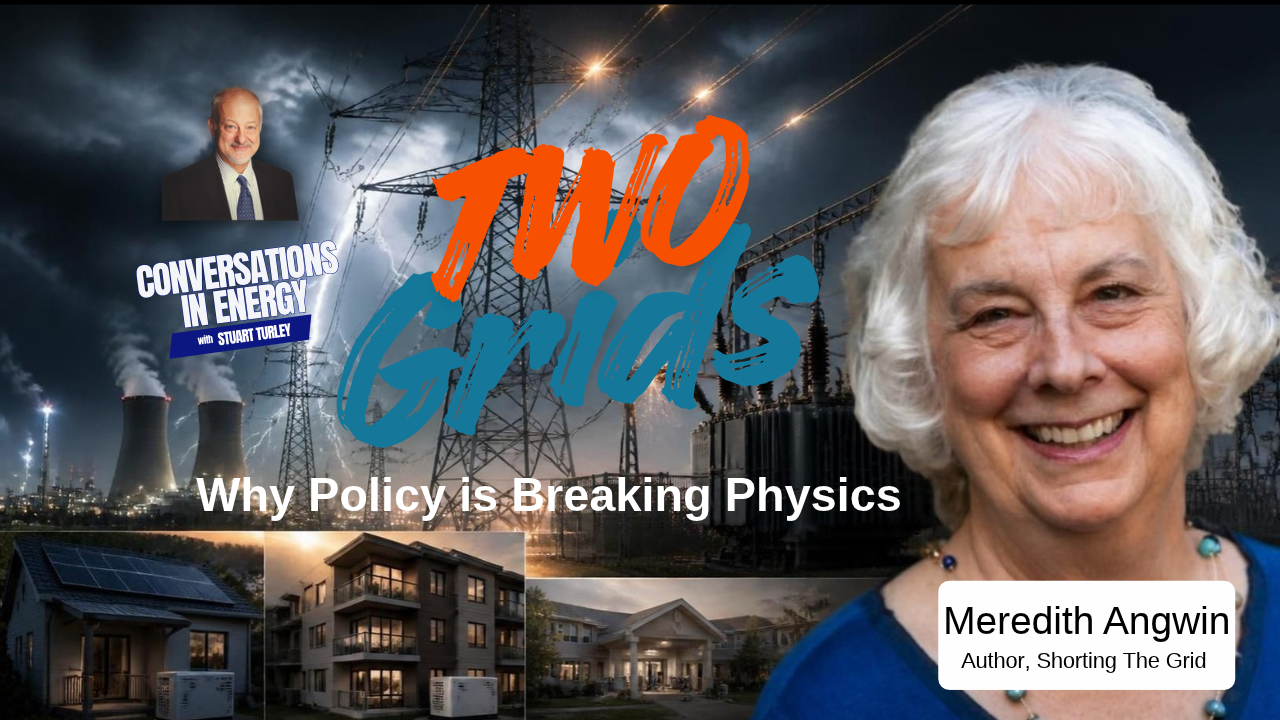
Welcome back to the Energy Newsbeat podcast. Today, we’re diving deep into one of the most critical—and misunderstood—issues facing America’s energy future. Most people think the grid is just the wires and power plants they see.
But what if I told you two grids are operating at the same time, and they’re increasingly working against each other? One is governed by the laws of physics. The other is governed by policy papers.
And right now, policy is winning—with dangerous consequences. Our guest today is Meredith Angwin , author of “Shorting the Grid” and what we call the national treasure of energy. She’s here to explain why your electricity bills are skyrocketing, why rolling blackouts are coming, and why the $10.3 trillion we’ve spent on wind and solar hasn’t made our grid more reliable—it’s made it more fragile.
If you care about keeping the lights on, affording your power bill, or understanding the real state of America’s energy infrastructure, you need to hear this conversation.

1. The Two Grids Concept
The Physical Grid: The actual infrastructure you can see (transmission lines, substations) governed by immutable physics and laws
The Policy Grid: A set of regulations and policies (net metering, renewable portfolio standards, net-zero mandates, renewable energy certificates) that determine how the physical grid is paid for
The key insight is that policy decisions often ignore physical realities, creating conflicts between what regulations demand and what physics allows.
2. The Fatal Trifecta of Grid Errors
Installing too many renewables without adequate backup systems
Failing to account for inertia and support from rotating machinery
Not understanding the grid’s need for reliable baseload power
3. Renewable Energy Limitations and Common-Mode Failure
Wind Variability: Wind doesn’t always blow when needed
Storage Requirements: Wind and solar must be paired with expensive storage systems to be grid-viable, yet these costs aren’t factored into affordability claims
4. Grid Resilience and Baseload Power
Nuclear, coal, natural gas, and hydro provide reliable baseload power
The grid cannot function reliably with high percentages of intermittent renewables without massive backup infrastructure
5. International Energy Policy Failures
France: Neglected nuclear maintenance, reducing operational capacity from 35 reactors to 25%
Norway & Canada: Prioritizing domestic energy needs over exports; Quebec and Norway are reconsidering power exports to neighboring regions
New York: Spent $6 billion on a hydroelectric interconnect with Canada that provides only 30 minutes of power daily
6. The Cost of Renewable Subsidies
Wind and solar are not truly “renewable”—less than 1% of solar panels are recycled, and wind turbines create a $93 billion land reclamation liability
Approximately 70,000 aging wind turbines in the US are approaching end-of-life with no funded decommissioning plan
7. Grid Vulnerability and Emergency Preparedness
Vulnerable populations (elderly in assisted living, those dependent on oxygen generators) lack backup power plans
Apartment buildings cannot easily accommodate backup power solutions like Tesla batteries or generators
Affordable backup solutions (like Jackery portable power units) are being explored for apartment complexes
8. The Path Forward
Multiple nuclear CEOs indicate significant reactor deployments within 10 years
Africa and developing nations want reliable baseload power, not just renewables
Energy independence and reliability must be prioritized over ideological commitments to 100% renewables
9. Political and Regional Disparities
Policy-driven energy decisions are creating economic disadvantages
The assumption that “all good people want 100% renewable grids” is becoming outdated as people recognize the need for reliability and affordability
The Global Grids Need Repairs and Upgrades
Today on Energy News Beat, I wrote this article, “Global Demand for Power is growing Faster Than Grids can support,” and it really hit home after I worked on this podcast with Meredith.
Global electricity demand is growing faster than the grids that have to carry it. The constraint is no longer just generation. It is the hardware that steps voltage up and down—large power transformers and the related substation gear—and the industrial base that used to build them.
The International Energy Agency’s Electricity 2026 report puts global power demand growth above 3.5 percent a year on average through the end of the decade, more than twice the pace of the prior ten years. Meeting that load, the IEA says, requires annual grid investment to rise about 50 percent by 2030 from roughly $400 billion today. More than 2,500 gigawatts of generation, storage, and large-load projects are already stuck in connection queues worldwide. Planning and building new transmission still takes 5 to 15 years. Data centers take 1 to 3.
That mismatch is now the binding constraint on what OilPrice and others have called the end of a long flat period in rich-country power demand.
Demand is no longer flat
In the United States, electricity use set a record and is still climbing after two decades of near-stagnation. The Energy Information Administration has data-center load as the dominant driver of long-term U.S. growth; OilPrice’s summary of the EIA outlook puts U.S. sales growth near 3.2 percent a year through 2035, with data centers about two-thirds of that. The IEA’s own U.S. figure is a bit lower—close to 2 percent a year through 2030, still more than double the prior decade—and attributes roughly half of advanced-economy demand growth to data centers. Either way, the direction is the same: load that shows up in one to three years, equipment that does not.
Asia-Pacific is expected to account for nearly three-quarters of global demand growth through 2035, led by industrialization and urbanization in China, India, and Southeast Asia. Europe’s rebound is smaller and policy-driven—electrification, heat pumps, and a push to cut gas exposure—landing on networks that were maintained, not expanded, for thirty years.
Gas turbines are a parallel bottleneck for new firm power. Transformers are the one that hits every pathway: gas, nuclear, wind, solar, and the data hall itself.
An old fleet, built one unit at a time
The age figures that circulate in the trade are real, and they are specific.
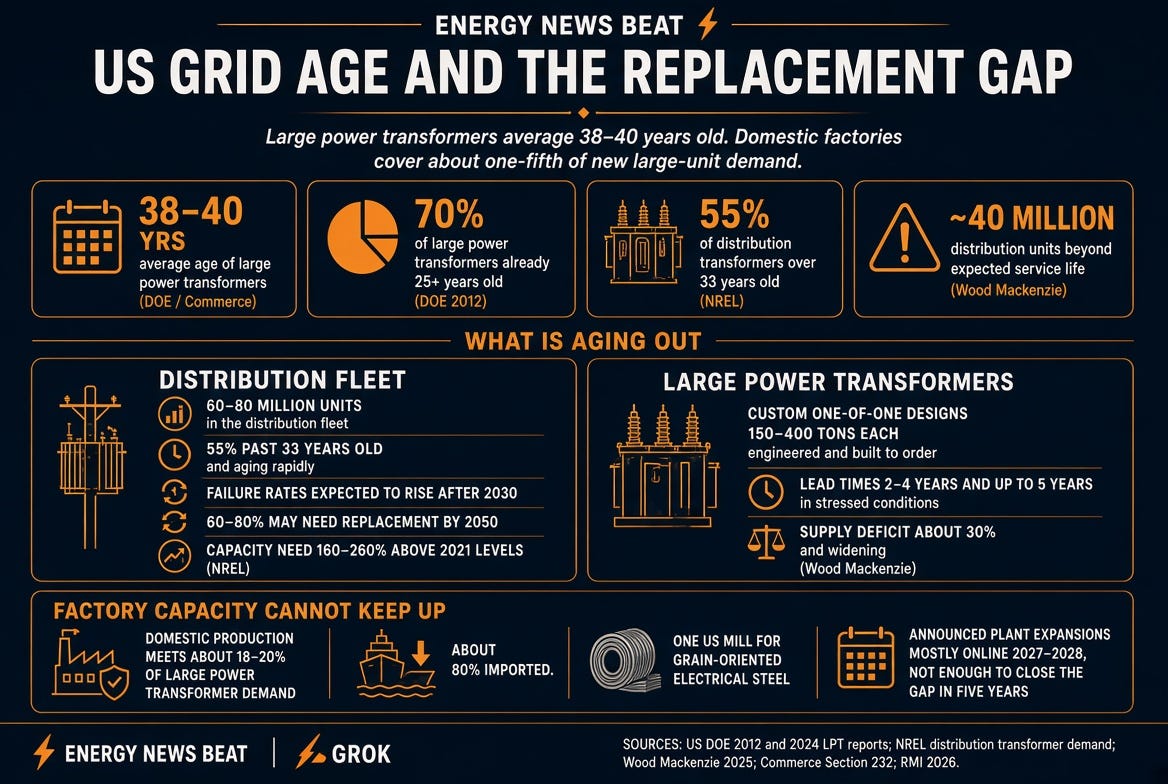
The Department of Energy’s 2012 Large Power Transformers and the U.S. Electric Grid report put the average age of installed large power transformers (generally 100 MVA and above) at about 40 years, with 70 percent already 25 or older. A later Commerce Department Section 232 review, cited by the National Infrastructure Advisory Council, put the in-service average near 38 years. Many of those units were designed around a 25- to 40-year technical life. They have been run past it.
Distribution is a different population. NREL estimates 60 to 80 million distribution transformers in service, with about 55 percent more than 33 years old and approaching end of life. Wood Mackenzie has put more than half of the distribution fleet—about 40 million units—beyond its expected service life. Failure rates are expected to rise sharply after 2030. By 2050, NREL estimates that 60 to 80 percent of in-service distribution units will need replacement, and required distribution-transformer capacity could be 160 to 260 percent above 2021 levels.
They are not interchangeable. DOE and industry counts put the number of distribution configurations above 80,000. Large power transformers are closer to one-of-one: about 1.3 units per design, matched to a specific impedance, voltage ratio, and substation footprint. A single large unit weighs 150 to 400 tons (some citations run higher), moves on specialized rail cars, and cannot be swapped from a warehouse shelf. When one fails, the replacement is engineered, not picked.
Britain is further along the same curve. Hitachi Energy’s U.K. managing director has described 30 to 40 years of “as-needed” growth and “very aging systems with aging equipment.” The roughly 500 supergrid transformers on the British high-voltage backbone were mostly installed five or six decades ago. The March 2025 North Hyde substation fire that shut Heathrow was traced to a transformer from the 1960s. An Ofgem-commissioned CEPA review found about a third of transformers and 30 percent of switchgear dating to the 1970s, and just over half of power cables from that era. Some control systems were built for a market that no longer exists.
Continental Europe’s high-voltage substations follow the same pattern: a large share of the fleet is 30 to 50 years old, replacement and renewable connections are arriving together, and factory slots are global.
We are now at a point where, if we have several key storms or multiple disasters at the same time in the US, the transformer shortage and other key infrastructure could be delayed for months, if not years.
I was working in my shop today finishing a few projects to harden my home for longer power outages.
Let me know your thoughts, and are you prepared?
Check out the World’s Greatest Podcast Show Notes at EnergyNewsBeat.co or EnergyNewsBeat.com, and the Energy News Beat Substack at:

A shout-out to Steve Reese and the Reese Energy Consulting group for sponsoring the Podcast https://reeseenergyconsulting.com/.
Data2 if you have any business systems, can you trust A? Well, they have the patent on validation. . https://data2.zoholandingpage.com/energy
And we have WellDatabase rolling, and we use their tools for the Energy News Beat weekly Rig Reports: https://welldatabase.com/
Also entering Sponsor Rey Trevino, Pecos Operating https://pecos.energy/
