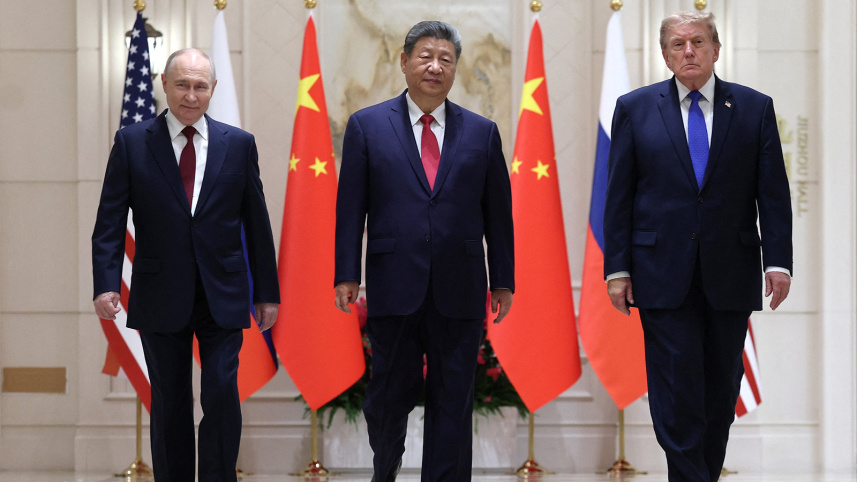
The official Shenzhen declaration, released by Xinhua after Thursday’s meeting of Presidents Xi, Putin, and Trump, says the three countries “plan to increase the production and supply of refined petroleum products for the benefit of all nations.” U.S. diesel averaged $5.930 a gallon on Nov. 19. A White House readout of the declaration had not been posted as of this morning.
The official English text is short. The fuel sentence is shorter.
On Thursday, Nov. 19, 2026, in Shenzhen, China, President Xi Jinping, President Vladimir Putin, and President Donald J. Trump issued the “China-Russia-U.S. Heads of State Declaration toward Peace.” Xinhua published the full text the same day. Point 2 reads, in full: “The three countries plan to increase the production and supply of refined petroleum products for the benefit of all nations. They reaffirmed the importance of stable energy flows.”
That is the entire product-supply commitment. The declaration names no volumes, no refineries, no export routes, and no dates. It does not mention Ukraine, Iran, or the Strait of Hormuz.
Reuters, in a dispatch datelined Shenzhen, Nov. 19, reported that China and Russia released the declaration and paraphrased the fuel line as a pledge to increase supplies. The official verb in the Xinhua text is “plan,” not “pledge.” Reuters also said the Kremlin released the document. As of this morning, a search of White House fact sheets and briefings found no U.S. readout of the trilateral declaration. A Nov. 18 arrival item and a Nov. 18 Philippines-and-ASEAN fact sheet are not that readout.
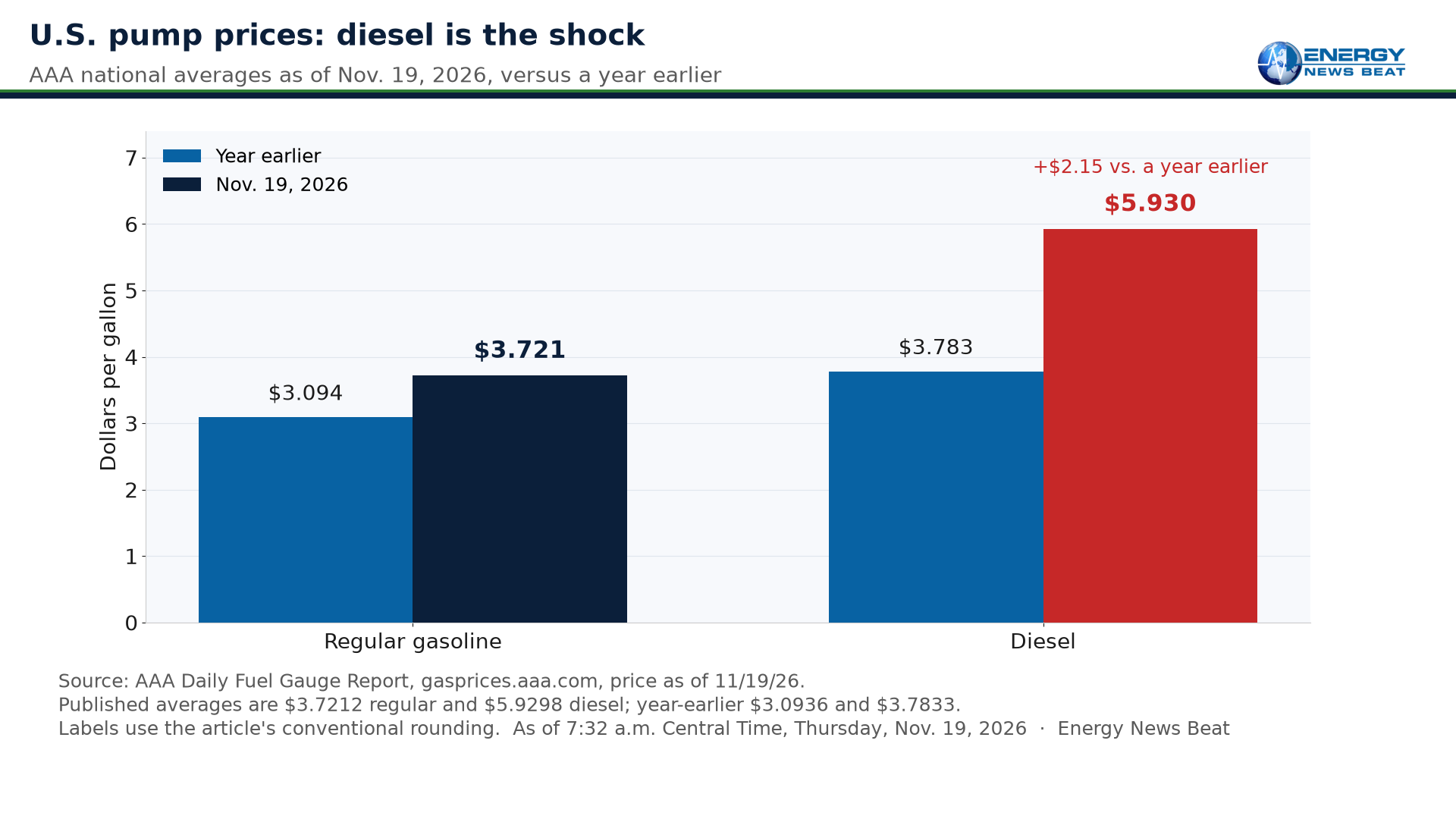
For households, the gap between a plan and a cargo is the story that matters. AAA put the national average on Nov. 19 at $3.721 a gallon for regular gasoline and $5.930 a gallon for diesel. A year earlier, those averages were $3.094 and $3.783. AAA’s diesel average has eased from $6.319 a month earlier, but remains more than $2 above a year ago.
What the official text says — and does not
The declaration has four points. Besides the fuel sentence, the leaders committed to U.N. reform; said state consent and official immunities are “of paramount importance” and that the International Criminal Court “and other similar bodies must not abuse their jurisdiction”; and reaffirmed that “a nuclear war cannot be won and must never be fought,” while agreeing to dialogue on nuclear risks and nonproliferation.
The meeting took place at Kylin Villa, on the sidelines of APEC in Shenzhen, Reuters reported. After the session, Trump departed without comment. Putin referred to “the conflict in Ukraine” in remarks around the meeting, Reuters recorded — a reference in the reporting, not in the four-point text. An Associated Press article was published; this report could not retrieve the full AP page and relies on the Xinhua text. The Kremlin’s English text of point 2 is identical.
Who could actually deliver the barrels
A plan to increase refined-product supply is only as good as spare distillation capacity and the ability to export it.
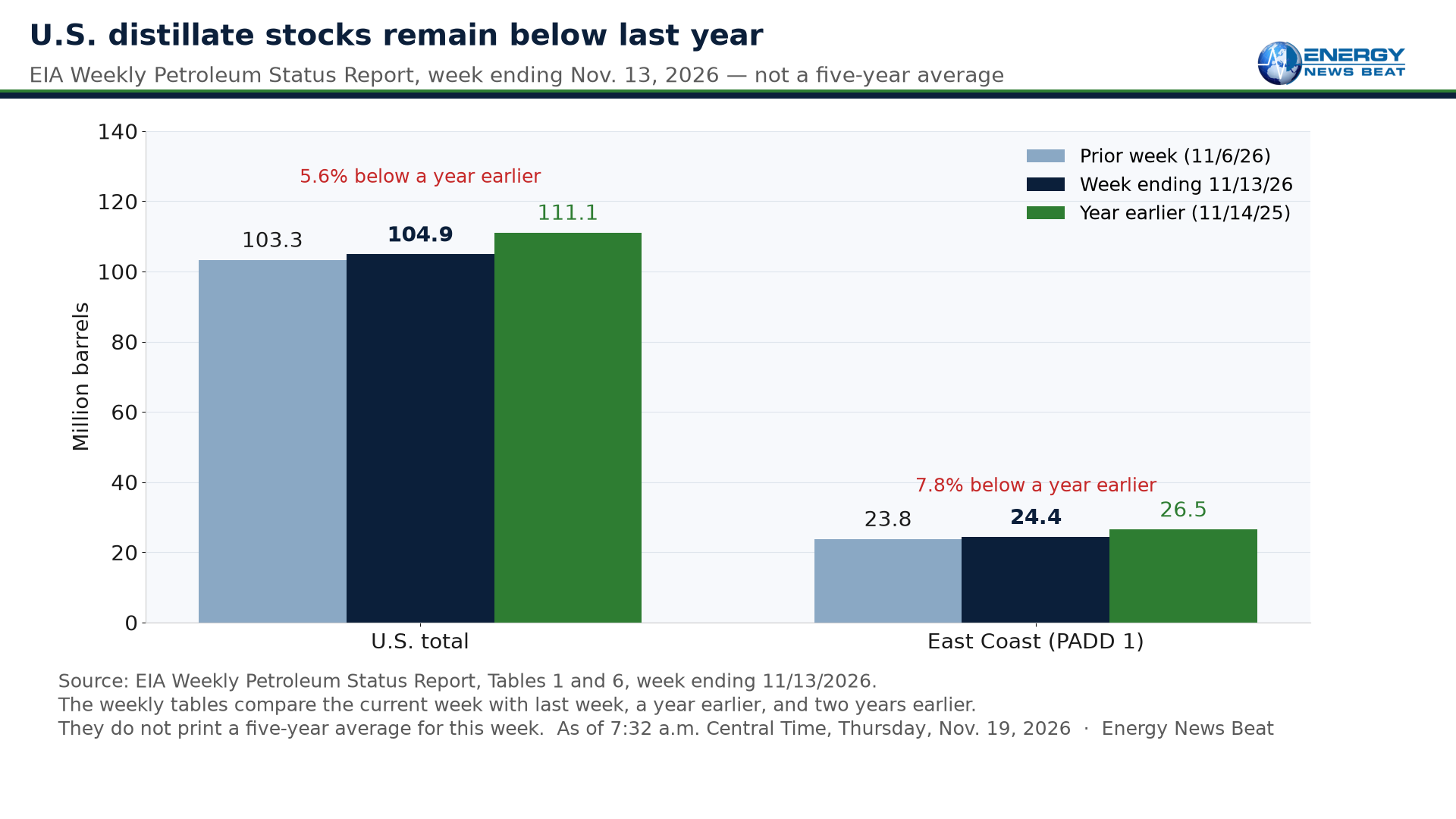
The United States is already running hard. In the four weeks ending Nov. 13, 2026, EIA data show U.S. refineries operating at 94.5% of operable capacity, with crude inputs averaging 16.8 million barrels a day and distillate production averaging 5.16 million barrels a day. Distillate stocks in the week ended Nov. 13 stood at 104.9 million barrels, up 1.6 million from the prior week but 5.6% below the 111.1 million barrels held a year earlier. East Coast (PADD 1) distillate stocks, the heating-oil region, were 24.4 million barrels, 7.8% below a year earlier. The New York Harbor spot price for No. 2 heating oil was $4.213 a gallon on Nov. 13, compared with $2.438 a year earlier.
That does not leave a large unused U.S. cushion. The International Energy Agency, in public highlights of its November Oil Market Report, published Nov. 13, wrote that “Atlantic Basin refineries, particularly in the United States, are running hard to capture high margins,” while “improved crude availability in Asia and fresh Chinese product export quotas could support higher refinery throughput rates in the region.”
China is the other obvious candidate for incremental exports, if Beijing uses the quotas. The IEA’s public summary did not publish a new quota volume, and late-October press reports of a batch were not independently confirmed here. New export plants, including Nigeria’s Dangote refinery and Kuwait’s Al-Zour, have added supply in recent years; their Nov. 19 utilization is not certified here. Russia, in a normal year, would be on that list. This is not a normal year.
Russia’s damaged plants cut against a ready surplus
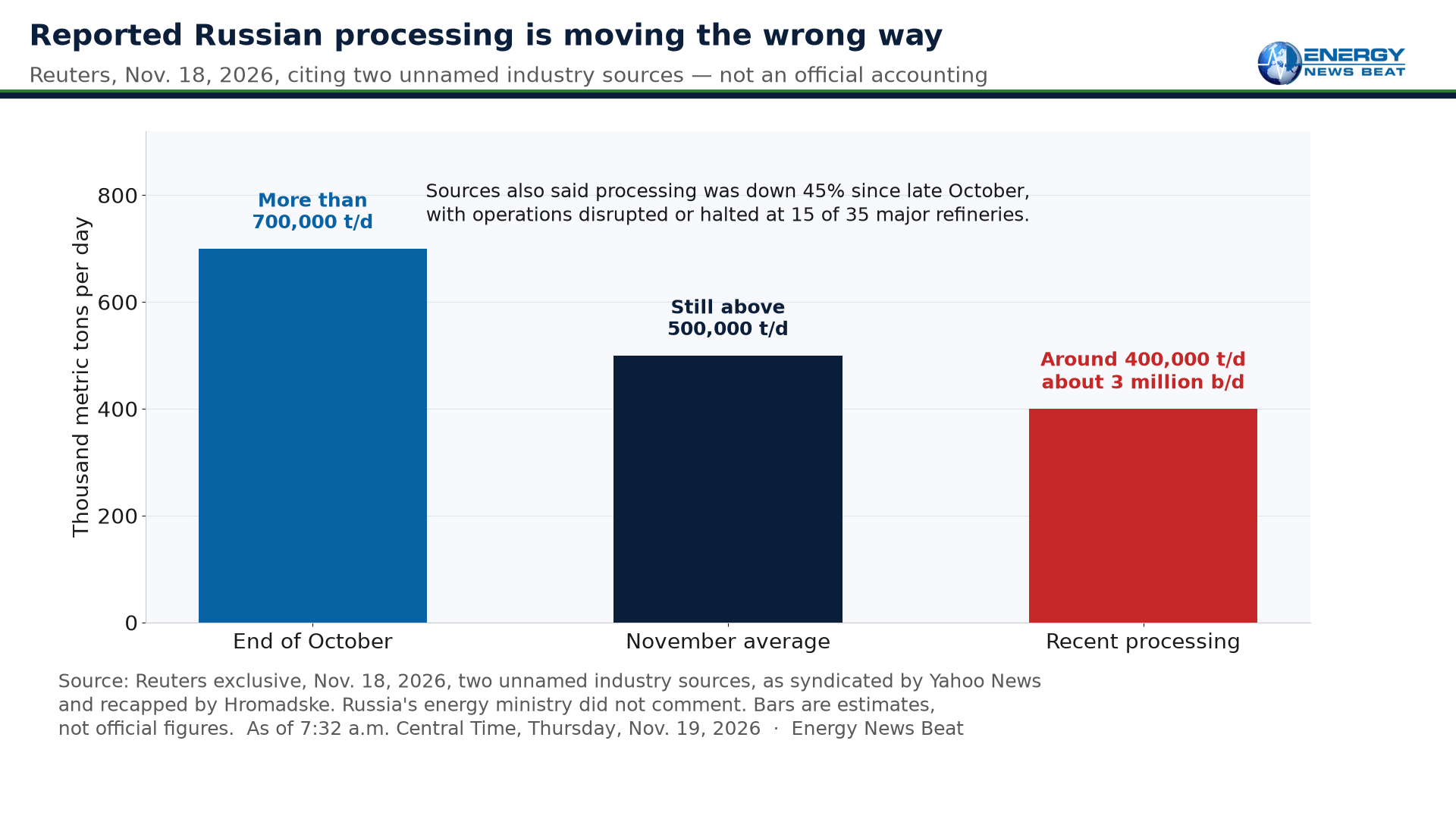
On Nov. 18, 2026 — the day before the Shenzhen text was posted — Reuters reported, citing two unnamed industry sources, that Ukrainian drone attacks had slashed combined Russian crude processing by 45% since late October, with operations disrupted or halted at 15 of 35 major refineries, up from nine the prior week. The same sources put recent processing at around 400,000 metric tons a day, or about 3 million barrels a day, down from more than 700,000 tons a day at the end of October, and said the November average was still above 500,000 tons a day, about 5 to 10% below September and October. Russia’s energy ministry did not comment, Reuters reported, in its exclusive as syndicated by Yahoo News and recapped by Hromadske.
Those are industry-source estimates, not an official accounting. They also cut against a ready increase in Russian product exports. The IEA’s November highlights put the same tension in official language: “Persistent attacks on Russian energy infrastructure continue to choke off the country’s diesel supplies to international markets, adding to losses from the Middle East.”
What the official outlook still says about diesel
Crude has eased from the early-October spike. The IEA’s public November highlights said North Sea Dated tumbled from $136 a barrel in early October to $93 at the time of writing, and that diesel prices in Europe fell 11% over the same period but, “at close to $180/bbl, remained 77% above pre-war levels.” The agency’s overriding concern, in its own words, was still “the severe tightness in product supply, especially for diesel.” It said an accelerated release of IEA emergency diesel stocks would be “a critical bridge across the supply gap until the global refinery system and product output recover.”
The public IEA landing page does not name a date when that tightness ends. Trade coverage of the same November report does. Oil & Gas Journal wrote that “IEA sees a let-up in market tension coming at best in the second half of 2027.” Rig & Refinery, in an account that closely follows Oil & Gas Journal’s, reported the same timing. Those are accounts of the report, not a sentence from a public IEA PDF. A circulating European diesel crack of about $60.83 a barrel over Brent could not be confirmed and is not used.
Consumer and Investor Views
For U.S. consumers, the declaration does not, by itself, change what is in the tank this week. Truckers and farmers are already paying a national diesel average of $5.930 a gallon, more than $2 above a year earlier. Airlines buy jet fuel in the same tight middle of the barrel. In the Northeast, heating-oil households saw a New York Harbor spot price of $4.213 a gallon on Nov. 13, more than $1.70 above a year earlier, and East Coast distillate stocks 7.8% thinner than a year earlier. Relief would show up as lower AAA averages and as EIA stocks rebuilding — not as a communique.
Investors will watch three measurable things. One is U.S. refining margins and utilization, already at 94.5% of capacity over the four weeks ending Nov. 13, with Atlantic Basin units running hard, the IEA says, to capture high margins. If foreign product arrives, those margins can compress; if not, the tight distillate balance can keep supporting them. The second is Chinese product export volumes, which will show up in customs and tanker data, not in the Shenzhen sentence. The third is whether Russian processing and product exports stabilize or fall further after the strikes Reuters’ sources described on Nov. 18.
A Sept. 2, 2026, Energy News Beat article by Clark Savage recounts Stu Turley’s view that energy policy is splitting the world into new trading blocs. Savage writes that Turley has described a growth-and-energy-realism grouping that includes the United States, Russia, China, India, Japan, Saudi Arabia, and the UAE, set against net-zero policies in the United Kingdom, the European Union, and Canada that, in Turley’s telling, drive high energy costs and deindustrialization. That is Stu’s thesis as presented in that article. Thursday’s sentence tests whether such an alignment can actually move product. The text has not yet proved it.
Timeline
Key dates around the Shenzhen declaration and the distillate market, in order.
Early October 2026. The IEA’s November highlights later reported that North Sea Dated reached $136 a barrel in early October, and that European diesel, even after an 11% decline from that period, remained close to $180 a barrel and 77% above pre-war levels as of the report’s writing.
Late October 2026. Reuters’ industry sources, quoted on Nov. 18, put Russian crude processing at more than 700,000 metric tons a day at the end of October, before the three-week drop they described.
Nov. 13, 2026. The IEA published its November Oil Market Report, calling severe tightness in diesel the overriding concern. EIA weekly data for the week ended Nov. 13 show U.S. distillate stocks at 104.9 million barrels and a four-week average refinery utilization of 94.5%.
Nov. 18, 2026. Reuters, citing two unnamed industry sources, reported a 45% drop in Russian crude processing since late October, with operations disrupted or halted at 15 of 35 major plants. The White House posted material on the president’s arrival in Shenzhen and a fact sheet on Philippines and ASEAN economic deals, not a trilateral readout.
Nov. 19, 2026. Xi, Putin, and Trump met at Kylin Villa in Shenzhen. Xinhua posted the full “China-Russia-U.S. Heads of State Declaration toward Peace,” including the refined-products sentence, at 18:58 Beijing time. AAA posted national averages of $3.721 a gallon for regular gasoline and $5.930 a gallon for diesel.
What We Do Not Yet Know
The declaration is hours old. A White House readout could still appear later today; none had been found in a morning search of whitehouse.gov fact sheets and briefings. The Kremlin’s English text of point 2 is identical to Xinhua’s. Reuters’ 45% and 15-of-35 figures come from unnamed industry sources; Russia’s energy ministry did not comment.
EIA’s 104.9 million-barrel distillate figure is from the weekly tables for the week ended Nov. 13. A five-year-average comparison was not confirmed from those tables, which do not print one for this week. The “second half of 2027” diesel-relief timing is from trade coverage of the IEA report, not from the agency’s public landing page. Utilization at Dangote, Al-Zour, and Indian export plants on Nov. 19 is not certified here. None of that changes the core fact: the official text plans an increase and does not say how much, or when.
Stu’s Take
The official sentence is modest, and it is all the market can take to the bank today. In Shenzhen, the three countries said they “plan to increase the production and supply of refined petroleum products for the benefit of all nations.” They did not say how many barrels, from which plants, or by when. That gap matters at the pump. AAA’s national diesel average on Nov. 19 was $5.930 a gallon, more than $2 above a year earlier. U.S. distillate stocks were 104.9 million barrels in the week ended Nov. 13, 5.6% below a year earlier. Reuters’ industry sources say Ukrainian strikes have cut Russia’s crude processing about 45% since late October, with operations disrupted or halted at 15 of 35 major plants — the opposite of a ready surplus. The IEA’s November report still calls diesel tightness the overriding concern. A plan is not a cargo. Until barrels show up, truckers, farmers, airlines, and Northeast households should watch inventories and prices, not the communique.
Stu has been very vocal for the last year about the new trading blocs forming, and this summit really does portray a new shift in the global trading powers. The UK, EU, and Canada are doubling down on Net Zero and de-industrialization, and the meetings in the Philippines, Japan, South Korea and Asia are heating up.
Sources
Primary and secondary sources opened for this article, with links and access dates. Access dates are Thursday, Nov. 19, 2026, unless noted. A source listed here was opened; a figure that could not be confirmed from an opened page is not used in the body.
- Xinhua, “Full text: China-Russia-U.S. Heads of State Declaration toward Peace,” posted 2026-11-19 18:58:16, official English text of the four-point declaration, including the refined-products sentence in point 2. Opened Nov. 19, 2026. https://english.news.cn/20261119/c15631ea3f054a278e3a3f592021f0da/c.html
- Kremlin, official English text, “Russia-China-U.S. Heads of State Declaration toward Peace,” November 19, 2026. Point 2 is word-for-word identical to the Xinhua English text. Opened Nov. 19, 2026. http://en.kremlin.ru/supplement/6618
- Reuters, Jarrett Renshaw and Trevor Hunnicutt, “China and Russia release ‘peace declaration’ after Trump, Xi, Putin meeting,” first published Nov. 18, 2026, 11:05 p.m. UTC and updated Nov. 19, dateline Shenzhen, Nov. 19. Paraphrases the fuel line as a pledge; reports a Xinhua and Kremlin release, the Kylin Villa meeting on the APEC sidelines, and Trump’s departure without comment. Canonical URL opened Nov. 19, 2026. https://www.reuters.com/world/china/trumps-historic-meeting-with-xi-putin-headlines-asia-trip-2026-11-18/
- Associated Press article on the Trump-Xi-Putin meeting (reported to note that the statement did not mention the wars in Ukraine or Iran). The full AP page could not be retrieved (access blocked). This article relies on the Xinhua full text for what the declaration does and does not say, and does not quote AP wording. URL recorded Nov. 19, 2026. https://apnews.com/article/trump-xi-putin-nuclear-ukraine-iran-a04dc76ed8e786b087e2c1ea9598783a
- White House fact sheets index and briefings, searched and re-checked the morning of Nov. 19, 2026, Central Time, for a readout or fact sheet of the Nov. 19 Shenzhen trilateral declaration. No such readout was found as of 7 a.m. CT or in a later morning search the same day. Closest items located were a Nov. 18 arrival item for the president in Shenzhen for APEC, and a Nov. 18 fact sheet on economic deals from the Philippines and ASEAN stops — not a readout of the declaration. A Sept. 25, 2026, fact sheet from an earlier Trump-Xi meeting included language urging increased refined-product production; that is a prior bilateral, not this declaration. https://www.whitehouse.gov/fact-sheets/
- White House briefings and statements index, searched the morning of Nov. 19, 2026, Central Time, as part of the readout search described above. No trilateral declaration readout found at access time. https://www.whitehouse.gov/briefing-room/
- AAA Daily Fuel Gauge Report, national average retail prices, “Price as of 11/19/26.” Regular $3.7212 a gallon; diesel $5.9298 a gallon; year-earlier regular $3.0936 and diesel $3.7833; month-earlier diesel $6.3187 (body rounding $6.319). Body text uses conventional rounding ($3.721, $5.930, $3.094, $3.783). Re-opened Nov. 19, 2026; published figures were unchanged. https://gasprices.aaa.com/
- U.S. Energy Information Administration, Weekly Petroleum Status Report, week ending Nov. 13, 2026. Table 1 (stocks, including U.S. distillate 104.9 million barrels); Table 4 and Table 6 (PADD 1 distillate 24.4 million barrels); highlights operations table for four-week-average refinery activity; New York Harbor and WTI prices in the highlights table are daily spots on the dates shown, not weekly averages. Opened Nov. 19, 2026. https://www.eia.gov/petroleum/weekly/
- International Energy Agency, Oil Market Report — November 2026, published Nov. 13, 2026. Public landing-page highlights, including diesel tightness language, European diesel “close to $180/bbl,” North Sea Dated prices, Atlantic Basin runs, Chinese product export quotas, and emergency diesel stocks. The public page opened here does not contain the second-half-2027 relief sentence. Opened Nov. 19, 2026. https://www.iea.org/reports/oil-market-report-november-2026
- Oil & Gas Journal, coverage of the IEA November Oil Market Report, including the line “IEA sees a let-up in market tension coming at best in the second half of 2027.” Used only as trade coverage of the report, not as a first-hand IEA PDF quotation. Opened Nov. 19, 2026. https://www.ogj.com/general-interest/economics-markets/news/55419515/iea-high-diesel-prices-ease-demand-supply-constraints-persist
- Rig & Refinery, “IEA Sees Diesel Relief No Earlier Than Second-Half 2027,” account of the same November Oil Market Report. Opened Nov. 19, 2026. https://rigandrefinery.com/articles/iea-sees-diesel-relief-no-earlier-than-second-half
- Hromadske, recap of the Reuters Nov. 18, 2026, exclusive on Ukrainian drone strikes and Russian refining, including the 45% and 15-of-35 figures attributed to industry sources. Opened Nov. 19, 2026. The reuters.com exclusive page returned an access error; a Reuters-bylined syndication was also reviewed. https://hromadske.ua/en/amp/war/274607-ukrainian-drone-strikes-slash-russian-oil-refining-by-45-in-three-weeks-reuters-reports
- Reuters, “Exclusive-Drone attacks nearly halve Russia’s November oil refining, sources say,” Nov. 18, 2026, citing two unnamed industry sources; Russia’s energy ministry did not comment. The reuters.com page was not opened successfully (access error). A Reuters-bylined Yahoo News syndication of the same exclusive was opened Nov. 19, 2026, and is the basis for the processing figures used in the body, together with the Hromadske recap. https://www.yahoo.com/news/articles/exclusive-drone-attacks-nearly-halve-145826294.html
- Clark Savage, Energy News Beat, “Russia’s surprise return to a G20 finance meeting in Asheville, North Carolina, this week laid bare a widening rift,” Sept. 2, 2026. An Energy News Beat article by Clark Savage that recounts Stu Turley’s trading-blocs thesis (growth-and-energy-realism grouping versus net-zero policies in the UK, EU, and Canada) as Stu’s view. Not a first-person Stu quotation and not a Stu-bylined article. Opened Nov. 19, 2026. https://energynewsbeat.co/enb-publisher-picks/russias-surprise-return-to-a-g20-finance-meeting-in-asheville-north-carolina-this-week-laid-bare-a-widening-rift/
Key Excerpts
Xinhua, official title and meeting line. Title: “Full text: China-Russia-U.S. Heads of State Declaration toward Peace.” Lead: “Xi Jinping, President of the People’s Republic of China, Vladimir Putin, President of the Russian Federation, and Donald J. Trump, President of the United States of America, met in Shenzhen on November 19, 2026. The Russian and U.S. heads of state expressed appreciation to China for hosting this historic trilateral Summit.” Posted 2026-11-19 18:58:16.
Xinhua, point 2, in full. “The three countries plan to increase the production and supply of refined petroleum products for the benefit of all nations. They reaffirmed the importance of stable energy flows.”
Xinhua, points 1, 3, and 4, in full. 1. “As permanent members of the United Nations Security Council, China, Russia, and the United States committed to reform the U.N. so that the U.N. can respond more effectively to global challenges and conform to its fundamental mission of international peace and security.” 3. “The three heads of state recognized that the principle of state consent and respect for immunities of State officials are of paramount importance, and concurred that the International Criminal Court and other similar bodies must not abuse their jurisdiction.” 4. “The three heads of state reaffirmed that a nuclear war cannot be won and must never be fought. The three countries will conduct a dialogue on reducing nuclear risks and preventing the proliferation of nuclear weapons.”
Reuters, on the declaration and the fuel line. Chinese President Xi Jinping and his US and Russian counterparts Donald Trump and Vladimir Putin agreed on a “peace declaration” at their unprecedented three-way meeting on Thursday in which they reaffirmed that a nuclear war should never be fought, China and Russia said. “In the declaration, the three leaders also pledged to advance reforms of the United Nations, to increase supplies of refined petroleum products for all countries and to uphold the immunity enjoyed by state officials in international courts.” “The document was released by Chinese state news agency Xinhua and by the Kremlin. Trump departed on his flight back to the US without making any comment after the meeting.”
IEA, Oil Market Report — November 2026, public highlights. “For now, the severe tightness in product supply, especially for diesel, remains the overriding concern of the broader market and consumers. Persistent attacks on Russian energy infrastructure continue to choke off the country’s diesel supplies to international markets, adding to losses from the Middle East. At the same time, Atlantic Basin refineries, particularly in the United States, are running hard to capture high margins, while improved crude availability in Asia and fresh Chinese product export quotas could support higher refinery throughput rates in the region. Notably, the accelerated release of IEA emergency diesel stocks over the coming months will provide a critical bridge across the supply gap until the global refinery system and product output recover.” Also: “Diesel prices also fell by 11% in Europe over the same period but, at close to $180/bbl, remained 77% above pre-war levels.” North Sea Dated “tumbling” from $136/bbl in early October to $93/bbl at the time of writing.
Oil & Gas Journal, on the IEA November report. “Because first- and second-quarter balances are largely in line with seasonal trends, IEA sees a let-up in market tension coming at best in the second half of 2027.”
Reuters exclusive of Nov. 18, 2026, via opened syndication and Hromadske recap, two unnamed industry sources. Ukrainian drone attacks slashed combined crude processing volumes by 45% since late October; operations disrupted or halted at 15 of 35 major refineries (up from nine mid prior week); recent processing around 400,000 metric tons a day (about 3 million barrels a day) from more than 700,000 tons a day at the end of October; November average still above 500,000 tons a day, about 5 to 10% below September and October. Russia’s energy ministry did not comment.
Energy News Beat article by Clark Savage, Sept. 2, 2026, recounting Stu Turley’s view. “Stu Turley of Energy News Beat has repeatedly described new trading blocs coalescing around energy realism and growth: Russia, China, India, Japan, Saudi Arabia, the UAE, and the United States. In contrast, he has argued the UK, EU, and Canada are locked into net-zero policies that drive high energy costs, deindustrialization, and fiscal strain.”
Data Tables
Figures below are taken from the opened sources named in each table note. As-of dates are stated in the headers or notes. Rounded body figures are identified in the notes.
Table A. AAA national average retail fuel prices
| Grade | As of Nov. 19, 2026 (published) | Year earlier (published) | Body rounding |
| Regular gasoline, $/gal | 3.7212 | 3.0936 | 3.721 / 3.094 |
| Diesel, $/gal | 5.9298 | 3.7833 | 5.930 / 3.783 |
Source: AAA Daily Fuel Gauge Report, https://gasprices.aaa.com/, “Price as of 11/19/26.” Accessed Nov. 19, 2026.
Table B. EIA distillate stocks and related weekly figures, week ending Nov. 13, 2026
| Series | Week ending 11/13/26 | Week ending 11/6/26 | Year earlier (11/14/25) | Change vs. year earlier |
| U.S. distillate stocks, million bbl | 104.9 | 103.3 | 111.1 | −6.2 / −5.6% |
| East Coast (PADD 1) distillate stocks, million bbl | 24.4 | 23.8 | 26.5 | −2.1 / −7.8% |
| New England (PADD 1A) distillate stocks, million bbl | 3.2 | 3.3 | 3.5 | −0.3 / −9.7% |
| NYH No. 2 heating oil, $/gal | 4.213 | 4.252 | 2.438 | — |
| NYH ultra-low sulfur diesel, $/gal | 4.345 | 4.467 | 2.586 | — |
| WTI Cushing, $/bbl | 91.96 | 94.37 | 60.87 | — |
Sources: EIA Weekly Petroleum Status Report, week ending 11/13/2026, Tables 1, 4 and 6, and highlights price table. Table 4 and Table 6 also report a two-years-earlier comparison (U.S. distillate 114.3 million barrels, −8.2%); that column is not a five-year average and is not used as one in the body. Prices are daily spot prices on the dates shown, not weekly averages. Accessed Nov. 19, 2026.
Table C. EIA refinery activity, four weeks ending Nov. 13, 2026
| Series | Four weeks ending 11/13/26 | Four weeks ending 11/6/26 | Four weeks ending 11/14/25 |
| Crude oil input to refineries, thousand b/d | 16,804 | 16,737 | 15,670 |
| Refinery capacity utilization, percent | 94.5 | 94.0 | 88.0 |
| Distillate fuel oil production, thousand b/d | 5,159 | 5,160 | 4,786 |
Source: EIA Weekly Petroleum Status Report highlights, “Refinery Activity (Thousand Barrels per Day), Four Weeks Ending.” These are four-week averages, not single-week figures. Accessed Nov. 19, 2026.
Table D. Russian crude-processing estimates reported by Reuters, Nov. 18, 2026
| Item | Figure | Attribution |
| Change in combined processing since late October | Down 45% | Two unnamed industry sources, Reuters |
| Major refineries with operations disrupted or halted | 15 of 35 (up from 9 mid prior week) | Same sources |
| Recent processing | Around 400,000 metric tons/day, about 3 million b/d | Same sources (barrel conversion as reported by Reuters) |
| End of October processing | More than 700,000 metric tons/day | Same sources |
| November average (as of the report) | Still above 500,000 metric tons/day, about 5–10% below September and October | Same sources |
| Russian energy ministry comment | Did not comment | Reuters |
Sources: Reuters exclusive, Nov. 18, 2026, citing two industry sources, as opened via Reuters-bylined Yahoo syndication and recapped by Hromadske. These are not official Russian or Ukrainian government figures.
Background
The Nov. 19, 2026, meeting in Shenzhen was a three-way encounter of the Chinese, Russian, and U.S. presidents on the sidelines of the APEC gathering. Xinhua published a four-point “China-Russia-U.S. Heads of State Declaration toward Peace” the same day, at 18:58 Beijing time. The refined-products sentence in point 2 is the hook of this article because it is a supply promise without volumes or dates, issued into a diesel market the IEA still described, six days earlier, as severely tight. A September 25, 2026, White House fact sheet from a prior Trump-Xi meeting included language that President Trump had urged President Xi to increase production of refined petroleum products to stabilize global supply. That earlier bilateral is background only; it is not a readout of the Nov. 19 trilateral declaration, and no White House readout of this declaration was found on the morning of Nov. 19, 2026, Central Time. The article also sits against Stu Turley’s longer-running view, as recounted in a Sept. 2, 2026, Energy News Beat article by Clark Savage, that energy policy is splitting the world into new trading blocs organized around energy realism and growth. That thesis is attributed to him as his view and is not treated as a finding of this report.