


North Carolina now has the lowest state average in the country after a 41-cent break. Studies say most of a cut reaches drivers, but not all of it, and the bill for roads comes due later.
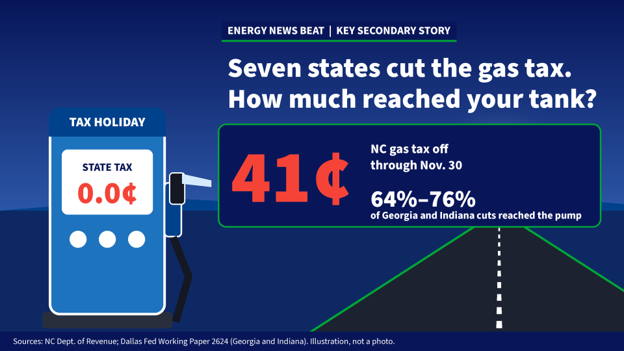
If you filled up in North Carolina this morning, you paid about $3.61 for a gallon of regular. That is the lowest state average in the country, 30 cents less than a week ago and 69 cents under the national average of $4.2953 (AAA, checked 6:12 to 6:16 a.m. CT; ENB calculation). A big reason is a tax that isn’t there. North Carolina’s 41-cent fuel tax has been suspended since Oct. 10 and comes back Dec. 1. On a 15-gallon fill, 41 cents is $6.15 (ENB calculation).
North Carolina is one of seven states that have cut, paused or frozen gas taxes this year, the National Conference of State Legislatures says. The others are Georgia, Illinois, Indiana, Kentucky, Ohio and Utah. Not all are still running: Georgia’s ended in June, and Kentucky’s 10-cent cut has ended, leaving a freeze on its tax rate. Massachusetts Gov. Maura Healey has proposed a two-month break from the state’s 24-cent tax, but the House budget chief has been noncommittal.
The cuts show up in the national numbers. GasBuddy’s Patrick De Haan said prices fell in most states last week, “led by a combination of state fuel tax suspensions and price-cycling markets working their way back down.” GasBuddy’s national average is $4.24, down 5.5 cents (WKYC). Diesel is $6.3187 nationally, up 5 cents in a week (AAA).
Key numbers. Sources: AAA, NCSL, Dallas Fed; week change is an ENB calculation.
Where the holidays stand
| State | What was cut | AAA regular, Oct. 19 | 1-week change |
| North Carolina | 41¢ gas and diesel, Oct. 10–Nov. 30 | $3.6096 | −30.3¢ |
| Ohio | 38.5¢ gas, 47¢ diesel, Oct. 4–Jan. 2 | $4.0430 | +16.9¢ |
| Indiana | About 61¢ gas excise and sales tax, through at least Nov. 4; diesel still taxed | $3.8427 | −6.4¢ |
| Kentucky | Freeze, not a holiday: 26.4¢ rate frozen since July 1 until the Iran war ends or gas falls below $3. Its 10¢ cut ran May 11–June 10 (June 30 in some localities) | $3.9324 | −9.2¢ |
| Utah | 6¢ cut, about 15.8% (37.9¢ to 31.9¢), July–Dec. 31 | $4.7764 | −3.2¢ |
| Illinois | Planned 1.3¢ increase paused until Jan. 1 | $4.6670 | −3.0¢ |
| Georgia | Full suspension, ended June 2; tax back June 3 | $3.7313 | −7.4¢ |
| U.S. average | — | $4.2953 | −6.0¢ |
Sources: NCSL, NCDOR, Ohio CPA, Kentucky governor, Kentucky LRC, Indiana DOR, Indiana Capital Chronicle, Utah State Tax Commission, Dallas Fed; prices from AAA state pages. Week change and Utah percentage are ENB calculations.
Ohio shows the limits. The state average is $4.04, up 17 cents in a week, though still 50 cents below a month ago (AAA; ENB calculation). GasBuddy tracked the same jump in Akron and Cleveland. Cedarville University economist Jared Pincin said the suspension cut prices by about 35 to 38 cents, but supply disruptions overseas kept pushing them up (Dayton 24/7 Now).
How much of the cut reaches you?
Most of it, but not all, and usually less as time goes on. A Dallas Fed working paper using sales from about 13,200 stations found Georgia’s 2026 holiday passed 64% of the gasoline tax cut to pump prices. Indiana’s combined suspension reached 76%. Penn Wharton found the 2022 holidays passed through 72% in Maryland, 58% to 65% in Georgia and 71% to 87% in Connecticut, and those price cuts “were often not sustained during the entire holiday.” A study of Germany’s 2022 fuel tax cut found pass-through faded over three months, a pattern the authors said was consistent with drivers paying less attention.
Ohio and North Carolina wrote pass-through language into their laws (LSC; NC law). In North Carolina, how far that goes is disputed. The law lets stations sell fuel they bought with the tax already paid at the old price, and WRAL reports it doesn’t force retailers to cut prices. Attorney General Jeff Jackson and NCSL say it requires the savings to reach drivers. Jackson launched a complaint site, N.C. Fuel Check: “If gas stations see their costs drop by 41 cents per gallon but don’t pass that along to drivers, that’s a massive windfall for these companies instead of relief for families” (NCDOJ).
The caveat: roads, and the day the tax comes back
Fuel taxes are the biggest source of state road money. Estimated losses run from about $40 million in Utah to nearly $700 million so far in Indiana (NCSL). North Carolina is covering an estimated $362.3 million in lost tax, a legislative staff estimate, with monthly transfers from its Stabilization and Inflation Reserve, mostly to highway funds. Ohio is covering its holiday with $725 million from its General Revenue Fund. Indiana’s DOT says combined state and local losses could reach $1.1 billion if the suspension runs through Dec. 4, and the State Highway Fund could hit a $427 million deficit by mid-2027 if lawmakers don’t refill it (Indiana Capital Chronicle).
Then the holiday ends. In the Indiana and Illinois sales-tax break of 2000, about 70% of the cut showed up at the pump, but 80% to 100% of the tax came back when it returned (Doyle and Samphantharak). Georgia went the other way this June: only about half of the tax returned at first (Dallas Fed), although that study window was only four weeks. North Carolina drivers should plan for up to 41 cents more after Nov. 30.
Consumer and investor angle
- Consumers: “Motorists in states that benefited from tax suspensions may continue to see some insulation from broader market pressures, but the overall picture remains fluid,” De Haan said (WKYC). The Dallas Fed paper found Georgia’s holiday covered about 28% of the per-gallon price shock, roughly the same share, 27% to 30%, at every income level (Dallas Fed).
- Investors: Casey’s CEO Darren Rebelez said Indiana’s holiday shifted fuel sales from the company’s Illinois border stores to its Indiana stores, which offset the Illinois losses: “I would say it is kind of a wash. Just guests kinda playing an arbitrage game” (Q1 call, Sept. 9).
| Stu’s Take (opinion)
A 41-cent break is real money, and I’m glad drivers in North Carolina and Ohio are getting it. But the research says only 64% to 76% of Georgia’s and Indiana’s 2026 cuts reached the pump. And the road bill, about $362 million in North Carolina and $725 million in Ohio, comes out of state money that taxpayers already paid in. A tax holiday treats the symptom. The cure is supply: more American production and more refining capacity. — Stuart Turley |
Sources
- AAA national averages (checked 6:16 a.m. CT, Oct. 19)
- AAA state averages: NC, OH, IN, KY, UT, IL, GA (checked 6:12 a.m. CT, Oct. 19)
- NCSL: Gas Tax Holidays: Relief at the Pump, but at What Cost? (Oct. 16)
- WKYC: GasBuddy weekly report (Oct. 19)
- NC Department of Revenue: motor fuel tax suspension
- NC Department of Justice: N.C. Fuel Check
- WRAL: Questions about NC’s gas tax suspension
- Johnston County Report: NC suspends 41-cent gas tax (Fiscal Research estimate)
- North Carolina Session Law 2026-62
- Ohio Society of CPAs: Ohio’s gas tax holiday enacted into law (Oct. 2)
- Ohio Legislative Service Commission: H.B. 519 analysis
- Kentucky governor: gas price actions
- Kentucky LRC: 103 KAR 43:341E
- Indiana Department of Revenue: October 2026 tax bulletin
- Indiana Capital Chronicle: Braun renews gas tax suspension (Sept. 30)
- Indiana Capital Chronicle: Surplus eyed to cover road losses (Aug. 28)
- Utah State Tax Commission: fuel tax rates
- GBH/State House News Service: Healey gas tax proposal (Oct. 1)
- Dayton 24/7 Now: Ohio gas tax holiday (Oct. 16)
- Bradt and Taylor, Dallas Fed Working Paper 2624 (Aug. 2026)
- Penn Wharton Budget Model: Effects of a State Gasoline Tax Holiday (2022)
- Frondel, Thiel and Vance, Regional Science and Urban Economics (2026)
- Doyle and Samphantharak, “$2.00 Gas!” (NBER)
- Casey’s Q1 fiscal 2027 earnings call transcript (Sept. 9)

