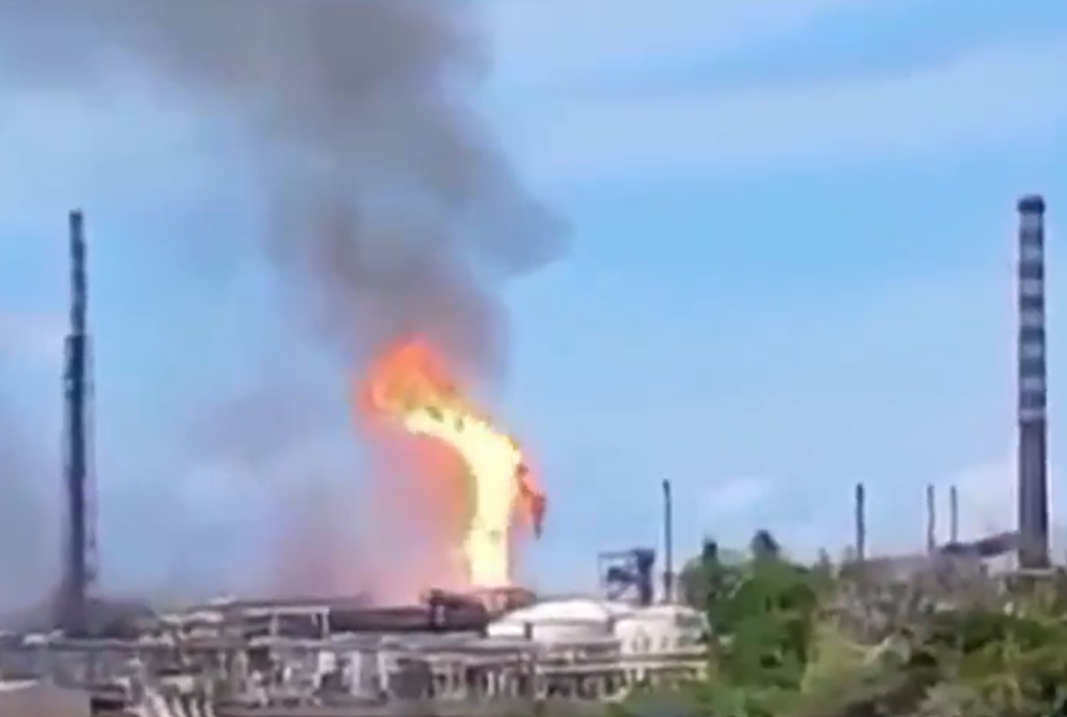
Venezuela’s Cardón refinery — the country’s second-largest plant — was fully halted on Tuesday after a gas-line fire and explosions at its diesel hydrotreater. The blaze was brought under control in under an hour with no reported injuries, but PDVSA has not issued a damage assessment or restart timeline. The outage hits an already fragile domestic fuel system far more than U.S. supply.
Cardón (sometimes rendered Cardon; the query’s “Ardon” matches this plant, not neighboring Amuay) sits at Punto Fijo in Falcón state and is half of the Paraguaná Refining Center. A social-media video posted by OSINTtechnical showed a large flame and smoke column; Reuters, citing multiple operational sources, confirmed the shutdown.
What happened
Around 3:20–3:25 p.m. local time on October 6, 2026, a gas line tied to the diesel hydrotreater (gasoil unit) opened or ruptured. Sources described explosions, a rapid fire, and an immediate halt of the whole refinery, including boilers. Workers were evacuated. One Reuters account said the fire was already under control; a later update, citing eight sources and neighbors, said the blaze was extinguished in less than an hour. No injured workers have been reported. PDVSA had not commented as of the latest wire reports. Local outlets also described the event as occurring near the H₂S / hydroprocessing area during startup operations.
The plant was already partially down. A crude distillation unit and the fluid catalytic cracker had been stopped last month for lack of feedstock.
Normal production and offtake
Nameplate capacity is 310,000 barrels per day. It is the second-largest Venezuelan refinery after Amuay (645,000 bpd). Together with the small Bajo Grande asphalt plant, they form the Paraguaná complex, rated about 955,000 bpd.
Actual runs have been far below nameplate for years. In 2025 industry reporting put Cardón’s FCC near 26,000 bpd (roughly 30% of that unit) and the reformer near 28,000 bpd. System-wide, PDVSA’s network was processing about 450,000 bpd in February 2026 (35% of roughly 1.29 million bpd installed) and about 399,000 bpd in April (31%). Paraguaná itself was cited at around 237,000–287,000 bpd in those periods, with only a fraction of distillation and cracking units online.
Products are gasoline, diesel/gasoil, and related streams aimed first at the domestic market. PDVSA’s older figures allocated roughly 55% of Paraguaná output to internal demand and 45% to export (Caribbean, Central and South America, and smaller flows to Europe and Africa). In practice, finished-fuel exports collapsed with utilization; Venezuela has repeatedly imported naphtha and gasoline components to cover shortfalls. In the first half of 2026, under broader U.S. authorizations, Venezuelan product shipments to the United States rose sharply — mainly residual fuel oil, unfinished oils, and heavy gasoil, not large volumes of finished Cardón gasoline. Crude, not refined product from Cardón, is the main commercial link to U.S. Gulf Coast refiners.
Repair estimates
None have been published. The short duration of the fire leaves open the possibility of limited damage and a relatively quick restart of unaffected units, but PDVSA has a long record of multi-week or multi-month delays after similar incidents because of spare parts, power, and feedstock. Until the company or workers confirm which units can return, the incremental loss is the portion of Cardón that was actually running, not the full 310,000 bpd nameplate.
How much of the system is offline
Venezuela’s domestic system is usually counted as six refineries with about 1.3 million bpd of nameplate capacity:
- Amuay, 645,000 bpd
- Cardón, 310,000 bpd
- Puerto La Cruz, about 187,000–190,000 bpd
- El Palito, about 140,000–146,000 bpd
- Bajo Grande, about 16,000 bpd (asphalt)
- San Roque, small, part of the eastern complex
Before Tuesday, roughly 65–69% of that capacity was already idle. Cardón’s nameplate is about 24% of the national total. Taking the whole plant offline raises the idle share, but the barrels actually lost are smaller than 310,000 bpd because distillation and the FCC were already stopped for feedstock. The practical risk is domestic gasoline and diesel, not a sudden hole in global product balances.
U.S. impact
Direct impact should be small. U.S. imports from Venezuela in 2026 have been dominated by heavy crude (Merey and similar grades) for complex Gulf Coast refineries — volumes that climbed into the several-hundred-thousand-bpd range and, by some EIA-based tallies, briefly made Venezuela the second-largest crude supplier after Canada. Those cargoes load from upstream and export terminals, not from Cardón’s fuel units. Product flows to the U.S. (residuals, unfinished oils, some blending components) are secondary and already intermittent. A prolonged Cardón outage is more likely to tighten Venezuelan domestic supply and increase the country’s need for imported naphtha or gasoline than to remove meaningful barrels from the U.S. market.
Check out the World’s Greatest Podcast Show Notes at EnergyNewsBeat.co or EnergyNewsBeat.com.
Appendices
- OSINTtechnical post and Reuters link: https://x.com/Osinttechnical/status/2107579228636287404
- Reuters, “Venezuela’s Cardon refinery halted amid fire, sources say,” Oct. 6, 2026: https://www.reuters.com/business/energy/venezuelas-cardon-refinery-halted-amid-fire-sources-say-2026-10-06/
- Reuters Spanish update (fire out in under an hour, diesel hydrotreater, no injuries): https://www.reuters.com/es/mundo/MLMPDKFDKRNJFIB7MVO5FL235A-2026-10-06/
- El Nacional summary of the Reuters report: https://www.elnacional.com/2026/10/reuters-incendio-en-la-refineria-cardon-paraliza-totalmente-sus-operaciones/
- Últimas Noticias, explosion at Cardón H₂S / hydroprocessing area under control: https://en.ultimasnoticias.com.ve/falcon/Explosion-at-Cardon-Refinery-Under-Control/
- NTN24, fire controlled, timing about 3:25 p.m.: https://www.ntn24.com/noticias-actualidad/reportan-incendio-en-la-refineria-cardon-la-segunda-mas-grande-de-venezuela-656281
- Reuters, refineries at 35% of capacity, Feb. 19, 2026: https://www.reuters.com/business/energy/venezuelas-refineries-boost-processing-35-capacity-sources-say-2026-02-19/
- World Energy News / Reuters-based report, network at 31% (399,000 bpd) in April 2026: https://www.worldenergynews.com/news/venezuelan-refineries-drop-crude-processing-capacity-773282
- EIA Venezuela export-by-destination tables (product flows remain modest versus crude): https://www.eia.gov/dnav/pet/pet_move_expc_dc_nus-nve_mbbl_a.htm
- Banca y Negocios on H1 2026 product shipments to the U.S. (mainly fuel oil and residuals): https://www.bancaynegocios.com/venezuela-cuadruplico-sus-exportac