Gov.-elect Gina Hinojosa pledges a Day One emergency order to freeze electricity rates. Texas households already pay more per kilowatt-hour than they did in 2020, but far less per kilowatt-hour than Californians, and ERCOT’s January outlook is comfortable. California’s 2000–01 record is a warning, not a prediction: freeze retail prices while costs rise, and the damage shows up in insolvency, weaker investment and later winters.
By Energy News Beat | As of November 10, 2026 CST
Sources opened Nov. 10, 2026 CST | Not investment advice
A Day One order, in two versions
Gina Hinojosa takes the oath on Jan. 19, 2027 (Texas Tribune, Nov. 4), as the first Democrat elected Texas governor in almost four decades (Texas Tribune, Nov. 4). In a written statement the Texas Tribune published Oct. 30, she said: “Within an hour of taking the oath of office, I will declare a high-cost emergency in the state of Texas and issue an emergency executive order to: one, suspend the gas and diesel tax; and two, freeze electricity rates.” That formulation is not limited to household bills.
Her campaign site is narrower. It says she will “direct the Public Utility Commission to freeze the rates residential customers pay until we have laws to ensure that data centers and other high-load users pay for themselves.” Fox News, in a Nov. 10 report, also quoted a shorter Day One line from “an interview with a local energy data group.” The same line appears in her campaign’s Sept. 18, 2026, statement: “On Day One as governor, I’ll freeze residential electricity rates and make corporations finally pay their fair share.” Directing the PUC is not the same as a disaster-act emergency order.
The law does not hand her a rate-setting pen
Texas opened most of the ERCOT market to retail choice in 2002. In competitive areas, a retail electric provider — not the governor — sets the energy price on a household plan. PURA §39.001 says that, except for transmission and distribution and stranded-cost recovery, “electric services and their prices should be determined by customer choices and the normal forces of competition.” Regulatory authorities “may not make rules or issue orders regulating competitive electric services, prices, or competitors” except as the statute allows. The only general retail freeze in that chapter expired on Jan. 1, 2002. ERCOT says about 85 percent of Texas electricity consumers have retail choice, across more than 8.5 million accounts. That is ERCOT’s estimate; parts of Texas lie outside the ERCOT grid.
The Day One path runs through the Texas Disaster Act. The governor may declare a disaster and, for 30 days unless it is renewed, suspend regulatory statutes “prescribing the procedures for conduct of state business” and agency rules. The legislature may terminate a declaration by law at any time. “Energy emergency” means a temporary shortage of petroleum, natural gas or liquid fuel — not high power prices. “High-cost emergency” is not a statutory term. The act also covers any “other public calamity requiring emergency action,” and its orders carry “the force and effect of law” — the arguments a Hinojosa order would lean on. Whether high prices qualify is untested. A declaration would not, by itself, write a lawful new tariff. Nick Loris of C3 Solutions, quoted in the Fox report, doubts that courts or state policymakers would treat today’s prices as a disaster. A durable freeze in competitive areas would need legislation. The Texas Senate remains Republican, though Democrats took the House, the attorney general’s office and the lieutenant governor’s office, who will preside over that Senate (Texas Tribune, Nov. 4). She cannot restaff the PUC on Day One; most commissioner terms run into 2027–2031 (EnergyChoiceMatters). She has the bully pulpit, delivery-rate cases and later appointments, but those are not a general retail price edict.
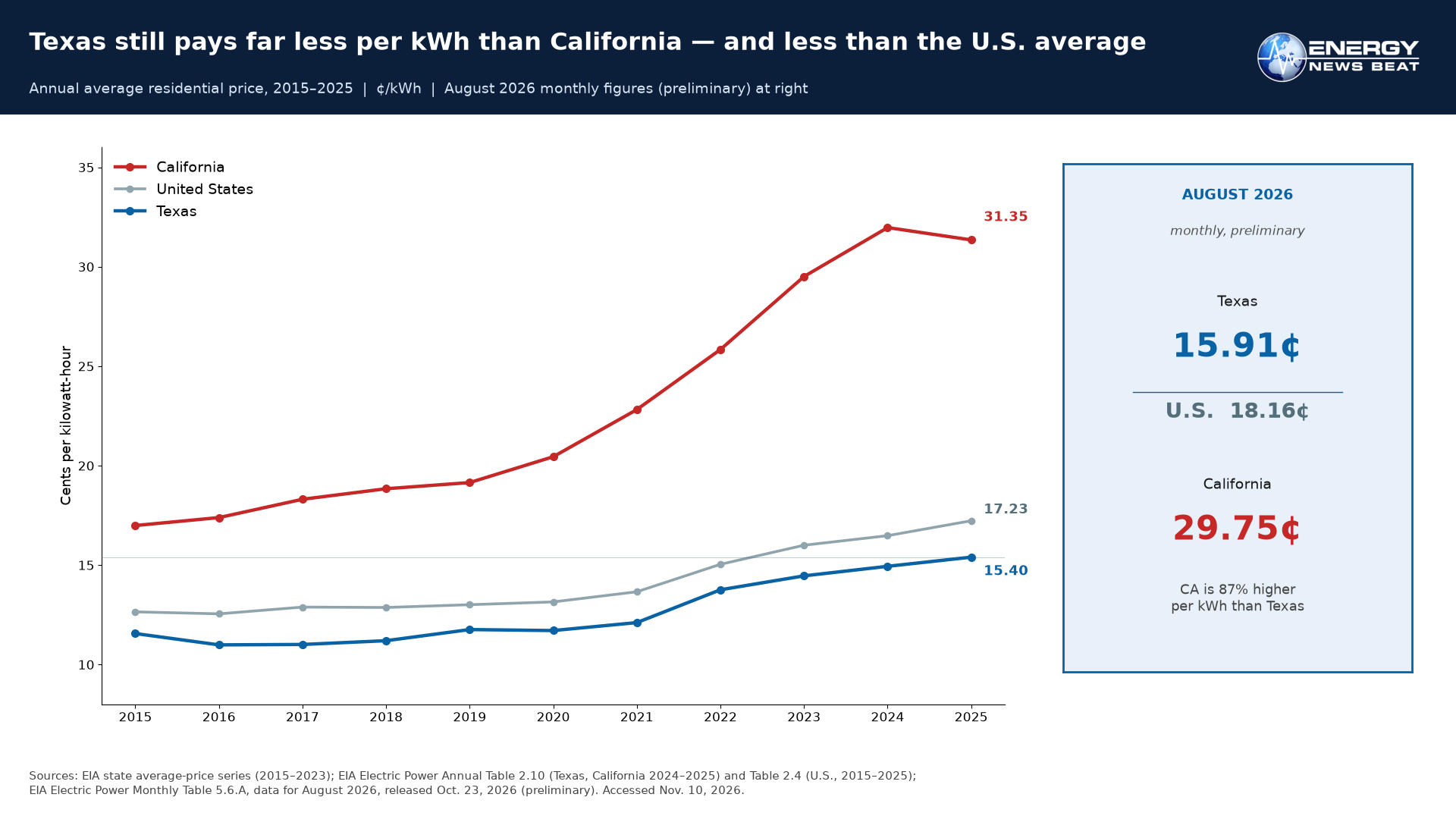
Texas rates have gone up. They are still not California’s.
In August 2026, the latest monthly EIA figures (preliminary), Texas residential electricity averaged 15.91 cents a kilowatt-hour. The U.S. average was 18.16 cents. California was 29.75 cents — 87 percent higher than Texas. Because Texans use about twice as much power, the average monthly bill is similar: $163.72 in Texas and $160.86 in California in 2024, per EIA. The EIA annual average rose from 11.71 cents in 2020 to 15.40 cents in 2025, about 31.5 percent. For illustration, at EIA’s 2024 Texas average of 1,096 kilowatt-hours a month, that 3.69-cent gap is about $40 — close to the campaign’s “about $40 more a month” figure, which it ties to Winter Storm Uri. The arithmetic covers the whole bill; it does not show a Uri surcharge.
California’s lesson — and what it is not
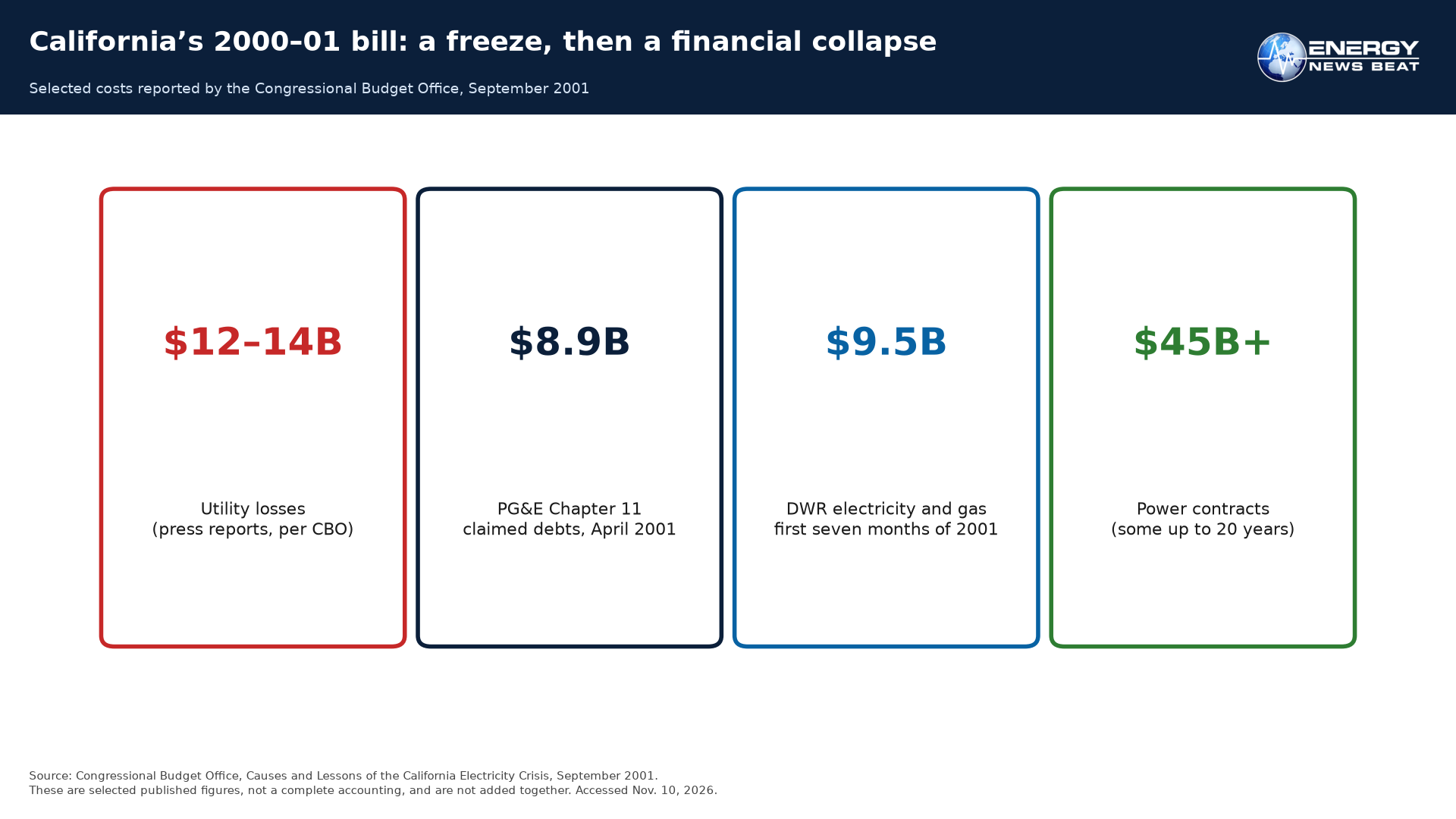
The warning is the mechanism documented by the Congressional Budget Office in September 2001. California froze retail rates while utilities were forced to buy a large share of power in the spot market. Wholesale prices that had been below $40 a megawatt-hour in 1998 averaged more than $250 by late 2000. The freeze, CBO found, “eliminat[ed] incentives for consumers to conserve power.” Utilities sold at a loss. Independent generators “even withdrew supplies when it looked as though the utilities might not be able to pay.” Rolling blackouts hit in January and March 2001, as regulators began approving retail rate increases. CBO noted that press reports put the utilities’ losses at $12 billion to $14 billion through early 2001, a total it said is hard to pin down. PG&E filed Chapter 11 in April 2001, claiming $8.9 billion in debts. The Department of Water Resources spent about $9.5 billion on electricity and natural gas in the first seven months of 2001 and signed contracts valued at more than $45 billion.
California’s August 2020 rolling blackouts were a resource-adequacy event in a West-wide heat wave, not a 2000-style retail freeze. The joint CAISO–CPUC–CEC analysis found no single root cause: a West-wide heat wave pushed demand past planning targets, those targets had not kept pace with the early-evening net-demand peak, and some day-ahead market practices made the shortfall worse. None of the three was a rate cap. The closest recent U.S. rate freezes, in New Jersey and Georgia, produced disappointing bills, Reason found, and neither produced blackouts. Texas already has retail competition, fixed-rate contracts and no mandatory Power Exchange — the same class of policy risk, not a photocopy of 2027.
Texas already has a retail warning
Winter Storm Uri is the home-grown lesson, in the opposite direction. In February 2021, ERCOT ordered 20,000 megawatts of load shed. FERC and NERC found that more than 4.5 million people in Texas lost power, some for as long as four days. The Texas Comptroller, citing the state health department, later reported at least 210 deaths, and Dallas Fed-range losses of $80 billion to $130 billion (Fiscal Notes, October 2021). Wholesale prices hit the $9,000-a-megawatt-hour cap. Griddy passed those prices through to residential customers, then lost access to the market. House Bill 16 later barred wholesale-indexed products for residential and small-commercial customers. A government freeze would break that link the other way: retailers could be told to sell below what power costs.
This winter is not the test
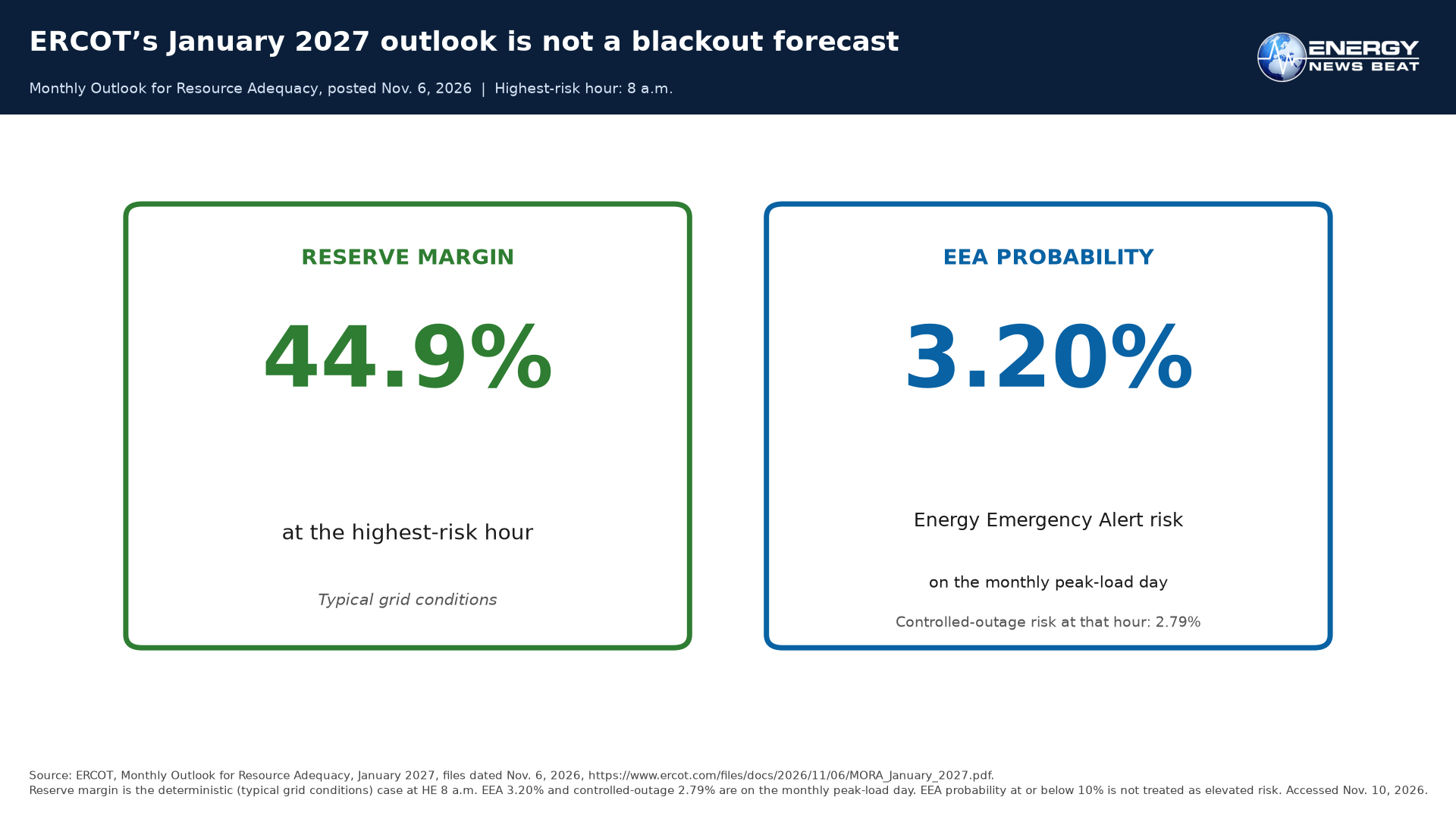
Do not read a Day One freeze as rolling blackouts this winter. ERCOT’s Monthly Outlook for Resource Adequacy for January 2027, posted Nov. 6, shows a 44.9 percent reserve margin at the highest-risk hour (8 a.m.) under typical conditions, and a 3.20 percent probability of an Energy Emergency Alert at that hour on the month’s peak-load day — well below ERCOT’s 10 percent line. ERCOT puts the chance of ordering controlled outages at that hour at 2.79 percent. If retailers cannot cover costs, they become weaker counterparties, as Loris warned. Frozen retail prices dull the signal to conserve, CBO found; in our view they also weaken the retail credit that finances new plants, storage and demand response. As we wrote Nov. 9, she can more readily pause data-center approvals than rewrite Texas power. Making large loads pay their way, building on SB 6, is sturdier policy than a hard retail cap.
What we still do not know
She has not published an order. We do not know whether it would cover only residential rates or all rates, existing contracts or new offers, energy or delivery charges, or municipal and co-op systems as well as competitive areas. As of about 4:00 p.m. CST on Nov. 10, 2026, we found no on-the-record response to the freeze pledge from the Public Utility Commission, ERCOT, the Texas Energy Association for Marketers, the Alliance for Retail Markets or the Texas Public Policy Foundation. Gulf Coast Power Association has already called the mechanics of a freeze in a competitive market “an open question.”
Consumer and investor views
For households: a short freeze might do little for customers on a fixed plan. The issue is whether retailers can still cover the cost of power when the next scarcity event arrives, and whether large loads pay their own freight. For investors, the first stress would show up in retail credit and the incentive to finance new plants, not in tomorrow’s reserve margin. This is not investment advice.
A fair reading — and the clock
A 31.5 percent rise in the residential rate from 2020 to 2025 is material in a high-usage state. Her long-term goal, on the campaign site, is to make data centers and other high-load users pay for themselves, not to cap prices forever. The legally clean path is the legislature, which convenes Jan. 12. Democrats will control the House, and a Democratic lieutenant governor will preside over a Republican Senate. If Texas copies California’s instinct to freeze the retail price while costs are still in motion, the danger is not a blackout this January. It is weaker companies, thinner investment and a harder grid in later winters. The loading of that risk starts, if she keeps the written pledge, within an hour of the oath on Jan. 19.
Stu’s Take
| Gina Hinojosa takes office January 19 having promised a Day One “high-cost emergency” order to freeze electricity rates. I will not tell you that means rolling blackouts this winter. ERCOT’s January outlook shows a 44.9 percent reserve margin and only a 3.20 percent chance of an energy emergency — well below its own elevated-risk line. California’s 2000–01 lesson is plain: a retail freeze plus soaring wholesale costs left utilities unable to pay, took away the conservation signal, and helped set up rolling blackouts, a bankruptcy and tens of billions in state purchases and contracts. Texas already learned a retail lesson in Winter Storm Uri, when Griddy passed wholesale prices to households. A freeze would break that link in the other direction. If she follows California, the risk is to future winters, as data-center load grows and new plants have less reason to show up. The sturdier path is legislation that makes large loads pay their way — not an hour-one price edict. |
Appendix A | Linked source list (accessed Nov. 10, 2026 CST)
- Fox News, Leo Briceno, Texas governor-elect’s plan to freeze electricity prices raises questions over legal authority, Nov. 10, 2026, 4:00 a.m. EST (3:00 a.m. CST). Source for the legal-authority frame and the on-the-record Nick Loris interview. Also quotes a shorter Day One line, which Fox attributed to an interview with a “local energy data group”; that line appears verbatim in Hinojosa’s Sept. 18, 2026, campaign statement. Fox also reports the Jan. 19, 2027, inauguration date. — https://www.foxnews.com/politics/texas-governor-elect-plan-freeze-electricity-prices-raises-questions-legal-authority
- Texas Tribune, Paul Cobler, An Hinojosa win would be a political feat, but she wouldn’t inherit the power Abbott holds, Oct. 30, 2026, 5:00 a.m. Central. Primary source for Hinojosa’s written Day One “high-cost emergency” statement, including the electricity-rate freeze and fuel-tax suspension. Also notes Abbott’s September 2026 fuel-price disaster declaration. — https://www.texastribune.org/2026/10/30/texas-governor-power-2026-greg-abbott-gina-hinojosa-split-government/
- Texas Tribune, Kayla Guo, Nov. 4, 2026, 6:27 p.m. Central. Confirms the election result, Democratic gains — the House, the attorney general’s office and the lieutenant governor’s office — and a Republican Senate. Describes her as the first Democrat elected to the Texas governor’s mansion in almost four decades. Lists the high-cost emergency and rate freeze among promised immediate actions. Does not state the Jan. 19 inauguration date. — https://www.texastribune.org/2026/11/04/gina-hinojosa-texas-democrat-governor/
- Texas Tribune, Nov. 4, 2026, data-center policy story. Source used here for the Jan. 19, 2027, inauguration date (“She takes office Jan. 19.”). — https://www.texastribune.org/2026/11/04/data-center-texas-pause-gina-hinojosa-governor-policies/
- Gina Hinojosa campaign, Money in Your Pocket (section “Freeze the Rates”). Live Nov. 10, 2026. Narrower pledge: direct the PUC to freeze residential rates until laws make data centers and other high-load users pay for themselves. — https://ginafortexas.com/priority/an-affordable-texas-that-works-for-everyone/
- Gina Hinojosa campaign statement, Sept. 18, 2026, on the ERCOT board pay raise. Includes the Day One line Fox attributed to a “local energy data group”: “On Day One as governor, I’ll freeze residential electricity rates and make corporations finally pay their fair share.” — https://ginafortexas.com/2026/09/statement-hinojosa-on-abbotts-ercot-ceos-salary-doubling-while-texans-suffer-skyrocketing-electricity-bills/
- Reason, Tosin Akintola, Gina Hinojosa Wants to Freeze Electricity Rates in Texas. New Jersey Shows Why That Won’t Work, Nov. 9, 2026. Legal and economic critique; New Jersey and Georgia freeze comparisons on bills. Reason does not address blackouts; that observation is the article’s. — https://reason.com/2026/11/09/gina-hinojosa-wants-to-freeze-electricity-rates-in-texas-new-jersey-shows-why-that-wont-work/
- Click2Houston / KPRC, Ajay Patel, Nov. 5–6, 2026. Ramanan Krishnamoorti (University of Houston): she cannot simply order rates down; wholesale prices flat to slightly down over six years; delivery infrastructure adding costs; large-load cost allocation could help residential bills. His “about 40 percent over the past five years” line is not used as an EIA figure; see Appendix F. — https://www.click2houston.com/news/local/2026/11/06/the-cost-of-keeping-the-lights-on-what-texas-next-governor-could-do-to-lower-electricity-bills/
- EnergyChoiceMatters, Paul Ring, Nov. 4, 2026. Notes that the Tribune Day One statement is not limited to residential rates; records PUC commissioner term end dates (most run into 2027–2031; Hjaltman’s term status was unconfirmed). — https://www.energychoicematters.com/news/in-texas-hinojosa-who-promised-to-freeze-electric-rates-wins-governor-race-also
- Gulf Coast Power Association, post-election brief. Calls the mechanics of a freeze in a competitive market “an open question.” Notes the 90th Legislature convenes Jan. 12, 2027. — https://www.gulfcoastpower.org/news/a-blue-wave-hits-the-gulf-coast-what-it-means-for-gcpa-members
- PURA, Texas Utilities Code Chapter 39, including §39.001(a) and (c). The historical rate freeze in §39.052 expired Jan. 1, 2002. — https://statutes.capitol.texas.gov/Docs/UT/htm/UT.39.htm
- Texas Government Code §418.004 (definitions of disaster and energy emergency), §418.012 (orders have the force and effect of law), §418.014 (30 days unless renewed; the legislature may terminate a declaration by law) and §418.016 (suspension of regulatory statutes prescribing the procedures for conduct of state business, and of agency rules), Texas Disaster Act of 1975. — https://statutes.capitol.texas.gov/GetStatute.aspx?Code=GV&Value=418.004
- EIA Electric Power Monthly Table 5.6.A, average price to ultimate customers, data for August 2026, released Oct. 23, 2026; next release Nov. 24, 2026. 2026 monthly figures are preliminary. Texas residential 15.91 ¢/kWh; California 29.75; U.S. 18.16. — https://www.eia.gov/electricity/monthly/epm_table_grapher.php?t=table_5_06_a
- EIA Electric Power Annual Table 2.10, average price by state and sector, 2024 and 2025 (final). Texas residential 14.94 (2024) and 15.40 (2025); California 31.97 and 31.35; U.S. 16.48 and 17.23. — https://www.eia.gov/electricity/annual/html/epa_02_10.html
- EIA Electric Power Annual Table 2.4, U.S. average price by end-use sector, 2015–2025. Source for the U.S. residential annual line on Chart 1 (Total Electric Industry). — https://www.eia.gov/electricity/annual/html/epa_02_04.html
- Annual workbook avgprice_annual.xlsx (1990–2020) for 2015–2020; EIA retail-sales series for 2021–2023 (2024–2025 match Table 2.10). — https://www.eia.gov/electricity/data/state/
- EIA Electric Sales, Revenue, and Average Price, Table 5A, 2024. Texas average monthly residential use 1,096 kWh and average monthly bill $163.72; California 503 kWh and $160.86. — https://www.eia.gov/electricity/sales_revenue_price/pdf/table_5a.pdf
- ERCOT, Monthly Outlook for Resource Adequacy (MORA), January 2027, files dated Nov. 6, 2026. Deterministic 44.9% reserve margin at the highest-risk hour (HE 8 a.m.) under typical conditions; 3.20% EEA probability and 2.79% controlled-outage probability at that hour on the monthly peak-load day. EEA probability at or below 10% is treated as low risk. — https://www.ercot.com/files/docs/2026/11/06/MORA_January_2027.pdf
- ERCOT Grid Insights: Retail Market, November 2025. “Approximately 85% of Texas electricity consumers” have retail choice; more than 8.5 million accounts; over 170 competitive retailers. — https://www.ercot.com/files/docs/2025/11/17/ERCOT-Grid-Insights-Retail-Market.pdf
- Congressional Budget Office, Causes and Lessons of the California Electricity Crisis, September 2001. — https://www.govinfo.gov/content/pkg/GOVPUB-Y10-PURL-gpo156192/pdf/GOVPUB-Y10-PURL-gpo156192.pdf
- CAISO, CPUC and CEC, Final Root Cause Analysis: Mid-August 2020 Extreme Heat Wave. No single root cause: West-wide heat wave, planning targets, and day-ahead market practices. Not a 2000-style retail freeze. — https://www.caiso.com/Documents/Final-Root-Cause-Analysis-Mid-August-2020-Extreme-Heat-Wave.pdf
- FERC, NERC and regional entities, final report on the February 2021 cold weather event, released Nov. 16, 2021. 20,000 MW of ERCOT load shed; more than 4.5 million people lost power. — https://www.ferc.gov/news-events/news/final-report-february-2021-freeze-underscores-winterization-recommendations
- Texas Comptroller, Jess Donald, Fiscal Notes, October 2021. At least 210 deaths (DSHS, as cited); Dallas Fed-cited financial losses of $80–130 billion. — https://comptroller.texas.gov/economy/fiscal-notes/archive/2021/oct/winter-storm-impact.php
- ERCOT Market Notice M-G022621-01, Feb. 26, 2021. Revoked Griddy’s market rights (about 10,127 ESI IDs). Primary record of Griddy’s loss of market access. — https://www.ercot.com/services/comm/mkt_notices/archives/5258
- ERCOT Market Notice M-C021521-01, Feb. 15, 2021. States that “the $9,000 High System-Wide Offer Cap (HCAP) currently in effect” was the system-wide offer cap used during the Uri event, per a PUCT order implemented that day. — https://www.ercot.com/services/comm/mkt_notices/archives/5196
- ERCOT, HB 4492 securitization page. Context for Uri balances repayable over a long tenor; not used to decompose the 2020–2025 bill gap. — https://www.ercot.com/about/hb4492securitization
- Texas Legislature Online, Senate Bill 6 (89R) history; effective June 20, 2025. Large-load interconnection and cost-recovery standards already in statute. — https://capitol.texas.gov/BillLookup/History.aspx?LegSess=89R&Bill=SB6
Appendix B | Key excerpts from primary documents and statements
Hinojosa, written Day One statement: “Within an hour of taking the oath of office, I will declare a high-cost emergency in the state of Texas and issue an emergency executive order to: one, suspend the gas and diesel tax; and two, freeze electricity rates.” (Texas Tribune, Oct. 30, 2026)
Campaign site, Freeze the Rates, Money in Your Pocket: “As Governor, Gina will direct the Public Utility Commission to freeze the rates residential customers pay until we have laws to ensure that data centers and other high-load users pay for themselves.” (ginafortexas.com, accessed Nov. 10, 2026)
Campaign statement, Sept. 18, 2026: “On Day One as governor, I’ll freeze residential electricity rates and make corporations finally pay their fair share.” (ginafortexas.com, Sept. 18, 2026)
PURA §39.001(a): “The legislature finds that the production and sale of electricity is not a monopoly warranting regulation of rates, operations, and services and that the public interest in competitive electric markets requires that, except for transmission and distribution services and for the recovery of stranded costs, electric services and their prices should be determined by customer choices and the normal forces of competition.” (Texas Utilities Code)
PURA §39.001(c): “Regulatory authorities … may not make rules or issue orders regulating competitive electric services, prices, or competitors or restricting or conditioning competition except as authorized in this title.” (Texas Utilities Code)
Disaster Act, “energy emergency”: “a temporary statewide, regional, or local shortage of petroleum, natural gas, or liquid fuel energy supplies that makes emergency measures necessary to reduce demand or allocate supply.” (Texas Government Code §418.004(3))
CBO, on the retail freeze: “the freeze on retail prices magnified the impact of that stress on wholesale prices by eliminating incentives for consumers to conserve power.” (CBO, September 2001)
CBO, on the utilities: “with a negative cash flow on nearly half of their sales, the utilities saw their losses mount… independent power generators… even withdrew supplies when it looked as though the utilities might not be able to pay for their purchases.” (CBO, September 2001)
Nick Loris, C3 Solutions, on unpaid costs: “If the electricity suppliers are not covering the costs that they incur, that’s going to leave them worse off and make it more vulnerable for them to adequately provide that power.” (Fox News, Nov. 10, 2026)
Nick Loris, C3 Solutions, on price signals: “Price signals really kind of act like a traffic light. They tell people when to speed up, when to slow down, or when to come to a full stop.” (Fox News, Nov. 10, 2026)
ERCOT MORA, January 2027, reserve margin: “The monthly capacity reserve margin for the deterministic scenario… is 44.9% for the highest risk hour, Hour Ending 8:00 a.m.” (ERCOT MORA, January 2027, posted Nov. 6, 2026)
ERCOT MORA, January 2027, EEA risk: “The hour with the highest EEA risk is Hour Ending (HE) 8:00 a.m. Central Standard Time (CST), with a 3.20% probability that ERCOT would need to declare an EEA.” (ERCOT MORA, January 2027, posted Nov. 6, 2026)
Appendix C | EIA residential price tables
Annual Texas and California figures for 2015–2020 are from the EIA workbook avgprice_annual.xlsx; 2021–2023 are from the EIA retail-sales series, via the state average-price page; 2024 and 2025 match Electric Power Annual Table 2.10. U.S. annual figures are Table 2.4, Total Electric Industry. August 2026 monthly figures are preliminary, from Electric Power Monthly Table 5.6.A, released Oct. 23, 2026.
Annual average residential price (¢/kWh)
| Year | Texas | California | United States |
| 2015 | 11.56 | 16.99 | 12.65 |
| 2016 | 10.99 | 17.39 | 12.55 |
| 2017 | 11.01 | 18.31 | 12.89 |
| 2018 | 11.20 | 18.84 | 12.87 |
| 2019 | 11.76 | 19.15 | 13.01 |
| 2020 | 11.71 | 20.45 | 13.15 |
| 2021 | 12.11 | 22.82 | 13.66 |
| 2022 | 13.76 | 25.84 | 15.04 |
| 2023 | 14.46 | 29.51 | 16.00 |
| 2024 | 14.94 | 31.97 | 16.48 |
| 2025 | 15.40 | 31.35 | 17.23 |
August 2026 monthly residential price (¢/kWh, preliminary)
| Jurisdiction | Aug. 2026 | Aug. 2025 | Change |
| Texas | 15.91 | 15.40 | +3.3% |
| California | 29.75 | 30.92 | −3.8% |
| U.S. total | 18.16 | 17.57 | +3.4% |
Appendix D | Key data table (as-of dates)
| Metric | Value | As-of / source |
| Inauguration | Jan. 19, 2027 | Texas Tribune data-center article, Nov. 4, 2026 (“She takes office Jan. 19.”); also Fox News, Nov. 10, 2026 |
| 90th Legislature convenes | Jan. 12, 2027 | Gulf Coast Power Association |
| Day One written pledge | Declare a “high-cost emergency”; suspend gas and diesel tax; freeze electricity rates (not expressly limited to residential) | Hinojosa written statement, Texas Tribune, Oct. 30, 2026 |
| Campaign freeze language | Direct the PUC to freeze residential rates until laws make data centers and other high-load users pay for themselves | Campaign site, Money in Your Pocket, accessed Nov. 10, 2026 |
| Sept. 18 Day One line | “On Day One as governor, I’ll freeze residential electricity rates and make corporations finally pay their fair share.” | Campaign statement, Sept. 18, 2026 (the line Fox attributed to a “local energy data group”) |
| TX residential, Aug. 2026 | 15.91 ¢/kWh (preliminary) | EIA Electric Power Monthly Table 5.6.A, data for Aug. 2026, released Oct. 23, 2026 |
| CA residential, Aug. 2026 | 29.75 ¢/kWh (preliminary); 87% higher than Texas | Same |
| U.S. residential, Aug. 2026 | 18.16 ¢/kWh (preliminary) | Same |
| TX year-over-year, Aug. 2025–Aug. 2026 | +3.3% (15.40 to 15.91) | Same; U.S. +3.4% (17.57 to 18.16) |
| TX annual residential, 2020 | 11.71 ¢/kWh | EIA annual workbook avgprice_annual.xlsx (1990–2020) |
| TX annual residential, 2025 | 15.40 ¢/kWh, about +31.5% vs. 2020 | EIA Electric Power Annual Table 2.10 |
| CA annual residential, 2025 | 31.35 ¢/kWh, about +53.3% vs. 2020 (20.45) | Same |
| Average monthly bill, 2024 | Texas $163.72 (1,096 kWh); California $160.86 (503 kWh) | EIA Table 5A, 2024 |
| Implied rate-gap illustration, 2020–2025 | About $40/month at EIA’s 2024 Texas average of 1,096 kWh (15.40 − 11.71 ¢) | Illustration using EIA Table 5A 2024 usage; not an official EIA average-bill figure and not a proven Uri surcharge |
| Retail choice | ERCOT: about 85% of Texas electricity consumers; >8.5 million accounts; 170+ retailers | ERCOT Grid Insights: Retail Market, Nov. 2025 |
| CA utility losses, 2000–01 | $12–14 billion, as frequently reported in the press, per CBO | CBO, Sept. 2001 |
| PG&E bankruptcy | Chapter 11, April 2001; claimed debts of $8.9 billion | CBO, Sept. 2001 |
| DWR purchases | About $9.5 billion on electricity and natural gas in the first seven months of 2001 | CBO, Sept. 2001 |
| CA power contracts | Short- and long-term delivery, some as long as 20 years, valued at more than $45 billion | CBO, Sept. 2001 |
| CA Aug. 2020 blackouts | No single root cause: heat wave, planning targets, day-ahead market practices; not a rate freeze | CAISO/CPUC/CEC Final Root Cause Analysis |
| Uri load shed | 20,000 MW, largest U.S. manual load-shed | FERC/NERC, Nov. 16, 2021 |
| Uri customers / deaths / losses | >4.5 million lost power; at least 210 deaths (DSHS, as cited by Comptroller); $80–130 billion (Dallas Fed, cited by Comptroller) | FERC/NERC; Comptroller, Oct. 2021 |
| Wholesale cap, Uri | $9,000/MWh HCAP, then in effect | ERCOT Market Notice M-C021521-01, Feb. 15, 2021 |
| Griddy, Uri | Access revoked (about 10,127 ESI IDs) | ERCOT Market Notice M-G022621-01, Feb. 26, 2021 |
| ERCOT Jan. 2027 reserve margin | 44.9% at HE 8 a.m., typical (deterministic) conditions | ERCOT MORA, January 2027, posted Nov. 6, 2026 |
| ERCOT Jan. 2027 EEA probability | 3.20% at HE 8 a.m. on the monthly peak-load day; 10% is ERCOT’s elevated-risk threshold | Same |
| ERCOT Jan. 2027 controlled-outage probability | 2.79% at HE 8 a.m. | Same |
| PUCT/ERCOT/TEAM/ARM/TPPF on the freeze | No on-the-record statements found | Search as of about 4:00 p.m. CST on Nov. 10, 2026 |
Appendix E | Background: retail choice, the Disaster Act, California and Uri
Retail choice in Texas. Senate Bill 7 (1999) restructured most of the ERCOT market. Beginning Jan. 1, 2002, investor-owned utilities unbundled into generators, retail electric providers and transmission-and-distribution utilities (PURA §39.051). In those areas, households choose a REP. The REP buys wholesale power, typically with hedges, and bills the customer for energy plus regulated delivery charges and various fees. The PUC licenses REPs, sets delivery rates, designates a provider of last resort, and oversees ERCOT. It does not set the energy price on competitive plans. Municipally owned utilities and most electric cooperatives remain outside Chapter 39 unless they opt in. Austin Energy and CPS Energy (San Antonio) are the large no-choice examples.
The Disaster Act. The Texas Disaster Act of 1975 (Government Code Chapter 418) lets the governor declare a disaster, including an “energy emergency” or “other public calamity requiring emergency action.” Energy emergency is defined as a temporary shortage of petroleum, natural gas or liquid fuel supplies, not a shortage of electricity and not high prices. Declarations last 30 days unless renewed; the legislature may terminate them by law, which the governor could veto. Section 418.016 authorizes suspension of regulatory statutes “prescribing the procedures for conduct of state business” and agency rules, not a free-standing power to set private contract prices. Orders under the chapter have “the force and effect of law” — the arguments a Hinojosa order would lean on, along with the public-calamity clause. Whether high prices qualify is untested. “High-cost emergency” does not appear in the statute. Gov. Greg Abbott used a September 2026 disaster declaration over high fuel prices to suspend dyed-diesel road restrictions — a closer fit to the statutory fuel-shortage definition, and not a precedent for freezing electric rates.
California 2000–01, in brief. AB 1890 froze retail rates for PG&E, SCE and SDG&E, required divestiture of fossil generation, and funneled residual purchases through a mandatory Power Exchange. The freeze was designed as a floor for stranded-cost recovery; in 2000 it became a ceiling. California combined that freeze with a West-wide supply shock and heavy spot-market dependence. Texas already has retail competition, hedging, and, since 2021, a ban on residential wholesale-indexed products. The comparable lesson is the mechanism — a retail cap against rising costs — not a claim that Texas in 2027 already is California in 2000. The CBO report is the canonical source used here.
Winter Storm Uri and the legislative response. The February 2021 freeze produced the largest manual load-shed in U.S. history and a retail crisis for customers on wholesale-indexed plans. House Bill 16 added PURA §39.110, barring those products for residential and small-commercial customers. House Bill 4492 authorized securitization of certain Uri balances over a long tenor, which is why “paying for decades” is directionally right about repayment length and not, by itself, a complete explanation of the 2020–2025 rate gap.
Large loads and the prior ENB story. Hinojosa also pledged a moratorium on new data-center approvals until the legislature writes protections, a subject Energy News Beat covered on Nov. 9, 2026. Senate Bill 6 (2025) already set large-load interconnection and cost-recovery standards, with a default threshold often described as 75 megawatts. A data-center pause and a retail price freeze can be paired politically; they are not the same legal or market instrument. This article does not repeat queue-gigawatt figures from that earlier piece except to note that making large loads pay their way is the campaign’s stated long-term alternative to a permanent cap.
Appendix F | Methodology and limits
- Lead legal and political facts (the Day One written statement, the campaign PUC language, the Sept. 18 Day One line, inauguration date, divided government, Disaster Act and PURA text) come from the Texas Tribune, the campaign site, and the Texas statutes, accessed Nov. 10, 2026, CST. The Jan. 19, 2027, inauguration date is cited to the Tribune’s Nov. 4 data-center article and is also reported by Fox News on Nov. 10. The Fox News article of Nov. 10 is the commissioning hook and the source for Nick Loris’s on-the-record comments. A shorter Day One quote that Fox attributed to an interview with a “local energy data group” appears verbatim in Hinojosa’s Sept. 18, 2026, campaign statement.
- The versions of the pledge are kept distinct: the Tribune written statement is a same-day emergency freeze of “electricity rates,” not expressly limited to residential customers; the campaign site directs the PUC to freeze residential rates until large-load legislation is in place; the Sept. 18 statement is a residential Day One freeze tied to corporations paying their share.
- EIA monthly prices for August 2026 were read from Electric Power Monthly Table 5.6.A (released Oct. 23, 2026; next release Nov. 24, 2026) and are preliminary. Annual Texas and California residential prices for 2015–2020 come from the EIA workbook avgprice_annual.xlsx (1990–2020); 2021–2023 come from the EIA retail-sales series; 2024 and 2025 match Electric Power Annual Table 2.10. U.S. annual residential prices on Chart 1 are from Electric Power Annual Table 2.4, Total Electric Industry. The 31.5 percent rise is 15.40 / 11.71 − 1, from 2020 to 2025. The 87 percent California-to-Texas gap is 29.75 / 15.91 − 1, from the August 2026 monthly figures, and is a per-kilowatt-hour comparison. Average monthly bills of $163.72 in Texas and $160.86 in California are from EIA Table 5A for 2024. The “about $40 a month” figure is an illustration: it multiplies the 3.69 ¢/kWh annual rate gap by EIA’s 2024 Texas average use of 1,096 kWh ($40.44). It is not an official EIA average-bill figure and is not a proven Uri surcharge, though it is close to a campaign figure of “about $40 more a month” that the campaign ties to Winter Storm Uri.
- A “about 40 percent over the past five years” remark by Ramanan Krishnamoorti, reported by Click2Houston, is not used as a lead figure, because the interview did not specify a baseline year and the EIA annual average from 2020 to 2025 is 31.5 percent.
- California 2000–01 figures are taken from CBO, Causes and Lessons of the California Electricity Crisis, September 2001. The $12–14 billion utility-loss range is press reporting relayed by CBO, which cautioned that a precise total is hard to pin down. Department of Water Resources spending of about $9.5 billion was on electricity and natural gas. The contracts valued at more than $45 billion cover short- and long-term delivery, some as long as 20 years. August 2020 California rolling blackouts are described from the official CAISO/CPUC/CEC root-cause analysis, which found no single root cause and did not identify a rate freeze.
- ERCOT January 2027 figures are from the Monthly Outlook for Resource Adequacy posted Nov. 6, 2026: a 44.9 percent deterministic reserve margin at Hour Ending 8 a.m. under typical conditions, a 3.20 percent EEA probability and a 2.79 percent controlled-outage probability at that hour on the monthly peak-load day, against a 10 percent elevated-risk line. Those figures are used to reject any claim that a freeze means blackouts this winter. The reliability argument in the article is about policy risk to retail-provider solvency, investment and later winters, not about January 2027 being a repeat of Uri.
- Winter Storm Uri figures are from the FERC/NERC final report (load shed and customer counts) and the Texas Comptroller’s October 2021 Fiscal Notes (deaths and the Dallas Fed-cited loss range). The $9,000/MWh cap is cited to ERCOT Market Notice M-C021521-01, Feb. 15, 2021, which refers to “the $9,000 High System-Wide Offer Cap (HCAP) currently in effect.” Griddy’s loss of market access is cited to ERCOT Market Notice M-G022621-01, Feb. 26, 2021.
- New Jersey and Georgia are acknowledged as recent freeze cases. Reason documented disappointing bills; the observation that those freezes did not produce blackouts is the article’s.
- No on-the-record statements from the PUC, ERCOT, TEAM, ARM or TPPF on this freeze pledge were found as of about 4:00 p.m. CST on Nov. 10, 2026. The article flags that gap and does not invent their positions. The Houston Chronicle’s related politics story was paywalled and is not quoted. Claims we could not verify are omitted.
- Prior Energy News Beat coverage of Hinojosa’s data-center moratorium (Nov. 9, 2026) is treated as background. This article is consistent with that piece on the inauguration date, Senate confirmation of PUC appointments, SB 6, and the limit of executive power, and it does not treat a pause on data-center approvals as the same policy as a retail price freeze.
- Not investment advice. No forecasts are presented as fact. The California comparison is offered as a warning about mechanism, not as a prediction that Texas will have rolling blackouts in January 2027.