

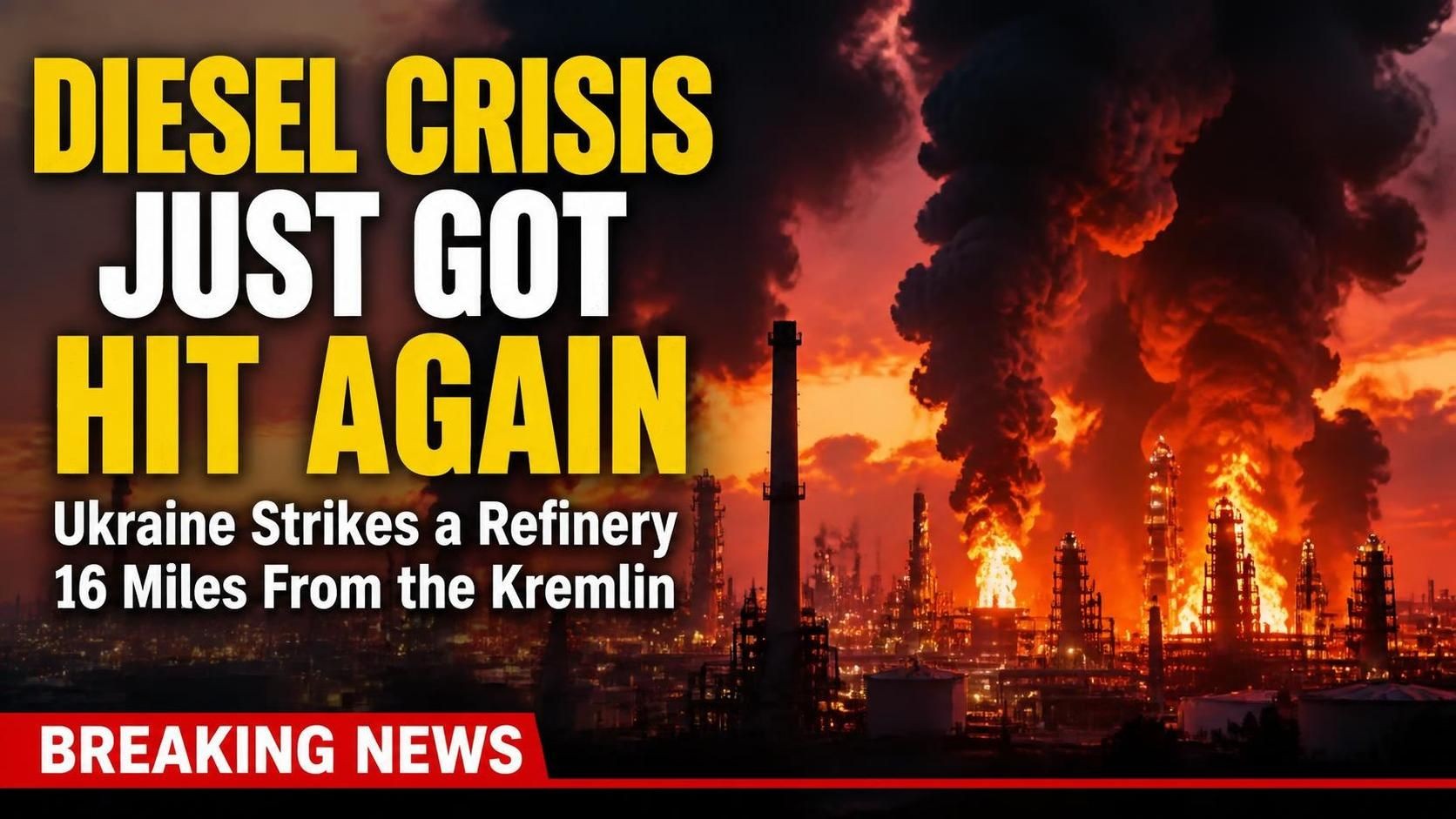
The global diesel squeeze just absorbed another shock. Overnight into Sunday, Ukrainian drones reached the Gazprom Neft Moscow Oil Refinery in Kapotnya — about 16 miles, or 25 kilometers, from the Kremlin — during what Russia called the largest drone barrage of 2026.
This was not a one-off raid on a storage tank. It was another strike on the processing heart of Russia’s fuel system, delivered on the last day of parliamentary elections, after a week of European wartime photo ops and against a diesel market that was already short of barrels.
The attack: 1,110 drones, a plant inside Moscow, two dead
Russia’s Defense Ministry said air defenses downed 1,110 Ukrainian drones across 19 regions plus Crimea, beating the previous 2026 overnight high of 822 in August.
Moscow Mayor Sergei Sobyanin put the wider tally even higher: more than 1,600 drones intercepted since Saturday, including about 450 headed for the capital. He called the assault “unprecedented” and accused Kyiv of trying to disrupt the vote.
Several drones still reached the refinery grounds. Reuters witnesses heard blasts and saw smoke rising from the plant. Sobyanin said a facility on the territory was damaged, one apartment was hit, and there were no casualties inside the city. Moscow Region Governor Andrey Vorobyov reported two deaths and multiple injuries outside the capital. Hundreds were evacuated from a high-rise after a fire.
President Volodymyr Zelenskyy claimed the hits. He said long-range systems — including FP-1, RZ-100, Flamingo, Pelican and others — struck “one of Russia’s key oil industry facilities and the aggressor’s logistics facility,” calling them “billions of dollars that sustain the war machine.” Ukrainian reports said primary processing and isomerization units were targeted and a large fire broke out. Fire Point said its FP-1 drones were used. Russia has not published a full damage inventory. The plant’s owner, Gazprom Neft, did not immediately comment.
The political timing was not subtle. Russia was finishing its first wartime Duma election since the 2022 invasion. The strike also came after Washington said both sides had agreed to stop hitting energy infrastructure. They did not stop.
Wartime photo ops in Europe, then drones over Moscow
The military optics in Europe this week were already loud. At the European Arctic Summit in Rovaniemi, Finland, EU leaders swapped suits for camouflage jackets and posed at an air base among fighter jets — a family photo designed to look like a war cabinet, not a climate conference. German Chancellor Friedrich Merz, EU foreign-policy chief Kaja Kallas and other leaders used the Arctic gathering to talk security, Russia, shipping lanes and defense.
At the same time, Zelenskyy hosted the inaugural Carpathian 8 Summit in Bukovel, western Ukraine, with Poland’s Donald Tusk, Serbia’s Aleksandar Vučić, Romania’s Nicușor Dan and other regional leaders. Security, energy and logistics were on the agenda. The pictures said alliance. The drones said escalation.

Did NATO or the EU help target the Moscow plant?
There is no public, verified proof that NATO or EU intelligence selected this specific Kapotnya aim point on September 20.
What is documented is a broader pattern. A Financial Times report earlier this year said U.S. and French intelligence have helped Ukraine map Russian air defenses, plot drone routes around those defenses, and pick higher-value targets for deep strikes. German officials have separately discussed tighter intelligence cooperation and more help with target coordinates after incidents inside Europe. Ukraine has also pushed domestically built long-range drones and missiles that no longer depend on Western launchers.
So the honest answer is: Western intelligence support for Ukraine’s deep-strike campaign is real and has been reported for months. Direct NATO/EU targeting credit for this particular Moscow refinery raid has not been established. Kyiv can now reach the capital with its own systems. That is the escalation.
How much damage — and why this plant matters
The Moscow Oil Refinery is not a backwater topping plant. It is inside the city, in Kapotnya, owned by Gazprom Neft, with nameplate capacity around 12 million tonnes a year, or roughly 220,000–245,000 barrels per day. In 2024 it processed 11.6 million tonnes and produced about 2.9 million tonnes of gasoline and 3.2 million tonnes of diesel. It has supplied on the order of 35–40 percent of Moscow’s fuel and a large share of regional gasoline, diesel and jet kerosene.
It has already been hammered. June 2026 strikes knocked out both primary crude units. Reuters sources then said the plant could stay offline into 2027. Sunday’s raid hit a facility that was already wounded. Ukrainian sources say an AVT-6-type primary unit and an isomerization unit were among the targets. Independent footage showed fire. Russia says damage occurred and emergency crews were on scene. Full operational status will take days or weeks to confirm. For diesel markets, the direction is what matters: another processing unit in the capital region is at risk, not just a tank farm.
Russia’s refinery fleet: still large on paper, badly diminished in practice
Before this war’s drone phase, Russia had about 32–34 major refineries and roughly 6.5 million barrels per day of installed capacity — historically the world’s third-largest refined-product producer after the United States and China.
That fleet is no longer intact. Oxford Institute analysis: 22 of 34 refineries have been attacked in 2026, covering 4.75 million b/d, or about 76 percent of capacity.
IEA: throughput fell to 3.8 million b/d in June, the lowest in more than 20 years and about 30 percent below a year earlier. Gasoline output was down about 20 percent; diesel production was estimated down nearly 30 percent. The IEA cut its outlook to about 4 million b/d for the rest of 2026 and 2027.
Late August: only five major refineries were still untouched.
Mid-September Reuters reporting: half of Russia’s six top diesel plants were shut or slashed. Kirishi was fully down. Volgograd and NORSI were running near 25 percent. Those six plants normally make about half of Russia’s diesel.
Ukrainian General Staff claim in early July: 42.7 percent of refining capacity disabled and $13.5 billion in industry losses since August 2025. Other Western estimates have clustered around 20–30 percent offline at peaks, with repair times stretching from weeks for a crude unit to many months for secondary units.
Russia still pumps crude. The bottleneck is refining. That is why Moscow banned or sharply restricted diesel exports, why filling stations queued across time zones, and why every additional hit on a Moscow, Kirishi, Volgograd, NORSI or TANECO unit feeds the global diesel crisis.The global diesel map is breaking
Diesel is not gasoline. It moves food, harvests, trucks, mines, factories and militaries. When refining capacity disappears, crude in the ground does not fill the tank.
The Macrobysunil thread circulating this weekend put the bind in blunt terms: the world is short diesel, Russia’s exports have collapsed, Middle East flows are disrupted, India has become a swing supplier — and Washington is talking about punishing buyers of Russian crude while floating a U.S. diesel export ban.
Public trade snapshots from July–August 2026, as compiled in that circulation and supporting trade data, look like this:
Major exporters (approximate recent rates)
- United States: about 1.77 million b/d of distillate exports (late-August four-week average)
- India: about 0.50 million b/d (July diesel exports 2.4 million tonnes; August around 2.1 million tonnes)
- China: about 0.32 million b/d
- Russia: about 0.15 million b/d seaborne diesel/gasoil in early–mid August — a collapse from a former second-place export machine
Major import markets
- Europe: still the largest visible sink, around 1.56 million b/d of diesel imports in July, down from nearly 2 million b/d earlier in the year
- Turkey: at least 0.29 million b/d, scrambling after losing most of its Russian supply
- Brazil: around 0.28 million b/d
- Australia: the world’s top diesel importer in volume terms, on the order of 25 million tonnes a year
- Also large: France, UK, Egypt, South Africa
After the EU banned seaborne Russian diesel, Europe rebuilt supply from the Middle East, then the United States and India. That replacement chain is now stressed from both ends: Ukrainian strikes and a Russian export ban on one side; Middle East war disruption, Red Sea risk, and talk of U.S. export limits on the other. Combined Middle East and Russian diesel exports in August were estimated 1.6 million b/d below February levels. IEA officials have said it is unclear where the missing refined barrels come from.
India’s rise is the swing variable. It refined discounted Russian crude and sold diesel into Europe and other deficit markets. That is exactly why tariff threats against buyers of Russian oil collide with diesel physics. You cannot sanction the feedstock and still expect the product to show up in Rotterdam.
U.S. inventories: a weekly build, a tight market
The latest EIA weekly data, for the week ending September 11 (released September 16), show U.S. distillate stocks at 107.9 million barrels, up 1.6 million on the week.
That build does not mean the crisis is over.
- National stocks remain well below the five-year seasonal average — one market recap put the deficit near 13 percent versus the seasonal norm and 13.5 percent versus a year earlier.
- PADD 1 (East Coast) held only 21.6 million barrels. That is the district that makes shortage headlines.
- Days of supply are around 30.
- The EIA’s Short-Term Energy Outlook this month warned U.S. diesel stocks could fall below 100 million barrels, the lowest since 2003, heading into peak demand.
U.S. distillate demand has been softer year-on-year, which helped inventories stabilize. Exports have been heavy because Europe can outbid domestic buyers.
U.S. pump diesel has already printed records above $6 a gallon. A U.S. export ban might cool domestic politics. It would tighten the Atlantic Basin further and raise the odds that India or China also hoard barrels. That is how a refinery fire 16 miles from the Kremlin becomes a harvest problem in Iowa and a trucking problem in Germany.
Bottom line
Ukraine just proved again that it can put drones into Moscow’s most sensitive industrial zip code. Russia can intercept a thousand airframes and still lose the one that hits a distillation unit. Europe can pose in camouflage and still import diesel from three oceans. The United States can talk about export bans while sitting on inventories that look comfortable only if you ignore the East Coast and the seasonal path.
The diesel crisis is not a crude story. It is a refining-capacity story. Sunday’s strike on Kapotnya was another subtraction from a system that has already lost a large slice of Russian diesel output. Until those units come back — or someone else runs harder — the market stays one successful drone wave away from the next price spike.
Making Appendices Great Again
Check out the World’s Greatest Podcast Show Notes at EnergyNewsBeat.co or EnergyNewsBeat.com.
Subscribe to the Energy News Beat Substack: https://theenergynewsbeat.substack.com/
Appendix: Sources and links
The September 20 attack
- Bloomberg: Moscow Refinery Hit as Russia Reports Largest 2026 Drone Attack
- Reuters: Two dead in Moscow region, drones hit oil refinery in Russian capital
- Kyiv Post: Zelensky Confirms Strikes on Moscow Refinery and Logistics Facilities
- CBS/AP: Ukraine launches 1,000 drones at Russia…
- ABC News: Ukrainian drones and missiles target Moscow, oil refinery
European wartime optics
- Kyiv Independent: Zelensky hosts European leaders at inaugural Carpathian 8 Summit
- APT / coverage of EU leaders in military-style gear at Rovaniemi Air Base, European Arctic Summit, mid-September 2026
Intelligence support (pattern, not this specific strike)
- Military Watch / FT reporting: U.S. and French Intelligence Playing Central Role in Ukraine’s Drone Deep Strikes
- UATV / Der Spiegel reporting on German intelligence and drone support discussions
Russian refining capacity and damage
- IEA: Russian refining sector struggles amid intensifying Ukrainian attacks
- Oxford Institute for Energy Studies PDF commentary on 2026 refinery attacks
- Reuters: Half of Russia’s top diesel-producing refineries cut back output
- Carnegie: Russian Oil Sector Battered but Not Broken
- Kyiv Post: Ukrainian Strikes Disable 43% of Russian Refining Capacity
- Euromaidan Press / Reuters on Moscow refinery offline into 2027 after June strikes
Global diesel trade
- X / Macro Liquidity by Sunil Reddy: https://x.com/Macrobysunil/status/2101298999731032446
- Reuters: Spare a thought for the world’s biggest diesel importers
- S&P Global: Middle East diesel exports to Europe, 2025
- Vortexa / PTI reporting on Indian diesel to Europe
- Energy News Beat prior coverage on Russia’s diesel export ban
- WSJ / Dow Jones: refineries as the global energy chokepoint, Sept. 19–20, 2026
U.S. inventories and prices
- EIA Weekly Petroleum Status Report / distillate stocks table, week ending Sept. 11, 2026: https://www.eia.gov/dnav/pet/pet_sum_sndw_a_epd0_sae_mbbl_w.htm
- EIA WPSR hub: https://www.eia.gov/petroleum/supply/weekly/
- Bloomberg: US Sees Diesel Stocks Falling to 2003 Low Ahead of Peak Demand
