

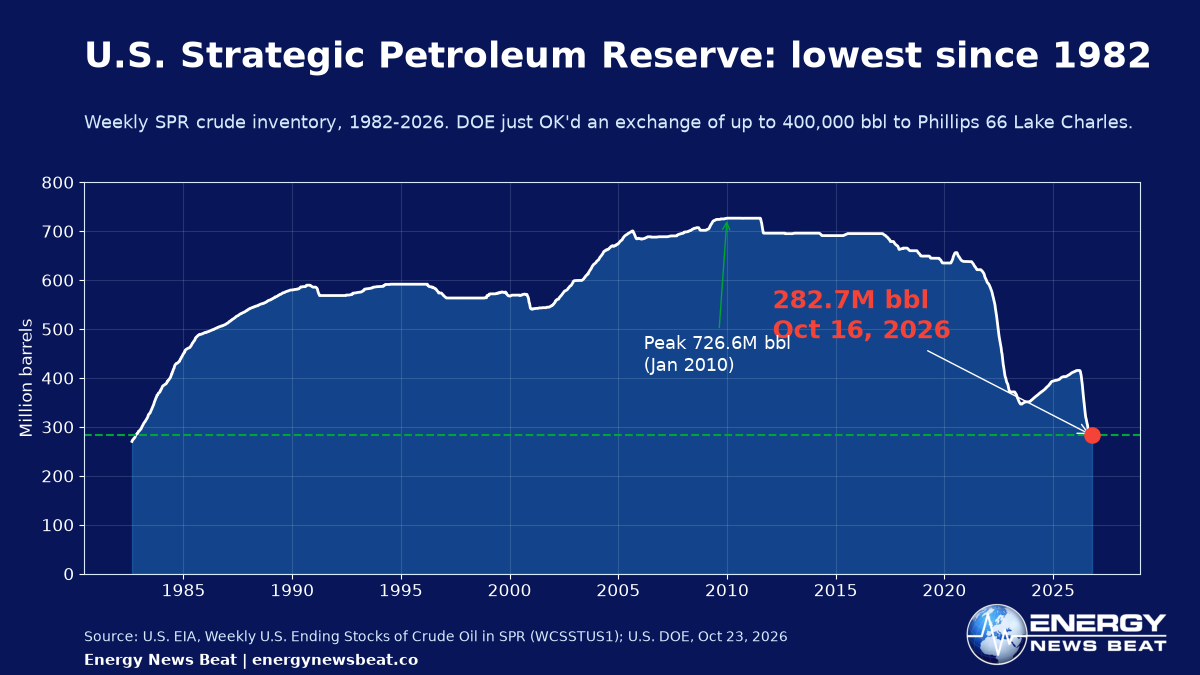
DOE approves an exchange of up to 400,000 barrels from an SPR already at its lowest level since 1982. A Phillips 66 spokesperson said the company expects no hit to operations.
If you fill up anywhere in Louisiana or the Southeast, this one is worth a minute. On Friday, Oct. 23, the U.S. Department of Energy authorized an emergency exchange of up to 400,000 barrels of crude oil from the Strategic Petroleum Reserve to the Phillips 66 Lake Charles refinery in Louisiana. The barrels come from the West Hackberry SPR site for immediate delivery.
What happened at Lake Charles
DOE said the oil will “help offset temporary disruptions affecting crude oil deliveries to the refinery and support continued production of transportation fuels serving Louisiana and surrounding markets.” That is as specific as anyone has been. Neither DOE nor Phillips 66 has said what caused the delivery problem, and OPIS reporting via MarketWatch noted the announcement did not specify the nature of the disruption.
The plant is a big one for the region. Phillips 66 lists the Lake Charles refinery in Westlake, La., at 264,000 barrels per day of crude throughput, and says it produces a high percentage of transportation fuels, with most products going to customers in the southeastern and eastern U.S.
A Phillips 66 spokesperson confirmed the refinery will receive SPR crude but declined to comment on operations or commercial activity, Reuters reported. “We do not anticipate impacts to Lake Charles operations,” he said.
This is a loan, not a giveaway
Under the deal terms, DOE says all borrowed crude will be returned “with additional premium barrels,” so the reserve should end up with more oil than it lends, “at no additional cost to taxpayers.” DOE Under Secretary of Energy Kyle Haustveit said the exchange “requires Phillips 66 to return more barrels to the SPR than are currently being withdrawn.” DOE has not published the premium size or the return date.
A reserve running thin
The bigger picture is the tank itself. According to EIA weekly data, the SPR held 282.683 million barrels in the week ending Oct. 16, 2026. That is the lowest weekly level since October 1982, when the reserve was still being filled for the first time. For comparison, the same EIA series peaked at about 726.6 million barrels in January 2010.
Reuters reports the reserve was drawn down under President Biden after Russia’s invasion of Ukraine and again under President Trump as the U.S. war on Iran disrupted supply lines. DOE has also asked companies to bid on another exchange of up to 17 million barrels, the remainder of a 40-million-barrel offer from late September, as it finishes the 172-million-barrel release pledged in March. DOE has not published the awards.
Next up: Phillips 66 reports third-quarter results Wednesday, Oct. 28, with a webcast at 11 a.m. CT. Watch for any comment on Lake Charles crude supply.
Stu’s Take
This is the SPR doing exactly what it was built for: a quick, short-term bridge so a refinery keeps making fuel for families and truckers. Up to 400,000 barrels equals about a day and a half of the plant’s full 264,000 b/d crude capacity. It’s a bridge for a delivery hiccup, not a replacement supply, and it comes back with interest. But the cushion is thin. At 282.7 million barrels, the reserve is at levels we have not seen since 1982, down from about 726.6 million at the peak. With bids out for another 17 million barrels, refilling the SPR needs to be a priority, not an afterthought.
Check out the World’s Greatest Podcast Show Notes at EnergyNewsBeat.co or EnergyNewsBeat.com. And subscribe to: The Energy News Beat Substack.
Sources
- S. DOE, “Energy Department Authorizes Strategic Petroleum Reserve Exchange to Support Fuel Supply Stability,” Oct. 23, 2026
- S. EIA, Weekly U.S. Ending Stocks of Crude Oil in SPR
- Phillips 66, Lake Charles Refinery
- Reuters, Oct. 23, 2026 (via Hydrocarbon Processing, Oct. 26)
- S. DOE, SPR release commitments and 40M bbl exchange RFP, Sept. 29, 2026
- Reuters via EnergyNow, 17M bbl exchange solicitation, Oct. 2026
- MarketWatch/OPIS, Oct. 23, 2026
- Phillips 66 Q3 2026 results announcement (Nasdaq/Business Wire)
