

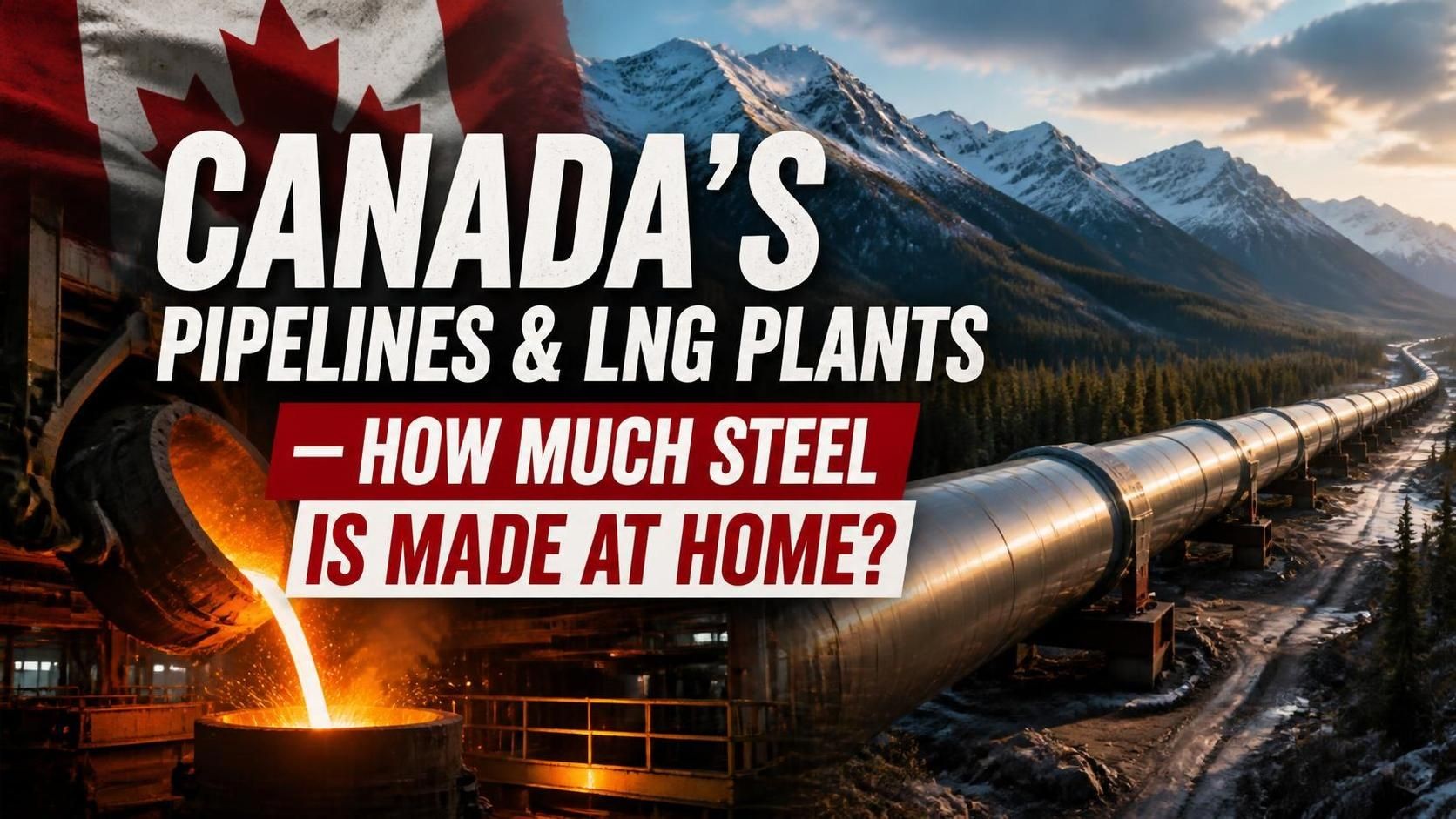
Trump’s tariffs and China’s steel glut are squeezing Canadian mills from both sides. Algoma’s blast furnace is shut, Stelco lines sit idle, and LNG Canada Phase 2 is going back to a Chinese fabrication yard.
By the ENB Research Desk for Stu Turley. Data as of Oct. 26, 2026 (CT).
Bottom line up front
| The short version
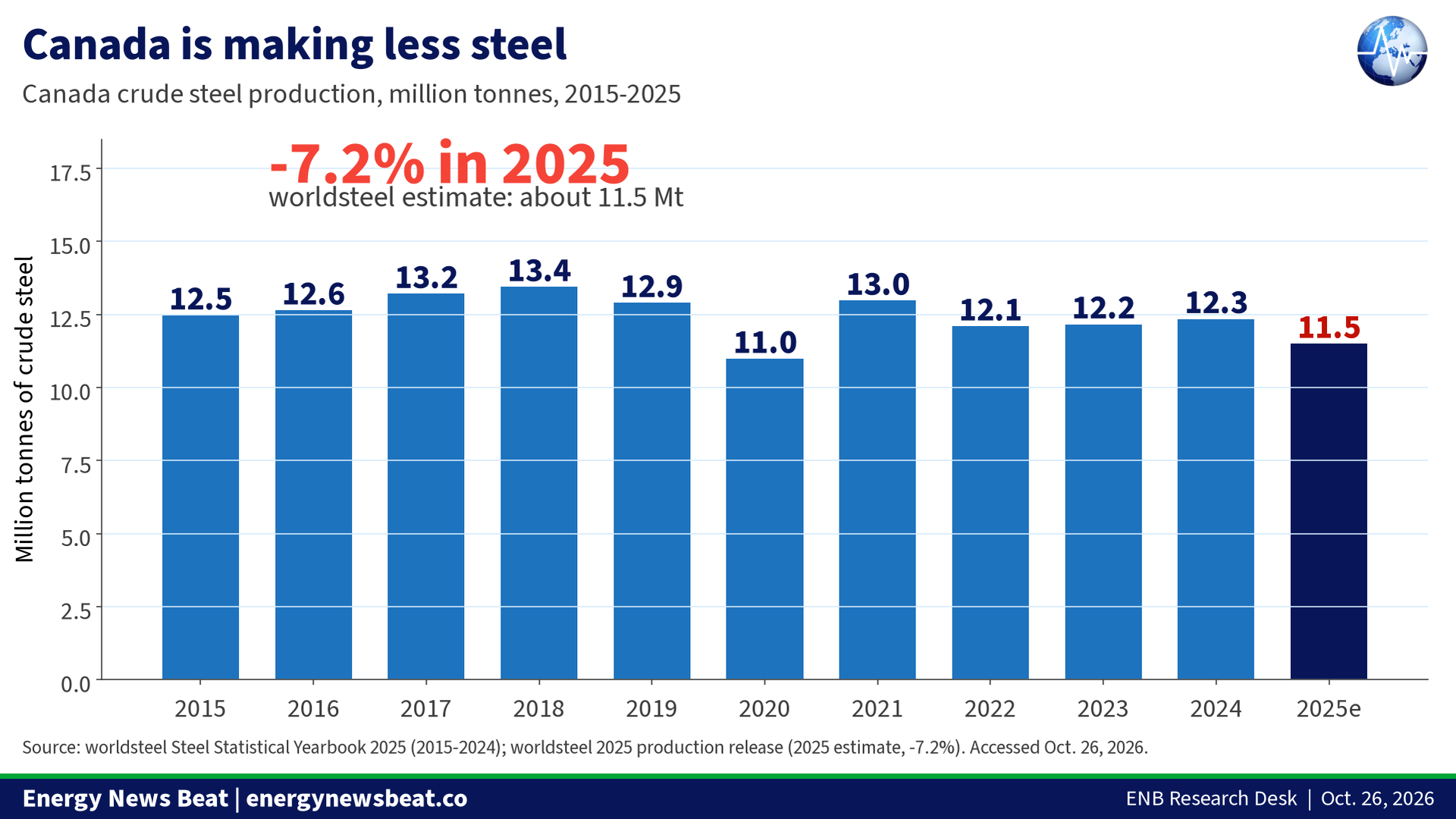
The U.S. charges up to 50% on Canadian steel under Section 232 (Trade Commissioner Service); Canada hits U.S. steel with a 50% surtax (CBSA). On Oct. 26, Reuters reported the two sides are working on a deal to ease the steel and auto tariffs. Canada made 12.3 million tonnes of crude steel in 2024 and an estimated 11.5 million in 2025, down 7.2%. Algoma has shut its last blast furnace and gone all electric arc. LNG Canada took its C$33 billion Phase 2 decision on Sept. 28, 2026. Its spokesperson told CBC that no Canadian yard can build the modules, so they go back to China’s state-owned COOEC. The big pipelines mostly used Canadian pipe from Evraz in Regina (now Orion Steel, owned by U.S.-based Atlas Holdings). Specialty pipe came from India (Welspun) and Japan (JFE on TMX). None of the named pipe makers is Chinese-owned. |
Squeezed from both sides
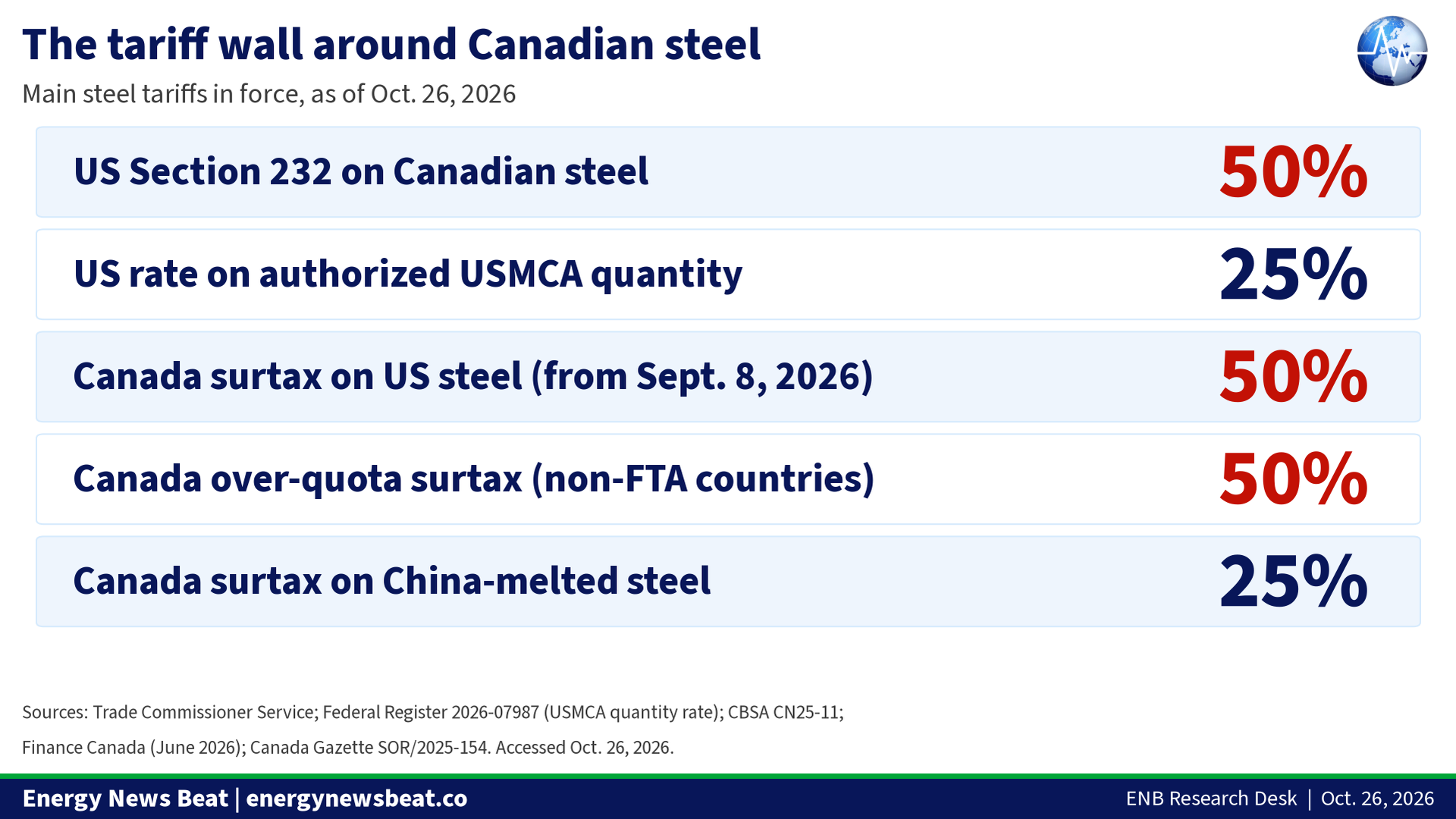
Start with Washington. Since April 6, 2026, Section 232 metals tariffs have run from 10% to 50% on the full value of the product, with most primary steel, including Canada’s, at 50% (Trade Commissioner Service). A limited quantity of Canadian steel pays 25% under HTS 9903.82.18 (Federal Register, Apr. 23, 2026), but only for volumes Commerce authorizes for producers that supply U.S. automakers and commit to new U.S. capacity; CBP had not yet issued filing instructions. Derivative products pay 15% to 25% (C.H. Robinson). On top of that, Section 338 duties add 50% more on about C$27.6 billion of other Canadian goods (Dentons), a list the White House revised again on Oct. 23, effective Oct. 30. Reuters reported Trump has also said he would raise steel and auto tariffs on Canada to 50% from Jan. 1, 2027 (Reuters; CBS News). Most Canadian steel already pays 50%; the change mainly hits autos.
The White House’s official target is China’s overcapacity. On Sept. 30, U.S. Trade Representative Jamieson Greer chaired a steel excess-capacity forum in Milwaukee that agreed a joint “Milwaukee Framework.” Greer said U.S. steel is “undergoing a renaissance on the strength of tariffs.” China made 960.8 million tonnes of the world’s 1,848.9 million in 2025 (1,849.4 million in its press release), worldsteel says, or about 52% (ENB calculation).
Ottawa has hit back on two fronts. Since Sept. 8, 2026, most U.S. steel, including line pipe, pays a 50% surtax (25% on some household items). Steel from countries without a trade deal with Canada faces quotas set at 20% of 2024 volumes, with a 50% surtax over the line, extended to June 27, 2027 (Finance Canada). Steel melted and poured in China has paid a 25% surtax since July 31, 2025.
Has it worked on China? Partly. The Canadian Steel Producers Association says Chinese steel shipments to Canada fell 38% in 2025, to about 400,000 tonnes, or 6% of imports (Financial Post). Global Affairs Canada permit data tells a different story. China’s share of Canada’s pipe and tube imports rose to an average 16.1% over the last three quarters of 2025, up from 8.9% in the first quarter. Its share of long products rose to 9.6% from 2.7%. McMaster economist Colin Mang told the Post this “supports the idea” that Beijing is “willing to eat the cost.”
What Canada has lost, mill by mill
Canada made 12.3 million tonnes of crude steel in 2024, below the 13.4 million of 2018. worldsteel estimates 11.5 million for 2025. worldsteel’s 2008 yearbook puts the 2000 peak at about 16.6 million tonnes.
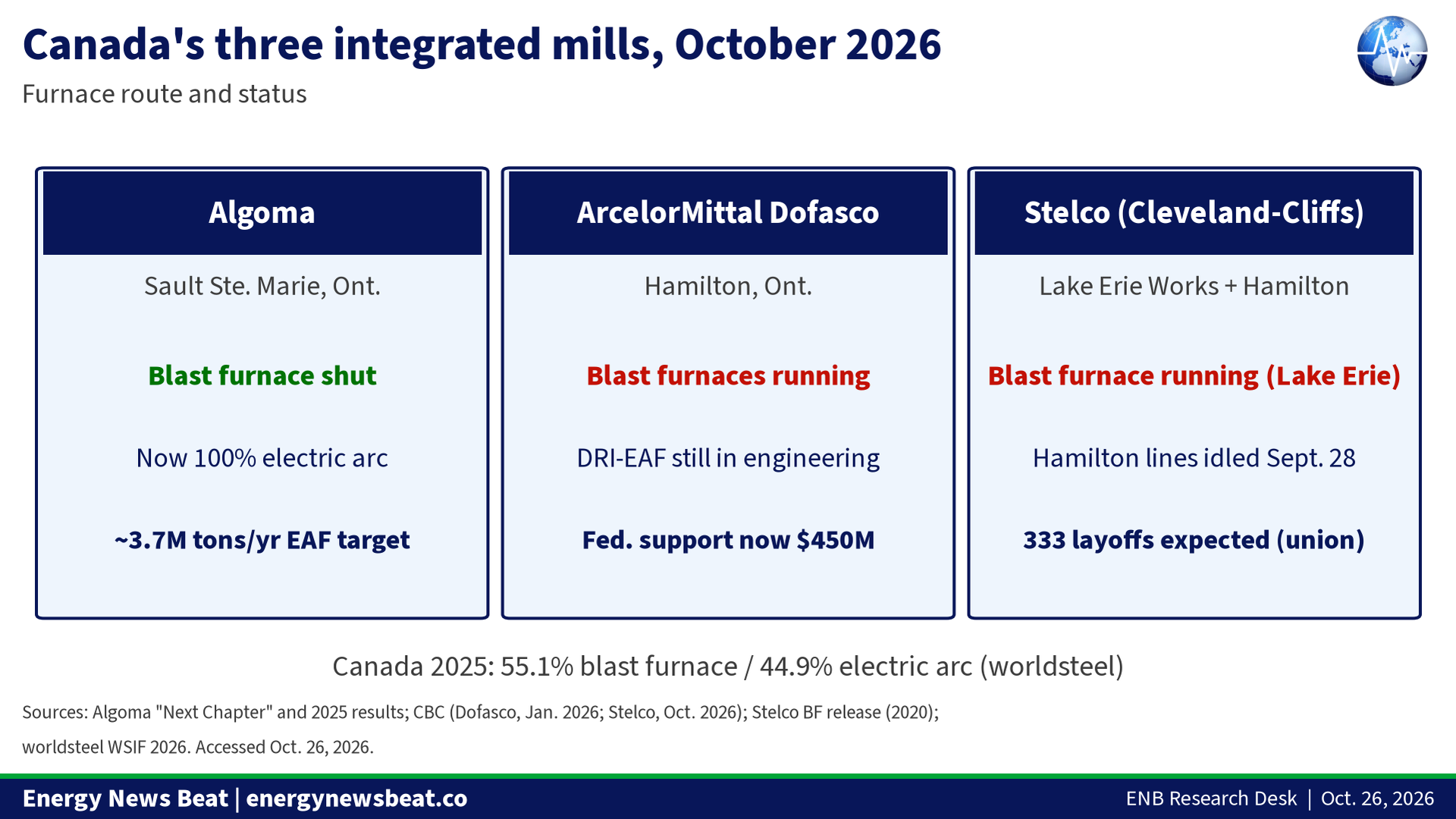
- Algoma (Sault Ste. Marie): Algoma decided to end blast furnace production shortly after Dec. 31, 2025, ahead of its 2027 plan, and began decommissioning blast furnace No. 7 in January (Algoma). Its coke batteries are closed and it now runs on electric arc furnaces, aiming for about 3.7 million tons a year. It lost $984.9 million in 2025 and has a $500 million government liquidity facility. Algoma is still Canada’s only maker of discrete plate.
- ArcelorMittal Dofasco (Hamilton): The C$1.8 billion plan to swap blast furnaces for direct reduced iron and an electric furnace is still in planning; CBC reports it “has gone through several engineering phases.” A Hamilton DRI plant will not be built; DRI is to come from Contrecoeur, Quebec, and federal funding is now $450 million. Until then, Dofasco still runs blast furnaces.
- Stelco (Cleveland-Cliffs): The Lake Erie Works blast furnace in Nanticoke still runs (CBC; it was relined in 2020). On Sept. 28, Stelco said it would idle part of its Hamilton plant; the union expects 333 layoffs there and up to 50 at Lake Erie, while the company puts the total at up to 500 (CBC). On Oct. 22, Industry Minister Mélanie Joly gave Stelco 15 days to reverse the layoffs (CBC).
Why the furnace type matters: a blast furnace turns iron ore into new iron. An electric arc furnace mostly melts scrap. In 2024, Canada mined 70 million tonnes of iron ore but made only 5.8 million tonnes of pig iron and 1.6 million tonnes of DRI (worldsteel). It also exported 4.6 million tonnes of scrap and imported 0.7 million. In 2025 the split was 55.1% blast furnace and 44.9% electric (worldsteel). Scrap steel is cheaper and cleaner, but some grades need low impurities and so new iron. With Algoma’s furnace gone, Canada’s ore-based capacity rests on Dofasco and Lake Erie.
Who made the pipe for CGL and TMX?
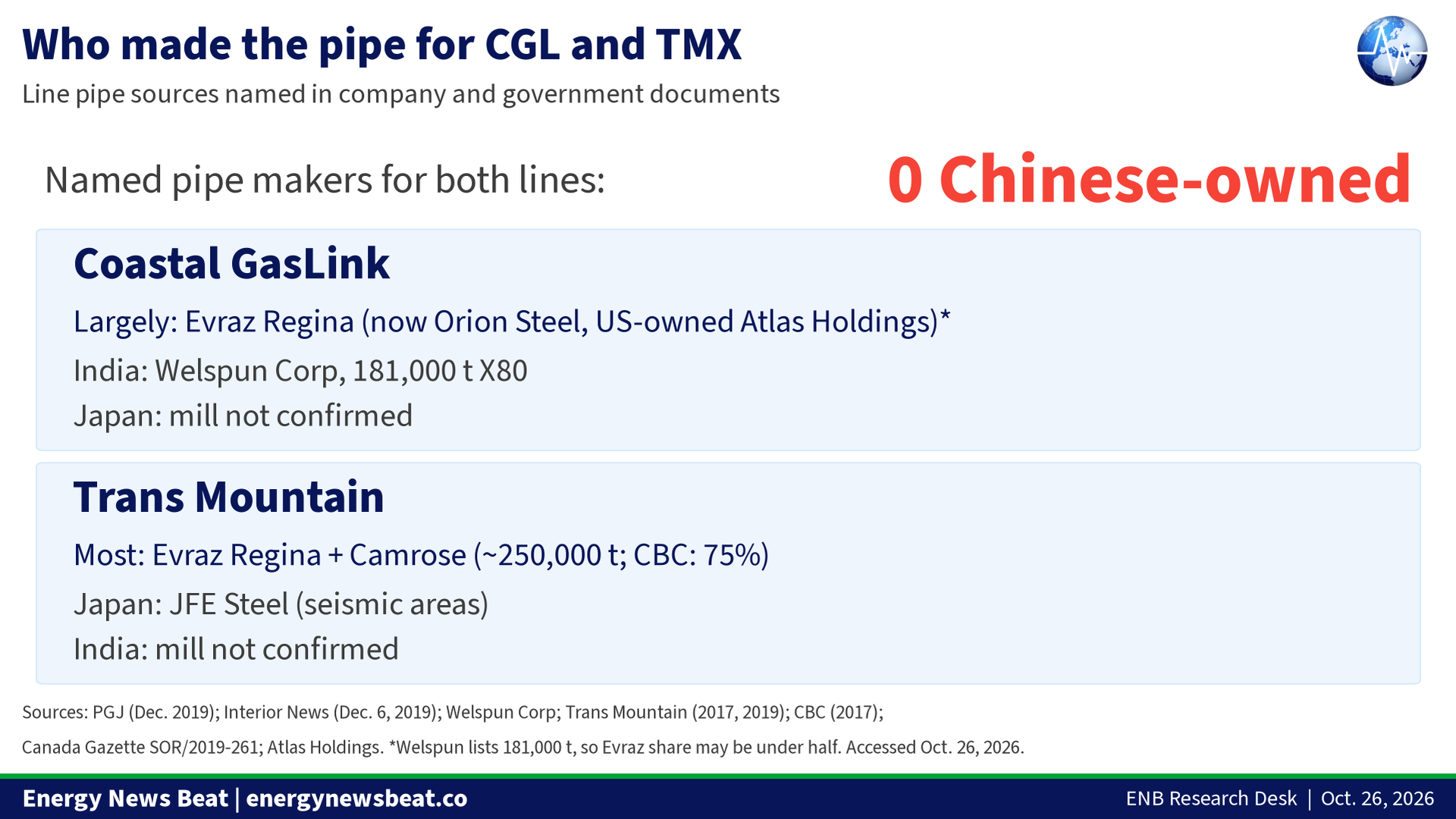
Coastal GasLink (670 km, about 390,000 tons of pipe): the pipe came largely from Evraz in Regina. The rest came from mills in India and Japan “because of constraints of manufacturing capacity,” the Interior News reported in 2019. India’s Welspun Corp lists 181,000 tonnes of X80 pipe for Coastal GasLink, so the Evraz share may be smaller than half, depending on how totals are counted. We could not confirm the name of the Japanese mill.
Trans Mountain Expansion: In 2017, Trans Mountain signed Evraz to make most of the pipe in Regina, about 250,000 tonnes; CBC put it at 75% of the steel. The rest came from India and Japan, with Japanese pipe for seismic and ground-movement areas (Trans Mountain). A Canadian duty remission order names Japan’s JFE Steel as a TMX supplier. We could not confirm the Indian maker for TMX.
Who owns them now? U.S. private equity firm Atlas Holdings bought Evraz North America on July 31, 2025, and renamed it Orion Steel. Its two mills are electric and use 98%+ recycled scrap. Welspun is part of India’s Welspun Group. JFE is Japanese. None is Chinese-owned.
LNG Canada: Phase 1 built in China, Phase 2 going the same way
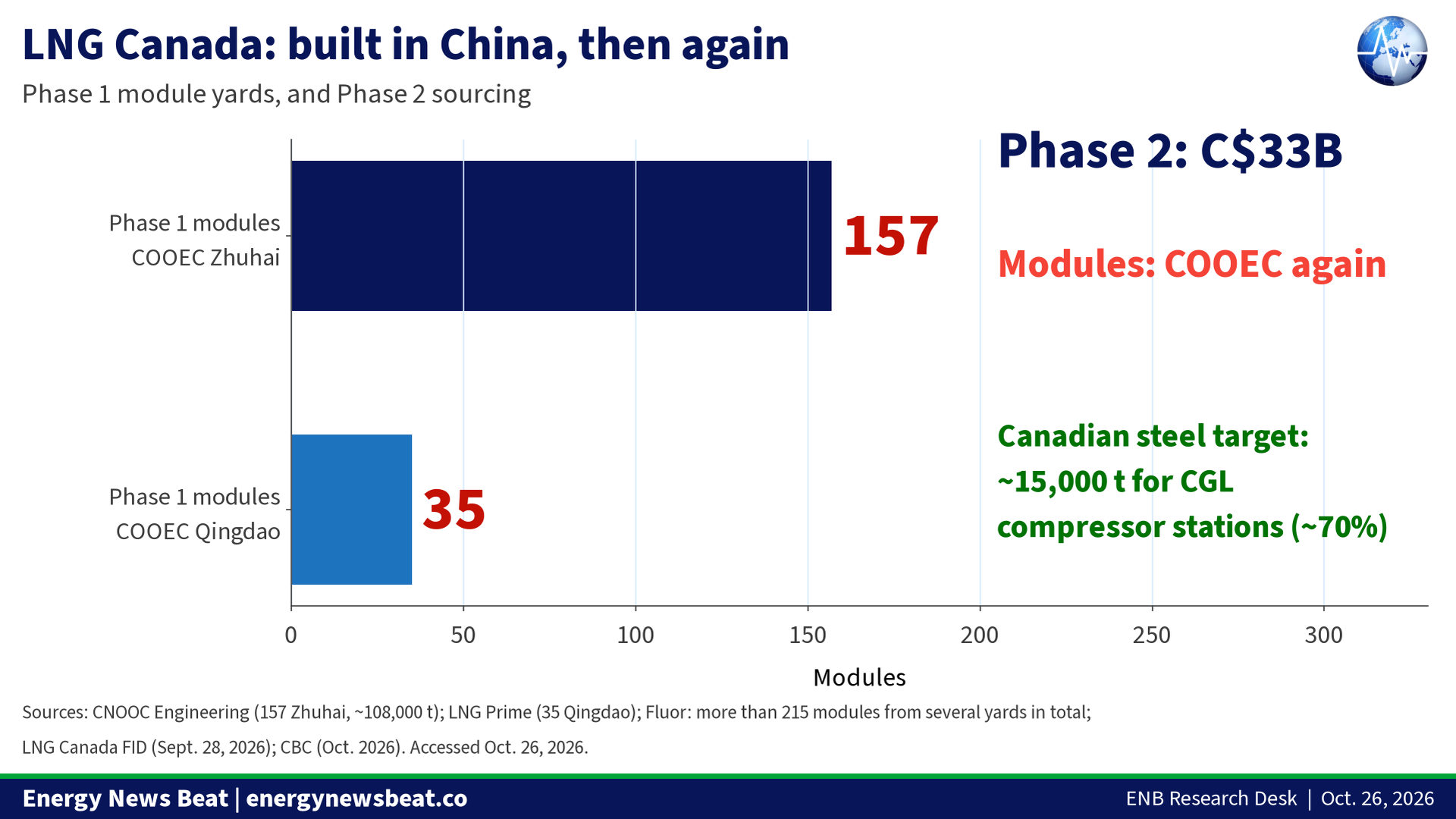
Phase 1 in Kitimat started exporting in June 2025. China’s state-owned COOEC built many of Phase 1’s modules at Zhuhai and Qingdao: 157 modules of about 108,000 tons from Zhuhai and 35 from Qingdao. Fluor says more than 215 modules came from several fabrication yards in total. Duty relief on Phase 1 imports was worth about $1 billion (CBC).
On Sept. 28, 2026, LNG Canada took its final investment decision on Phase 2, a project CBC values at C$33 billion: two more trains, and capacity going from 14 to 28 million tonnes a year. Its owners are Shell (40%), PETRONAS (25%), PetroChina (15%), Mitsubishi (15%) and KOGAS (5%). Contractor JGC Fluor started early works on Oct. 1. The modules are going back to COOEC. LNG Canada’s Paul Hagel told CBC: “There are no fabrication yards in Canada that can manufacture and deliver the additional modules required for Phase 2.” Prime Minister Mark Carney said there will be “full opportunities to buy Canadian steel… But it will be for them to decide.”
The Canadian steel target is in the pipeline expansion. Coastal GasLink Phase 2 adds compressor stations to nearly double capacity, with no new pipe. LNG Canada says the stations target “almost 15,000 tonnes” of Canadian steel, about 70% of what that work needs. Canadian steel fabricators (CISC) say they can do “a substantial portion” of the module work and want to engage with LNG Canada “in the coming weeks” (CBC).
Consumer and investor views
For consumers: Tariffs on both sides can raise the cost of steel used in cars, appliances and buildings, and Canada’s 50% surtax applies to U.S. steel goods Canadians buy. Building modules abroad can lower an LNG plant’s cost, while the fabrication work is done outside Canada.
For investors: Cleveland-Cliffs reported a strong price environment in the U.S. while its Canadian arm idles lines. Algoma now runs only electric furnaces and lost $984.9 million in 2025. The tariff deal Reuters reported is the main item to watch; any relief would change the outlook for Canadian mills.
Caveats and the other side
- Electric furnaces are not necessarily a loss. They generally have lower emissions and running costs, and U.S. producers are building them too. Algoma chose this route before the tariffs.
- The CSPA says China’s share of Canada’s imports actually fell in 2025, to 6%. The share gains are in certain categories.
- No Canadian yard has built LNG modules at this scale. Sending the work to Chinese yards may reflect yard capacity as much as policy.
- Most Coastal GasLink and Trans Mountain pipe was Canadian-made. Imports from India and Japan were for capacity and specialty grades, not Chinese pipe.
What to watch
- A U.S.-Canada Section 232 deal, which a Canadian source told Reuters could come before the Nov. 3 midterms.
- Whether Stelco reverses its Hamilton layoffs before Joly’s deadline.
- Algoma’s second electric furnace and its plate output.
- Dofasco’s DRI-EAF schedule.
- Whether CISC fabricators win any Phase 2 module work.
Stu’s Take
| Stu’s Take (ENB opinion)
Calling it “Canadian steel” versus “Chinese steel” is semantics. China makes about 52% of the world’s steel. Its share of Canada’s pipe and tube imports rose to 16.1% last year, despite a 25% surtax. Low-cost imports still set the price Canadian mills have to meet. Meanwhile, Algoma has shut its last blast furnace, Stelco is idling Hamilton lines with 333 layoffs expected, and LNG Canada’s C$33 billion Phase 2 is rolling forward with modules from COOEC in China, again. The Canadian steel promise is about 15,000 tonnes for compressor stations. To be fair, the big pipelines were mostly Canadian pipe, and none of the import makers is Chinese-owned. But when the one country that mines 70 million tonnes of iron ore can’t build its own LNG modules, that is de-industrialization in full swing. I was wrong on the podcast and said that they had switched to Chinese pipe, but it does not seem like they will be able to make the pipelines without foreign help. The pipe actually came from Japan and India, with manufacturing handled and shipping by Chinese companies. So that does not count as “Chinese Pipe”. The bottom line, they have lost control of growth in manufacturing, and I am not sure how they will ever re shore manufacturing back into Canada. And President Trump was right about how Canada was treating the US in Trade Relations, so as things progress, watch how many jobs are lost in Canada, and gained in China, India and Japan. |
