Prices are up 82% in a year. Washington has offered to lend out up to 315,000 barrels of emergency heating oil, and is pointing to a gas pipeline as the long-term fix.
By Energy News Beat | Oct. 30, 2026
If you heat with oil in Maine, this week brought a number nobody wanted. The state’s weekly survey put the average price of heating oil at $6.05 a gallon on Oct. 26, a record and a penny above the $6.04 record of the week before, which itself topped the $6.02 set Sept. 21. A year ago, the same survey found $3.32.
What it means at the tank
The Maine Department of Energy Resources uses a standard 275-gallon tank as its yardstick. Here is the arithmetic, done the plain way:
- Today: 275 gallons x $6.05 = $1,663.75
- A year ago: 275 gallons x $3.32 = $913.00
- Difference: $750.75 more to fill the same tank, which matches the state’s estimate of about $750
The percentage checks out too. $6.05 divided by $3.32 is 1.822, an increase of 82%. That is cash price for a delivered fill, not a pre-buy or contract price, which the state’s survey excludes. Prices also vary by region: the survey’s Central Maine average was $6.11, and the highest single quote it found statewide was $6.81.
Federal data tell the same story. The U.S. Energy Information Administration’s Maine residential heating oil price was $6.040 on Oct. 26, against $3.249 a year earlier. Across New England it was $6.165. And heating oil is close kin to diesel: the national average diesel price was $6.352 that same week, up from $3.718 a year ago and only a little below the $6.529 record set on Sept. 21.
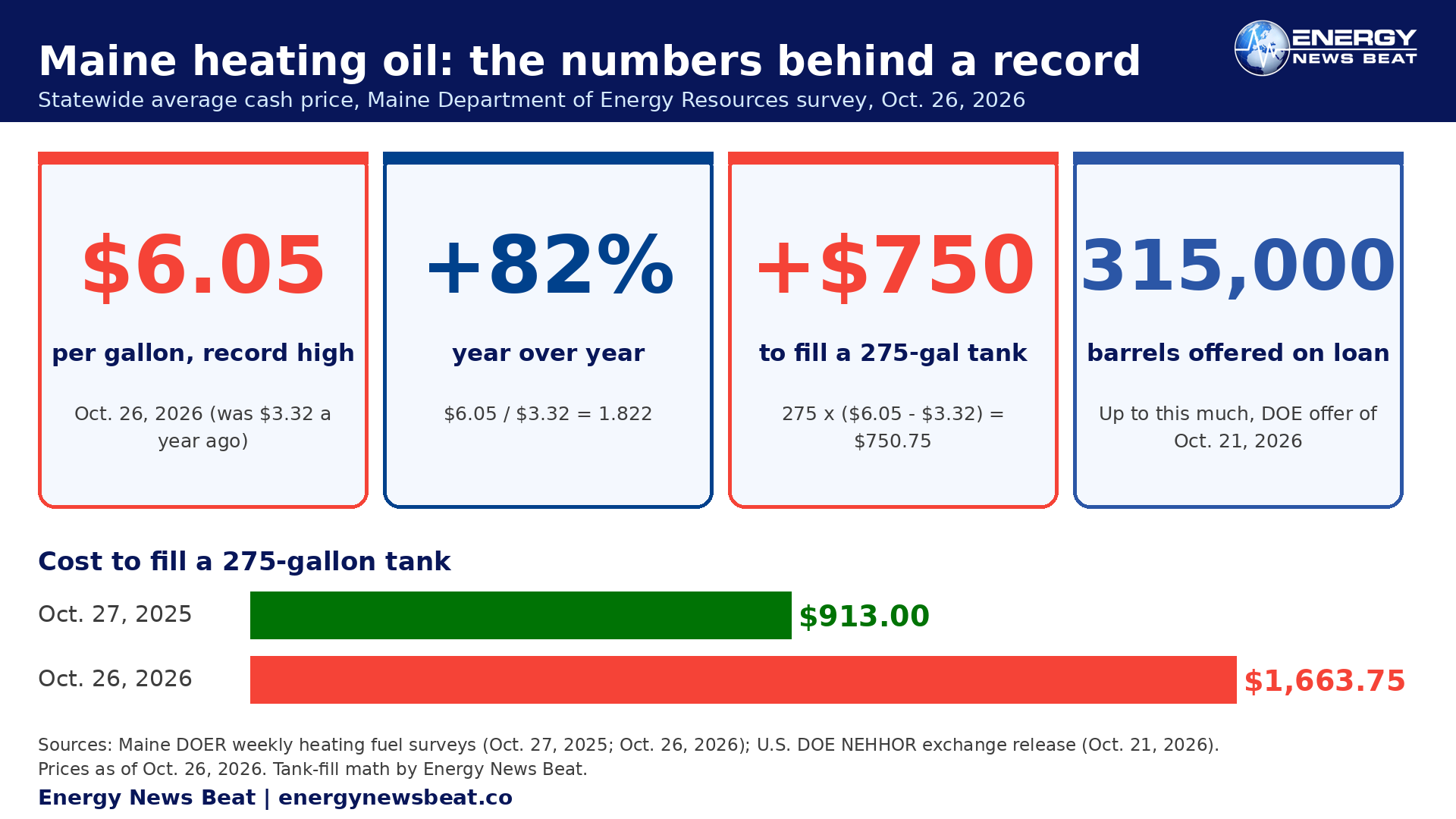
Chart 1. The Maine numbers in one place. Sources: Maine DOER weekly surveys (Oct. 27, 2025; Oct. 26, 2026); DOE NEHHOR release (Oct. 21, 2026). Prices as of Oct. 26, 2026.
Washington’s short-term move
On Oct. 21, the Department of Energy announced a request for proposals to exchange up to 315,000 barrels from the Northeast Home Heating Oil Reserve, which Bloomberg describes as holding about 1 million barrels. (The four storage sites listed in DOE’s bid document total 701,127 barrels.) It is a loan, not a giveaway: companies that take barrels must return the same volume plus a premium, with returns scheduled between January and September 2027. Bids were due Oct. 27, and deliveries are scheduled to be completed by Nov. 13.
For scale, 315,000 barrels is 13,230,000 gallons (315,000 x 42). New England’s terminals held 2.47 million barrels of distillate in the week to Oct. 23, so the full amount would be about 12.8% of what New England terminals held in the week to Oct. 23, close to the 13% figure Maine’s senators cited. That inventory is 29% lower than a year earlier.
One thing to know: as of Oct. 30, DOE had not posted the results of the bidding on its reserve page. An offer to lend is not the same as barrels moving, and how much is actually taken depends on the bids.
The long-term pitch: a pipeline
Energy Secretary Chris Wright paired the loan with a push for natural gas. In DOE’s own release he called the exchange “a temporary measure to solve a temporary supply disruption” and said: “I encourage the governors of New York and New England to work with the Trump Administration to build the Constitution Pipeline and replace home heating oil with low-cost natural gas.” (DOE) Two days earlier, DOE committed up to $42 million in Defense Production Act money to the 125-mile Pennsylvania-to-New York line. Wright told Fox Business he hopes to see it in service for the winter of 2028.
That is two winters away. For a family filling a tank in November, the pipeline is a debate, not a delivery.
What you can do now
The state’s advice is practical: compare current prices, check Efficiency Maine incentives, and contact your local Community Action Agency if you need help now (DOER statement via WMTW). Calling more than one dealer matters when quotes in the same survey run from $5.50 to $6.81.
Caveats
The state survey is a cash-price average, rounded to the penny, and your dealer’s price may differ. The $750 figure assumes a completely empty 275-gallon tank; most deliveries are smaller, so most bills will rise by less per delivery but by more over a full winter. The EIA and state numbers use different samples and do not match exactly. The reserve loan is an offer, its final size was not public at the time of writing, and its effect on retail prices cannot yet be measured. Some reports have described the 315,000 barrels as already released or loaned; the primary documents describe an offer through bidding.
| STU’S TAKE
Opinion. Every number is linked to its source. Here is my view. A record $6.05 a gallon is a policy problem that lands on kitchen tables. Lending out up to 315,000 barrels is a reasonable bridge, and I give Washington credit for structuring it as an exchange that has to be paid back with a premium. But a bridge is not a road. New England’s distillate stocks are 29% below last year, and that is the real story. The region chose not to build gas pipes, and families pay for that choice every time the oil truck backs in. Secretary Wright is right that more supply is the answer, and the Constitution Pipeline is the obvious place to start. Until it is in the ground, the honest advice is: shop your dealer, watch the weekly survey, and do not wait for Washington to fill your tank. Make no mistake – we got here because of the energy polices of the last several decades, and you cannot pin this one on the current Administration. Pin this on the climate fearmongering politicial leaders that took money from the UN, USAID and others. Like Al Gore. As I have said, there is only two ways around this problem of high diesel, gasoline, jet fuel and now home heating oil, and that is 1: more supply or demand destruction. It is that simple. |
Appendix
A. Sources (all accessed Oct. 30, 2026)
- Maine Department of Energy Resources (DOER), “2025-2026 Heating Season – Weekly Fuel Prices, October 26, 2026” (PDF)
- Maine DOER, “Weekly Fuel Prices, October 27, 2025” (PDF, year-ago comparison)
- Maine DOER, “Weekly Fuel Prices, October 19, 2026” (PDF)
- Maine DOER, “Weekly Fuel Prices, September 21, 2026” (PDF)
- Maine DOER, “Weekly Fuel Prices, February 23, 2026” (PDF)
- Maine DOER, Heating Fuel Prices page
- WMTW, “Average price of heating oil in Maine reaches record high for second time in two weeks,” Oct. 29, 2026 (carries the DOER statement)
- Portland Press Herald, Drew Johnson, “Maine heating oil prices hit another record high,” Oct. 29, 2026
- S. Department of Energy, “Energy Department Authorizes Exchange from Northeast Home Heating Oil Reserve,” Oct. 21, 2026
- DOE Strategic Petroleum Reserve office, NEHHOR Exchange Request for Proposal, Oct. 21, 2026 (PDF)
- DOE, NEHHOR exchange page, spr.doe.gov (checked Oct. 30, 2026: RFP, exhibits and Q&A posted; no award notice)
- EIA, Weekly Maine No. 2 Heating Oil Residential Price, release of Oct. 28, 2026
- EIA, Weekly New England No. 2 Heating Oil Residential Price, release of Oct. 28, 2026
- EIA, U.S. No. 2 Diesel Retail Price, weekly, Oct. 26, 2026
- EIA, Weekly New England Ending Stocks of Distillate Fuel Oil, week to Oct. 23, 2026
- DOE, “Energy Department Advances Constitution Pipeline Project with $42 Million in Defense Production Act Funding,” Oct. 19, 2026
- Fox Business, “Trump administration commits up to $42M to revive stalled Northeast natural gas pipeline,” Oct. 19, 2026
- Bloomberg via Yahoo Finance, Ari Natter, “US to Tap National Diesel Reserve as Prices Soar Before Election,” Oct. 21, 2026
- Office of U.S. Sen. Susan Collins, release on the NEHHOR exchange, Oct. 21, 2026
B. Key verbatim excerpts
“based on a standard 275-gallon oil tank, Maine residents are estimated to pay approximately $750 more to fill their tank to capacity than they would have one year ago.” (DOER, as reported) Link
“Heating oil prices in Maine are now breaking records week after week, putting growing pressure on Maine families as temperatures continue to drop.” DOER Acting Commissioner Celina Cunningham Link
“The U.S. Department of Energy today announced a Request for Proposal for an exchange of up to 315,000 barrels of ultra-low sulfur distillate (fuel oil) from the Northeast Home Heating Oil Reserve (NEHHOR).” Link
“Under the terms of the exchange, borrowing companies must return the same volume of fuel oil plus a premium, ensuring that NEHHOR is refilled ahead of the 2027–2028 heating season.” Link
Secretary Chris Wright: “Of course, this is a temporary measure to solve a temporary supply disruption. I encourage the governors of New York and New England to work with the Trump Administration to build the Constitution Pipeline and replace home heating oil with low-cost natural gas. Doing so would save their residents billions of dollars in home heating and electricity costs.” Link
Wright to Fox Business: “We’ll want to see this pipeline in service two years from now, as we go into the winter of 2028.” Link
C. Data table
| Measure | Value | As of | Source |
| Maine heating oil, statewide avg (DOER) | $6.05/gal | Oct. 26, 2026 | DOER |
| Same, prior week (DOER) | $6.04/gal | Oct. 19, 2026 | DOER |
| Earlier record (DOER) | $6.02/gal | Sept. 21, 2026 | DOER |
| Reserve size (Bloomberg) / RFP site total | about 1 million bbl / 701,127 bbl | Oct. 2026 | Bloomberg / RFP |
| Same, a year earlier (DOER) | $3.32/gal | Oct. 27, 2025 | DOER |
| Same, before the Iran war (DOER) | $3.82/gal | Feb. 23, 2026 | DOER |
| DOER range of quotes, statewide | $5.50 to $6.81 | Oct. 26, 2026 | DOER |
| Maine residential heating oil (EIA) | $6.040 vs $3.249 | Oct. 26, 2026 vs Oct. 27, 2025 | EIA |
| New England residential heating oil (EIA) | $6.165 vs $3.519 | Oct. 26, 2026 vs Oct. 27, 2025 | EIA |
| U.S. diesel retail (EIA) | $6.352 vs $3.718; record $6.529 | Oct. 26, 2026; record Sept. 21, 2026 | EIA |
| New England distillate stocks (EIA) | 2,470 vs 3,487 thousand bbl | Week to Oct. 23, 2026 vs Oct. 24, 2025 | EIA |
| NEHHOR exchange offered | up to 315,000 bbl | RFP Oct. 21; bids Oct. 27; deliveries by Nov. 13, 2026 | DOE |
| Constitution Pipeline DPA funding | up to $42 million, 125 miles | Oct. 19, 2026 | DOE |
D. Methodology and what could not be verified
- Arithmetic: 275 x $6.05 = $1,663.75; 275 x $3.32 = $913.00; difference $750.75. Ratio 6.05 / 3.32 = 1.8223, or +82.2%. EIA Maine: 6.040 / 3.249 = +85.9%. EIA New England: 6.165 / 3.519 = +75.2%. Diesel: 6.352 / 3.718 = +70.8%. Stocks: 2,470 / 3,487 = 0.708, or 29.2% lower. 315,000 x 42 = 13,230,000 gallons; 315 / 2,470 = 12.8%. Since the Feb. 23 DOER survey: 6.05 / 3.82 = +58.4% (the Press Herald reported roughly 57%, likely from a different base week; that figure is not used in the article).
- The reserve action is an offer, not a completed loan. DOE’s Oct. 21 release announced a request for proposals for up to 315,000 barrels. As of Oct. 30, 2026, no award notice was posted on the NEHHOR page or in DOE’s press releases (DOE’s Oct. 29 award release concerns the Strategic Petroleum Reserve, not NEHHOR). The volume actually loaned could not be verified.
- DOE’s release says each offer is a minimum of 25,000 barrels “but not to exceed 30,000”; the RFP itself sets a 40% per-offeror cap and no 30,000-barrel cap. The article does not rely on either figure.
- The previous-record wording differs between outlets: the Press Herald says $6.05 is three cents above a September record of $6.02, while WMTW and DOER describe $6.04 on Oct. 19 as the previous record. The DOER survey PDFs show both are right: $6.02 on Sept. 21 was the old record, $6.04 on Oct. 19 topped it, and $6.05 on Oct. 26 topped that. DOE’s own release does not state the reserve’s total size; the article attributes about 1 million barrels to Bloomberg and notes the RFP’s four listed sites total 701,127 barrels (300,347 + 75,000 + 125,780 + 200,000). As of Oct. 30, 2026, the NEHHOR page lists only the RFP, offer form and Q&A; no award notice is posted.
- The DOER $750 figure assumes a completely empty tank filled to 275 gallons. The DOER statement was read via WMTW and the Press Herald, not on a DOER press page; the underlying prices were read directly from the DOER survey PDFs.
- The DOE claim that the pipeline “would save their residents billions of dollars” is DOE’s assertion; DOE publishes no method for it, and the article quotes it as a claim only.