Brent topped $116 on claims Riyadh has not confirmed. A U.S. letter to Tehran and Qatari mediators point one way, a market bracing for post-election strikes points the other, and the bill lands at the diesel pump.
By Energy News Beat | Oct. 30, 2026 | AAA read Oct. 30, 2026, morning CT; EIA data through Oct. 27, 2026
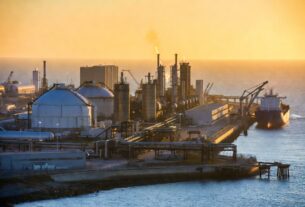
Yemen’s Houthis say they fired on three of Saudi Arabia’s most important oil sites on Thursday: the 550,000-barrel-a-day Ras Tanura refinery, the Rabigh refinery on the Red Sea coast, and an Aramco facility at Abqaiq. Saudi Arabia has not confirmed any of it. So before anything else, let’s be plain about what we know: these are claims, not confirmed damage.
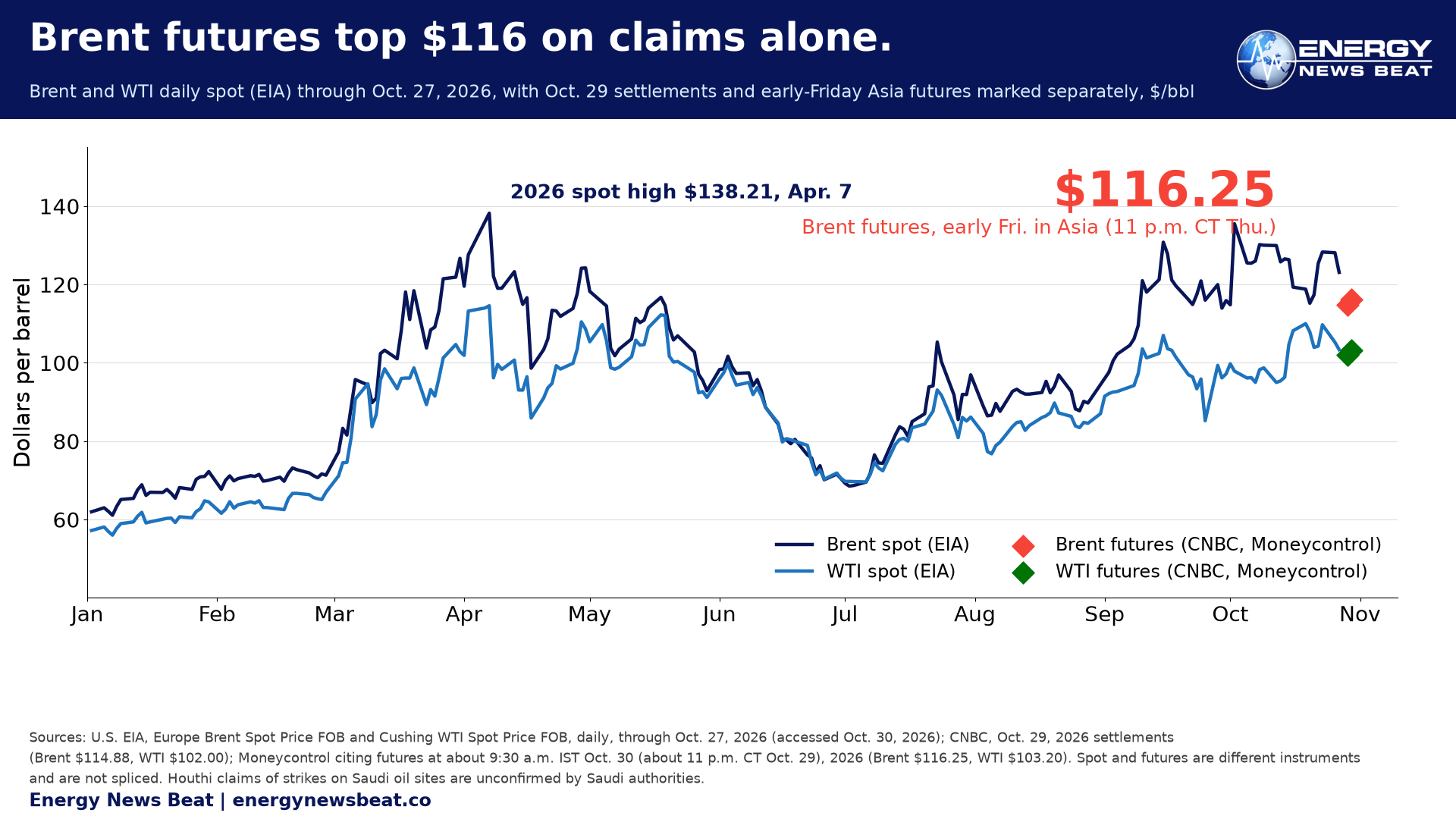
The oil market did not wait for confirmation. Brent futures rose 1.19% to $116.25 a barrel in early Friday trading in Asia (about 11 p.m. CT Thursday), and West Texas Intermediate rose 1.18% to $103.20. If you drive a truck, run a farm, or book a flight, that move does not stay on a trading screen. It shows up first in diesel and jet fuel.
What the Houthis claimed, and what Riyadh has said
Houthi military spokesman Yahya Saree claimed six attacks in all, posted on X: a ballistic missile at Ras Tanura, a missile at the Aramco site in Abqaiq, multiple missiles at King Khalid International Airport in Riyadh, a drone at King Fahd International Airport in Dammam, a ballistic missile at Rabigh, and an attack on a military headquarters in Najran. Al Jazeera reported that “there was no independent corroboration of the group’s claims”. Reuters, carried by the Jerusalem Post, reported “no immediate confirmation from Saudi authorities”.
What Saudi officials did say was about interceptions, not hits. The Saudi-led coalition said its air defenses intercepted and destroyed two ballistic missiles fired toward the capital, and Saudi Civil Defence said shrapnel wounded one citizen in Riyadh and damaged a house and a vehicle. The coalition also said it intercepted a cruise missile heading toward the kingdom’s western regions. Xinhua reported the coalition’s count as three ballistic missiles intercepted, two toward Riyadh and one toward the Eastern Province, home to Ras Tanura and Abqaiq. This would be the second claimed attack on Ras Tanura this week; after Tuesday’s reports of a fire there, Saudi authorities said it was quickly contained. The Houthis have also claimed a hit on the East-West pipeline, which Saudi Arabia has not confirmed; that line had recovered to 5.8 million barrels a day by Oct. 6 after a September shutdown.
Why it matters even unconfirmed: a fire near a loading berth is a logistics headache. A damaged distillation unit at a 550,000 b/d refinery is a fuel-supply problem, and refineries make the diesel and jet fuel the world is short of.
A market pricing two futures at once
Thursday told the diplomatic story. Brent settled down 44 cents at $114.88 and WTI down 78 cents at $102 after the Wall Street Journal reported that Vice President JD Vance had reached out to Mohsen Rezaei, secretary of Iran’s Supreme National Security Council, to try to restart peace talks. Investing.com, summarizing the Journal, reported that the contacts “have not included specific peace proposals” and that the talks “have instead centered on a possible framework for negotiations.” The Journal’s report is paywalled; we cite it as reported, with its core confirmed by Axios, which said Vance told Rezaei that any talks to head off U.S. strikes “require discussions on the nuclear issue.”
Friday told the other story. Brent was on course for a monthly gain of nearly 14%, WTI about 15%. Saul Kavonic of MST Marquee, quoted by Reuters, put it this way: “Continued kinetic action around the Strait of Hormuz amidst doubts of a viable diplomatic pathway are keeping oil prices elevated in expectation of an escalation of the conflict in coming weeks.” CNBC reported investors weighing the possibility of U.S. military action against Iran following the Nov. 3 midterm elections.
The fork: a deal, or escalation
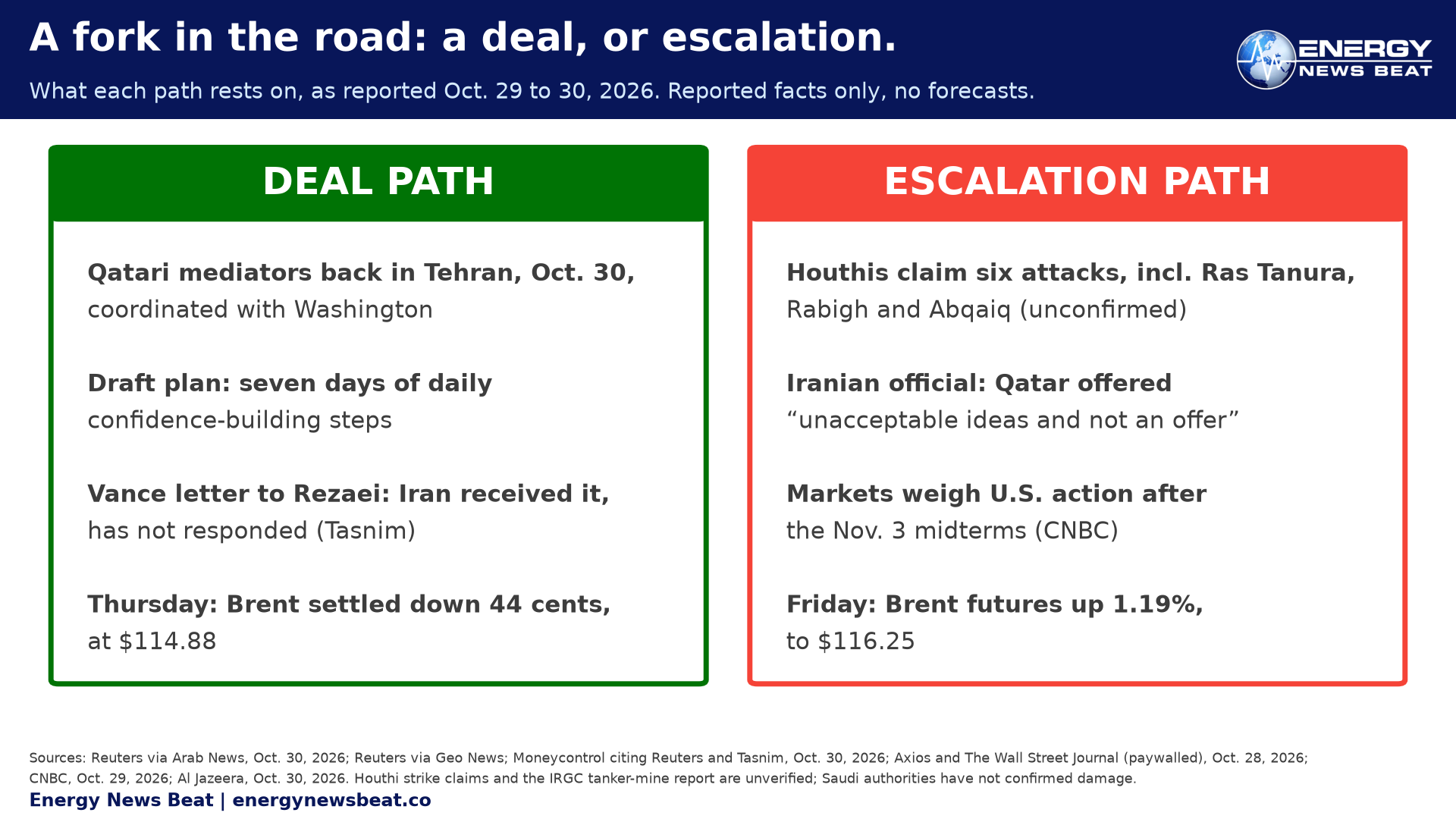
Here is the deal path. Qatari mediators returned to Tehran on Friday, in talks an official said were coordinated with Washington. Qatar presented a draft on Sunday with a seven-day timeline of daily confidence-building steps and several guarantor countries. Iran’s Tasnim agency said Tehran received the Vance letter but has not responded.
Here is the escalation path. A senior Iranian official called Qatar’s ideas “unacceptable ideas and not an offer” and said there would be no flexibility on the nuclear file. Washington wants the nuclear issue on the table from the start; Tehran wants the port blockade lifted and oil sanctions removed first. President Trump told reporters the Vance outreach was about medical supplies. Iran’s Revolutionary Guard said three tankers hit sea mines south of the Strait of Hormuz, a claim we could not verify. And ExxonMobil and Chevron cancelled executive travel to next week’s big oil show in the UAE, two sources told Reuters.
Neither path is priced fully. That is why the price jumps each time a headline lands, as Thursday’s 44-cent drop and Friday’s 1.19% rise show.
Diesel and jet fuel take the hit first
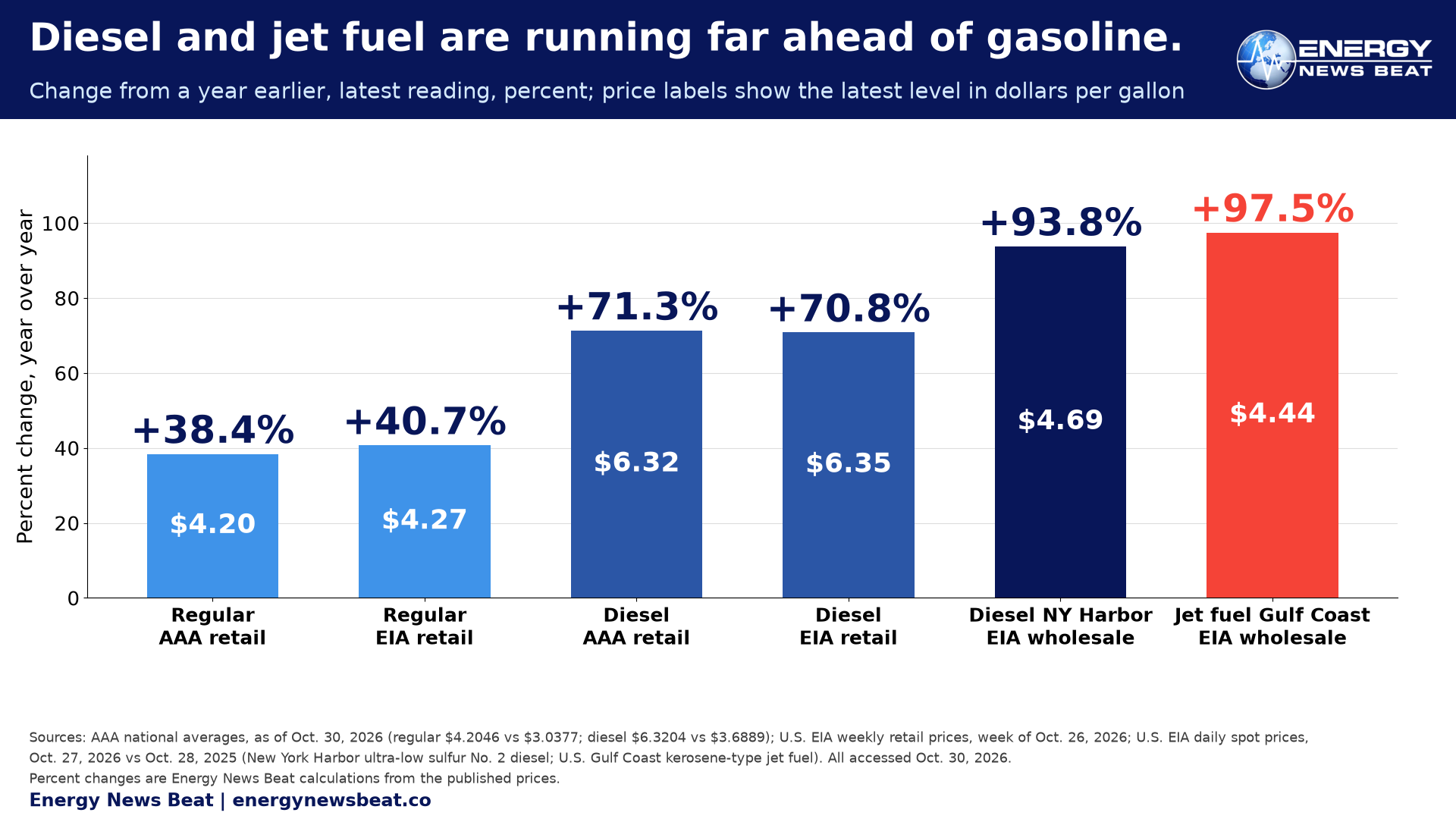
Look at your receipt. AAA’s national average for regular was $4.2046 a gallon on Oct. 30, down 8.8 cents from a week ago and up 38.4% from $3.0377 a year ago. Diesel was $6.3204, essentially flat on the week and up 71.3% from $3.6889. Diesel now costs $2.12 more than regular; a year ago the gap was 65 cents. The all-time diesel record is $6.5276, set Sept. 22, 2026. We are 21 cents from it.
The federal numbers say the same thing. EIA’s weekly retail diesel price was $6.352 on Oct. 26, up 70.8% from a year earlier, against $4.269 for regular, up 40.7%. Wholesale is starker: New York Harbor ultra-low sulfur diesel was $4.687 a gallon on Oct. 27, up 93.8% on the year, and Gulf Coast jet fuel was $4.444, up 97.5%. Jet fuel has nearly doubled. Airlines buy it near wholesale, and that cost finds its way into fares.
Inventories explain part of the squeeze. U.S. distillate stocks were 102.8 million barrels in the week ended Oct. 23, down 9.4 million barrels, or 8.3%, from a year earlier. Jet fuel stocks, interestingly, were 42.2 million barrels, 1.9% above last year. So jet’s price spike suggests a global price story rather than a U.S. shortage. Diesel is both.
Diesel is the fuel that moves everything you buy, from groceries to building materials. When its price runs $2 ahead of gasoline, the bill arrives later as higher freight surcharges and shelf prices, not just at the pump.
Consumer and investor views
For households: gasoline is drifting lower even as crude rises, because stations reprice on delivered cost with a lag. Don’t count on that drift if Brent holds above $116; the Oct. 30 AAA table shows regular down on the week while diesel has not budged. If you heat with fuel oil, it is a distillate and tracks diesel. If you are booking holiday flights, jet fuel at nearly double last year’s price is the cost airlines are carrying.
For investors: the premium is event-driven and two-sided. Interactive Brokers economist José Torres wrote that “pricey crude remains the predominant driver of above-target inflation,” and that “there could be a geopolitical resolution right around the corner,” adding that WTI falling toward $70 would strengthen the case for rate cuts. Refiners and distillate-heavy producers benefit from wide product spreads while they last; airlines and truckers carry the cost. Either way, positioning around a binary event, a deal or post-election strikes, cuts both ways.
What is unconfirmed, and what could reverse
- No Saudi or Aramco statement confirms damage at Ras Tanura, Rabigh, Abqaiq or the East-West pipeline. Every hit here is a Houthi claim, and Al Jazeera found no independent corroboration.
- The tanker-mine report comes from Iran’s Revolutionary Guard, via Reuters, and was not independently verified.
- Price prints differ by source and time. The $116.25 Brent figure, quoted in early Friday trading in Asia (about 11 p.m. CT Thursday), is a futures quote, not a settlement; EIA’s Brent spot price, a different instrument, was $123.10 on Oct. 27.
- A deal could reverse this fast. Thursday’s $114.88 settle showed how quickly a diplomatic headline can take dollars out. The Qatari track, Iran’s response, and the 3 election are all live.
- Escalation could also make it worse. If damage is later confirmed at a major refinery, product prices, diesel first, would likely react more than crude.
| STU’S TAKE
Opinion. Every number is linked to its source. This is my opinion, and take it as one. Everybody watches Brent. I watch the diesel pump. Regular is $4.2046 and falling; diesel is $6.3204, 21 cents off its all-time record of $6.5276. Jet fuel on the Gulf Coast is up 97.5% in a year. That is the real inflation story, because diesel moves every truck, tractor and freight car in this country. I am not going to pretend we know what got hit in Saudi Arabia. Riyadh has not confirmed damage, and I would rather wait for proof than sell you a scare. But the market is telling you something when Brent runs to $116.25 on a claim alone: there is no slack left. We have distillate stocks 8.3% below last year and a world that has spent years discouraging the very refining capacity that would cushion this. A Vance letter and a Qatari shuttle are good news, and I hope they work. Hope is not a supply plan. Harden your homes, and prepare for any natural disaster is a great idea, especially now. We will have more on this soon. |
Appendix
Sources, verbatim excerpts, data tables and methodology notes for “Houthis Claim Hits on Three Saudi Oil Sites, and Diesel Pays First.”
A. Sources (all accessed Oct. 30, 2026)
- Al Jazeera, “Houthi forces claim six attacks on Saudi airports, oil facilities,” Oct. 30, 2026
- The Jerusalem Post, carrying Reuters, Houthi claims on Saudi oil sites, Oct. 29, 2026
- com (Irina Slav), “Houthis Claim Fresh Strikes on Saudi Oil Refineries and Aramco Facilities,” Oct. 30, 2026
- Moneycontrol, carrying Reuters, “Brent crude crosses $116, WTI tops $103 as Saudi attacks fuel supply disruption fears,” Oct. 30, 2026
- CNBC (Lee Ying Shan), oil price report, Oct. 29, 2026
- The Wall Street Journal, Vance outreach to Iranian official Mohsen Rezaei, updated Oct. 28, 2026 (paywalled)
- com summary of the Wall Street Journal report, Oct. 28, 2026
- Xinhua, coalition interception count, Oct. 30, 2026
- S. EIA, Today in Energy, Saudi Arabia crude oil production outage (Abqaiq attack), Sept. 23, 2019
- Axios (Barak Ravid), Vance letter to Iran on nuclear talks, Oct. 28, 2026
- Arab News, carrying Reuters, “Qatari mediators return to Tehran to push for US-Iran deal,” Oct. 30, 2026
- Anadolu Agency, Qatari mediators return to Tehran, Oct. 30, 2026
- Geo News, carrying Reuters, Qatar draft deal and Iranian response, Oct. 2026
- AAA national gas price averages, read Oct. 30, 2026, morning CT
- S. EIA, Europe Brent Spot Price FOB, daily
- S. EIA, Cushing WTI Spot Price FOB, daily
- S. EIA, New York Harbor ULSD No. 2 diesel spot price, daily
- S. EIA, U.S. Gulf Coast kerosene-type jet fuel spot price, daily
- S. EIA, U.S. on-highway diesel retail price, weekly
- S. EIA, U.S. regular gasoline retail price, weekly
- S. EIA, U.S. ending stocks of distillate fuel oil, weekly
- S. EIA, U.S. ending stocks of kerosene-type jet fuel, weekly
B. Verbatim excerpts
Al Jazeera: “There was no independent corroboration of the group’s claims.” Link
Reuters, via The Jerusalem Post: “There was no immediate confirmation from Saudi authorities of the Houthi claims.” Link
Saudi foreign ministry, via Al Jazeera, after Monday’s meeting in Tehran (not in response to the strike claims), on “the importance of opening channels of negotiation to prevent a return to military escalation.” Link
Analyst quoted by Moneycontrol, carrying Reuters: “Continued kinetic action around the Strait of Hormuz amidst doubts of a viable diplomatic pathway are keeping oil prices elevated in expectation of an escalation of the conflict in coming weeks.” Link
Analyst Torres, quoted by CNBC: “pricey crude remains the predominant driver of above-target inflation” and “there could be a geopolitical resolution right around the corner.” Link
Axios on the Vance letter: talks would “require discussions on the nuclear issue”; “The President was enthusiastic about the letter.” Link
An Iranian official, via Reuters on Geo News, describing the Qatari proposals: “unacceptable ideas and not an offer.” Link
C. Data tables
C1. AAA national averages, as of Oct. 30, 2026 ($/gal)
| Fuel | Today | Yesterday | Week ago | Month ago | Year ago | Record |
| Regular | 4.2046 | 4.2258 | 4.2926 | 4.4343 | 3.0377 | 5.0165 (6/14/22) |
| Diesel | 6.3204 | 6.3347 | 6.3172 | 6.4139 | 3.6889 | 6.5276 (9/22/26) |
Source: AAA. Derived by this desk: regular +38.4% and diesel +71.3% year over year; diesel-to-regular gap $2.12 versus $0.65 a year ago; diesel 21 cents below its record.
C2. EIA prices, latest versus a year earlier
| Series | Latest | As of | Year earlier | Change | 2026 high |
| Brent spot, $/bbl | 123.10 | Oct. 27, 2026 | 64.03 | +92% | 138.21 (Apr. 7) |
| WTI spot, $/bbl | 103.37 | Oct. 27, 2026 | 60.97 | +70% | 114.58 (Apr. 7) |
| NY Harbor ULSD, $/gal | 4.687 | Oct. 27, 2026 | 2.418 | +93.8% | 5.365 (Sep. 16) |
| Gulf Coast jet, $/gal | 4.444 | Oct. 27, 2026 | 2.25 | +97.5% | 4.705 (Sep. 15) |
| Retail diesel, $/gal | 6.352 | Week of Oct. 26 | 3.718 | +70.8% | — |
| Retail regular, $/gal | 4.269 | Week of Oct. 26 | 3.035 | +40.7% | — |
C3. EIA inventories (thousand barrels)
| Series | Week ending Oct. 23, 2026 | Year earlier | Change |
| Distillate stocks | 102,824 | 112,189 | −9,365 (−8.3%) |
| Jet fuel stocks | 42,217 | 41,420 | +797 (+1.9%) |
C4. Futures prints (different instrument from EIA spot)
| Brent | WTI | Source | |
| Oct. 29 settlement | $114.88 (−44c) | $102.00 (−78c) | CNBC |
| About 11 p.m. CT Oct. 29 (9:30 a.m. IST Oct. 30) | $116.25 (+1.19%) | $103.20 (+1.18%) | Moneycontrol |
D. Background and methodology
Ras Tanura is Saudi Aramco’s Gulf-coast refining and export hub, put at 550,000 barrels a day by OilPrice.com; Abqaiq is the processing center attacked in September 2019, per EIA; Rabigh is a Red Sea-coast refinery. The Houthis claimed a separate Ras Tanura attack earlier this week; Saudi Arabia said a Tuesday fire there was quickly contained (OilPrice.com).
Method. Percent changes were computed by this desk from published prices. EIA spot prices and exchange futures are different instruments and are never spliced; the charts mark futures separately. Times are converted to U.S. Central where a source gave its own zone. Every strike is reported as a claim because no Saudi or Aramco statement confirming damage was found as of publication.
Earlier Energy News Beat coverage referenced: “A Missile Claim at Ras Tanura, a $2 Slide, and a Small Rebound: Why Your Pump Price Barely Moved” (Oct. 28) and “Vance Tells Iran: Talks Must Cover the Nuclear Program” (Oct. 29).
What could not be verified
- Any damage at Ras Tanura, Rabigh or Abqaiq. All are Houthi claims with no Saudi or Aramco confirmation.
- The claimed attack on the East-West pipeline.
- The IRGC report that three tankers hit mines.
- The full text of the Wall Street Journal report, which is paywalled; details were checked against Investing.com, Axios and CNBC summaries.
- Whether Iran has answered the Vance letter; Tasnim says it was received and not yet answered.
- Other Houthi claims in the same statement, including airport targets, beyond what Al Jazeera reported.