

Both Oklahoma senators voted yes as the Senate cleared a first procedural hurdle on a 494-page bipartisan permitting bill. Here is the full roll call, what the bill would change for power lines, pipelines and data centers, what its critics fear, and why the House and the lame-duck clock now decide its fate.
By Energy News Beat | As of November 10, 2026 CST
Sources opened Nov. 10, 2026 CST | Not investment advice
A 73–25 vote, and what it actually did
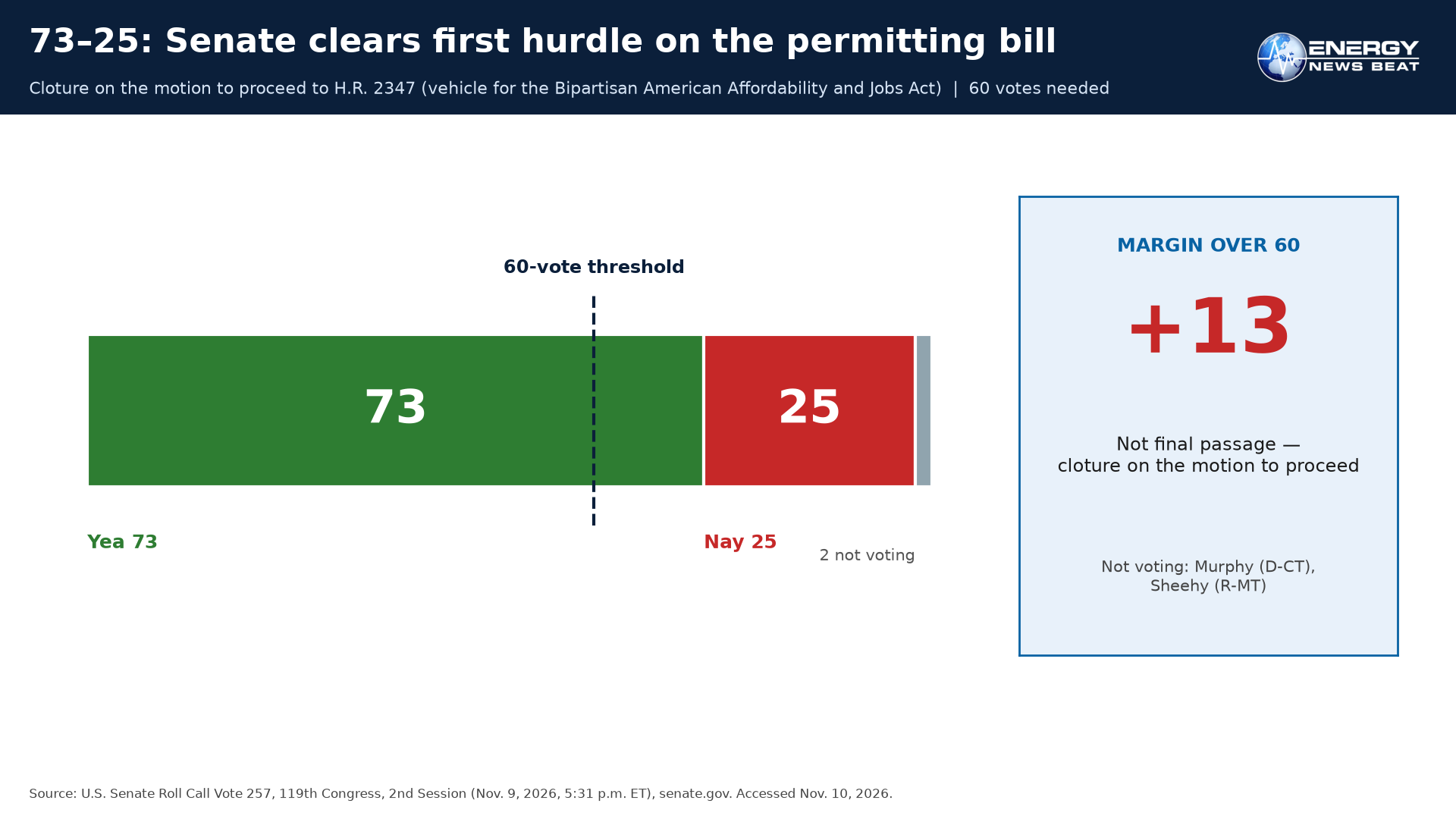
Monday evening, Nov. 9, the U.S. Senate voted 73–25 to invoke cloture on the motion to proceed to H.R. 2347, the legislative vehicle for the Bipartisan American Affordability and Jobs Act of 2026 (Senate roll call vote 257). Sixty votes were needed. Two senators did not vote. In kitchen-table terms: senators agreed to move ahead toward debating the bill. It was not final passage, and nothing has become law.
The bill began as S. 5653, introduced Sept. 30 by Sens. Shelley Moore Capito (R-W.Va.) and Mike Lee (R-Utah) with Democrats Sheldon Whitehouse (R.I.) and Martin Heinrich (N.M.), the leaders of the Senate’s environment and energy committees. That version ran 417 pages. The substitute text the four posted on Saturday, Nov. 7 runs 494 pages, the “sweeping 494-page measure” Axios described. One quirk worth knowing: H.R. 2347 is a House-passed tax bill, the Survivor Justice Tax Prevention Act. The substitute keeps it as Division C and puts permitting in front of it.
Who voted how, including both Oklahoma senators
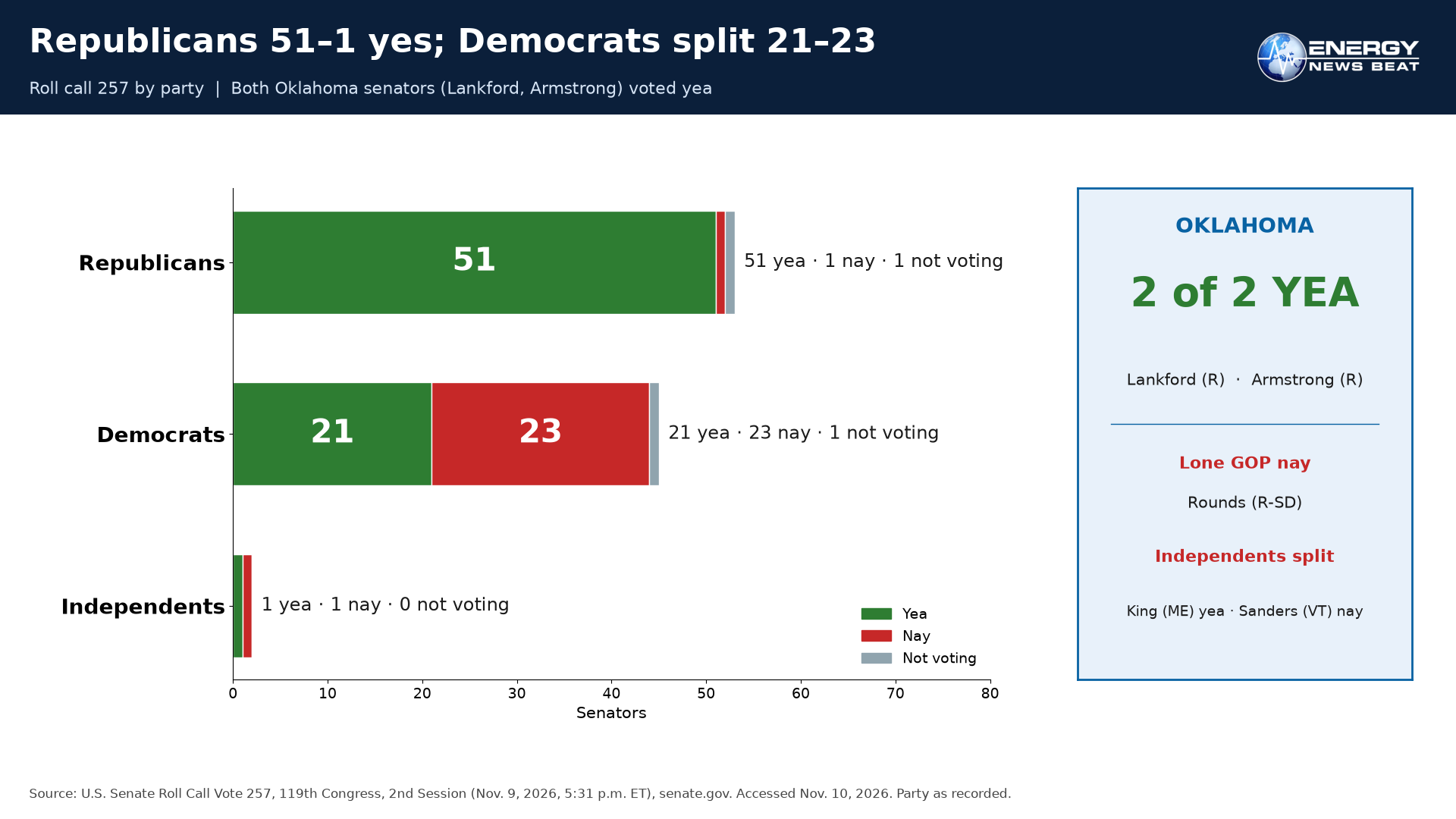
Republicans voted 51–1 for cloture. Sen. Mike Rounds of South Dakota was the only Republican no. Democrats split 21–23. The two independents split: Angus King of Maine voted yes and Bernie Sanders of Vermont voted no. Chris Murphy (D-Conn.) and Tim Sheehy (R-Mont.) did not vote. Democratic yes votes included Minority Leader Chuck Schumer and the bill’s co-authors, Heinrich and Whitehouse.
Oklahoma’s two Republican senators, James Lankford and Alan Armstrong, both voted yea. Armstrong is not a typical senator. Gov. Kevin Stitt appointed him in March to fill Markwayne Mullin’s seat, and he serves only through January 2027 (Armstrong’s Senate office). He was CEO of Tulsa-based Williams Companies from 2011 until July 2025, then executive chairman until March 2026. At his appointment he said, “My short time in the Senate will be tightly focused on meaningful permitting reform” (Oklahoma Governor’s office, March 24). His former company is pursuing the Constitution gas pipeline in New York, which the Guardian says could benefit from the bill’s Clean Water Act changes.
The 25 no votes: Democrats Alsobrooks (Md.), Baldwin (Wis.), Bennet (Colo.), Blunt Rochester (Del.), Booker (N.J.), Cantwell (Wash.), Duckworth (Ill.), Durbin (Ill.), Hassan (N.H.), Hirono (Hawaii), Kaine (Va.), Kelly (Ariz.), Luján (N.M.), Markey (Mass.), Merkley (Ore.), Murray (Wash.), Padilla (Calif.), Schiff (Calif.), Smith (Minn.), Van Hollen (Md.), Warren (Mass.), Welch (Vt.) and Wyden (Ore.); independent Sanders (Vt.); and Republican Rounds (S.D.). The full 100-senator table is in the appendix.
What is actually in the 494 pages
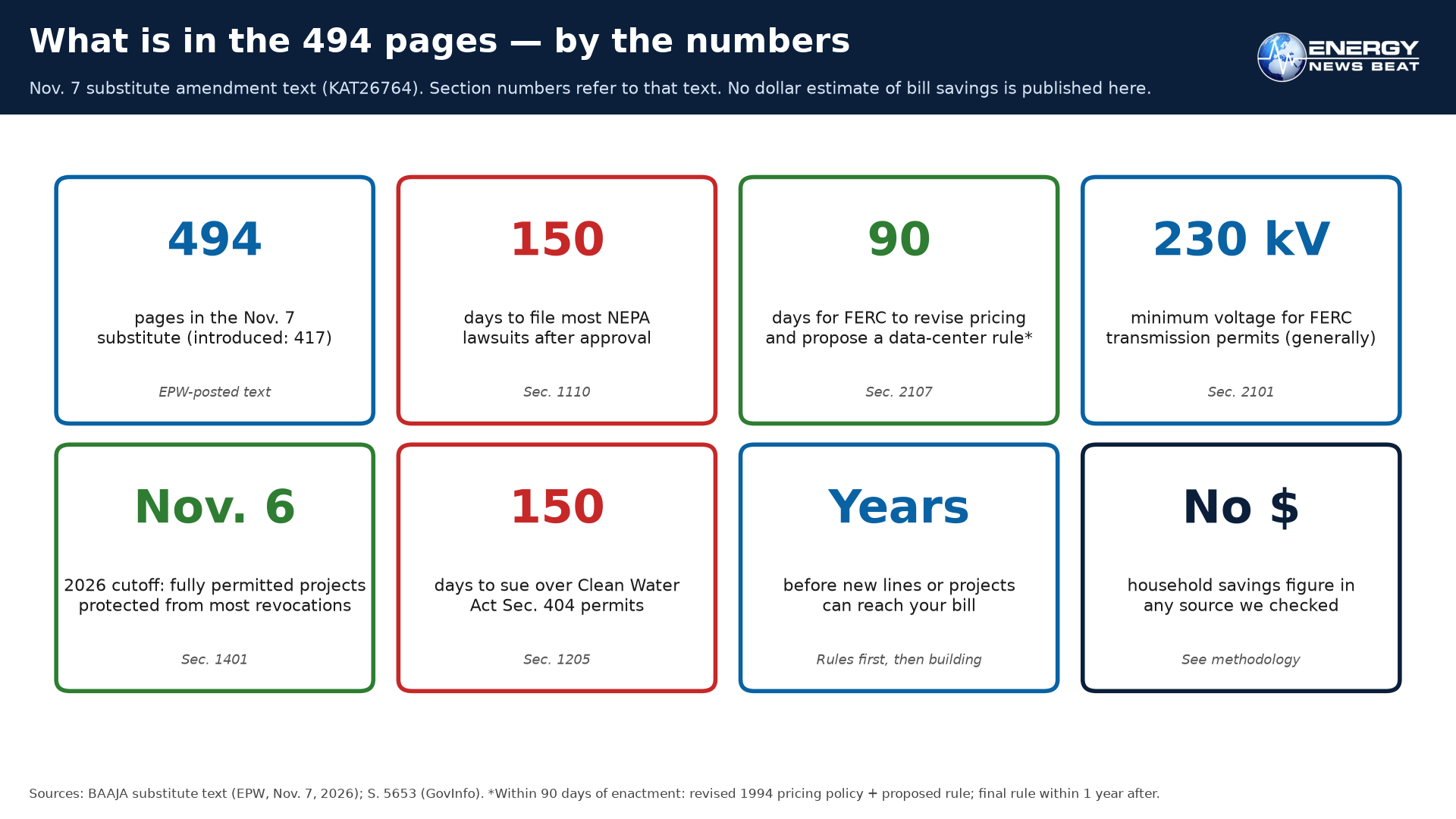
Faster reviews, shorter lawsuits. The text rewrites parts of the National Environmental Policy Act (NEPA). Most NEPA court challenges would be barred unless filed within 150 days of an approval, generally brought by someone who raised the issue during public comment, and tied to “actual or imminent” direct harm (Sec. 1110). Challenges to Clean Water Act Section 404 dredge-and-fill permits get the same 150-day window (Sec. 1205). States and other authorities that certify water quality would have to show, by clear and convincing evidence, that any condition they impose is necessary and is “the least burdensome” way to meet water-quality requirements (Sec. 1202).
Permits that stay put. For projects that already hold all their federal permits, agencies could not revoke, suspend or materially change a permit in effect on or after Nov. 6, 2026, except in listed cases, such as court orders, material permit violations, fraud, urgent new hazards, the holder’s own request, or action taken under other applicable law or regulation (Sec. 1401). Axios notes this was “a priority for renewables groups and Democrats upset with Trump administration barriers.”
Power lines. The Federal Energy Regulatory Commission (FERC) would get broader authority to permit interstate transmission lines “necessary in the national interest,” generally at 230 kilovolts or more, with costs allocated “at least roughly commensurate with the benefits” (Sec. 2101). Per Axios, weekend revisions “dialed back some provisions to attract power sector support.”
Data centers. Congress would declare it U.S. policy that data-center owners and operators “bear the full cost of any electric service that they require and the full cost of any infrastructure built to serve them … so that such costs are not borne by other customers, including residential customers.” Within 90 days of enactment, FERC would have to revise its 1994 transmission pricing policy and propose a rule charging data centers the embedded and incremental cost of transmission service, with a final rule due within a year after that (Sec. 2107).
What it could mean for your electric bill, and why it will take years
We looked hard for a credible estimate of how much this bill would cut a household’s power bill. We did not find one, so we will not invent one.
What exists are claims and models without a bill-level number. Heinrich said the bill would save households billions on electricity costs, AP reported. In her floor remarks (as prepared for delivery), Capito cited a White House Council of Economic Advisers estimate of $82 billion to $164 billion a year in added economic output and said the council expects electricity bills to fall (EPW, Nov. 9). ENR reports that Nov. 6 modeling by the Center for Climate and Energy Solutions and Greenline Insights suggests the reforms would reduce power-system costs. None of these gives a per-household figure.
The timeline is the real story. Even if the bill becomes law, FERC gets 90 days just to revise a pricing policy and propose a rule, and up to a year more to finalize it. Agencies then write rules. Projects then apply, and lawsuits still get their 150 days. As the Guardian notes, interstate transmission lines can take a decade to build. The data-center provision is protection against new costs being shifted onto homes. It does not refund today’s bills. Fuel prices, weather and local wires still shape what you pay. Any relief from faster building would take years, not months.
The case against, in critics’ own words
The opposition is real, and much of it comes from Democrats’ own coalition. Sierra Club Executive Director Loren Blackford said the bill “remains deeply flawed” despite the changes, and that “the Sierra Club cannot support this legislation” without more (statement via CleanTechnica, Nov. 9). Earthjustice Action President Abigail Dillen praised the transmission package but urged senators to “come back in the new year” (Nov. 9). Mark Macarro, president of the National Congress of American Indians, said, “This is such an existential threat to Indian country” (Guardian).
Bradley Campbell of the Conservation Law Foundation said moving now would be a “terrible mistake,” according to AP. Sen. Chris Van Hollen voted no partly because the bill does not fully address the administration’s efforts to block Maryland’s offshore wind project (AP). Sen. Jeff Merkley said “robust consideration of the bill should be a priority in the new Congress” (Common Dreams). Supporters span the American Petroleum Institute, the American Clean Power Association (AP), the Solar Energy Industries Association and building-trades unions (cited in Capito’s floor remarks).
Consumer and investor views
For households: Watch the data-center cost language through the floor amendments. It is the provision most directly aimed at residential bills. Ask your utility commission how any new large-load rules would apply to your utility. Treat any promise of quick bill cuts with caution.
For investors: Both oil-and-gas and clean-power trade groups back the bill, so a law would reach midstream, transmission, renewables and data-center developers alike. The binding risk is political, not technical. Analysts at Jefferies wrote that the House “now appears to be the binding constraint” (Axios). This is not investment advice.
Stu’s conversation with Sen. Armstrong
Five days before the vote, Stu and Rey Trevino hosted Armstrong and energy consultant Steve Reese on a joint episode of The Crude Truth and Energy News Beat (Nov. 4). The episode summary says Armstrong called permitting reform the critical legislative priority before Congress adjourns, and previewed that the first Senate vote would be on cloture for a bill streamlining projects across energy sectors without picking winners or losers. The panel also discussed the bill’s requirement that state water-quality conditions be the “least burdensome” option, which is in the text (Sec. 1202).

The cliffhanger: the House and the lame-duck clock
Senate debate is set to resume Tuesday, Nov. 10 (Senate Press Gallery), and Whitehouse promised a “very healthy amendment process” (Axios). ENR reports a final Senate vote could come later this month. Because the vehicle is a House-passed bill, any Senate version still has to clear the House.
That is where it gets hard. Jefferies wrote that “House Democratic leaders argue that the Senate bill falls short, while Republican support for accepting the Senate product also appears uncertain” (Axios). House Minority Leader Hakeem Jeffries, expected to become speaker in January, said he would not “rubber-stamp legislation without more constructive involvement with our caucus” (Guardian).
President Trump urged passage, calling the bill a “BIG WIN for U.S. ENERGY INDEPENDENCE and DOMINANCE” (AP). On Monday, though, he told reporters, “I will not approve wind turbines.” ENR adds that it is unclear whether enough lawmakers who lost re-election will return to pass it. The 119th Congress ends at noon on Jan. 3, 2027. By congressional practice, a bill not law by then dies and starts over in a Congress where Democrats hold more power. Check the roll call and call your senators.
Stu’s Take
| Seventy-three senators voted to start fixing how America builds, and both Oklahoma senators, Lankford and Armstrong, were among them. Good. Republicans went 51–1. Democrats split 21–23. The 494-page text gives most NEPA lawsuits 150 days to be filed and gives FERC 90 days to start rewriting pricing so data centers carry their own transmission costs. That is real. But nobody has shown me a household dollar figure, and I won’t make one up. Permits do not lower your bill; steel in the ground does, and that takes years. Now the House decides. Jefferies calls it “the binding constraint,” and the 119th Congress expires at noon on Jan. 3. If this dies in the lame duck, we start over. Watch the roll calls. Your utility bill depends on them. I am also going through the bill to see how this will fast track wind and solar, and will report back, and if it has any negative problems for coal, natural gas or oil exploration. |
Appendix A | Linked source list (accessed Nov. 10, 2026 CST)
- U.S. Senate, Roll Call Vote 257, 119th Congress, 2nd Session — On Cloture on the Motion to Proceed H.R. 2347 (Nov. 9, 2026, 5:31 p.m. ET) — https://www.senate.gov/legislative/LIS/roll_call_votes/vote1192/vote_119_2_00257.htm
- U.S. Senate, Roll Call Vote 257 — XML record — https://www.senate.gov/legislative/LIS/roll_call_votes/vote1192/vote_119_2_00257.xml
- U.S. Senate Press Gallery (Democratic/Republican Daily Press), Monday, Nov. 9, 2026 — https://www.dailypress.senate.gov/monday-november-9-2026/
- Bipartisan American Affordability and Jobs Act — substitute amendment text (KAT26764, 494 pp.), posted by Senate EPW Committee, Nov. 7, 2026 — https://www.epw.senate.gov/public/index.cfm?a=files.serve&File_id=2908E3D0-D53E-499F-9308-BF12EBE10B1E
- Senate EPW, Capito, Lee, Whitehouse, and Heinrich Release Substitute Amendment, Nov. 7, 2026 — https://www.epw.senate.gov/public/index.cfm/2026/11/capito-lee-whitehouse-and-heinrich-release-substitute-amendment-to-bipartisan-american-affordability-and-jobs-act-of-2026
- GovInfo (GPO), S. 5653 (IS), Bipartisan American Affordability and Jobs Act of 2026, introduced Sept. 30, 2026 (417 pp.) — https://www.govinfo.gov/app/details/BILLS-119s5653is
- Congress.gov, S. 5653 bill page (official bill record) — https://www.congress.gov/bill/119th-congress/senate-bill/5653
- GovInfo (GPO), H.R. 2347 (EH), Survivor Justice Tax Prevention Act, engrossed in House — https://www.govinfo.gov/app/details/BILLS-119hr2347eh
- Sen. Capito, Capito, Lee, Whitehouse, and Heinrich Introduce Bipartisan American Affordability and Jobs Act of 2026, Sept. 30, 2026 — https://www.capito.senate.gov/news/press-releases/capito-lee-whitehouse-and-heinrich-introduce-bipartisan-american-affordability-and-jobs-act-of-2026
- Senate EPW, Senate Advances Bipartisan American Affordability and Jobs Act (Capito floor remarks as prepared for delivery), Nov. 9, 2026 — https://www.epw.senate.gov/public/index.cfm/2026/11/senate-advances-capito-s-bipartisan-american-affordability-and-jobs-act
- Axios, Ben Geman, Senate advances bipartisan permitting bill in key test vote, Nov. 9, 2026 — https://www.axios.com/2026/11/09/senate-advances-bipartisan-permitting-bill-key-test-vote
- AP, Matthew Daly and Jennifer McDermott, Senate advances sweeping energy legislation in first major action since midterm elections, Nov. 9, 2026 — https://apnews.com/article/permitting-reform-energy-projects-environment-c6290598e26a7b01622e5c4eec571516
- ABC News (AP wire copy of the same story), Nov. 9, 2026 — https://abcnews.com/US/wireStory/senate-advances-sweeping-energy-legislation-major-action-midterm-137979691
- OPB (AP wire copy of the same story), Nov. 9, 2026 — https://www.opb.org/article/2026/11/09/senate-advances-sweeping-energy-legislation-in-first-major-action-since-midterm-elections/
- Politico live updates, Senate votes to advance bipartisan permitting reform bill, Nov. 9, 2026 — https://www.politico.com/live-updates/2026/11/09/congress/senate-votes-to-advance-bipartisan-permitting-reform-bill-01157283
- The Guardian, Senate advances bill to speed up projects from gas pipelines to clean energy, Nov. 9, 2026 — https://www.theguardian.com/us-news/2026/nov/09/senate-energy-infrastructure-bill-vote
- ENR, Permitting Reform Inches Closer to Passage with Senate Vote, Nov. 9, 2026 — https://www.enr.com/articles/64253-permitting-reform-inches-closer-to-passage-with-senate-vote
- Sierra Club statement (Loren Blackford) via CleanTechnica, BAAJA Remains Fundamentally Flawed Despite Manager’s Amendment, Nov. 9, 2026 — https://cleantechnica.com/2026/11/09/baaja-remains-fundamentally-flawed-despite-managers-amendment/
- Earthjustice Action, Responds to Manager’s Amendment for Senate Permitting Bill, Nov. 9, 2026 — https://earthjusticeaction.org/news/earthjustice-action-responds-to-managers-amendment-for-senate-permitting-bill
- Common Dreams, Green Groups Boost Pressure on Schumer to Block Permitting Bill, Nov. 9, 2026 — https://www.commondreams.org/news/permitting-bill-vote
- Oklahoma Governor’s Office, Governor Stitt Appoints Alan Armstrong as U.S. Senator, March 24, 2026 — https://oklahoma.gov/governor/newsroom/newsroom/2026/governor-stitt-appoints-alan-armstrong-as-us-senator.html
- Office of U.S. Sen. Alan Armstrong, About — https://www.armstrong.senate.gov/about/
- Energy News Beat (Substack), Senator Alan Armstrong, and Steve Reese, Rey Trevino and Stu Turley, Nov. 4, 2026 — https://theenergynewsbeat.substack.com/p/senator-alan-armstrong-and-steve
Appendix B | Key excerpts from the bill text and primary statements
Roll call result (Senate): “Cloture on the Motion to Proceed Agreed to (73-25, 3/5 majority required)” (Senate Roll Call Vote 257, Nov. 9, 2026)
Short title (substitute): “This Act may be cited as the ‘Bipartisan American Affordability and Jobs Act of 2026’.” (Substitute text, Sec. 1(a))
NEPA lawsuit window (Sec. 1110): “a claim shall be barred unless the claim— (1) is filed not later than 150 days after the date on which, unless a shorter deadline is specified under Federal law— (A) in the case of a claim in which an environmental impact statement was prepared, the applicable authorization was published in the Federal Register; and (B) in the case of any other claim, the authorization was made public” (Substitute text, new NEPA Sec. 111(b))
Standing to sue (Sec. 1110): “is filed by a party alleging (or has an individual member alleging) an actual or imminent injury in fact amounting to a direct harm.” (Substitute text, new NEPA Sec. 111(b)(3))
Clean Water Act Sec. 404 (Sec. 1205): “an action seeking judicial review … of an individual permit or general permit issued under this section shall be filed not later than the date that is 150 days after the date on which the permit was issued” (Substitute text, Sec. 1205)
State water certifications (Sec. 1202): “the least burdensome conditions to ensure compliance with water quality requirements.” (Substitute text, Sec. 1202)
Permit protection (Sec. 1401): “a Federal department or agency shall not take any new action that would revoke, rescind, withdraw, terminate, suspend, vacate, remand, reopen, materially amend, or materially alter a Federal authorization or permit in effect on or after November 6, 2026” (Substitute text, Sec. 1401(b)(1))
Transmission permits (Sec. 2101): “issue one or more permits to individual or joint applicants for the construction or modification of electric transmission facilities necessary in the national interest” (Substitute text, Sec. 2101(b), amending FPA Sec. 216(b))
Transmission cost allocation (Sec. 2101): “at least roughly commensurate with the benefits” (Substitute text, Sec. 2101(e), new FPA Sec. 216(f)(3))
Data-center costs (Sec. 2107): “computational load owners and computational load operators bear the full cost of any electric service that they require and the full cost of any infrastructure built to serve them, regardless of whether they take the electric service that they request, so that such costs are not borne by other customers, including residential customers” (Substitute text, Sec. 2107(a)(1)(A))
FERC deadline (Sec. 2107): “Not later than 90 days after the date of enactment of this Act, the Commission shall— (i) revise the 1994 transmission pricing policy statement” (Substitute text, Sec. 2107(a)(3)(A); clause (ii) also requires a proposed rule, and subparagraph (B) a final rule within one year after it)
Trump (via AP): “BIG WIN for U.S. ENERGY INDEPENDENCE and DOMINANCE.” (AP, Nov. 9, 2026, quoting a Sunday social media post)
Trump on wind (via AP): “Well, the bill hasn’t been fully negotiated. I will not approve wind turbines because wind turbines are a major loser.” (AP, Nov. 9, 2026)
Jefferies (via Axios): “now appears to be the binding constraint.” (Axios, Nov. 9, 2026)
Whitehouse (via Axios/AP): “This bill is the floor, not the ceiling, of our climate and environmental aspirations” (Axios and AP, Nov. 9, 2026)
Heinrich (EPW release): “Americans can’t afford to wait for lower electricity prices. We need to pass this bill now.” (EPW release, Nov. 7, 2026; also quoted by AP)
Jeffries (via Guardian): “rubber-stamp legislation without more constructive involvement with our caucus” (Guardian, Nov. 9, 2026)
Sierra Club: “the draft legislation remains deeply flawed.” (Loren Blackford statement, Nov. 9, 2026 (via CleanTechnica))
Armstrong at appointment: “My short time in the Senate will be tightly focused on meaningful permitting reform to get Americans access to whatever affordable energy solutions they choose.” (Oklahoma Governor’s Office, March 24, 2026)
Appendix C | Full roll call: Senate Vote 257, Nov. 9, 2026
On Cloture on the Motion to Proceed H.R. 2347 (vehicle for the Bipartisan American Affordability and Jobs Act). Result: agreed to, 73–25, 2 not voting; 3/5 required. Vote time 5:31 p.m. ET. As of Nov. 10, 2026 CST, from the official record: senate.gov roll call vote 257.
| Senator | Party-State | Vote | Senator | Party-State | Vote |
| Angela Alsobrooks | D-MD | Nay | Angus King | I-ME | Yea |
| Alan Armstrong | R-OK | Yea | Amy Klobuchar | D-MN | Yea |
| Tammy Baldwin | D-WI | Nay | James Lankford | R-OK | Yea |
| Jim Banks | R-IN | Yea | Mike Lee | R-UT | Yea |
| John Barrasso | R-WY | Yea | Ben Lujan | D-NM | Nay |
| Michael Bennet | D-CO | Nay | Cynthia Lummis | R-WY | Yea |
| Marsha Blackburn | R-TN | Yea | Edward Markey | D-MA | Nay |
| Richard Blumenthal | D-CT | Yea | Roger Marshall | R-KS | Yea |
| Lisa Blunt Rochester | D-DE | Nay | Mitch McConnell | R-KY | Yea |
| Cory Booker | D-NJ | Nay | David McCormick | R-PA | Yea |
| John Boozman | R-AR | Yea | Jeff Merkley | D-OR | Nay |
| Katie Britt | R-AL | Yea | Ashley Moody | R-FL | Yea |
| Ted Budd | R-NC | Yea | Jerry Moran | R-KS | Yea |
| Maria Cantwell | D-WA | Nay | Bernie Moreno | R-OH | Yea |
| Shelley Capito | R-WV | Yea | Lisa Murkowski | R-AK | Yea |
| Bill Cassidy | R-LA | Yea | Christopher Murphy | D-CT | Not Voting |
| Susan Collins | R-ME | Yea | Patty Murray | D-WA | Nay |
| Christopher Coons | D-DE | Yea | Jon Ossoff | D-GA | Yea |
| John Cornyn | R-TX | Yea | Alex Padilla | D-CA | Nay |
| Catherine Cortez Masto | D-NV | Yea | Rand Paul | R-KY | Yea |
| Tom Cotton | R-AR | Yea | Gary Peters | D-MI | Yea |
| Kevin Cramer | R-ND | Yea | John Reed | D-RI | Yea |
| Mike Crapo | R-ID | Yea | Pete Ricketts | R-NE | Yea |
| Ted Cruz | R-TX | Yea | James Risch | R-ID | Yea |
| John Curtis | R-UT | Yea | Jacky Rosen | D-NV | Yea |
| Steve Daines | R-MT | Yea | Mike Rounds | R-SD | Nay |
| Tammy Duckworth | D-IL | Nay | Bernie Sanders | I-VT | Nay |
| Richard Durbin | D-IL | Nay | Brian Schatz | D-HI | Yea |
| Joni Ernst | R-IA | Yea | Adam Schiff | D-CA | Nay |
| John Fetterman | D-PA | Yea | Eric Schmitt | R-MO | Yea |
| Deb Fischer | R-NE | Yea | Charles Schumer | D-NY | Yea |
| Ruben Gallego | D-AZ | Yea | Rick Scott | R-FL | Yea |
| Kirsten Gillibrand | D-NY | Yea | Tim Scott | R-SC | Yea |
| Darline Graham | R-SC | Yea | Jeanne Shaheen | D-NH | Yea |
| Chuck Grassley | R-IA | Yea | Tim Sheehy | R-MT | Not Voting |
| Bill Hagerty | R-TN | Yea | Elissa Slotkin | D-MI | Yea |
| Maggie Hassan | D-NH | Nay | Tina Smith | D-MN | Nay |
| Josh Hawley | R-MO | Yea | Dan Sullivan | R-AK | Yea |
| Martin Heinrich | D-NM | Yea | John Thune | R-SD | Yea |
| John Hickenlooper | D-CO | Yea | Thomas Tillis | R-NC | Yea |
| Mazie Hirono | D-HI | Nay | Tommy Tuberville | R-AL | Yea |
| John Hoeven | R-ND | Yea | Chris Van Hollen | D-MD | Nay |
| Jon Husted | R-OH | Yea | Mark Warner | D-VA | Yea |
| Cindy Hyde-Smith | R-MS | Yea | Raphael Warnock | D-GA | Yea |
| Ron Johnson | R-WI | Yea | Elizabeth Warren | D-MA | Nay |
| James Justice | R-WV | Yea | Peter Welch | D-VT | Nay |
| Timothy Kaine | D-VA | Nay | Sheldon Whitehouse | D-RI | Yea |
| Mark Kelly | D-AZ | Nay | Roger Wicker | R-MS | Yea |
| John Kennedy | R-LA | Yea | Ron Wyden | D-OR | Nay |
| Andy Kim | D-NJ | Yea | Todd Young | R-IN | Yea |
Nays (25): Alsobrooks (D-MD), Baldwin (D-WI), Bennet (D-CO), Blunt Rochester (D-DE), Booker (D-NJ), Cantwell (D-WA), Duckworth (D-IL), Durbin (D-IL), Hassan (D-NH), Hirono (D-HI), Kaine (D-VA), Kelly (D-AZ), Lujan (D-NM), Markey (D-MA), Merkley (D-OR), Murray (D-WA), Padilla (D-CA), Rounds (R-SD), Sanders (I-VT), Schiff (D-CA), Smith (D-MN), Van Hollen (D-MD), Warren (D-MA), Welch (D-VT), Wyden (D-OR). Not voting (2): Murphy (D-CT), Sheehy (R-MT). Oklahoma: Lankford (R-OK) Yea; Armstrong (R-OK) Yea.
Appendix D | Key data table (as-of dates)
| Metric | Value | As-of / source |
| Cloture vote result | 73 yea, 25 nay, 2 not voting | Senate Roll Call 257, Nov. 9, 2026, 5:31 p.m. ET |
| Threshold | 3/5 (60 votes) | Same |
| Republicans | 51 yea, 1 nay, 1 not voting | Same |
| Democrats | 21 yea, 23 nay, 1 not voting | Same |
| Independents | 1 yea, 1 nay | Same |
| Oklahoma | Lankford (R) yea; Armstrong (R) yea | Same |
| Substitute text length | 494 pages | EPW-posted KAT26764, Nov. 7, 2026 |
| Introduced text length | 417 pages | S. 5653 (IS), GovInfo, Sept. 30, 2026 |
| NEPA claim filing window | 150 days | Substitute Sec. 1110 |
| CWA Sec. 404 challenge window | 150 days | Substitute Sec. 1205 |
| FERC data-center pricing revision | Within 90 days of enactment | Substitute Sec. 2107 |
| FERC transmission permit voltage | Generally 230 kV or more | Substitute Sec. 2101 |
| Permit-protection date | Permits in effect on or after Nov. 6, 2026 | Substitute Sec. 1401 |
| Household savings estimate | None found | Sources reviewed Nov. 10, 2026 |
| 119th Congress ends | Noon, Jan. 3, 2027 | U.S. Constitution, 20th Amendment (bill expiry: congressional practice) |
Appendix E | Background
The bill. The Bipartisan American Affordability and Jobs Act of 2026 (BAAJA) was introduced as S. 5653 on Sept. 30, 2026, and referred to the Senate Energy and Natural Resources Committee. Its four authors lead the two committees with jurisdiction: Capito (EPW chair), Whitehouse (EPW ranking member), Lee (ENR chair) and Heinrich (ENR ranking member). Division A covers NEPA, the Clean Water Act, the Endangered Species Act, project certainty, nuclear licensing, wildfire emissions and brownfields. Division B covers transmission, ratepayer protection, interconnection queues, onshore and offshore leasing, geothermal, hydropower and historic preservation. Division C is the original text of H.R. 2347.
The vehicle. H.R. 2347, the Survivor Justice Tax Prevention Act, passed the House earlier in the 119th Congress (engrossed text on GovInfo). Senate leaders are using it as the legislative vehicle. A Senate-passed substitute would go back to the House for action.
Sen. Alan Armstrong. Appointed by Gov. Kevin Stitt on March 24, 2026, to fill the seat vacated by Markwayne Mullin. He serves through the end of the 119th Congress and is not a candidate. He led Williams Companies as president and CEO from 2011 until July 2025, then was executive chairman until March 2026. While he led the company, Williams revived the Northeast Supply Enhancement project and pursued the Constitution Pipeline (Oklahoma Governor’s Office).
House action to date. In her Nov. 9 floor remarks, Sen. Capito noted that the House has passed the SPEED Act and the PERMIT Act on permitting. Neither is the Senate text.
Lame-duck calendar. Members elected Nov. 3, 2026, take office in January 2027. The current Congress may keep working until it adjourns or until noon on Jan. 3, 2027, when its term ends under the 20th Amendment.
Appendix F | Methodology and limits
- Vote facts come from the official Senate roll call (HTML and XML), retrieved Nov. 10, 2026 CST. The XML lists 100 members: 73 yea, 25 nay, 2 not voting. Party labels are as recorded. Names in the appendix table follow the Senate record (for example, “Lujan” appears without an accent in the record).
- The cloture vote was on the motion to proceed to H.R. 2347, the vehicle bill. It was not a vote on the substitute amendment or on final passage.
- Bill provisions are quoted from the 494-page substitute text posted by the Senate EPW Committee with its Nov. 7, 2026 release (document code KAT26764). Section numbers refer to that text. The 417-page introduced text (S. 5653) is from GovInfo. Amendments on the floor may change any provision.
- The Congress.gov bill page is listed as the official bill record. It could not be opened on Nov. 10; text and status were confirmed through GovInfo (GPO) and the committee-posted PDF.
- Politico’s Nov. 9 live update is listed for completeness. It could not be opened on Nov. 10, and no claim in this article relies on it.
- AP quotations were checked against AP’s wire copy as published by ABC News and OPB (sources 13 and 14). The Axios article and the Earthjustice Action statement were read directly.
- No dollar estimate of household bill savings appears in any source reviewed. Sponsor and White House claims are attributed and are not treated as forecasts. The CEA output figure was cited by Sen. Capito. ENB did not review the CEA report itself. Capito’s remarks are quoted as prepared for delivery.
- The Armstrong interview is described from its published episode summary on the Energy News Beat Substack (Nov. 4, 2026). The video was not re-watched for this article.
- Under the 20th Amendment, the 119th Congress ends at noon on Jan. 3, 2027; by congressional practice, bills not enacted by then die and must be reintroduced. No forecasts are presented as fact. Not investment advice.