

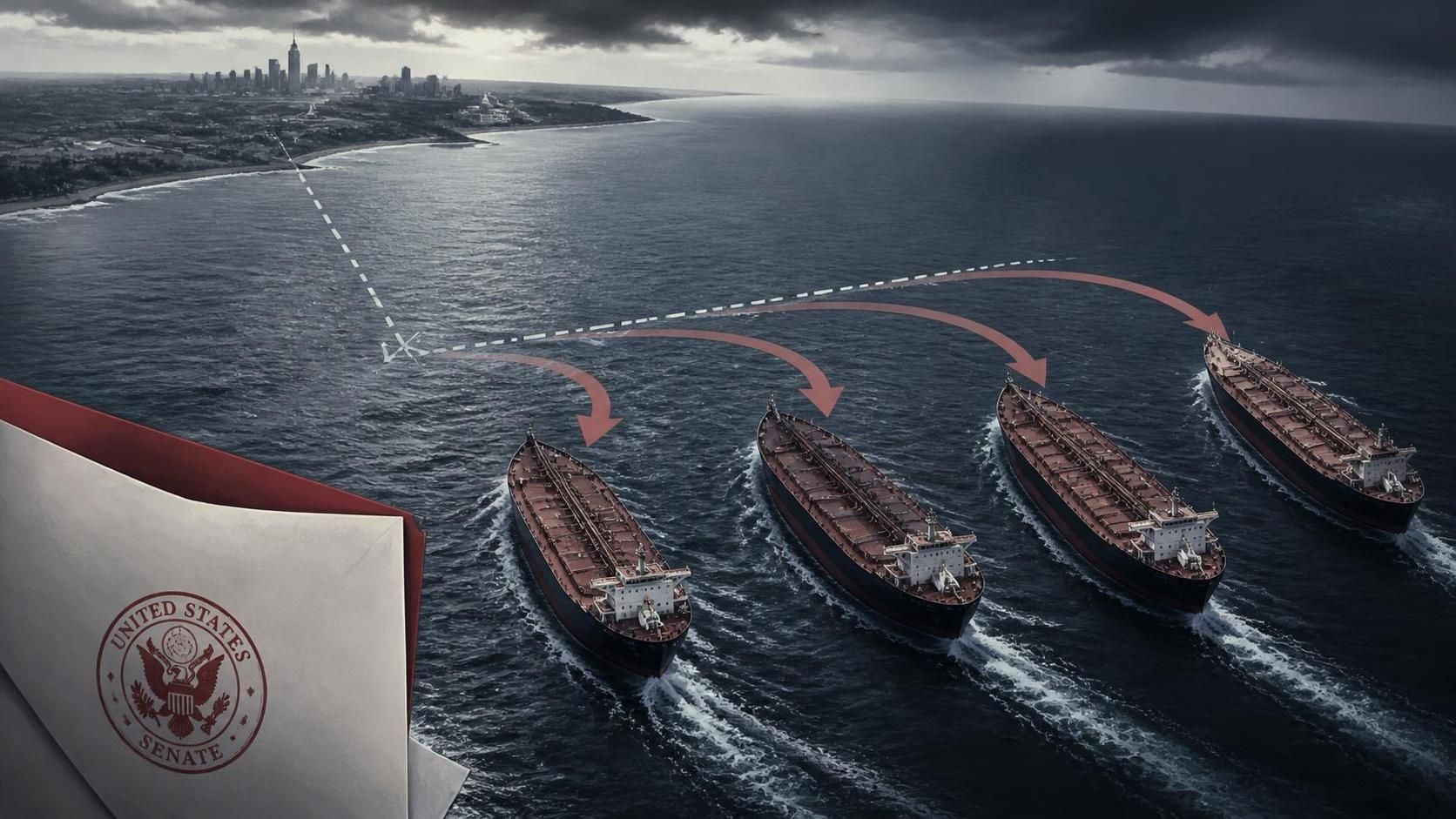
Four tankers that left Russia declaring U.S. destinations have turned away, the Wall Street Journal reports. Two are headed to Brazil, one has reached Egypt, and the fourth was listed for South America in Kpler data cited by the Journal on Nov. 10. No barrels have landed here. Diesel is still $6.13 a gallon — $2.19 above gasoline — because the global squeeze, not these cargoes, sets the pump.
By Energy News Beat | As of November 11, 2026, 7:21 AM CST
An update to our Nov. 9 report, “Oil Crashed. Your Diesel Didn’t.” | AAA national averages, Price as of 11/11/26 (rechecked this morning; AAA updates daily) | Distillate stocks: EIA week ended Oct. 30; next weekly Thursday, Nov. 12, 11:00 a.m. CST | Not investment advice
The cargoes never landed. The diesel bill is still here.
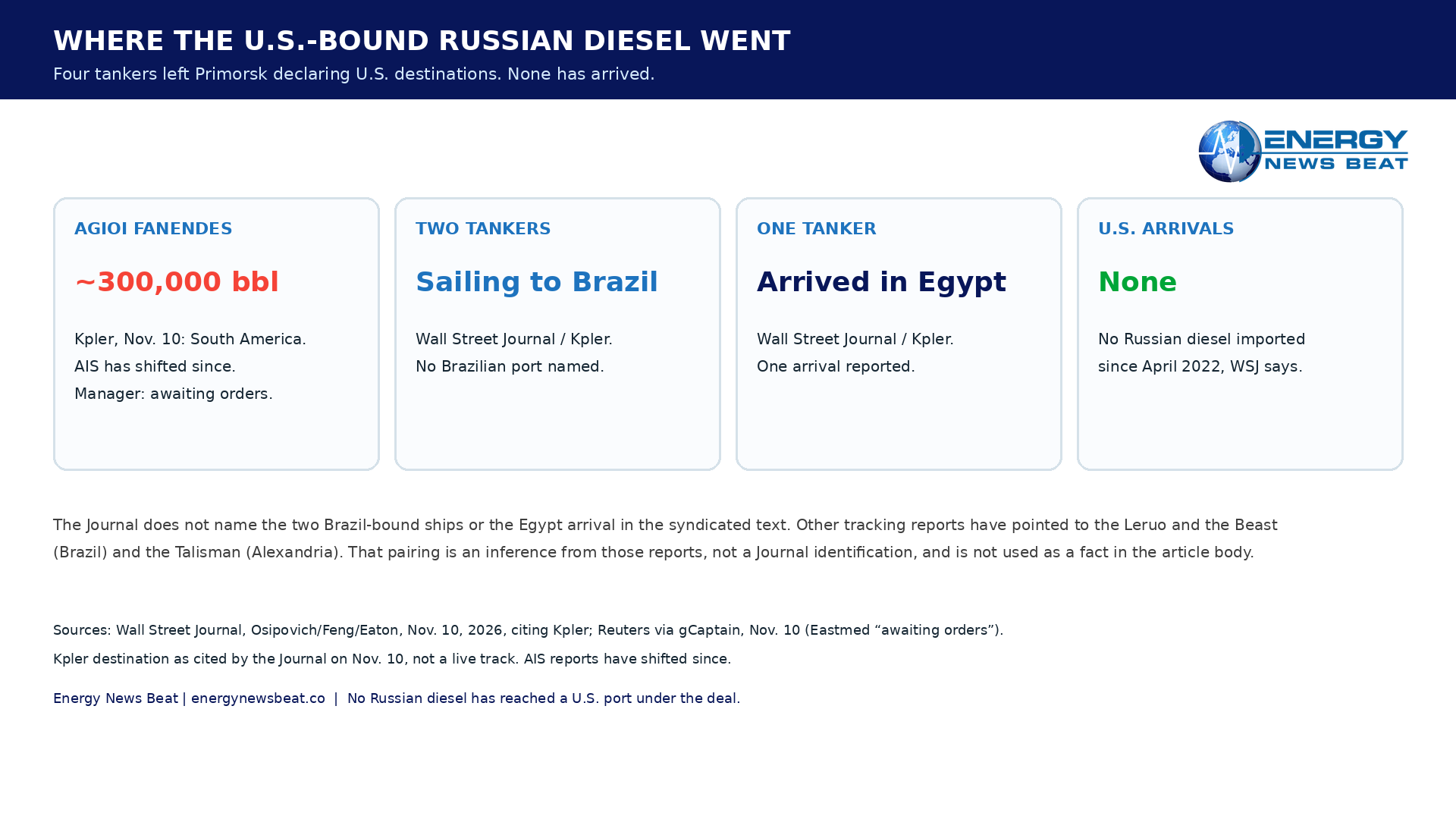
Two days after our last diesel report, the follow-up arrived. The Wall Street Journal reports that four tankers which left Russia’s Primorsk declaring U.S. destinations have turned away. Two are sailing to Brazil. One has arrived in Egypt. The first cargo, the Malta-flagged Agioi Fanendes, carrying about 300,000 barrels, had been listed for New York. No Russian diesel has reached a U.S. port. U.S. government data, the Journal notes, show no Russian diesel imports since April 2022.
Sen. Richard Blumenthal (D., Conn.), in an open letter to the Greek owner of the Agioi Fanendes, wrote that it would be “engaged in an illegal transaction” if it delivered its cargo to U.S. shores, the Journal reported. The letter was reported on Oct. 28; that same day the senator posted, “Reverse course while there’s still time.” After a sitting U.S. senator told the owner in writing that delivery would be illegal, the tanker stopped short of U.S. waters, and Kpler data cited by the Journal on Nov. 10 listed South America; AIS destinations have shifted since, and the manager says the ship is still awaiting orders. That is the sequence, not a confirmed cause. The owner has not publicly said why, and the Journal also cites difficulties finding buyers. No country in South America has been named.
President Trump’s October deal with Vladimir Putin was meant to get Russian diesel to “the American and Global Marketplace,” as Trump put it on Oct. 9. It did not mean Washington bought the fuel. Treasury’s General License 135, issued Oct. 9 and running until 12:01 a.m. ET on April 7, 2027, allows private companies to buy, ship and import Russian-origin diesel. Without a willing U.S. buyer, the ships are looking for another discharge.
Why the ships turned
The Journal says the tankers “shifted course following difficulties finding buyers willing to accept the controversial cargoes.” Industry executives and lobbyists told the paper that U.S. oil companies are reluctant because of “potential legal and reputational consequences.” After Democrats won last week’s midterms, “companies feared that being involved in any transactions would get them caught up in investigations by the next Congress, oil lobbyists said.”
That is a threat of legal action and investigations, not a lawsuit. No lawsuit challenging these cargoes or the license has been filed. What is on the record are written warnings, mostly from Democrats, joined by some Republicans.
Blumenthal’s letter was part of a broader paper trail, including an Oct. 24 bipartisan letter to six banks and four port authorities, an Oct. 26 warning from Rep. Jamie Raskin to API, AFPM and the Chamber, and a Nov. 2 notice from New Jersey Gov. Mikie Sherrill to port operators.
Two House bills would revoke the license, including the Ronald Reagan Peace Through Strength Act from Republicans Brian Fitzpatrick and Don Bacon and Democrat Marie Gluesenkamp Perez. A Trump administration official told the Journal the waiver complies with all applicable laws. No court has ruled.
Did a senator cross the line?
The same fight also shows how costly it is when the branches do not work together.
One case is that a senator stepped into a presidential lane. In United States v. Curtiss-Wright Export Corp. (1936), the Supreme Court, quoting John Marshall’s 1800 House speech, called the president “the sole organ of the nation in its external relations.” The Logan Act, 18 U.S.C. § 953, bars unauthorized correspondence or intercourse with a foreign government, or any officer or agent of one, intended to influence that government or “to defeat the measures of the United States.” Blumenthal wrote directly to a foreign shipowner to block a cargo the administration had authorized. The Act’s text reaches dealings with a foreign government or its officers or agents, and no prosecutor or court has applied it here.
The case for him is also clear. Article I gives Congress the power to regulate commerce with foreign nations. The 2022 Russian import ban is a statute, and he argues General License 135 violates it. He wrote to a private company, not a foreign government. A 2018 Congressional Research Service legal sidebar found only two Logan Act indictments since the law’s 1799 enactment, and no convictions. Some Republicans — Tillis, Fitzpatrick and Bacon — also question the waiver. No court has ruled.
That leaves the questions that matter at the pump. Should a senator try to scare off a ship with a letter rather than pass a bill or go to court? If the White House and Congress disagree, why are truckers and farmers paying for it?
A rounding error against American demand
Even if every barrel had docked, the volumes were small.
The Agioi Fanendes’ 300,000 barrels are about 1.7 hours of U.S. distillate demand, using 4.175 million barrels a day, the average of EIA’s four weekly readings through Oct. 30. The first three announced tranches, 1.8 million tons, or about 13.4 million barrels, would be roughly 3.2 days of that demand if every barrel came here. Trump also said a further 3 million tons could follow; all 4.8 million tons would be about 8.6 days.
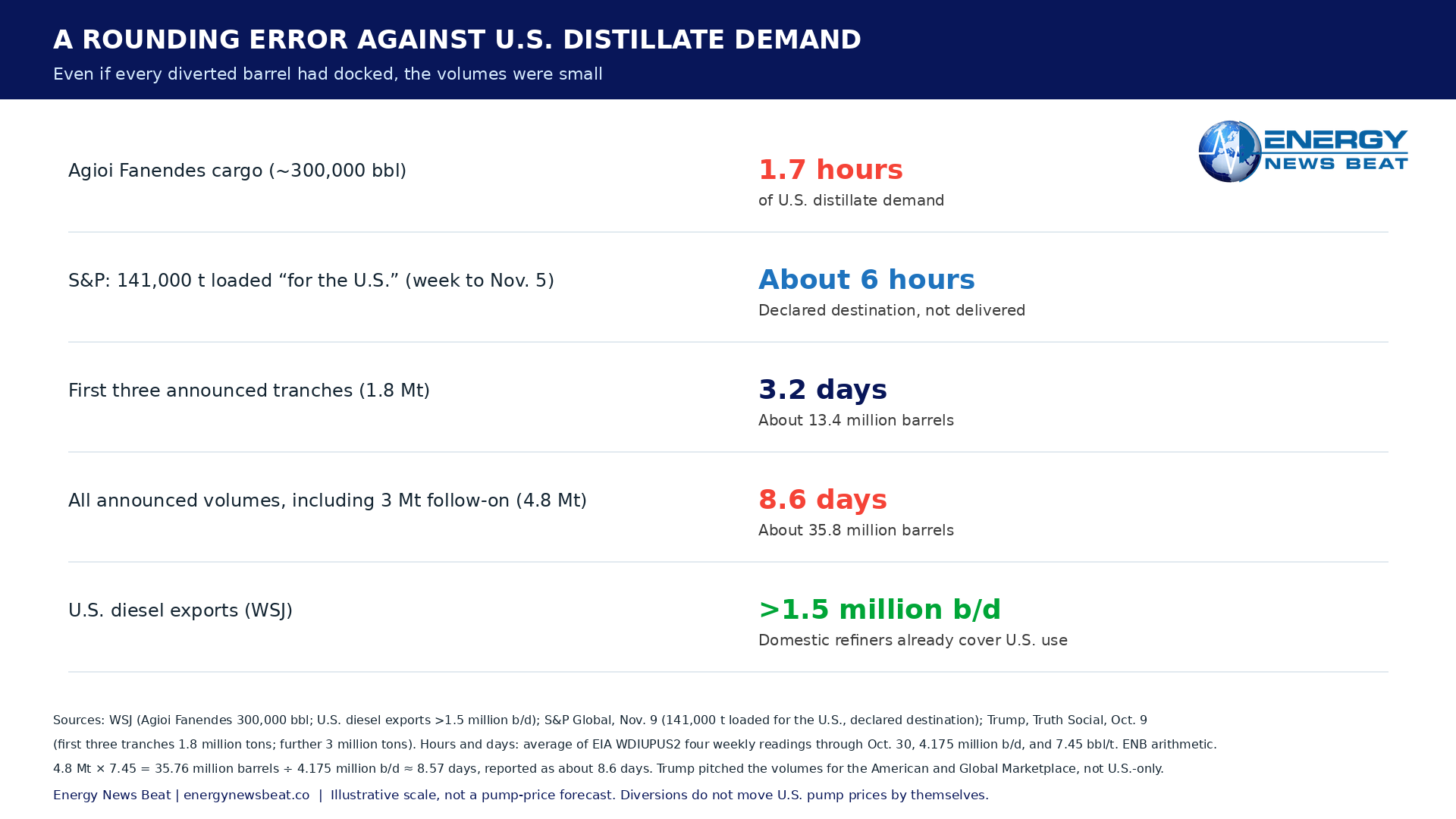
S&P Global counted 141,000 tons of Russian gasoil loaded for the United States in the week to Nov. 5, the top declared destination that week — loadings, not deliveries. S&P also counted five medium-range tankers still listed toward the U.S. Atlantic Coast as of Nov. 9, none of which had arrived. Tracking since then shows most of those ships turning away.
Energy Secretary Chris Wright was not worried about the loitering ship. “Not at all. No, it’ll go to another port,” he told reporters in New Orleans, Reuters reported. “We just want that diesel going into the world markets.” Cargoes that reach Brazil or Egypt still add to global supply.
The squeeze that actually matters
Reuters, citing two industry sources, reported that Ukrainian strikes have reduced Russia’s oil refining capacity by about 30 percent. That is nameplate capacity at the affected plants — about 2.2 million barrels a day, or 300,000 tons a day, out of roughly 930,000 tons a day of primary capacity — not the volume of fuel that has stopped flowing. The same sources said the actual reduction in runs could be up to 200,000 tons a day. Nine of Russia’s 35 major refineries were disrupted over the past week, Reuters reported; separately, Kirishi was hit Nov. 9.
EIA’s November Short-Term Energy Outlook, released Nov. 10, now expects U.S. retail diesel to average $5.03 a gallon in 2027, up from $4.49 in the October forecast, “because it now expects global supplies of refined fuels to remain tight through the end of 2027.” The 2026 annual average is $5.25, still far above 2024 and 2025.
U.S. distillate stocks were 99.3 million barrels for the week ended Oct. 30, the first reading under 100 million since May 2003, per EIA’s weekly series. That is 13.3 percent, or about 15.3 million barrels, below the five-year average for the same week, by our calculation on EIA data. Separately, Kpler has called the print a “22-year low”; the precise EIA wording is lowest since May 2003.
What the pump shows this morning
AAA’s national average for regular gasoline, Price as of 11/11/26, is $3.9429. Diesel is $6.1306. The gap is $2.19 a gallon — wider than the $2.16 in our Nov. 9 article, because gasoline has fallen faster than diesel. Diesel is down about 14 cents on the week; regular is down about 18 cents. Diesel is still about $2.38, or 64 percent, above its year-ago average of $3.748.
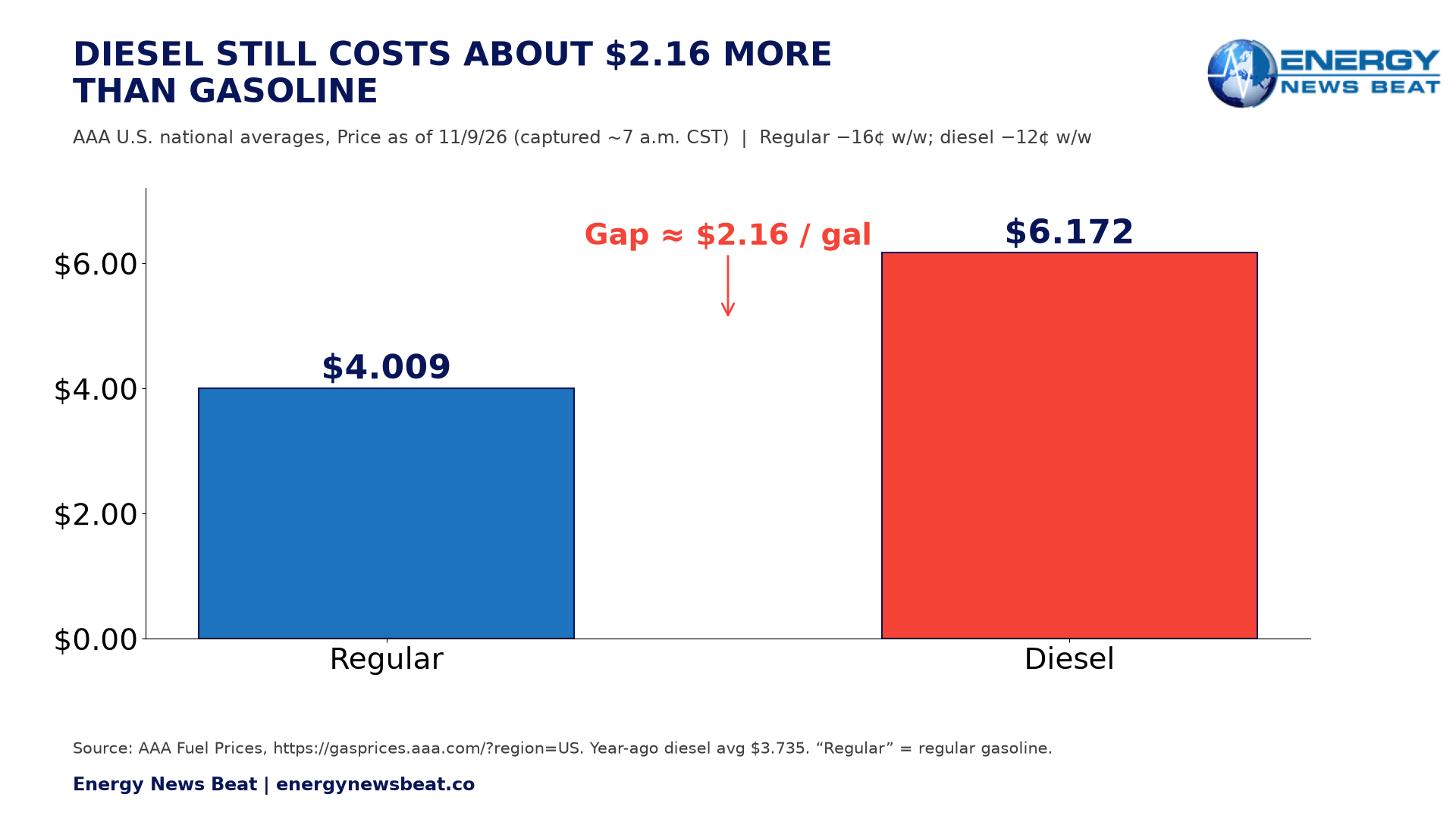
For households, that is the same story we told on Nov. 9, with a slightly wider gap. Truckers, farmers and Northeast families on heating oil still carry the cost. These diverted cargoes were never large enough to move the pump by themselves.
What investors should watch
Wide distillate cracks remain a tailwind for complex U.S. refiners. Legal and compliance risk is a real cost for terminals, traders, banks and insurers. Watch Thursday’s EIA weekly, whether any Russian cargo discharges here, and what the next Congress does. None of this is investment advice.
Caveats and fair criticism
Our reading could over-weight the legal scare and under-weight ordinary commercial friction. The Blumenthal letter came first, and the Agioi Fanendes later stopped off the East Coast; that sequence is not proof the letter caused the turn. The ship was listed for South America in Kpler data cited by the Journal on Nov. 10; AIS destinations have shifted since, and its manager says it is still awaiting orders. S&P’s U.S.-bound loadings record declared destinations at loading, not arrivals.
The 30 percent refining figure is from Reuters’ industry sources, not an official Russian or EIA series, and it measures affected capacity, not lost output. We have not independently tracked the four tankers. The Journal does not name the two Brazil-bound ships or the Egypt arrival; other tracking reports point to the Leruo and the Beast heading for Brazil and the Talisman at Alexandria, but that pairing is an inference, not a Journal identification. No Brazilian port has been named.
Wright is right that barrels delivered to Brazil or Egypt still loosen the global tank. They do not refill a 99.3-million-barrel U.S. stock or close a $2.19 pump gap.
Stu’s Take
| The Russian diesel from President Trump’s deal was never a government purchase and has not landed here. Sen. Richard Blumenthal, in an open letter to the Greek owner of the Agioi Fanendes, wrote that a U.S. delivery would be an “illegal transaction,” the Journal reported. After a sitting U.S. senator told the owner in writing that delivery would be illegal, the tanker stopped short of U.S. waters and was listed for South America as of Tuesday. That is the sequence, not a confirmed cause: the manager says it is awaiting orders, and the Journal also cites trouble finding buyers. Two other tankers turned toward Brazil and one to Egypt. Industry executives and lobbyists told the Journal that companies fear legal and reputational consequences and, after Democrats won the midterms, investigations by the next Congress. No lawsuit has been filed. AAA diesel is $6.1306, $2.19 above regular. If the White House and Congress disagree, why are truckers and farmers paying for it?
Make no mistake there are two key points. The diesel deal by President Trump was to get President Putin interested to the table and talk peace. You have to study Russian politics to understand things a little differently. What is important is a sitting United States Senator crossing the line and thinking he is doing good things and actually slowing down potential peace negotiations. The other part of this that the Net Zero policies and Climate Crisis fear mongering helped shut down the refineries globally, exacerbating this problem. |
Appendix A | Linked source list (accessed Nov. 11, 2026 CST)
Selected excerpts in Appendix B are short evidence pointers, not full reproductions. An access gap is not proof a document does not exist. The Wall Street Journal article is cited as the Journal, with the WSJ URL; a Hindustan Times syndication was the full-text access path.
- Wall Street Journal, Alexander Osipovich, Rebecca Feng and Collin Eaton, “Trump’s Plan to Import Russian Diesel Stalls on the High Seas,” published late Nov. 10, 2026 (syndicated text accessed via Hindustan Times, 9:02 p.m. CST Nov. 10). Primary source for the four diverted tankers, destinations (Brazil, Egypt, South America per Kpler), “difficulties finding buyers,” legal and reputational risk attributed to industry executives and lobbyists, midterm investigation fears, the administration compliance quote, “no Russian diesel imported since April 2022,” U.S. diesel exports above 1.5 million b/d, and the Agioi Fanendes zigzag / 300,000-barrel cargo. WSJ’s own timestamp was not independently confirmed. Accessed Nov. 11, 2026 CST. — https://www.wsj.com/business/energy-oil/trumps-plan-to-import-russian-diesel-stalls-on-the-high-seas-a5b26b66
- Hindustan Times syndication of the same WSJ article, posted 08:32 IST Nov. 11 (9:02 p.m. CST Nov. 10). Backup access path for the full text; the article is cited as the Journal, with the WSJ URL. — https://www.hindustantimes.com/world-news/trumps-plan-to-import-russian-diesel-stalls-on-the-high-seas-101794365893560.html
- Reuters via gCaptain, “Tanker Carrying Russian Diesel Halts Off U.S. Coast,” Nov. 10, 2026. Eastmed, the Greek manager of the Agioi Fanendes: “Nothing has changed regarding the vessel’s destination, she is still awaiting orders.” Also records the announced 300,000-ton, 500,000-ton and 1-million-ton tranches (1.8 million tons in total). — https://gcaptain.com/tanker-carrying-russian-diesel-halts-off-u-s-coast-shipping-data-shows/
- Reuters via Investing.com, “US confident Russian diesel cargo off US coast will sell in global market,” Nov. 10, 2026. Energy Secretary Chris Wright in New Orleans: “Not at all. No, it’ll go to another port… We just want that diesel going into the world markets.” — https://www.investing.com/news/commodities-news/us-confident-russian-diesel-cargo-off-us-coast-will-sell-in-global-market-5016698
- Reuters via Arab News, “Recent Ukrainian attacks have reduced Russia’s oil processing capacity by 30 percent, sources say,” updated Nov. 10, 2026. Two industry sources: about 30 percent of refining capacity affected; about 300,000 t/d or 2.2 million b/d of nameplate at plants hit since late October, against about 930,000 t/d primary capacity; actual run cuts “could be up to 200,000 tonnes per day”; nine of 35 major refineries disrupted “over the past week.” Kirishi was hit Nov. 9, which is reported separately. — https://www.arabnews.com/world/recent-ukrainian-attacks-have-reduced-russias-oil-processing-capacity-by-30-percent-sources-say-3010967
- S&P Global Commodity Insights, “Russian diesel exports rise despite refinery strikes; US top destination,” Nov. 9, 2026. Week to Nov. 5: 410,000 t of Russian diesel/gasoil exports, U.S. top declared destination at 141,000 t; five MR tankers listed to the U.S. Atlantic Coast with 176,000 t, none arrived, “could still be diverted elsewhere.” Loadings by declared destination, not deliveries. — https://www.spglobal.com/energy/en/news-research/latest-news/refined-products/110926-russian-diesel-exports-rise-despite-refinery-strikes-us-top-destination
- EIA press release, November 2026 Short-Term Energy Outlook, Nov. 10, 2026 (forecast completed Nov. 5). “EIA forecasts that diesel will average $5.03 per gallon, up from $4.49 per gallon in the October forecast,” because it “expects global supplies of refined fuels to remain tight through the end of 2027.” — https://www.eia.gov/pressroom/releases/press594.php
- EIA STEO petroleum products page / Table 2 companion, November 2026. Retail on-highway diesel annual averages: 2024 $3.76, 2025 $3.66, 2026 $5.25, 2027 $5.03. — https://www.eia.gov/outlooks/steo/report/petro_prod.php
- EIA Weekly U.S. Ending Stocks of Distillate Fuel Oil (WDISTUS1). Week ended Oct. 30, 2026: 99,259 thousand barrels (99.3 million). Last earlier week under 100 million: May 9, 2003. Source for “lowest since May 2003.” — https://www.eia.gov/dnav/pet/hist/LeafHandler.ashx?n=PET&s=WDISTUS1&f=W
- EIA Weekly U.S. Product Supplied of Distillate Fuel Oil (WDIUPUS2). Four weeks ended Oct. 30, 2026: 4,323 / 3,732 / 4,207 / 4,439 kb/d, average 4,175 kb/d. Denominator for the hours-and-days scale calculations. — https://www.eia.gov/dnav/pet/hist/LeafHandler.ashx?n=PET&s=WDIUPUS2&f=W
- EIA Weekly Petroleum Status Report release schedule. Week-ended Nov. 6 data: Thursday, Nov. 12, 2026, 12:00 p.m. ET / 11:00 a.m. CST (Veterans Day delay). — https://www.eia.gov/petroleum/supply/weekly/schedule.php
- AAA Fuel Prices, national averages, Price as of 11/11/26, captured about 6:23 a.m. CST and rechecked live about 6:29 a.m. CST Nov. 11, 2026. Regular $3.9429; diesel $6.1306; yesterday $3.9788 / $6.1572; week ago $4.1239 / $6.2748; month ago $4.3585 / $6.2771; year ago $3.0719 / $3.7480; diesel record $6.5276 on Sept. 22, 2026. Gap $2.1877, reported as $2.19. — https://gasprices.aaa.com/?region=US
- Kpler, “Distillates continue to drive support for margins,” Nov. 11, 2026. “22-year low for any month and an all-time October low”; USGC ULSD cracks excluding RVO “rose by $4.0/bbl w/w”; PADD 1 stocks near an all-time low. The “22-year low” wording is Kpler’s; EIA series wording used in the body is “lowest since May 2003.” — https://www.kpler.com/blog/distillates-continue-to-drive-support-for-margins
- New Jersey Governor Mikie Sherrill, letter and release to port and terminal operators, Nov. 2, 2026. “Every port and terminal operator, intermediary, and buyer is on notice: do not help bring illegal Russian diesel into New Jersey.” — https://www.nj.gov/governor/news/2026/20261102a.shtml
- Senate Foreign Relations Committee, Sen. Jeanne Shaheen leads bipartisan letters to six bank CEOs and four port authorities, released Oct. 26, 2026 (letters dated Oct. 24). Signers: Shaheen, Wyden, Whitehouse, Coons, Warren, Tillis (R-NC), and Rep. Meeks. “May be subject to legal action, as well as congressional investigations.” Record-preservation demand. — https://www.foreign.senate.gov/press/dem/release/ranking-member-shaheen-leads-bipartisan-lawmakers-in-warning-ceos-of-banks-port-authorities-and-fuel-distributors-against-importing-russian-diesel
- Rep. Jamie Raskin, letter to API, AFPM and the U.S. Chamber, Oct. 26, 2026. Warns of civil and criminal penalties, including under IEEPA, and accountability “whether in this Administration—or the next.” — https://democrats-judiciary.house.gov/sites/evo-subsites/democrats-judiciary.house.gov/files/evo-media-document/2026-10-26-raskin-to-sommers-api-thompson-afpm-clark-uscc-re-russian-diesel.pdf
- H.R. 10866, the Ronald Reagan Peace Through Strength Act, introduced Oct. 22, 2026, by Reps. Fitzpatrick (R-PA), Perez (D-WA) and Bacon (R-NE). “General License 135 … shall have no force or effect.” — https://www.govinfo.gov/content/pkg/BILLS-119hr10866ih/html/BILLS-119hr10866ih.htm
- Cleary Gottlieb, “President Trump Waives Lindsey Graham Act Sanctions,” Nov. 10, 2026. Background on GL 135 (sale, delivery, offloading and importation of Russian-origin diesel, including into the U.S., through April 7, 2027; diesel only) and on H.R. 10828 (Meeks) and H.R. 10866. — https://www.clearygottlieb.com/news-and-insights/publication-listing/president-trump-waives-lindsey-graham-act-sanctions
- Maritime Executive, “U.S. Senator Calls Out Greek Shipowner Over Cargo of Russian Diesel,” published Oct. 28, 2026, 7:31 p.m. ET. Same-day report of Blumenthal’s open letter to the Agioi Fanendes owner, including the “illegal transaction or aiding and abetting it” wording and the senator’s Oct. 28 X post, “Reverse course while there’s still time.” Used to date the letter, which the WSJ syndicated text does not date. The letter PDF itself was not opened. — https://maritime-executive.com/article/u-s-senator-calls-out-greek-shipowner-over-cargo-of-russian-diesel
- Sen. Richard Blumenthal, X post, Oct. 28, 2026. “I’m sending a sledgehammer message to shipping companies whose tankers are transporting illegal Russian diesel to our ports. Reverse course while there’s still time.” — https://x.com/SenBlumenthal/status/2115453977579930062
- Maritime Executive, “Tanker Linked to Trump’s Russian Diesel Waiver Pauses Off U.S. East Coast,” Nov. 10, 2026. Supporting ship-status reporting and a later mention of the Blumenthal letter. — https://maritime-executive.com/article/tanker-linked-to-trump-s-russian-diesel-waiver-pauses-off-u-s-east-coast
- AFP via Arab News, “Russia says US oil shipments on course as two vessels head elsewhere,” Nov. 5, 2026. Early diversion reporting; Kremlin comments that shipments remained on course. — https://www.arabnews.com/world/russia-says-us-oil-shipments-on-course-as-two-vessels-head-elsewhere-3009994
- Daily Baku, citing MarineTraffic, “Tankers carrying Russian diesel divert from US to Brazil and Egypt,” Nov. 10, 2026. Supporting tracking: Talisman at Alexandria, Egypt; Beast heading to Brazil. Used only as supporting context for the Journal’s unnamed Brazil and Egypt ships; the body treats the Leruo / Beast / Talisman pairing as an inference, not a Journal identification. — https://dailybaku.az/en/article/tankers-carrying-russian-diesel-divert-from-us-to-brazil-and-egypt
- OilPrice, “U.S. Traders Weigh the Cost of Taking Trump’s Russian Diesel,” Nov. 9, 2026. Supporting context on the 1.8-million-ton announced total (300,000 + 500,000 November + 1 million tons later). — https://oilprice.com/Energy/Crude-Oil/US-Traders-Weigh-the-Cost-of-Taking-Trumps-Russian-Diesel.html
- Donald J. Trump, Truth Social post, Oct. 9, 2026. Primary source for “the American and Global Marketplace” and the announced volumes: more than 300,000 tons, another 500,000 tons in November, 1,000,000 tons immediately thereafter, and a further 3,000,000 tons “within a short period of time.” Accessed Nov. 11, 2026 CST. — https://truthsocial.com/@realDonaldTrump/posts/117412435306815143
- United States v. Curtiss-Wright Export Corp., 299 U.S. 304 (1936). Primary source for the ‘sole organ’ language. Justice Sutherland, at 299 U.S. 319, quotes John Marshall’s March 7, 1800, House speech: ‘The President is the sole organ of the nation in its external relations, and its sole representative with foreign nations.’ The Court also refers to ‘the sole organ of the federal government in the field of international relations.’ Accessed Nov. 11, 2026 CST. — https://supreme.justia.com/cases/federal/us/299/304/
- Same opinion, Cornell LII text. Cross-check of the Justia wording at 299 U.S. 319. Accessed Nov. 11, 2026 CST. — https://www.law.cornell.edu/supremecourt/text/299/304
- 18 U.S.C. § 953, Private correspondence with foreign governments (the Logan Act). Cornell LII official-code text, accessed Nov. 11, 2026 CST. The statute bars unauthorized ‘correspondence or intercourse with any foreign government or any officer or agent thereof’ with the intents quoted in the body and Key Excerpts. A parallel uscode.house.gov lookup by title and section returned a 404 during this pass, so the statutory wording is taken from Cornell LII. — https://www.law.cornell.edu/uscode/text/18/953
- Zivotofsky v. Kerry, 576 U.S. 1 (2015). Primary source for the later limit on Curtiss-Wright: the ‘sole organ’ description ‘was not necessary to the holding of Curtiss-Wright,’ and ‘Curtiss-Wright did not hold that the President is free from Congress’ lawmaking power in the field of international relations.’ Accessed Nov. 11, 2026 CST. — https://supreme.justia.com/cases/federal/us/576/1/
- Congressional Research Service, ‘The Logan Act: An Overview of a Sometimes Forgotten 18th Century Law,’ Legal Sidebar LSB10058, dated Jan. 12, 2018. ‘Prosecutors have only brought two Logan Act indictments since its enactment, neither of which led to conviction’ (1803 and 1853). Accessed Nov. 11, 2026 CST. — https://www.congress.gov/crs_external_products/LSB/PDF/LSB10058/LSB10058.3.pdf
- U.S. Constitution, Article I, Section 8, Clause 3. Congress’s power ‘To regulate Commerce with foreign Nations.’ Constitution Annotated, accessed Nov. 11, 2026 CST. — https://constitution.congress.gov/browse/article-1/section-8/clause-3/
Appendix B | Key excerpts
Quotes below are short excerpts from the Wall Street Journal (via syndicated text), official letters, Reuters, and EIA. They are evidence pointers, not complete documents.
WSJ, on the diversions: “Several fuel tankers bound for the U.S. shifted course following difficulties finding buyers willing to accept the cargoes.” (Wall Street Journal, Nov. 10, 2026, via syndicated text)
WSJ, on buyer reluctance: “The diverted ships show U.S. oil companies are reluctant to handle the cargoes of Russian diesel because of the potential legal and reputational consequences, industry executives and lobbyists said.” (Same)
WSJ, on midterm investigation fears: “After the triumph of Democrats in the midterm elections last week, companies feared that being involved in any transactions would get them caught up in investigations by the next Congress, oil lobbyists said.” (Same)
WSJ, Agioi Fanendes destination: “The Agioi Fanendes, a tanker loaded with 300,000 barrels of Russian diesel, slowed down near the U.S. East Coast on Monday and started loitering in a zigzag pattern. … Ship-tracking service Kpler lists its new destination as South America.” (Same)
WSJ, the other three ships: “Three other diesel tankers turned away last week. Two are sailing to Brazil, while a third pivoted from the Atlantic Ocean to the Mediterranean Sea and has now arrived in Egypt, according to Kpler. All of those ships had initially listed their destinations as Atlantic Coast—shorthand for the U.S.—when they left the Russian port of Primorsk last month.” (Same)
Eastmed, vessel manager: “Nothing has changed regarding the vessel’s destination, she is still awaiting orders.” (Reuters via gCaptain, Nov. 10, 2026)
Energy Secretary Chris Wright: “Not at all. No, it’ll go to another port… We just want that diesel going into the world markets.” (Reuters, New Orleans, Nov. 10, 2026)
Administration official, to WSJ, reported speech: “The Treasury waiver is in compliance with all applicable laws, the administration official said.” (Wall Street Journal via syndicated text; not set off as a direct quotation)
Shaheen-led bipartisan letter: “Any importation of Russian diesel into the U.S. raises significant legal questions and may be subject to legal action, as well as congressional investigations.” (Letter dated Oct. 24, 2026, released Oct. 26)
Gov. Mikie Sherrill: “Every port and terminal operator, intermediary, and buyer is on notice: do not help bring illegal Russian diesel into New Jersey.” (Nov. 2, 2026 letter)
Sen. Richard Blumenthal, open letter, as quoted by the WSJ: “Sen. Richard Blumenthal (D., Conn.), in an open letter to the Greek owner of the Agioi Fanendes, wrote that it would be “engaged in an illegal transaction” if it delivered its cargo to U.S. shores.” (Wall Street Journal, Nov. 10, 2026. The letter was reported Oct. 28 by Maritime Executive; the senator posted the same day, “Reverse course while there’s still time.”)
Sen. Richard Blumenthal, fuller letter wording via Maritime Executive: “Should the Agioi Fanendes [arrive] and discharge its cargo, you would be engaged in an illegal transaction or aiding and abetting it.” (Maritime Executive, Oct. 28, 2026, quoting the letter)
U.S. Supreme Court, Curtiss-Wright, 299 U.S. 304, 319 (1936): “As Marshall said in his great argument of March 7, 1800, in the House of Representatives, “The President is the sole organ of the nation in its external relations, and its sole representative with foreign nations.”” (Justia and Cornell LII, accessed Nov. 11, 2026 CST)
U.S. Supreme Court, Curtiss-Wright, at 320, the Court’s own phrasing: “the very delicate, plenary and exclusive power of the President as the sole organ of the federal government in the field of international relations” (Same)
Logan Act, 18 U.S.C. § 953: “Any citizen of the United States, wherever he may be, who, without authority of the United States, directly or indirectly commences or carries on any correspondence or intercourse with any foreign government or any officer or agent thereof, with intent to influence the measures or conduct of any foreign government or of any officer or agent thereof, in relation to any disputes or controversies with the United States, or to defeat the measures of the United States, shall be fined under this title or imprisoned not more than three years, or both.” (Cornell LII, accessed Nov. 11, 2026 CST)
Zivotofsky v. Kerry, 576 U.S. 1 (2015): “This description of the President’s exclusive power was not necessary to the holding of Curtiss-Wright—which, after all, dealt with congressionally authorized action, not a unilateral Presidential determination. Indeed, Curtiss-Wright did not hold that the President is free from Congress’ lawmaking power in the field of international relations.” (Justia, accessed Nov. 11, 2026 CST)
Congressional Research Service, on Logan Act enforcement: “Prosecutors have only brought two Logan Act indictments since its enactment, neither of which led to conviction.” (CRS Legal Sidebar LSB10058, dated Jan. 12, 2018, accessed Nov. 11, 2026 CST)
President Trump, Truth Social, Oct. 9, 2026: “Russia will immediately supply over 300,000 Tons of Diesel Fuel to the American and Global Marketplace, another 500,000 Tons during the month of November, and 1,000,000 Tons immediately thereafter. Additionally… Russia will then deliver, within a short period of time, 3,000,000 Tons of Diesel Fuel.” (Truth Social, accessed Nov. 11, 2026 CST)
EIA, November STEO: “EIA raised both forecasts from October because it now expects global supplies of refined fuels to remain tight through the end of 2027. EIA forecasts that diesel will average $5.03 per gallon, up from $4.49 per gallon in the October forecast…” (EIA press release, Nov. 10, 2026)
Reuters industry sources, on Russian refining: “Recent Ukrainian attacks have reduced Russia’s oil processing capacity by about 30 percent.” (Reuters via Arab News, Nov. 10, 2026. Nameplate at affected plants, not lost output.)
Appendix C | Key data table (as-of dates)
| Metric | Value | As-of / source |
| AAA regular gasoline | $3.9429 | Price as of 11/11/26; rechecked ~6:29 a.m. CST |
| AAA diesel | $6.1306 | AAA, Price as of 11/11/26 |
| Diesel–regular gap | $2.19 ($2.1877) | ENB calc: 6.1306 − 3.9429 |
| AAA diesel / regular, Nov. 9 article | $6.172 / $4.009; gap $2.16 | ENB Nov. 9 report |
| Diesel week-ago / change | $6.2748 / −14.4¢ | AAA |
| Regular week-ago / change | $4.1239 / −18.1¢ | AAA |
| Diesel year-ago / change | $3.7480 / +$2.38, about +64% | AAA; ENB calc |
| Diesel record average | $6.5276 on Sept. 22, 2026 | AAA |
| U.S. distillate stocks | 99.3 million bbl (99,259 kb) | EIA WDISTUS1, week ended Oct. 30, 2026 |
| First sub-100 million since | May 2003 (May 9, 2003: 99,878 kb) | EIA WDISTUS1 |
| vs five-year average | −13.3%, about −15.3 million bbl | Global Oil Shock on EIA, as used Nov. 9 |
| “22-year low” wording | Kpler, Nov. 11 blog | Not the EIA series label |
| Distillate product supplied, 4-wk avg | 4.175 million b/d | ENB average of EIA WDIUPUS2 weekly readings ended Oct. 9–30 |
| Agioi Fanendes cargo | About 300,000 bbl (about 40,000 t) | WSJ; about 1.7 hours of U.S. demand |
| First three announced tranches | 1.8 million t (300k + 500k + 1M t) | Trump Oct. 9 Truth Social; about 13.4 million bbl, or 3.2 days |
| Further 3 million t / all four tranches | 4.8 million t | Same post; about 35.8 million bbl, or 8.6 days |
| S&P loadings “for the U.S.,” week to Nov. 5 | 141,000 t (declared destination) | S&P Global, Nov. 9; not deliveries |
| Five U.S.-declared MRs as of Nov. 9 | 176,000 t, none arrived | S&P; later tracking shows diversions |
| U.S. diesel exports | More than 1.5 million b/d | WSJ |
| Russian refining capacity affected | About 30% nameplate; 2.2 million b/d / 300,000 t/d of 930,000 t/d | Reuters sources, Nov. 10 |
| Actual run cut (same sources) | Up to 200,000 t/d | Reuters sources |
| Refineries disrupted “over the past week” | 9 of 35 major plants; Kirishi hit Nov. 9, reported separately | Reuters sources |
| EIA retail diesel, 2024–2027 annual | $3.76 / $3.66 / $5.25 / $5.03 | November STEO Table 2 |
| October STEO 2027 diesel forecast | $4.49 | Superseded Nov. 10 |
| GL 135 window | Oct. 9, 2026, until 12:01 a.m. ET April 7, 2027 | OFAC GL 135 |
| Next EIA weekly | Thursday, Nov. 12, 2026, 11:00 a.m. CST | EIA WPSR schedule; refresh before publish |
| Next STEO | Dec. 8, 2026 | EIA |
Appendix D | Background
This is an update. This piece updates Energy News Beat’s Nov. 9 report, “Oil Crashed. Your Diesel Didn’t.,” which focused on a roughly $19 crude drop that left diesel’s shortage premium intact, distillate stocks at 99.3 million barrels, and an AAA diesel–gasoline gap of about $2.16. This update adds the Wall Street Journal’s Nov. 10 account of diverted U.S.-declared Russian diesel cargoes, the legal-threat record, the Reuters refining-outage report, the November STEO, and today’s AAA print. The earlier inventory and premium frame still holds; the cargoes do not replace it.
What GL 135 actually does. On Oct. 9, after President Trump announced a deal for Russia to supply diesel to “the American and Global Marketplace,” the Treasury Department’s Office of Foreign Assets Control issued General License 135. It authorizes private parties to sell, deliver, offload and import Russian-origin diesel, including into the United States, until 12:01 a.m. ET on April 7, 2027. It is a waiver for diesel only, not a government purchase contract. Background: Cleary Gottlieb, Nov. 10.
The legal dispute, still unadjudicated. Critics cite the Ending Importation of Russian Oil Act (P.L. 117-109), CAATSA congressional-review provisions, and penalty statutes including 18 U.S.C. §545 and 19 U.S.C. §1595a. The administration says the waiver complies with all applicable laws. No lawsuit, court filing, or state enforcement action was found as of this morning, and no court has ruled on the license.
The ‘sole organ’ line, and its later limit. The ‘sole organ’ phrase in Curtiss-Wright, 299 U.S. at 319, quotes John Marshall’s March 7, 1800, speech in the House of Representatives. In Zivotofsky v. Kerry, 576 U.S. 1 (2015), the Supreme Court later said that description was not necessary to the Curtiss-Wright holding — which concerned a congressional delegation, not unilateral presidential action — and that Curtiss-Wright ‘did not hold that the President is free from Congress’ lawmaking power in the field of international relations.’ The body presents both the 1936 language and the Article I / statutory case; this note records the later limit.
Ship identities, labeled as inference. The Journal names the Agioi Fanendes (Malta flag, Greek manager Eastern Mediterranean Maritime / Eastmed, IMO 9798375) and describes, without naming, two Brazil-bound tankers and one arrival in Egypt. Separate tracking reports (FT/Meduza, Maritime Executive, MarineTraffic via Daily Baku, AFP) have pointed to the Leruo and the Beast heading for Brazil and the Talisman at Alexandria. That pairing is an inference from those reports. It is not a Journal identification and is not used as a fact in the body. No Brazilian or other South American port has been named. Unverified extra-tanker claims (Greenpeace Ukraine; RFE/RL’s “Taurus” off North Carolina) are omitted.
Volume arithmetic. Hours and days use 4.175 million b/d, the average of EIA WDIUPUS2’s four weekly readings through Oct. 30 (weeks ended Oct. 9, 16, 23 and 30), and, for the announced tonnage, 7.45 barrels per metric ton of ultra-low-sulfur diesel. Agioi Fanendes: 300,000 / 4,175,000 × 24 ≈ 1.7 hours (WSJ’s 300,000 barrels; about 40,000 t is consistent). The first three announced tranches, 1.8 million t × 7.45 ≈ 13.41 million barrels / 4,175,000 ≈ 3.21 days, reported as about 3.2 days. A further 3 million tons named in the same Oct. 9 post would bring the total to 4.8 million t × 7.45 ≈ 35.76 million barrels / 4,175,000 ≈ 8.57 days, reported as about 8.6 days. S&P’s 141,000 t ≈ 1.05 million barrels, or about 6 hours; the five-tanker 176,000 t ≈ 7.5 hours. These are illustrative scale checks, not price forecasts. Trump pitched the volumes for the American and Global Marketplace, not as a U.S.-only allocation.
Appendix E | Methodology and limits
- AAA prices are national averages from gasprices.aaa.com, Price as of 11/11/26, first captured about 6:23 a.m. CST Nov. 11 and rechecked live about 6:29 a.m. CST the same morning. AAA publishes no intraday timestamp and updates daily. Gap = $6.1306 − $3.9429 = $2.1877, reported as $2.19. Weekly diesel change = $6.2748 − $6.1306 = $0.1442 (about 14 cents; 14.4 cents in the table). Weekly regular change = $4.1239 − $3.9429 = $0.1810 (about 18 cents). Diesel year-over-year = $6.1306 − $3.7480 = $2.3826 (about $2.38), or 63.6 percent, reported as about 64 percent.
- The Nov. 9 gap of about $2.16 used AAA Price as of 11/9/26 (diesel $6.172, regular $4.009). Today’s wider gap reflects gasoline falling faster than diesel, not a diesel spike.
- Distillate stocks of 99.3 million barrels and “lowest since May 2003” follow EIA WDISTUS1 (99,259 kb for the week ended Oct. 30, 2026; prior sub-100 million week May 9, 2003). The 13.3 percent / 15.3 million barrel comparison to the five-year average is the Global Oil Shock calculation on EIA data used in the Nov. 9 report and was not rebuilt from raw weekly averages for this update. Kpler’s “22-year low” wording is attributed to Kpler when used and is not paired with the 15.3 million barrel figure as if they were one source. Kpler also cites a different “−22 mb from the five-year seasonal average,” which this piece does not use.
- EIA 2026 and 2027 diesel averages and the tight-through-2027 language are from the November STEO, released Nov. 10, forecast completed Nov. 5. The $4.49 2027 figure is the superseded October forecast, shown only as the baseline EIA raised.
- The 30 percent Russian refining figure, the 2.2 million b/d / 300,000 t/d nameplate, the 930,000 t/d primary-capacity denominator, the “up to 200,000 tonnes per day” run cut, and “nine of 35 major refineries over the past week” are Reuters reporting, attributed to two industry sources, via Arab News on Nov. 10. Thirty percent is affected nameplate, not lost output. Reuters reports the Kirishi strike on Nov. 9 separately and does not list Kirishi among the nine.
- S&P’s 141,000 tons is treated as loadings for the United States by declared destination in the week to Nov. 5, not as barrels delivered.
- WSJ facts are taken from the Journal via a complete syndicated copy (Hindustan Times). The piece is cited as the Wall Street Journal, with the WSJ URL. WSJ’s own timestamp was not independently confirmed. The Journal, on Nov. 10, cited Kpler as listing South America. Morning aggregator AIS reports on Nov. 11 indicated the declared destination had changed; we did not independently verify those feeds, so the body hedges the destination and notes that AIS reports have shifted, while the manager still says the ship is awaiting orders. A later destination change would not contradict that statement.
- No lawsuit, court ruling, or state enforcement action against these cargoes or GL 135 was found as of this morning. Warnings and bills are described as warnings and bills. The body does not say Democrats sued, or that lawsuits diverted the ships. The Take follows the Journal’s separately attributed points that companies fear legal and reputational consequences and, after Democrats won the midterms, investigations by the next Congress. That is not a claim that lawsuits have been filed. Republican participation (Tillis on the senators’ letter; Fitzpatrick and Bacon on H.R. 10866) is noted in the body.
- The featured Blumenthal wording — that the owner would be “engaged in an illegal transaction” if it delivered to U.S. shores — is quoted from the Wall Street Journal. The letter’s date is attributed, not taken from a letter PDF: Maritime Executive published a same-day report at 7:31 p.m. ET on Oct. 28, 2026, and the senator posted about the warning the same day. The WSJ syndicated text does not date the letter.
- The line that after a sitting U.S. senator told the owner in writing that delivery would be illegal, the tanker stopped short of U.S. waters, is the documented sequence plus a reading of that sequence, not a confirmed cause. The Take says the ship “was listed for South America as of Tuesday” (Nov. 10). The owner has not publicly said why the ship diverted. Its manager said on Nov. 10, Reuters reported, that the ship is “still awaiting orders,” and the Journal also cites difficulties finding buyers. Both facts are in the body and the Take.
- The government-purchase framing is corrected: GL 135 authorizes private imports; it is not a U.S. government buy. The license runs until 12:01 a.m. ET on April 7, 2027. Trump’s Oct. 9 wording is “the American and Global Marketplace,” quoted from his Truth Social post, not the WSJ/Reuters paraphrase “U.S. and global markets.”
- The 4.175 million barrel-a-day figure is ENB’s average of EIA WDIUPUS2’s four weekly readings through Oct. 30, not an EIA-labeled four-week series. Scale math for 4.8 million tons: 4.8 Mt × 7.45 bbl/t = 35.76 million barrels ÷ 4.175 million b/d ≈ 8.57 days, reported as about 8.6 days.
- Flag for pre-publish refresh: AAA (updates daily); the EIA weekly Petroleum Status Report due Thursday, Nov. 12, 2026, at 11:00 a.m. CST; and the Agioi Fanendes destination and AIS status.
- This piece is not investment advice.
- The short section ‘Did a senator cross the line?’ presents two cases and then poses questions. It does not call anyone’s conduct illegal, does not say the Logan Act was violated, and does not claim a court has found a constitutional breach. The ‘sole organ’ wording is quoted from United States v. Curtiss-Wright Export Corp., 299 U.S. 304, 319 (1936), as published on Justia and cross-checked on Cornell LII on Nov. 11, 2026 CST. The opinion itself attributes that phrase to John Marshall’s March 7, 1800, House speech (Annals, 6th Cong., col. 613). The Logan Act wording is quoted from 18 U.S.C. § 953 on Cornell LII the same morning; a uscode.house.gov lookup did not resolve. The ‘two indictments, no convictions’ statement is attributed to CRS Legal Sidebar LSB10058, dated Jan. 12, 2018, not asserted independently. The Logan Act paragraph is followed in the same paragraph by the sentence that the Act’s text reaches dealings with a foreign government or its officers or agents, and that no prosecutor or court has applied it here.
- Zivotofsky v. Kerry, 576 U.S. 1 (2015), is noted in the appendix, not the body: the Supreme Court later said Curtiss-Wright’s ‘sole organ’ description was not necessary to that holding and that Curtiss-Wright did not hold the President is free from Congress’s lawmaking power in international relations. That limit is recorded so readers are not left with the 1936 language alone.
