

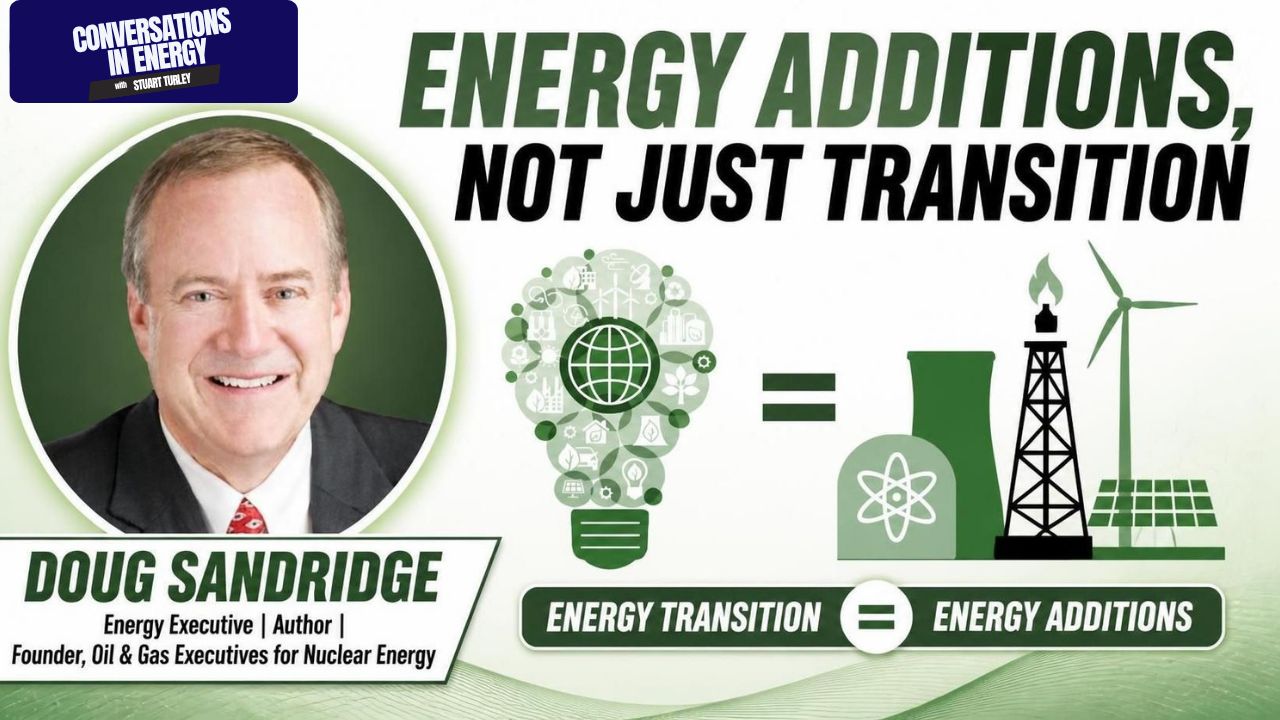
In this episode of the Energy News Beat Podcast, host Stu Turley sits down with Douglas C. Sandridge, Senior Vice President at Fulcrum Energy Capital Funds, to challenge one of the most widely accepted narratives in energy policy: that we’re in the midst of an energy transition away from fossil fuels toward renewables.
Drawing on historical analysis and hard data, Sandridge argues that what we’re actually experiencing is an “energy addition”—a period where renewable energy sources are being layered onto existing fossil fuel consumption rather than replacing it. Through a compelling journey through humanity’s energy history, from the biomass era through coal and petroleum, the conversation reveals uncomfortable truths about global energy consumption, the failures of major energy policies in Germany and California, and why energy literacy is critical for making sound policy decisions. This discussion cuts through the rhetoric to examine what the data actually tells us about where global energy is headed.
Connect with Douglas on LinkedIn: https://www.linkedin.com/in/douglas-c-sandridge-63996312/
Check out Douglas’s Substack: https://douglascsandridge.substack.com/

1. The Energy Transition Myth
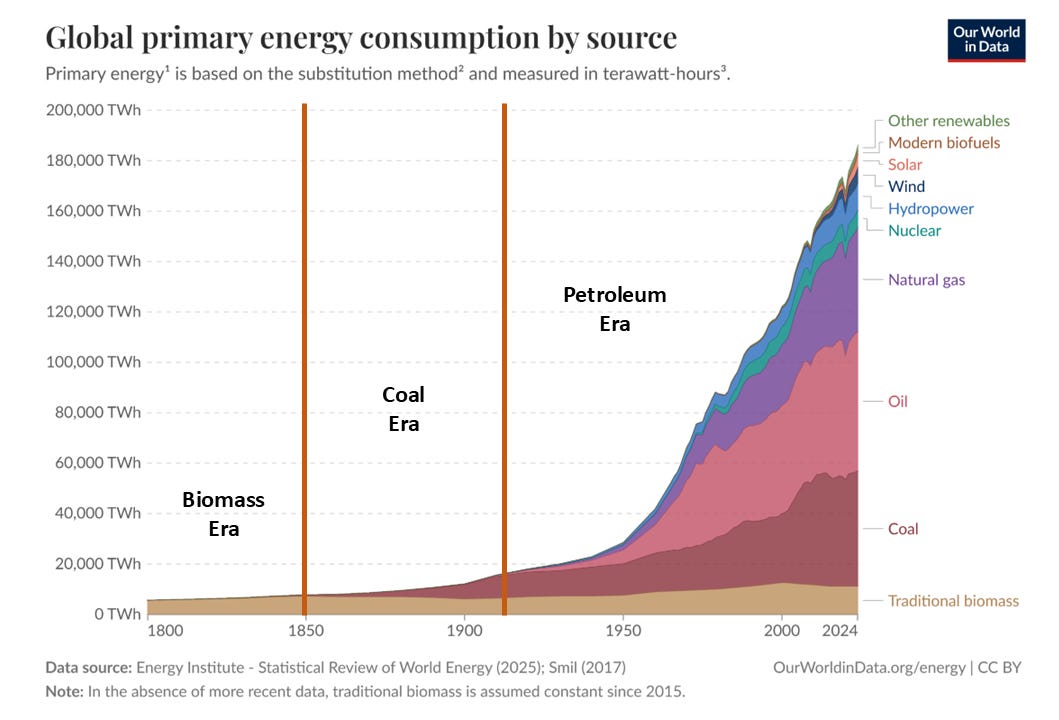
The central thesis is that we’re not actually in an “energy transition” from fossil fuels to renewables. Instead, we’re in an “energy addition” where all energy sources—biomass, coal, oil, gas, and renewables—are being used simultaneously, with fossil fuel consumption actually increasing. Since the 2015 Paris Climate Accords, natural gas consumption has increased 15%, crude oil 11%, and coal 11%.
2. Historical Energy Eras
Doug traces humanity’s energy history through distinct eras:
Biomass Era (300,000 years until ~1850): Wood, straw, dung for heating, cooking, lighting
Coal Era (beginning ~1850): Powered the Industrial Revolution and steam engines
Petroleum Era (beginning ~1915): Driven by naval competition, automobile advent, and whale oil depletion
The key insight is that each new energy source was added rather than replacing the previous one.

3. Why Petroleum Took Off
Multiple factors accelerated oil adoption: whale oil depletion (70% of US lighting), Colonel Drake’s 1859 well in Pennsylvania, refining technology development, and the automobile’s massive demand for gasoline (originally an unwanted byproduct).
4. The Percentage vs. Absolute Consumption Problem
While fossil fuels appear to be declining as a percentage of total energy, in absolute terms we’re using record amounts. The podcast emphasizes this critical distinction that most people misunderstand.
This is a huge difference in how you look at the numbers. Doug is right to point this out. We are truly in an energy addition.
5. Grid Reliability and Energy Policy
Discussion of how wind and solar need to compete fairly with backup battery storage to provide reliable, on-demand power. The current pricing structure doesn’t account for the costs of spinning fossil fuel plants up and down to compensate for renewable intermittency.
This brings us to the Energy News Beat New Energy Legislation and Market Watch program we are rolling out. This is already getting moving in our first few runs, but we are rolling out weekly updates on key legislation in states with paid subscribers first.
6. Germany’s Energy Policy Failure
Doug witnessed Germany shutting down its final nuclear reactors (April 2023) despite having some of the world’s most efficient plants. This has crippled their industrial base, particularly steel production, forcing reliance on expensive imports.
7. Refinery Decline and Energy Costs
The US has declined from 300 refineries to 130, with California dropping from 40 to 7. This drives massive price differences—diesel cracking costs $5/barrel in Texas but $15 in California due to carbon taxes and cap-and-trade policies. Blue states have 52% higher electricity costs.
8. Energy Literacy and Policy
The overarching message: good energy policy requires energy literacy and a commitment to facts rather than narratives. Without understanding actual energy consumption patterns, policymakers can’t make effective decisions.
We are seeing a new era of political division in the United States, and electricity prices in Blue States are 52% higher because of energy policies, not just because of adding wind and solar to the grid. Energy pricing is completely disconnected from consumers, and the entire model needs to be overhauled.
9. Energy Poverty and Human Development
Referenced through Secretary Chris Wright’s “Bettering Human Lives” initiative. Billions still lack access to electricity, and energy policy should prioritize human welfare over ideological goals. I don’t know whether Chris knows how much his keynote address impacted me all those years ago.
We’re also looking forward to interviewing the Bettering Human Lives Foundation again in their new report, as this is a huge legacy started by Secretary Chris Wright while he was at Liberty Energy. As I discussed, I changed my business model because I had never thought about how energy isn’t evenly available around the world. In my podcast with Anne Hyre, Executive Director of the Foundation, it is eye-opening how well they have done and how many lives they have impacted. I am reaching out to interview her and Douglas after their newest report rolls out. This will be huge.
Global And US Energy Policies
So, with just focusing on Energy Policies, regardless of political party, we are trying to get the best information to consumers and investors, and how they can best impact their local communities.
Key points this morning from our ENB Energy Legislative Watch are below:
This week’s energy politics map mixes a live Senate schedule item, a Texas campaign pledge, a Virginia utility merger still before regulators, and older New York and California actions that still shape bills and project timelines. Status labels matter: enacted law, pending proceeding, and campaign promise are not the same thing for households or investors.
Federal: cloture on a motion to proceed — not final passage
The U.S. Senate returns for business Monday, Nov. 9, at 3 p.m. Eastern (2 p.m. CT). At about 5:30 p.m. Eastern (4:30 p.m. CT), senators are scheduled to vote on cloture on the motion to proceed to H.R. 2347, the Survivor Justice Tax Prevention Act—named on the Senate Daily Press as the legislative vehicle for the permitting reform bill. That cloture vote is a procedural step to begin debate. It is not final passage of a permitting package.
Texas: governor-elect pledge, not an enacted moratorium
Democrat Gina Hinojosa is Texas governor-elect and takes office Jan. 19. On the campaign trail she pledged a data-center moratorium—a pause on approvals—until the Legislature passes “real protections so Texans can have a seat at the table,” including community, water and electricity safeguards (Texas Tribune). That pledge is not an enacted executive order. On CNN’s The Lead with Jake Tapper on Thursday, Nov. 5, Hinojosa said, “It is not that I hate data centers,” while repeating that Texas needs to stop what it is doing with data centers until protections are in place (Mediaite; USA Today). Existing pauses under Gov. Greg Abbott on environmental permitting and grid connections already constrain some data-center approvals during an audit period. No transition appointments or orders rewriting those rules have been sourced yet, and no project cancellations can be pinned on the new governor from current reporting.
Virginia: $67 billion combination still pending at the SCC
Virginia regulators are reviewing a proposed Dominion Energy–NextEra Energy combination that Virginia Mercury describes as an all-stock trade valued at $67 billion. The case is SCC docket PUR-2026-00112 and remains pending—not approved. Written public comments are due Nov. 12; the evidentiary hearing begins Nov. 17 (SCC). The companies have accepted some staff and Attorney General recommendations and rejected others, including a three-year rate freeze and a 10-year staffing hold, according to Virginia Mercury.
New York: Affordability Index (Sept. 17 context)
Older context, not a new Nov. 6 law: On Sept. 17, Gov. Kathy Hochul announced that the Public Service Commission opened a proceeding on an Energy Affordability Index aimed at keeping electric and gas utility expenses below 6% of household income. That is a measurement and oversight tool tied to rate cases and possible monitors—not a binding household bill cap. Utilities’ first annual affordability filings are due Feb. 1, 2027.
California: seven signed data-center bills (Sept. 21 context)
Also older context: On Sept. 21, Gov. Gavin Newsom signed seven data-center bills that expand reporting on water and electricity use, give communities more information on land use, and aim to stop cost shifts onto everyday ratepayers for grid upgrades. Those enacted laws create compliance and buildout tradeoffs for operators. They do not, by themselves, guarantee lower household bills.
Consumer and investor view
· Consumers: Watch timing and status labels. Senate cloture is not a finished federal law. Texas’s moratorium is still a pledge. Virginia’s merger is still pending before the SCC. New York’s index and California’s statutes are real tools and rules, not overnight rate cuts.
· Investors: Permitting debate, state data-center rules and a $67 billion utility combination all change project risk and capital timing. The outcomes remain uncertain until the votes and orders land. On Fox Business Nov. 5, Charles Payne warned that data-center policy fallout could extend beyond the stock market—commentary, not a measured impact.
Please keep giving us feedback on format, and how we can continue to grow, add value, and keep you informed. It is only the 6th of the month, and with our past growth, it is easy to see that we are on track to pass 3 million people reading the Podcast Show Notes websites.
Thank you to our GREAT paid subscribers, sponsors, and patrons keeping the lights on. I am working on this week’s rig report and other key legislative issues. Paid subscribers can request project research and their State’s legislative actions.
Monday, we have Charlie Garcia , and Doomberg to cover the Energy and Political landscape, and that should be another epic episode.
We would also like to give our sponsors a shout-out.
A shout-out to Steve Reese and the Reese Energy Consulting group for sponsoring the Podcast https://reeseenergyconsulting.com/.
Data2 if you have any business systems, can you trust A? Well, they have the patent on validation. .https://reeseenergyconsulting.com/.
And we have WellDatabase rolling, and we use their tools for the Energy News Beat weekly Rig Reports: https://welldatabase.com/
Also entering Sponsor Rey Trevino, Pecos Operating https://pecos.energy/


