

ENB Pub Note: This article first ran on America OutLoud, and we highly recommend reading their publication. Ronald Stein, a great friend of the Energy News Beat Podcast, and Lance Christensen wrote this article on California and the pending crisis.
Despite what out-of-state friends and family have said for years, California won’t fall into the Pacific Ocean. But if its policymakers and legislators continue down a path of carbon-isolation uber-allies, California may continue to alienate itself from the rest of the world, sinking economically as an energy island, isolated from the rest of the continental USA by the majestic Sierra Mountains.
As more refinery closures are anticipated in the coming years, more of the demands of 58 million gallons of transportation fuel DAILY will be dependent on Asian refineries to meet these daily supply chain demands to keep the 4th largest economy humming:
- 11 million gallons/day for Jet fuel for the States’ 40 military and 9 international airports. California is the nation’s largest jet-fuel consumer. Roughly 20% of supply is now imported, primarily from India and other Asian refiners (South Korea). Imports have surged alongside refinery closures.
- 10 million gallons/day of diesel for the States’ trucking and construction industries.
- 37 million gallons/day for Gasoline for the States’ more than 36 million vehicles. Gasoline imports are rising to fill the gap left by the shrinking of in-state refining, from refineries in the Bahamas, India, South Korea, and the Gulf Coast.
- In addition, Bunker fuel is needed for the 1,000s of merchant ships serving 3 of the busiest ports in America: Long Beach, Los Angeles, and Oakland.
California’s overall demand for petroleum-based transportation fuels is decreasing slightly over the long term. However, supply of those transportation fuels is dropping even faster due to refinery closures, creating tight market conditions. Thus, California regulations are supporting the increasing profitability of the few remaining refineries by reducing the supply chain to meet the humongous daily demands of transportation fuels.
California is regulating itself out of transportation fuel production while the rest of the world expands it. And for some reason, Golden State lawmakers think that they can regulate 99.5 percent of the world’s population that do not live in California under the various climate change regimes they have implemented within California over the last half century of ecological doomsaying, but the weight of the policy changes is displacing much of our productivity to other nations that are not so inclined to kill industriousness.
The history is long and broad, but since the 1970s, the anti-car movement moved from dealing with a legitimate challenge: rapid growth in the cities and smog – especially within several of the denser basins in Southern California – to a phalanx of new agencies who were apt to mission creep. Created to manage air pollution through technological improvements, it wouldn’t take many years before the radical zero-population ideologues had captured the sincere environmental activists.
And even good governors, like Ronald Reagan, were implicated in these movements to uphold their image as sincere conservationists. Naively believing that he could restrict the cancerous growth of environmental activists and restrain the growth of government, Reagan signed both the Mulford-Carrell Act in 1967 — which created the California Air Resources Board (CARB) — and the California Environmental Quality Act in 1970 (CEQA).
CARB’s mission was to fight air pollution from mobile sources, and CEQA was originally slated to oversee the environmental impacts of state and local agencies’ projects on the ground. These policies have been taken to court so often against builders and movers that the litigation is wagging the tail of the legislature.
Both efforts have been converted to restrict and inhibit any growth in maintaining or expanding our refinery sector, thus increasing costs and requiring that most of our petroleum products be shipped from hostile countries overseas, like Iran and China.
But it’s more than the rabid ecologists that are slowing the development of any refinery capacity to meet the demands for the products and transportation fuels of our materialistic society. Our progressive zeitgeist has produced a few generations of clueless Watermelon Warriors – green on the outside, red on the inside – and we’re dabbling in a Marxist oil war, something that former-Soviet-citizen-turned-American-capitalist-novelist Ayn Rand predicted in her work, The Left: Old and New, Return of the Primitive: The Anti-Industrial Revolution, “It has been reported in the press many times that the issue of pollution is to be the next big crusade of the New Left activists, after the war in Vietnam peters out. And just as peace was not their goal or motive in that crusade, so clean air is not their goal or motive in this one.”
While many are quick to opine on the virtue or vice that NIMBY-types (“not in my backyard”) played in holding down development of California and its economy, it is the BANANAs activists who have inflicted the most pain, shutting down nearly all progress in energy production in the state. The “build-absolutely-nothing-anytime-near-anything” zealots don’t want a drop of oil explored for, drilled, refined, sold, or expended in the state, and are able to utilize the useful idiots found in our many agencies and departments at the state level, leveraging the federal government rules and local community outrage to suffocate any opportunity to have a rich refinery future.
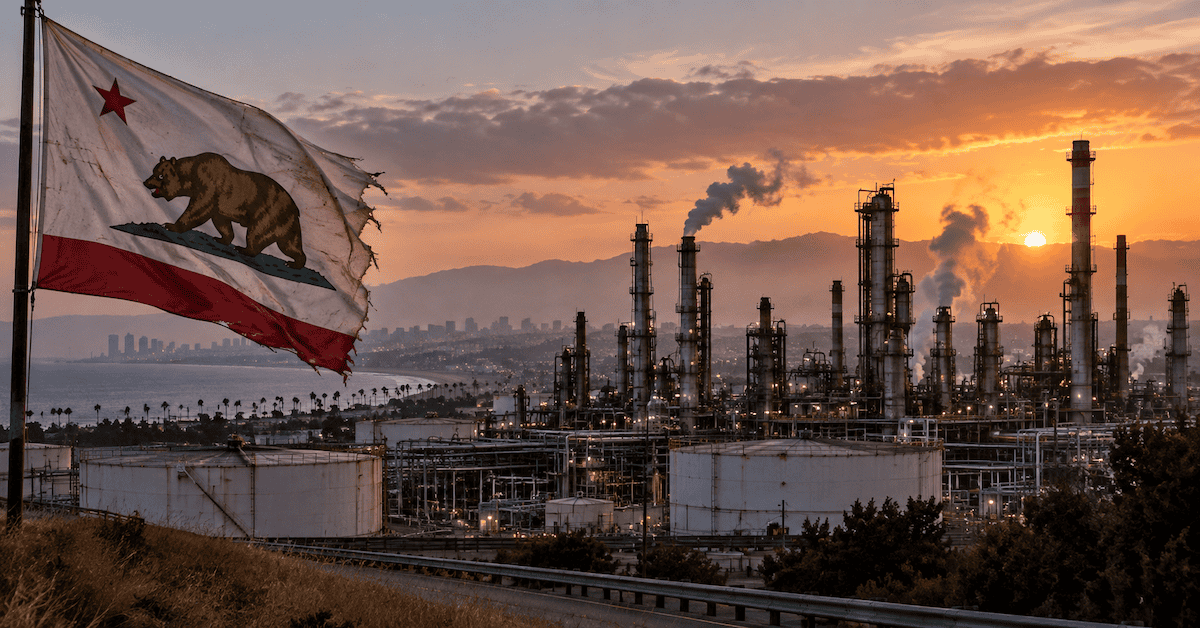
California can’t pipe in refined fuel overland the way most states can; it’s cut off, hence “Energy Island.” Add the recent closures of Phillips 66 Los Angeles and Valero Benicia and more imminent closures, and CARB’s tightening emissions standards squeezing the refiners that remain, and Californians have the highest transportation fuel prices in the country.
So, who actually fills the transportation fuels gap?
As in-state refining capacity shrinks, California increasingly imports transportation fuels from Asia. Those refineries aren’t accountable to CARB. They have no equivalent emissions, environmental, and labor standards; anything goes in those countries to extract, refine, and sell oil they get out of the ground. By CARB’s own definitions, all these countries would qualify as “gross polluters” if it were done in-state. This is a consequence of cutting off our own ability to produce petroleum at home. It is the textbook definition of “leakage” on a scale of mass proportions.
Then there’s the shipping angle as the fuel crosses the Pacific on high-emission tankers, voyages as long as 45 days. This is a global emissions cost; California’s policy simply exports rather than eliminates. However, three of the busiest ports at Long Beach, Los Angeles, and Oakland are not designed for all the tankage required to accept and store 58 million gallons a day of imported transportation fuels from foreign refineries.
Tie the fuel-import dependency directly to the assets that run on it: military installations, international airports, major shipping ports. Relying on foreign-refined fuel — particularly refined in and shipped from Asia — for the fuel that powers military and port logistics is a national security exposure, not merely a pocketbook issue.
> While California has closed 2 refineries, with the 7 remaining at risk of closing, approximately 181 new oil refinery projects are planned or announced to commence operations in Africa, Asia, and the Middle East between 2024 and 2030, with Africa leading with roughly 70–89 projects, Asia follows, with a strong focus on expansion (e.g., in India and China). The Middle East is adding significant capacity (approx. 30–81 projects), with major projects in Iran and Iraq.
> The rest of the world is moving decisively in the opposite direction of California as they recognize that their economies are totally dependent on the products and transportation fuels MADE FROM raw crude oil, the same products and transportation fuels that unreliable electricity generated from Wind and Solar CANNOT make!
> Note the Brownsville, Texas refinery point: new domestic capacity elsewhere doesn’t solve California’s transportation fuels supply chain problems because the state’s fuel specs and Energy Island logistics keep it walled off even from other U.S. refiners.
Here’s the irony: policymakers believe closing California refineries that utilize approximately 500 acres each reduces worldwide emissions, but they’re actually increasing the emissions overseas to less-regulated refineries and dirtier tankers, all the while adding transit emissions that wouldn’t exist if the fuel were refined at home. And we have a lot of crude oil reserves under our feet in the Monterey Shale that in-state refineries need.
Policymakers need to treat in-state refining and production capacity to meet the daily demands for the products and 58 million gallons of transportation fuels demanded daily that are made from the raw crude oil refined at refineries as core infrastructure and a national security asset, not as a hobby horse and liability to be regulated away.
Please share this information with teachers, students, and friends to encourage Energy Literacy conversations at the family dinner table.
Click this Link to Sign up for Energy Literacy from Ronald Stein.


