

Global energy markets are undergoing a dramatic rebalancing, and most people have no idea what’s happening.
While politicians argue about which energy sources to cancel, real-world supply constraints are forcing a reckoning. Ukraine sanctions have wiped out Russian refinery capacity, diesel prices are spiking worldwide, and the U.S. is caught in a policy whiplash China would never tolerate.
Meanwhile, Canada’s new Prime Minister Mark Carney is quietly executing a 180-degree pivot toward hydrocarbon dominance—and it’s working. In this episode, we sit down with two of Substack’s most influential energy analysts, Charlie Garcia of Capital Mischief and Doomberg , to break down the diesel crisis, expose why refinery capacity matters more than new drilling, explain why blue states are paying 42% more for energy than red states, and reveal how AI’s insatiable appetite for power is about to reshape the entire energy landscape. If you care about energy security, geopolitics, or your wallet, you’ll want to listen to this conversation.
I truly had an absolute blast learning from Doomberg and Charlie about their success and how they are growing their Substack audience. We all have different strengths, and I am truly honored to be in the same set with them.
This was our first successful live feed to Substack, and I hope to work out the bugs and get better at it. Doomberg’s and Charlie’s past episodes were very well received by our subscribers. Let us know your thoughts.

The hosts discuss how Mark Carney, Canada’s new Prime Minister, is dramatically shifting energy policy away from Justin Trudeau’s climate-focused approach. Carney is pursuing LNG expansions, gas pipeline projects, and new oil pipelines—governing like a “Texas conservative” to position Canada as part of North American energy dominance.
2. Global Diesel Crisis & Refinery Capacity
We covered the refinery and diesel issue, along with the pre-game or pre-podcast notes.
The people who buy and sell the physical stuff say the same. Chevron CEO Mike Wirth said on Oct. 6 that “the landed price of physical oil in Asia is currently closer to $150 per barrel than $100, where Brent oil futures are trading” (Reuters via ETEnergyworld). Aramco CEO Amin Nasser said some physical barrels are changing hands at $20 to $50 over Brent (Business Upturn). Wood Mackenzie says Norway’s Johan Sverdrup moved from a typical 3% discount to a record $24 premium to Brent, with medium-sour crude in Europe priced above $140 (Wood Mackenzie). And the same West African oil that looks cheap at the dock looks dear on arrival: Indian Oil bought Angolan Nemba for November delivery at Dated Brent plus $18, and Murban at plus $13 to $14 (Reuters via Egypt Oil & Gas). Chinese independents paid $12 to about $20 over ICE Brent delivered for Iraqi and Qatari crude (Reuters via Economic Times).
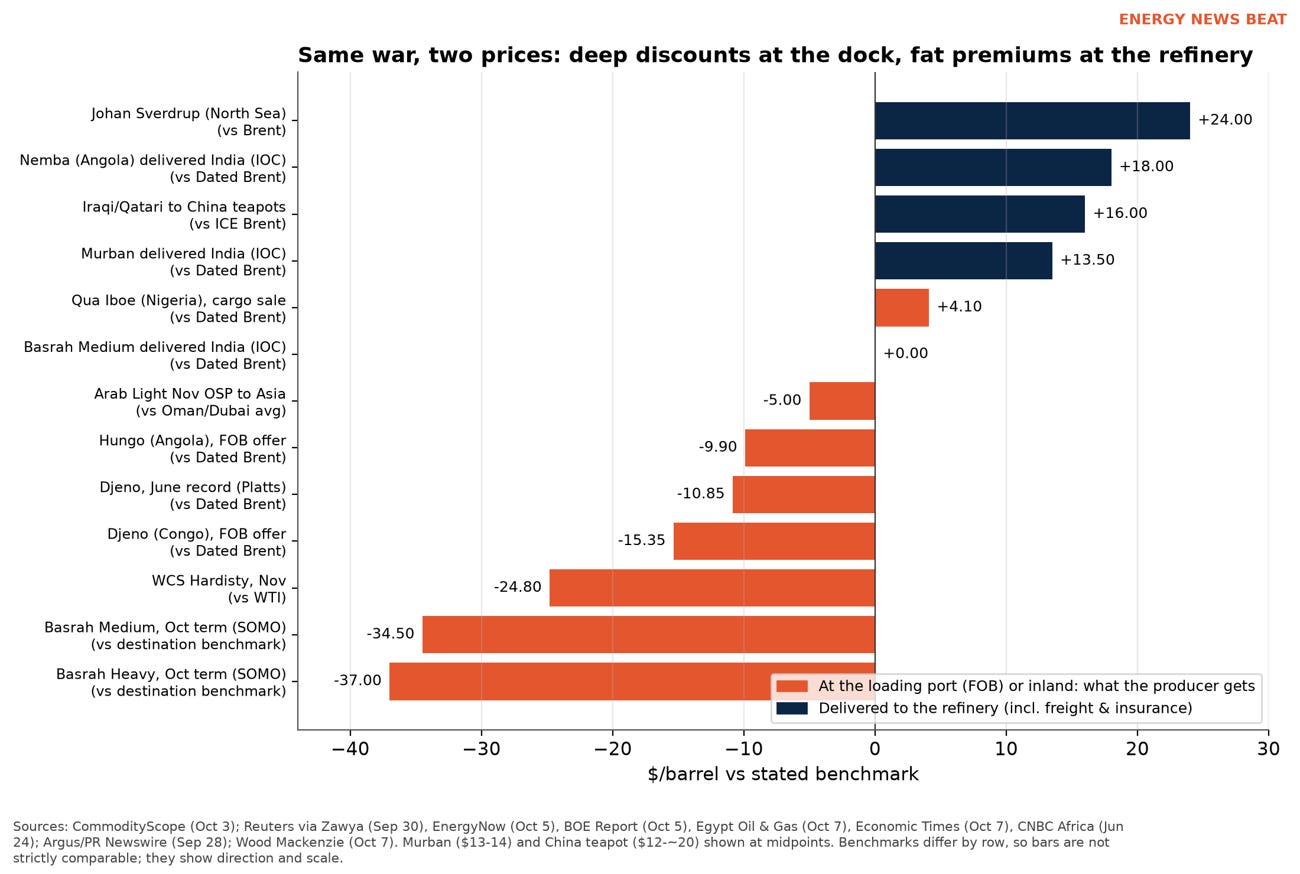
Chart 3. Reported FOB discounts vs. delivered premiums, late September–early October 2026 (June Djeno record for reference). Benchmarks differ by row. Sources: see Appendix A.
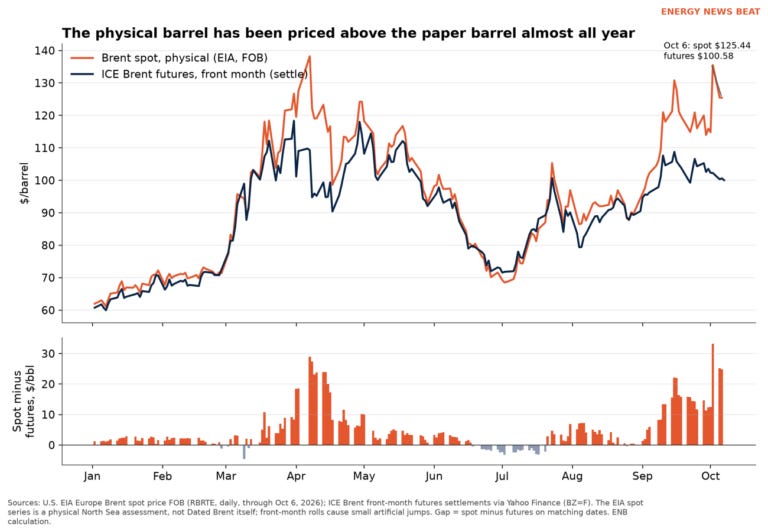
This also reconciles ENB’s earlier Hormuz coverage, which found physical Brent running well above futures at times (ENB, Oct. 6). Both things are true at once. Atlantic Basin crude that can reach a refinery quickly commands a big premium. Gulf and West African crude that needs an expensive, risky voyage has to be marked down at the dock to compete. Brent futures sit in the middle, and the tanker owners and insurers collect the spread.
3. U.S. Refinery Challenges & State-Level Energy Policy
In getting ready for the podcast, I posted out my pre-podcast show notes generated by AI, and it had some key points we covered in the podcast.
One that I did not get to cover was that the price of physical delivery of oil has been priced over paper for a year, and that bill is about to get evened out.
4. China’s Strategic Energy Independence
5. AI Boom & Energy Demand
6. Political & Economic Cycles
7. Investment Opportunities & Risk
Discussion of tax-advantaged oil and gas partnerships (like Shalehaven Partners) offering:
- 90-95% tax deductions on investments
- Return of principal within 18-24 months
- Ongoing production revenue (”mailbox money”)
- Our Recommendation on the show we discuss. Shale Haven.
- The link is just above, and the leadership from Shale Haven has been on the Energy News Beat podcast, and we see great value in their leadership.
- We also covered there are good private oil investments and bad ones on the market. We are very picky about those that we invest in and look at. Tax-advantaged investments are critical.
8. Demand Description: real abroad, mild at home
At home the picture is softer. EIA’s implied U.S. gasoline demand averaged 8.78 million b/d over the four weeks to Oct. 2, just 0.3% below the same weeks of 2025. Distillate was down 1.6% and 3.0% below the 2021–25 average. Jet fuel was up 6.0% (EIA; ENB calculation). EIA’s outlook has U.S. gasoline use averaging 8.75 million b/d this year, about 2% below 2025. That is a bend, not a break.
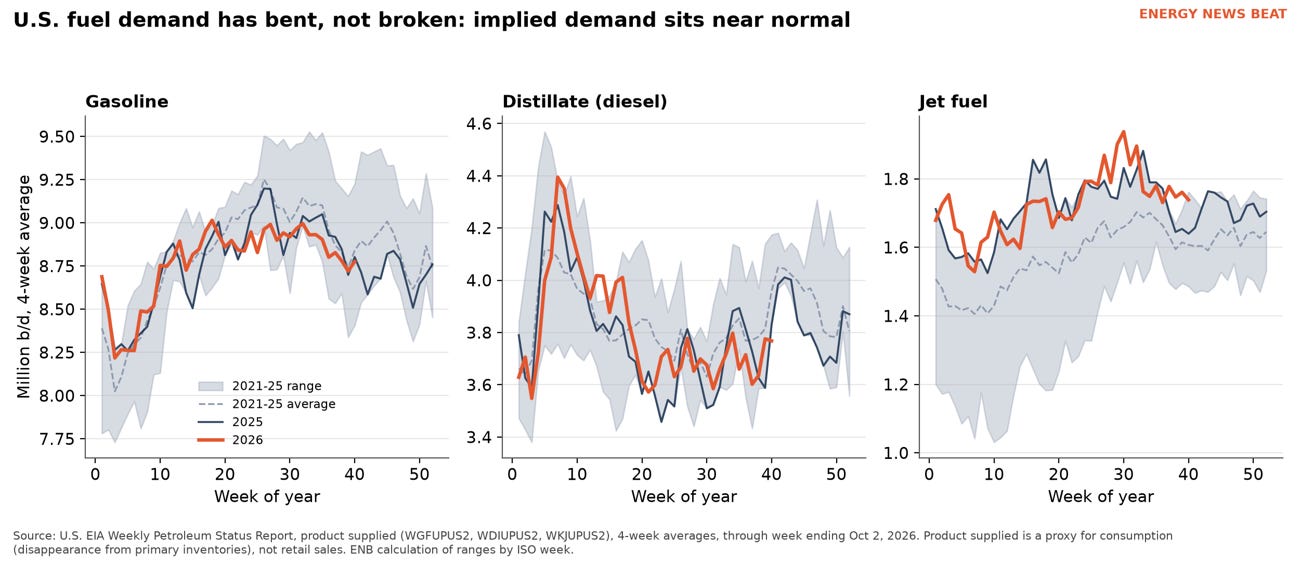
Chart 5. U.S. product supplied (4-week average) for gasoline, distillate and jet fuel: 2026 vs. 2025 and the 2021–2025 range. Source: U.S. EIA; ENB calculation.
Trucking is mixed. ATA’s tonnage index was 1.6% below a year earlier in August, and chief economist Bob Costello said tonnage was “down in four of the last five months” (ATA). Cass shipments, though, posted their first year-over-year gain since January 2023 (Cass). On the road, Georgia drivers told Atlanta News First fleets are laying off drivers and parking trucks.
The counterpoint matters: global inventories are still falling. EIA estimates stocks drew about 1.9 million b/d in the third quarter (EIA press release), and the IEA counts 507 million barrels of observed draws since February (IEA). Demand is weakening, but supply is still weaker. That is why prices have not collapsed.
Thank you to the hundreds of people who have already watched the live feed from LinkedIn, Substack, X, and YouTube. We can’t thank you enough.
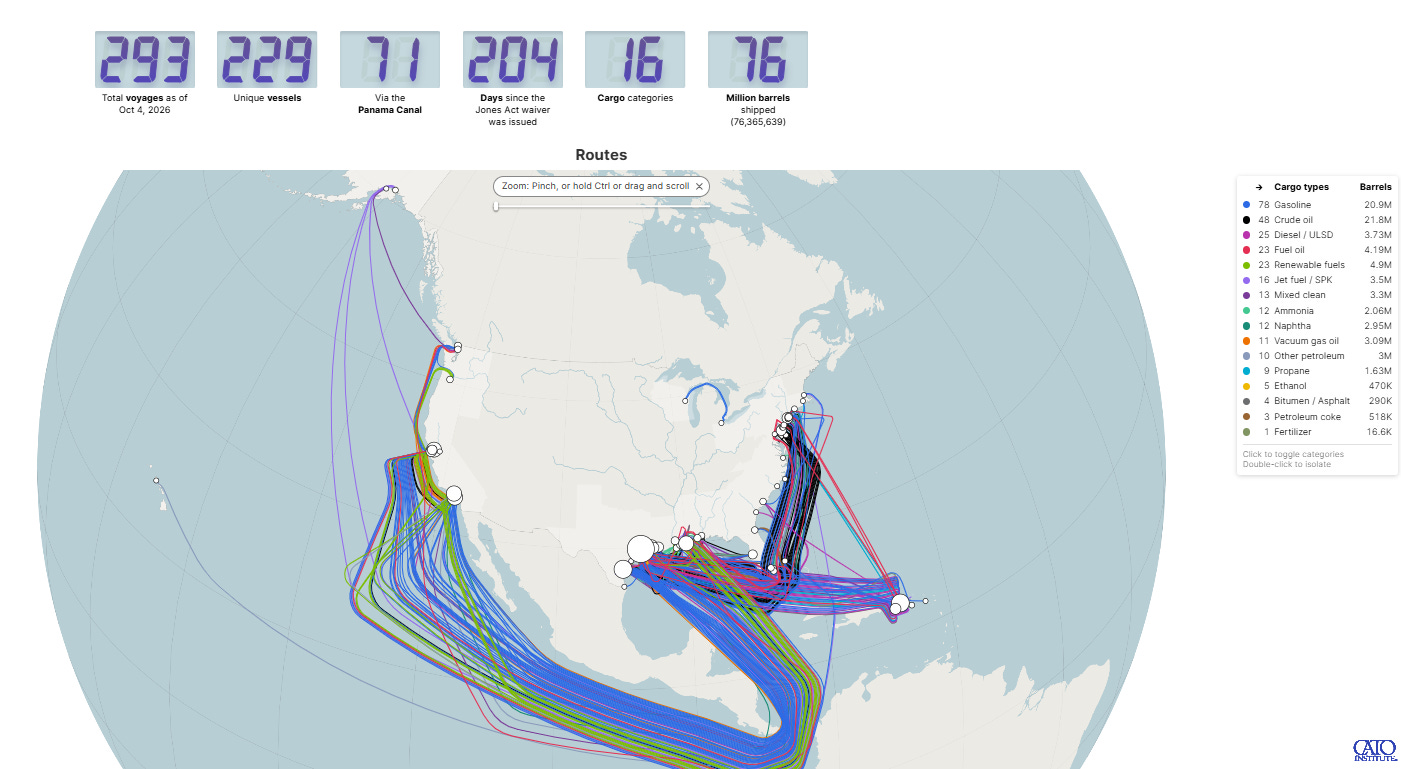
9: Jones Act Tracker
https://www.cato.org/jones-act-waiver-tracker
We would also like to give our sponsors a shout-out.
Please check out Doomberg.com and Charlie’s Substack, Capital Mischief

Check out the World’s Greatest Podcast Show Notes at EnergyNewsBeat.co or EnergyNewsBeat.com, and the Energy News Beat Substack at:

A shout-out to Steve Reese and the Reese Energy Consulting group for sponsoring the Podcast https://reeseenergyconsulting.com/.
Data2 if you have any business systems, can you trust A? Well, they have the patent on validation. . https://data2.zoholandingpage.com/energy
And we have WellDatabase rolling, and we use their tools for the Energy News Beat weekly Rig Reports: https://welldatabase.com/
Also entering Sponsor Rey Trevino, Pecos Operating https://pecos.energy/
