


The oil-insurance policy that sits between a shock in the Strait of Hormuz and the price at the pump is being topped up in Japan. It is not being topped up in the United States.
Saudi Arabia and Japan announced Friday that Tokyo intends to buy as much as 8 million barrels of Saudi crude for its national petroleum reserve and to give Riyadh temporary use of an additional 16 million barrels of storage in Japan, according to a joint statement carried by the Saudi Press Agency and reported by the Saudi Gazette. Including the existing 8-million-barrel joint holding, the kingdom’s available capacity in Japan would rise to 24 million. The statement said Saudi Arabia has already begun replenishing the joint tanks.
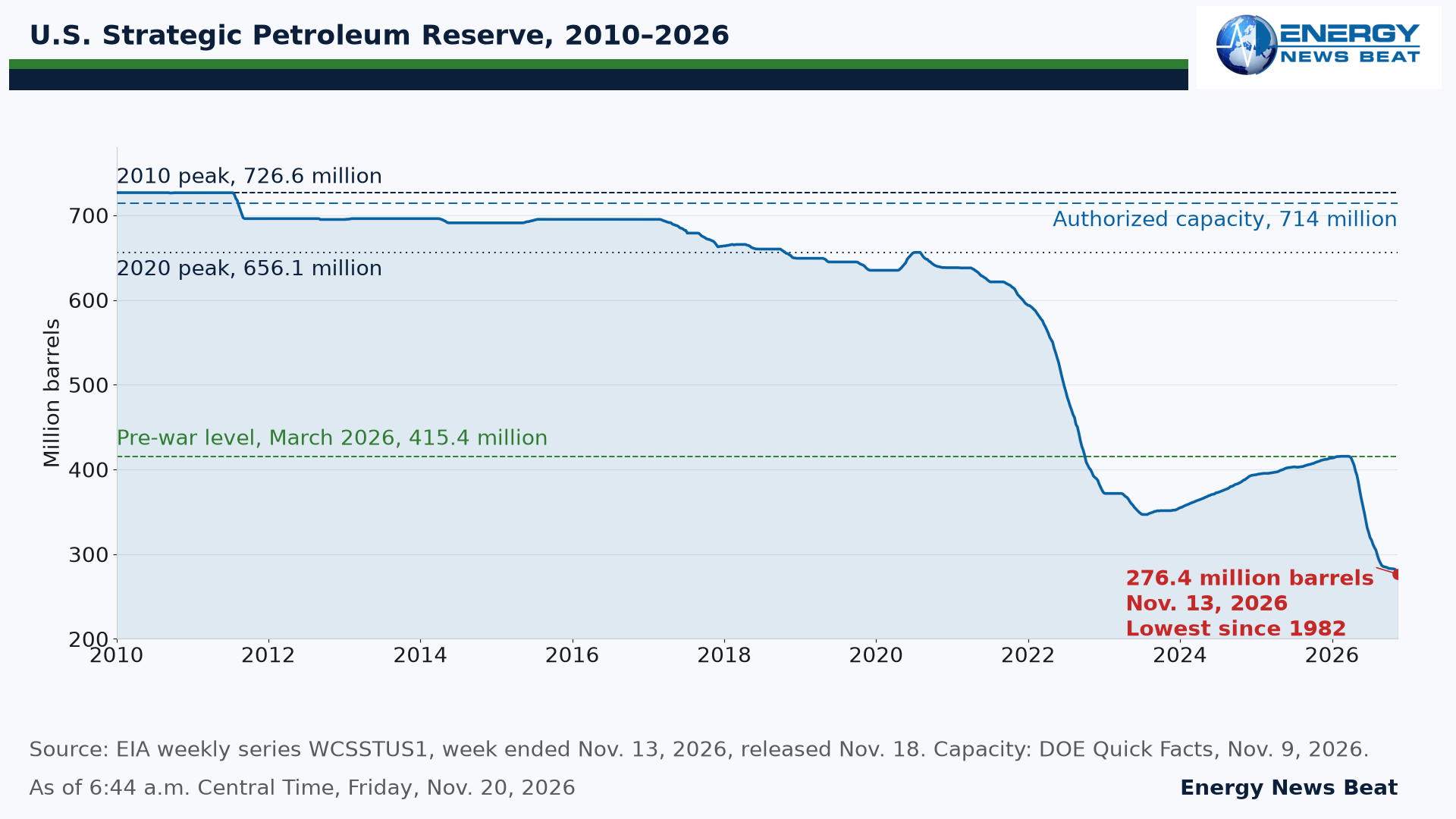
The U.S. Strategic Petroleum Reserve held 276.4 million barrels in the week ended Nov. 13, the Energy Information Administration said — the lowest weekly level since August 1982, 139 million barrels below the level just before this year’s emergency draw, and less than two-fifths of the 714 million barrels the Energy Department now lists as authorized capacity.
What Japan and Saudi Arabia actually agreed to
The purchase and the extra storage are intentions, not a locked-in cargo schedule. The joint statement, issued after a Nov. 9 virtual meeting between Saudi Energy Minister Prince Abdulaziz bin Salman and Japan’s economy, trade and industry minister, Ryosei Akazawa, says Japan will buy “up to 8 million barrels” of Saudi crude “subject to favorable market conditions and the completion of necessary internal procedures.” The additional storage would be made available “for a limited period through its national stockpiling facilities.”
The Joint Crude Oil Stockpiling Project dates to 2010. In November 2025, JOGMEC and Saudi Aramco renewed a three-year lease on 13 national tanks at the Okinawa CTS Corporation base, about 8.2 million barrels. Japan has preferential access to that crude in an emergency. The Friday statement does not say the new 16 million barrels will also sit in Okinawa. NHK reported that Saudi Arabia would use Japanese government and private tanks free of charge for a fixed period; that phrase is not in the Gazette’s account of the official statement.
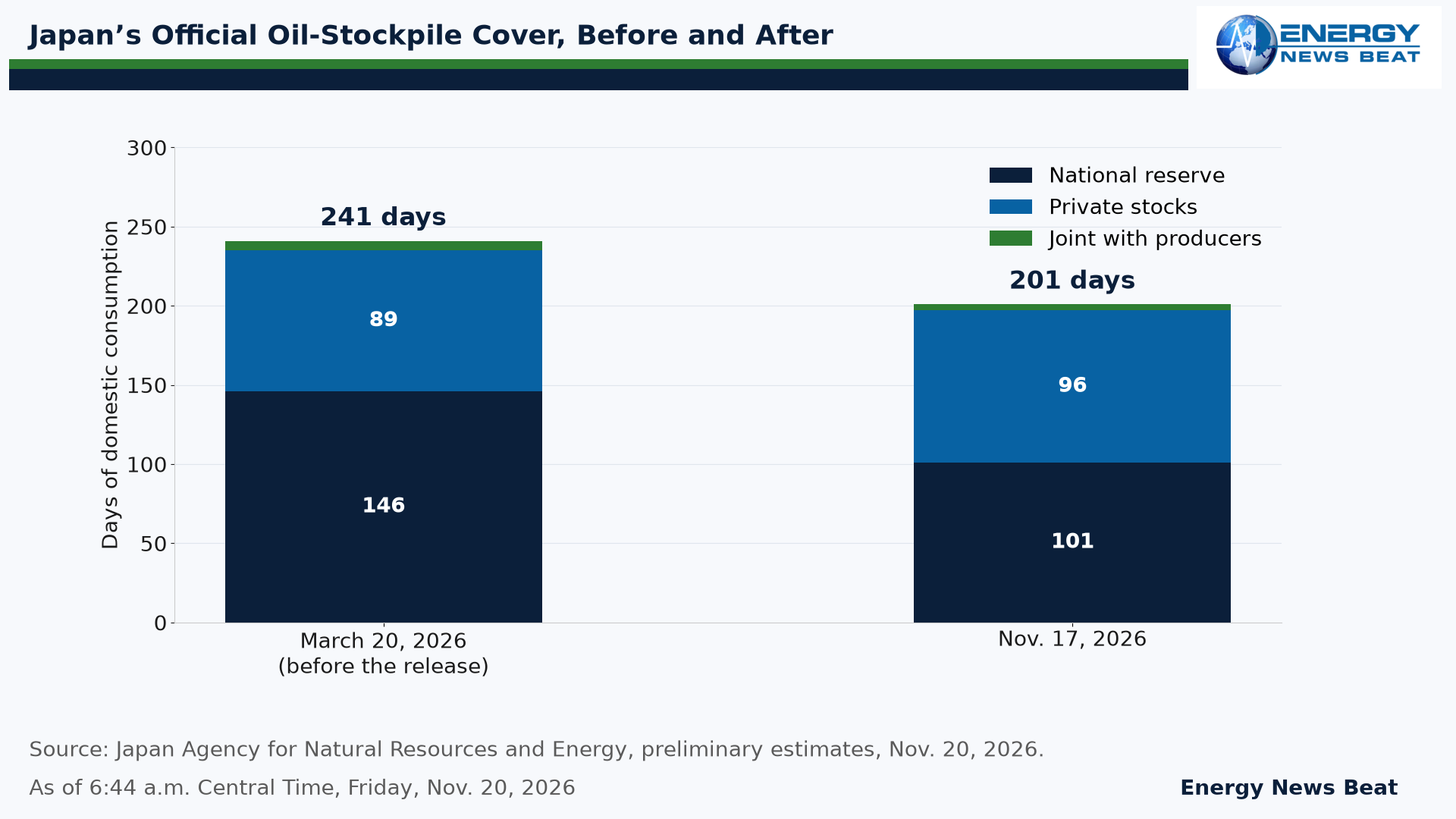
Eight million barrels will not, by itself, put Japan back where it started. The Agency for Natural Resources and Energy, in a preliminary table published Nov. 20, put Japan’s oil stockpile at 201 days of domestic consumption as of Nov. 17: 101 days national, 96 days private and 4 days in joint stockpiles with producers. Just before the March release, the same series showed 146 days in the national reserve and about 241 days in total. Japan’s public contribution to the IEA’s March action was 54 million barrels, plus 25.8 million from obligated industry stocks.
The wartime draw, and who still needs to refill
The Hormuz crisis that began Feb. 28 produced the largest oil-supply disruption on record, the IEA has said, and the largest coordinated stock release in the agency’s history. On March 11, the 32 member countries agreed to make 400 million barrels available. They then held more than 1.2 billion barrels in public emergency stocks and a further 600 million barrels of industry stocks under government obligation. A March 19 country table totaled 426 million barrels, including 172.2 million from the U.S. reserve, 79.8 million from Japan and 22.46 million from South Korea.
By Oct. 7, about 325 million barrels had been released and about 100 million barrels of pledged oil had not yet come out. IEA governments still held around 1.1 billion barrels of public emergency stocks, including more than 200 million barrels of diesel. The November Oil Market Report, published Nov. 13, said observed global inventories rose 52 million barrels in October, the first increase since June, as oil on the water jumped 86 million barrels. On-land stocks kept falling and were at their lowest since at least 2016. OECD stocks fell 47 million barrels, 41 million of that from industry. Observed global stocks have dropped 462 million barrels since the war began. The public report does not give a single official total for world commercial plus strategic oil.
South Korea’s trade ministry said on March 12 that Seoul’s share was 22.46 million barrels. In late May, an official told Yonhap the private stockpiling mandate for refiners would fall from 40 days of sales to 20 days and that Seoul planned to report about 12 million barrels of its pledge that way. Korea National Oil Corp., which runs the government stockpile, says it held 100 million barrels of reserves, excluding international joint stockpiles, as of August 2026. Europe’s March regional commitment was 32.7 million barrels from government stocks and 74.8 million from obligated industry stocks, mostly products; the public November IEA report has no updated country days-of-cover table. India’s petroleum ministry told Parliament on March 23 that its strategic caverns held about 3.37 million tonnes, roughly 64 percent of capacity, as reported by the Indian Express and Business Standard; no later official figure was found. China does not publish a regular official strategic-reserve series.
How low the U.S. reserve is, and what it would cost to fill it
The EIA’s weekly series, WCSSTUS1, put the SPR at 276.361 million barrels for the week ended Nov. 13, released Nov. 18. A year earlier it was 410.9 million. In the three weeks ended March 6, 13 and 20, before the wartime draw really started, it held 415.4 million. The 2020 peak was 656.1 million barrels on July 10, 2020. The all-time high on the weekly series is 726.6 million on Jan. 1, 2010, when authorized capacity was 727 million. DOE’s SPR Quick Facts, updated Nov. 9, now list authorized capacity at 714 million barrels. In 1982 the reserve was still being filled; EIA’s monthly series last held less oil that August.
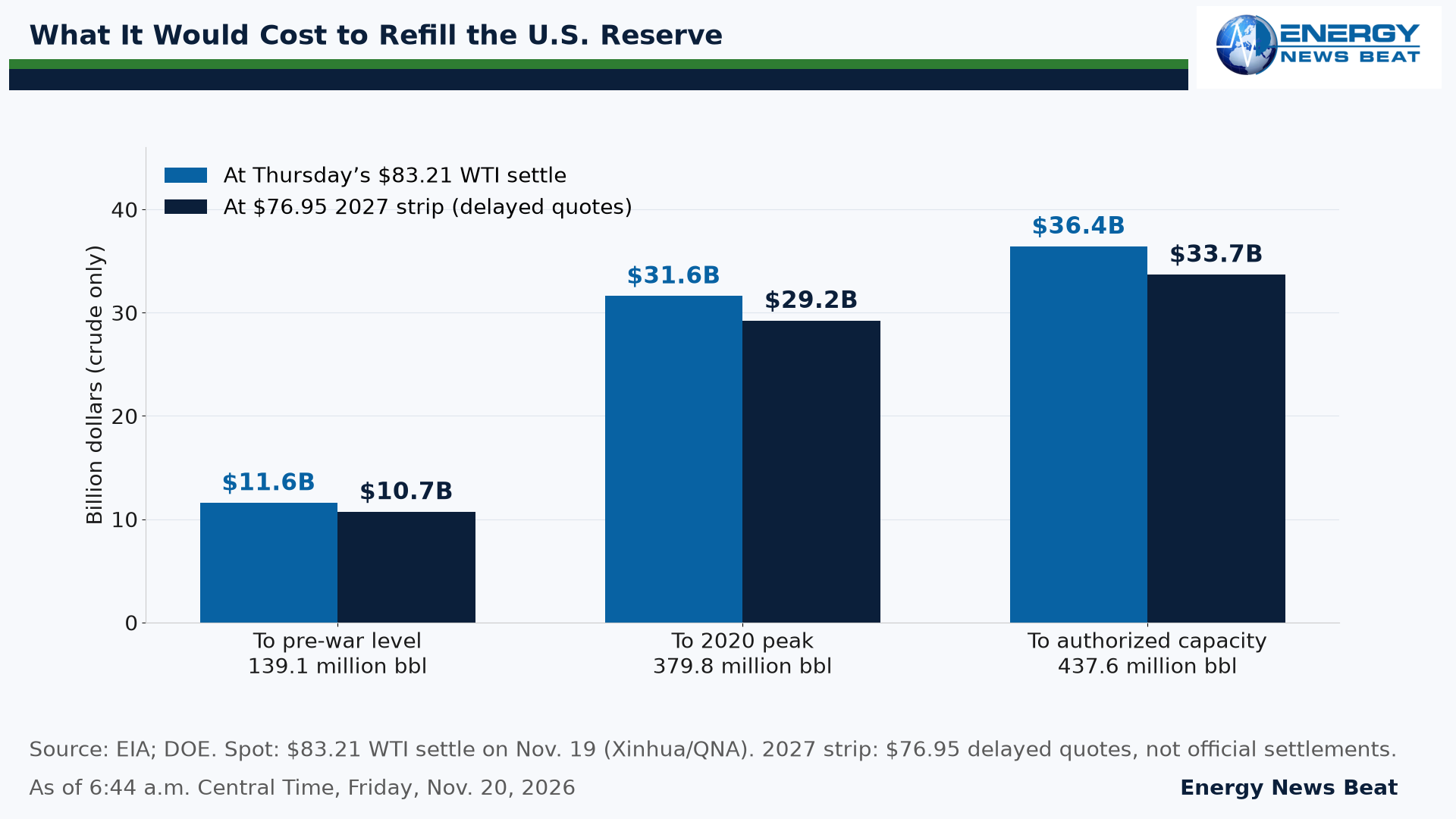
Restoring the reserve to its pre-war 415.4 million barrels would take 139.1 million barrels. Getting back to the 2020 peak would take 379.8 million. Filling it to today’s 714-million-barrel authorized capacity would take 437.6 million. West Texas Intermediate for December delivery settled at $83.21 a barrel on Thursday, Nov. 19, and Brent for January settled at $91.98, according to Xinhua and the Qatar News Agency, both citing the futures exchanges. At $83.21, a pre-war refill would cost about $11.6 billion for the oil alone; a refill to the 2020 peak about $31.6 billion; and a fill to authorized capacity about $36.4 billion, excluding transportation, injection and cavern work.
The futures curve is in backwardation, so later barrels are cheaper if the curve is realized. A simple average of the 12 monthly NYMEX WTI contracts for 2027, using delayed Oilprice.com quotes on Friday morning that are not official exchange settlements, was about $76.95 a barrel. At that strip, the same three jobs would cost about $10.7 billion, $29.2 billion and $33.7 billion. Friday morning trading was already below Thursday’s close: CNBC had December WTI near $81.59 around 10:32 a.m. Greenwich time.
The money already on the books does not come close. In October 2025 DOE, citing $171 million appropriated in the Working Families Tax Cut, solicited 1 million barrels for Bryan Mound. As of Nov. 12, 2025, it had awarded contracts for 900,000 barrels totaling $55.8 million. The fiscal 2027 request asks $295.1 million for SPR facilities, operations and program management, up 43 percent from the $206.3 million enacted for fiscal 2026 — not for buying oil. The SPR Petroleum Account is requested at $100,000, the same token level as in fiscal 2025 and 2026. The fiscal 2027 request itself does not include a large purchase appropriation.
Consumer and Investor Views
For households, the story is not a Japanese storage contract. It is whether the next disruption finds the world’s emergency inventories already drawn down by about 325 million barrels. The IEA’s November report said North Sea Dated crude had fallen from $136 a barrel in early October to about $93 when that report was written, and Thursday’s Brent settlement was just under $92. Prices have come down as Gulf exports recovered, a cheaper window to buy oil back — if governments use it.
A U.S. refill at these prices would be a multi-tens-of-billions appropriation fight, not a rounding error in the maintenance budget. Japan’s 8-million-barrel purchase is a start on a much larger hole. America’s hole is more than 17 times that size just to get back to March.
Timeline
Key dates for the Japan-Saudi stockpile agreement, the IEA release and the U.S. reserve. Times are Central where a clock time is given.
Dec. 27, 2009. The U.S. SPR reached 726.6 million barrels, then its full authorized capacity of 727 million, the Energy Department says. The EIA weekly series peaked at 726.6 million barrels on Jan. 1, 2010.
- Japan and Saudi Arabia established the Joint Crude Oil Stockpiling Project.
July 10, 2020. EIA weekly SPR stocks peaked for 2020–21 at 656.1 million barrels.
Oct. 21, 2025. DOE solicited 1 million barrels of U.S.-produced crude for Bryan Mound, funded by $171 million appropriated to begin a refill, with deliveries in December 2025 and January 2026.
Nov. 12, 2025. DOE awarded contracts for 900,000 barrels totaling $55.8 million under the Bryan Mound solicitation.
Nov. 19, 2025. JOGMEC and Aramco renewed the Okinawa tank lease, about 8.2 million barrels for three years.
Feb. 28, 2026. The Middle East conflict that closed down most Hormuz oil flows began, the IEA later said.
March 6–20, 2026. U.S. SPR weekly stocks held at 415.4 million barrels, the plateau immediately before the wartime draw.
March 11, 2026. IEA members agreed to make 400 million barrels of emergency stocks available, the largest collective action in the agency’s history.
March 19, 2026. IEA published country contributions totaling 426 million barrels, including 172.2 million from the United States, 79.8 million from Japan and 22.46 million from Korea.
May 2026. Japan and Saudi Arabia established a joint task force on energy-security cooperation. Korea cut its private stockpiling mandate from 40 days to 20 days, starting May 29, as part of its IEA pledge.
Oct. 7, 2026. The IEA said about 325 million barrels had been released, about 100 million barrels of pledges remained, and public emergency stocks were still around 1.1 billion barrels.
Oct. 8, 2026. Japan presented an AZEC ministerial work programme on strengthening oil stockpiling in Asia.
Nov. 9, 2026. Prince Abdulaziz and Minister Akazawa held a virtual meeting. DOE updated SPR Quick Facts, listing authorized capacity of 714 million barrels.
Nov. 13, 2026. IEA November Oil Market Report: observed inventories up 52 million barrels in October; on-land stocks still the lowest since at least 2016. EIA week-ending SPR stocks: 276.4 million barrels, released Nov. 18.
Nov. 17, 2026. Japan’s official preliminary estimate: 201 days of oil stockpiles (101 national, 96 private, 4 joint).
Nov. 19, 2026. NYMEX WTI December settled at $83.21 a barrel; ICE Brent January at $91.98.
Nov. 20, 2026. Saudi Press Agency carried the joint statement on Japan’s intended 8-million-barrel purchase and 16 million barrels of additional storage.
Caveats and Criticism
The Japan-Saudi announcement is a statement of intent. The 8 million barrels are a ceiling, contingent on market conditions and Japanese procedures, and the extra storage is temporary. The terms follow the agency’s text as reported by the Saudi Gazette, corroborated on the volumes and purchase condition by Bloomberg, as carried in part by The Japan Times, and by NHK. NHK’s “free of charge” wording is not in the Gazette’s account.
The public November IEA report does not give a single official total for world commercial plus strategic stocks. The 1.1 billion barrels of public IEA emergency stocks as of Oct. 7 excludes most non-IEA government reserves, including China’s. Refill-cost estimates are for crude only and would change with the market, the grade of oil and logistics. Friday’s session was still open. The next EIA weekly SPR release is scheduled for Nov. 25.
Stu’s Take
Japan started talking about putting oil back in the tank. The volumes are modest, the purchase is hedged on price and paperwork, and the extra Saudi storage is temporary. Still, Tokyo is treating a hole in its national reserve as a problem to fix.
Washington is not. The Strategic Petroleum Reserve is at 276 million barrels, the lowest since 1982. It would take nearly $12 billion of oil at Thursday’s price just to get back to March, and more than $36 billion to fill the caverns to authorized capacity. The last refill money Congress actually appropriated, $171 million, is a rounding error against that bill. The new budget request spends more on fixing pipes and caverns, and $100,000 in the account that actually buys oil.
Cheap oil after a shock is when you refill, not when you congratulate yourself that the pump price came down. If the next closure of Hormuz arrives before the barrels do, households will pay that bill again.
Appendix A. Sources
Primary and contemporaneous sources used for this article, with access dates. Official EIA weekly stocks and DOE capacity figures control the U.S. reserve numbers. Deal terms follow the Saudi Press Agency text as reported by the Saudi Gazette, corroborated by Bloomberg and NHK. Accessed Nov. 20, 2026.
- Saudi Gazette, “Japan plans to offer Saudi Arabia 16 million barrels of additional oil storage, buy up to 8 million barrels,” Nov. 20, 2026, reporting a joint statement carried by the Saudi Press Agency. Accessed Nov. 20, 2026. https://saudigazette.com.sa/article/666403/saudi-arabia/japan-to-expand-saudi-oil-storage-capacity-to-24-million-barrels
- Bloomberg, James Herron, “Saudis make deal with Japan to replenish depleted oil stockpiles,” Nov. 20, 2026 (subscription). Accessed Nov. 20, 2026. https://www.bloomberg.com/news/articles/2026-11-20/saudis-make-deal-with-japan-to-replenish-depleted-oil-stockpiles
- The Japan Times, reprint of the Bloomberg story, Nov. 20, 2026. Accessed Nov. 20, 2026. https://www.japantimes.co.jp/business/2026/11/20/saudi-japan-oil-deal/
- NHK World-Japan, “Japan to triple Saudi crude oil reserves,” Nov. 20, 2026. Accessed Nov. 20, 2026. https://www3.nhk.or.jp/nhkworld/news/20261120de79324/
- JOGMEC, “JOGMEC and Aramco renew crude oil storage, throughput, and tank lease agreement in Okinawa,” Nov. 19, 2025. Accessed Nov. 20, 2026. https://www.jogmec.go.jp/english/news/release/release_00430.html
- Agency for Natural Resources and Energy, “Status of oil stockpiling (preliminary estimates)” (石油備蓄の状況(推計値の速報)), table published Nov. 20, 2026, with figures as of Nov. 17 and earlier dates, including mid-March 2026. Accessed Nov. 20, 2026. https://www.enecho.meti.go.jp/statistics/petroleum_and_lpgas/pl001/pdf-oil-res/oil_daily.pdf
- IEA, “IEA Member countries to carry out largest ever oil stock release amid market disruptions from Middle East conflict,” March 11, 2026. Accessed Nov. 20, 2026. https://www.iea.org/news/iea-member-countries-to-carry-out-largest-ever-oil-stock-release-amid-market-disruptions-from-middle-east-conflict
- IEA, “Update on IEA collective action decision of 11 March 2026,” March 15, 2026. Accessed Nov. 20, 2026. https://www.iea.org/news/update-on-iea-collective-action-decision-of-11-march-2026
- IEA, “IEA confirms Member country contributions to collective action to release oil stocks in response to Middle East disruptions,” March 19, 2026. Accessed Nov. 20, 2026. https://www.iea.org/news/iea-confirms-member-country-contributions-to-collective-action-to-release-oil-stocks-in-response-to-middle-east-disruptions
- IEA, “Statement by IEA Executive Director on meeting of IEA Member governments on 7 October 2026,” Oct. 7, 2026. Accessed Nov. 20, 2026. https://www.iea.org/news/statement-by-iea-executive-director-on-meeting-of-iea-member-governments-on-7-october-2026
- IEA, Oil Market Report, November 2026, published Nov. 13, 2026. Public highlights. Accessed Nov. 20, 2026. https://www.iea.org/reports/oil-market-report-november-2026
- U.S. Energy Information Administration, Weekly Petroleum Status Report, week ending Nov. 13, 2026, released Nov. 18, 2026; next release Nov. 25, 2026. Table 1 and series WCSSTUS1, WCESTUS1, WTTSTUS1, WTESTUS1. Accessed Nov. 20, 2026. https://www.eia.gov/petroleum/supply/weekly/ and https://www.eia.gov/dnav/pet/hist/LeafHandler.ashx?n=PET&s=WCSSTUS1&f=W
- U.S. Department of Energy, SPR Quick Facts, updated Nov. 9, 2026. Authorized storage capacity 714 million barrels; Dec. 27, 2009 peak 726.6 million at then-authorized 727 million; site inventory as of Oct. 30, 2026, 281.8 million barrels; end-2025 inventory 411 million barrels. Accessed Nov. 20, 2026. https://www.energy.gov/hgeo/opr/spr-quick-facts
- U.S. Department of Energy, “Energy Department Issues Solicitation to Purchase Crude Oil for the Strategic Petroleum Reserve,” Oct. 21, 2025. Accessed Nov. 20, 2026. https://www.energy.gov/articles/energy-department-issues-solicitation-purchase-crude-oil-strategic-petroleum-reserve
- U.S. Department of Energy, FY 2027 Congressional Justification, Petroleum Reserves Accounts / Strategic Petroleum Reserve (Volume 3). Operations request $295.102 million; SPR Petroleum Account $100,000; FY2025 net crude imports 2.34 million barrels a day; end-2025 inventory 413.5 million barrels. Accessed Nov. 20, 2026. https://www.energy.gov/documents/doe-fy-2027-volume-3-spr
- U.S. Department of Energy, FY 2026 Congressional Justification, Strategic Petroleum Reserve, Life Extension Phase 2 risk-adjusted estimate at complete of $1.485 billion as of April 2025. Accessed Nov. 20, 2026. https://www.energy.gov/sites/default/files/2025-06/doe-fy-2026-vol-3-spr-v1.pdf
- Xinhua, “Crude futures settle lower,” Nov. 20, 2026, reporting Nov. 19 settlements: WTI December $83.21, Brent January $91.98. Accessed Nov. 20, 2026. https://english.news.cn/20261120/b3d6a568365a46eebadb2251aedb2e7d/c.html
- Qatar News Agency, “Oil Prices End Largely Unchanged as Brent Edges Higher and US Crude Slips,” Nov. 20, 2026, same settlements. Accessed Nov. 20, 2026. https://qna.org.qa/en/news/news-details?date=20%2F11%2F2026&id=oil-prices-end-largely-unchanged-as-brent-edges-higher-and-us-crude-slips
- CNBC, “Oil prices set for third straight weekly decline on Middle East export flows,” Nov. 20, 2026, updated Friday morning; December WTI near $81.59 around 10:32 a.m. GMT. Accessed Nov. 20, 2026. https://www.cnbc.com/2026/11/20/oil-wti-brent-hormuz.html
- Oilprice.com, WTI futures contract board, delayed quotes as quoted on the morning of Nov. 20, 2026, used for a 12-month 2027 strip average of about $76.95. These are not official CME settlements. Accessed Nov. 20, 2026. https://oilprice.com/futures/wti
- Ministry of Trade, Industry and Resources (Korea), “Korea to Join IEA Collective Action, Release 22.46 Million Barrels of Emergency Oil Stocks,” March 12, 2026. Accessed Nov. 20, 2026. https://english.motir.go.kr/eng/article/EATCLdfa319ada/2530/view
- Yonhap, “S. Korea to ease private sector’s oil stockpiling obligations to join IEA’s collective action,” May 28, 2026. Accessed Nov. 20, 2026. https://en.yna.co.kr/view/AEN20260528004900320
- Sabq, “Saudi energy minister and Japanese counterpart affirm energy market stability,” Nov. 20, 2026, carrying the English text of the joint statement. Accessed Nov. 20, 2026. https://sabq.org/en/article/saudi-energy-minister-and-japanese-counterpart-affirm-energy-market-stability-as
- Korea National Oil Corp., “Oil Stockpiling Projects,” page updated Aug. 31, 2026, inventory as of August 2026: 100 million barrels of reserves, excluding international joint stockpiling reserves, and 146 million barrels of capacity across nine bases. Accessed Nov. 20, 2026. https://www.knoc.co.kr/ENG/sub03/sub03_3_3.jsp
- The Indian Express, “One-third of India’s strategic petroleum reserves are empty: Why this matters for fuel security,” March 23, 2026, quoting Minister of State Suresh Gopi’s written Rajya Sabha reply that ISPRL held around 3.372 MMT, about 64 percent of 5.33 MMT capacity. Accessed Nov. 20, 2026. https://indianexpress.com/article/explained/explained-economics/india-strategic-petroleum-reserve-capacity-west-asia-10597131/
- Business Standard / PTI, “India’s strategic oil reserves at 64% capacity, govt informs Rajya Sabha,” March 23, 2026, same ministerial figures. Accessed Nov. 20, 2026. https://www.business-standard.com/industry/news/indian-strategic-oil-reserves-about-two-thirds-full-minister-126032300650_1.html
- U.S. Department of Energy, “Bryan Mound December 2025 and January 2026 Purchase Award Information,” Solicitation No. 89243525RCR000033, as of Nov. 12, 2025: contracts for 900,000 barrels totaling $55,798,800.00. Accessed Nov. 20, 2026. https://www.spr.doe.gov/posting/PURCHASE/1-Bryan%20Mound%20December%202025%20and%20January%202026%20Purchase/1-Request%20for%20Proposal/Bryan%20Mound%20December%202025%20and%20January%202026%20Purchase%20Award%20Information.pdf
- U.S. Energy Information Administration, monthly series MCSSTUS1, U.S. ending stocks of crude oil in the SPR. August 1982: 273.593 million barrels, the last month at or below 276.361. Release date Oct. 30, 2026. Accessed Nov. 20, 2026. https://www.eia.gov/dnav/pet/hist/LeafHandler.ashx?n=PET&s=MCSSTUS1&f=M
Appendix B. Key excerpts
Saudi Press Agency joint statement, as reported by the Saudi Gazette, Nov. 20, 2026. “Japan intends to make an additional 16 million barrels of crude oil storage capacity available to Saudi Arabia for a limited period through its national stockpiling facilities. The additional capacity would bring the total storage capacity available to the Kingdom under the arrangement to 24 million barrels, including the existing capacity of 8 million barrels. Japan also intends to purchase up to 8 million barrels of Saudi crude oil for its national stockpile reserves, subject to favorable market conditions and the completion of necessary internal procedures.” The report also said the kingdom “has already begun replenishing joint oil stockpiling tanks in Japan,” after a Nov. 9 virtual meeting between Prince Abdulaziz bin Salman and Minister Ryosei Akazawa.
NHK World-Japan, Nov. 20, 2026. “Saudi Arabia will get to use storage tanks owned by the Japanese government and private companies free of charge for a fixed period. This will provide capacity for an additional 16 million barrels of crude oil. Riyadh currently can store up to 8 million. … But in an emergency, Japanese oil companies will have priority to buy the crude stored in the tanks. Separately, the two sides have agreed on Japan’s purchase of up to 8 million barrels of Saudi crude for national reserves.”
IEA, March 11, 2026. “The 32 Member countries of the International Energy Agency unanimously agreed today to make 400 million barrels of oil from their emergency reserves available to the market. … IEA members hold emergency stockpiles of over 1.2 billion barrels, with a further 600 million barrels of industry stocks held under government obligation.” The conflict “began on 28 February 2026.”
IEA Executive Director statement, Oct. 7, 2026. “To date, approximately 325 million barrels of oil have been released under the March 2026 Collective Action, with some countries having released greater volumes than they initially pledged. The full release of all the stocks that had been pledged but have not yet been released … would bring approximately 100 million barrels to the market. IEA Member governments still have significant levels of publicly held emergency oil stocks – equivalent to around 1.1 billion barrels, including over 200 million barrels of diesel.”
IEA Oil Market Report, November 2026, published Nov. 13, 2026 (highlights). “Observed oil inventories rebounded by 52 mb (+1.7 mb/d) in October, the first increase since June, as oil on water surged by 86 mb to its highest level since January on robust crude exports from the Gulf. On-land stocks continued to fall, however, and remain at their lowest level since at least 2016. OECD total stocks declined by 47 mb, with industry inventories down 41 mb. Observed global stocks have fallen by a cumulative 462 mb since the start of the war.” North Sea Dated “plunged … to around $93/bbl at the time of writing.”
EIA Weekly Petroleum Status Report, week ending Nov. 13, 2026, released Nov. 18. Strategic Petroleum Reserve: 276.4 million barrels, versus 279.5 million a week earlier and 410.9 million a year earlier. Commercial crude oil excluding the SPR: 417.8 million barrels. Total petroleum stocks including the SPR: 1,501.3 million barrels; excluding the SPR: 1,224.9 million barrels.
DOE SPR Quick Facts, updated Nov. 9, 2026. “Current authorized storage capacity – 714 million barrels.” “Highest inventory – On December 27, 2009, the SPR reached its full authorized capacity of 727 million barrels, marking the highest inventory recorded at 726.6 million barrels.” Year-end 2025 inventory is given as 411 million barrels, “equivalent to approximately 125 days … of U.S. crude oil net imports.”
DOE FY 2027 Congressional Justification, Strategic Petroleum Reserve. “While the U.S. is currently a net exporter of petroleum, as defined by the IEA, it remains a net importer of crude oil, and the inventory of 413.5 million barrels of crude oil would provide approximately 176 days of net crude oil import protection (based on net crude oil imports of 2.34 million barrels per day … FY 2025).” The request is $295,102,000 for facilities and operations; the SPR Petroleum Account is $100,000.
Xinhua, Nov. 19 (QNA reports the same settlements). “The West Texas Intermediate (WTI) for December delivery dropped 5 cents, or 0.06 percent, to settle at 83.21 U.S. dollars a barrel on the New York Mercantile Exchange. Brent crude for January delivery added 3 cents, or 0.03 percent, to settle at 91.98 dollars a barrel on the London ICE Futures Exchange.”
Korea National Oil Corp., Oil Stockpiling Projects, updated Aug. 31, 2026. “KNOC is running nine stockpiling bases with a capacity of 146 million barrels of oil, and currently holds 100 million barrels of reserves, excluding international joint stockpiling reserves as of August, 2026.”
Indian Express, March 23, 2026, quoting a Rajya Sabha written reply (Business Standard reports the same figures). “Currently, ISPRL has around 3.372 MMT of crude stock available which is around 64% of the total storage capacity,” Minister of State for Petroleum and Natural Gas Suresh Gopi said in a written reply to a question in the Rajya Sabha.
DOE, Bryan Mound December 2025 and January 2026 Purchase Award Information, as of Nov. 12, 2025. “As of November 12, 2025, the following contracts for the purchase of 900MB, totaling $55,798,800.00, have been awarded under Solicitation No. 89243525RCR000033: Trafigura Trading LLC – 600MB Energy Transfer Crude Marketing LLC – 300MB.”
Appendix C. Data tables
Inventory, cost, Japanese stockpile-day, IEA-release and selected official Korea and India stockpile figures used in this article, with as-of dates. As of 6:44 a.m. Central Time, Friday, Nov. 20, 2026
Table A. U.S. Strategic Petroleum Reserve benchmarks
| Benchmark | Date / as-of | Million barrels | Gap versus Nov. 13, 2026 (276.361) |
| Latest EIA weekly | Week ended Nov. 13, 2026 | 276.361 | — |
| Prior week | Week ended Nov. 6, 2026 | 279.535 | 3.174 drawn in one week |
| Year earlier | Week ended Nov. 14, 2025 | 410.926 | 134.565 |
| Pre-war plateau | Weeks ended March 6, 13 and 20, 2026 | 415.442 | 139.081 |
| 2020–21 peak | July 10, 2020 | 656.149 | 379.788 |
| Authorized capacity (DOE, current) | Quick Facts updated Nov. 9, 2026 | 714 | 437.639 |
| All-time EIA weekly peak | Jan. 1, 2010 | 726.617 | 450.256; above current authorized capacity |
| DOE historical peak / then-authorized 727 | Dec. 27, 2009 | 726.6 | Historical; capacity later restated at 714 |
| Last week at or below 276.361 before 2026 (weekly series begins Aug. 20, 1982) | Aug. 27, 1982 | 272.603 | Lowest weekly level since 1982 |
Sources: EIA pet_stoc_wstk_dcu_nus_w.xls / WCSSTUS1, released Nov. 18, 2026; DOE SPR Quick Facts, updated Nov. 9, 2026. The 2010 peak exceeds current authorized capacity and is not a present fill target.
Table B. Illustrative crude-only cost to refill the U.S. SPR
| Fill target | Barrels required (million) | At $83.21/bbl (Nov. 19 WTI settle) | At $76.95/bbl (2027 strip average) |
| Pre-war level, 415.442 million barrels | 139.081 | $11.6 billion | $10.7 billion |
| 2020 peak, 656.149 million barrels | 379.788 | $31.6 billion | $29.2 billion |
| Authorized capacity, 714 million barrels | 437.639 | $36.4 billion | $33.7 billion |
Spot price is the NYMEX WTI December 2026 settlement on Nov. 19, 2026, $83.21 a barrel, as reported by Xinhua and QNA. The 2027 strip is a simple average of delayed Oilprice.com last prices for the 12 monthly NYMEX WTI contracts for calendar 2027, retrieved the morning of Nov. 20, 2026 (about $76.95). Those quotes are not official CME settlements. Exact products: 139.081 million × $83.21 = $11.573 billion; × $76.95 = $10.702 billion. 379.788 million × $83.21 = $31.602 billion; × $76.95 = $29.225 billion. 437.639 million × $83.21 = $36.416 billion; × $76.95 = $33.676 billion. Rounded in the table to one decimal in billions.
Table C. Japan official oil stockpile, days of domestic consumption (preliminary)
| As of | National (days) | Private (days) | Joint with producers (days) | Total (days) |
| March 20, 2026 (published March 23) | 146 | 89 | 6 | 241 |
| Nov. 17, 2026 (published Nov. 20) | 101 | 96 | 4 | 201 |
| Change | −45 | +7 | −2 | −40 |
Source: METI / ANRE, 石油備蓄の状況(推計値の速報), https://www.enecho.meti.go.jp/statistics/petroleum_and_lpgas/pl001/pdf-oil-res/oil_daily.pdf. The agency notes that preliminary figures can differ from later confirmed values, and that national and joint days are recorded when receipt by refiners is confirmed.
Table D. IEA March 2026 collective action, selected contributions
| Country or item | Total | Public stocks | Obligated industry | Production increase |
| United States | 172.2 | 172.2 | — | — |
| Japan | 79.8 | 54.0 | 25.8 | — |
| Korea | 22.5 | Details not then available | Details not then available | — |
| Germany | 19.5 | 19.5 | — | — |
| United Kingdom | 14.0 | — | 14.0 | — |
| France | 14.6 | Details not then available | Details not then available | — |
| Canada (production increase) | 23.6 | — | — | 23.6 |
| Total IEA (March 19 table) | 426 | 280 | 119 | 28 |
| Original March 11 announcement | 400 | — | — | — |
Sources: IEA news releases, March 11, 15 and 19, 2026; Oct. 7, 2026 update. Korea’s ministry separately stated an allocation of 22.46 million barrels on March 12. U.S. EIA weekly stocks show a 139.1-million-barrel SPR decline from the March 6–20 plateau to Nov. 13, less than the 172.2 million pledged; the remainder had not all been released, or had not all shown up in the weekly series, as of that week.
Table E. U.S. petroleum stocks, week ended Nov. 13, 2026
| Category | Nov. 13, 2026 | Nov. 6, 2026 | Nov. 14, 2025 |
| Crude oil, total | 694.2 | 694.0 | 835.1 |
| Commercial crude (excluding SPR) | 417.8 | 414.4 | 424.2 |
| Strategic Petroleum Reserve | 276.4 | 279.5 | 410.9 |
| Total petroleum stocks, including SPR | 1,501.3 | 1,495.3 | 1,680.1 |
| Total petroleum stocks, excluding SPR | 1,224.9 | 1,215.7 | 1,269.2 |
Source: EIA, Weekly Petroleum Status Report, Table 1, week ending Nov. 13, 2026.
Table F. U.S. SPR days of net crude-import cover, two DOE methods
| Method | Inventory used | Implied or stated days | Notes |
| FY 2027 budget request | 413.5 million barrels at end of 2025 | About 176 days then; about 118 days at 276.361 million, if the same 2.34 million b/d FY2025 average net crude import rate still applied | Explicit denominator: FY2025 average net crude imports of 2.34 million b/d. The request also states the U.S. is a net exporter of petroleum as the IEA defines it. |
| SPR Quick Facts, updated Nov. 9, 2026 | 411 million barrels at end of CY 2025 | About 125 days then | The fact sheet does not state the import rate used. A pro-rata at today’s inventory is not calculated here because the denominator is not given. |
The IEA 90-day obligation is measured on net imports of petroleum, public plus private stocks. Because the United States is a net petroleum exporter as defined by the IEA, that obligation is not the same test as days of net crude-import cover from the SPR alone.
Table G. Official stockpile figures, Korea and India
| Country | Source and as-of | Figure | Notes |
| Korea | KNOC, page updated Aug. 31, 2026; inventory as of August 2026 | 100 million barrels held; 146 million barrels of capacity | Excluding international joint stockpiling reserves. KNOC operates nine stockpiling bases. |
| India | Rajya Sabha written reply, March 23, 2026, as reported by Indian Express and Business Standard | 3.372 MMT, about 64 percent of 5.33 MMT capacity | Cited as reported by those outlets. No later official fill figure was found. |
Sources: Korea National Oil Corp., Oil Stockpiling Projects, https://www.knoc.co.kr/ENG/sub03/sub03_3_3.jsp; Indian Express, March 23, 2026; Business Standard / PTI, March 23, 2026.
Appendix D. Background
The Joint Crude Oil Stockpiling Project between Japan and Saudi Arabia began in 2010. Under the November 2025 JOGMEC-Aramco renewal, 13 national crude tanks at the Okinawa CTS Corporation base are leased to Aramco for about 8.2 million barrels over three years, with preferential Japanese access in an emergency. The Nov. 20, 2026, statement would add, for a limited period, 16 million barrels of capacity in Japan’s national stockpiling facilities; the statement does not name Okinawa as the site of that increment.
The U.S. SPR is a system of four Gulf Coast salt-cavern sites — Bryan Mound, Big Hill, West Hackberry and Bayou Choctaw — owned by the Department of Energy. Authorized capacity is now 714 million barrels. The reserve was last full, at a then-authorized 727 million barrels, in late 2009. It was drawn down in the 2022 energy-security sales and, far more sharply, in the 2026 IEA collective action after the Feb. 28 start of the Middle East conflict that disrupted oil transit through the Strait of Hormuz.
Japan’s official stockpile days are reported as days of domestic consumption under its stockpiling law. That is a different metric from the IEA’s 90-day net-import obligation. Japan’s 201 days of consumption cover as of Nov. 17 remains well above 90 days, but the national reserve has fallen from 146 days just before the March release to 101 days.