

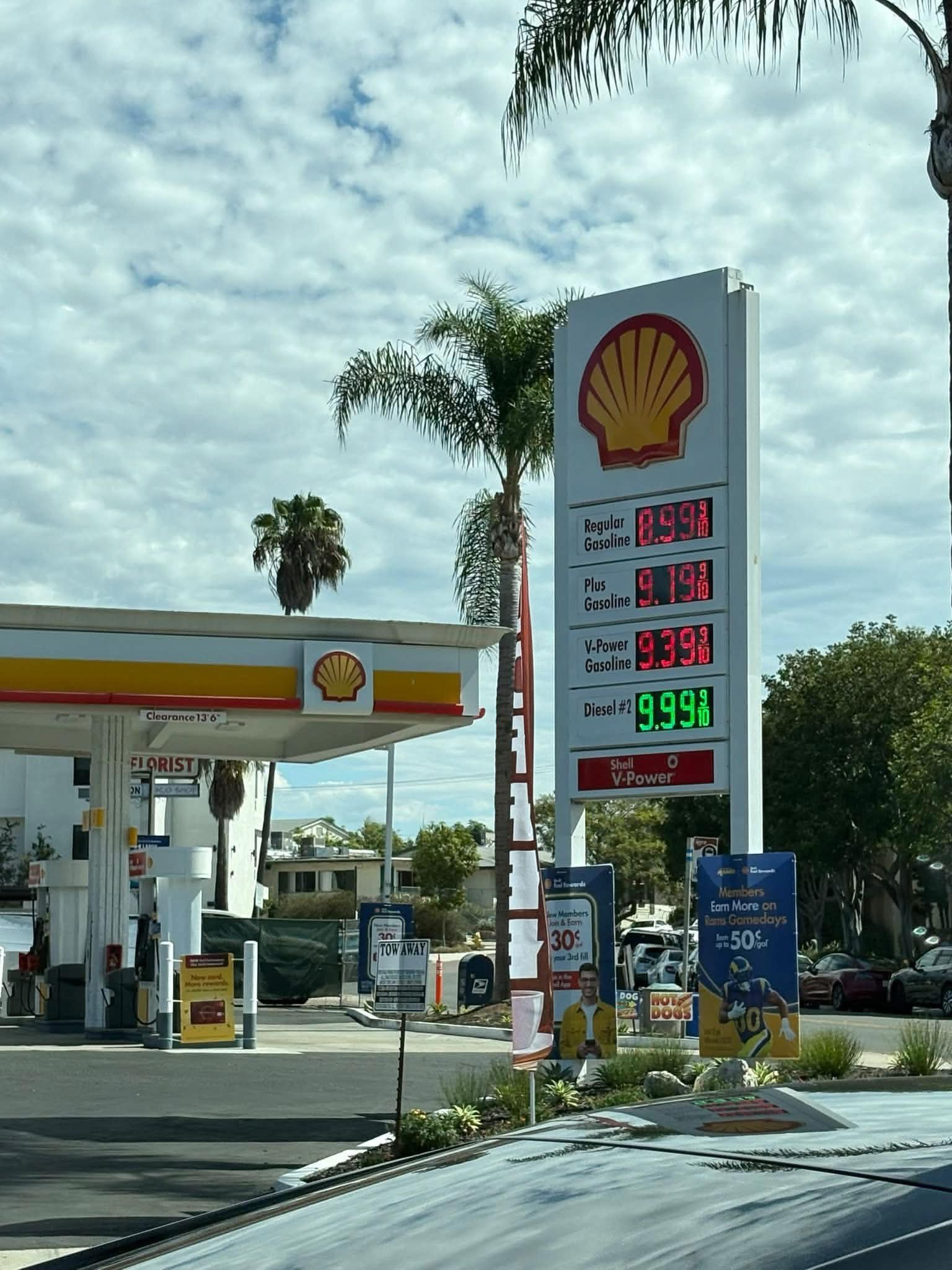
Washington let Russian diesel in, then froze the new Russia sanctions law with no end date. Diesel is up 4.5 cents in a week.
Filled up a diesel truck today? You paid about $6.32 a gallon, the AAA national average ($6.3224), up 4.5 cents from a week ago and $2.69 more than a year ago. A 30-gallon fill now runs about $189.67, against $109.10 last October (AAA; ENB calculation). Regular gas is $4.2988, down about 6 cents in a week (AAA).
The “no drop” is about the past week. Diesel is still 12.5 cents below a month ago, half a cent below yesterday and under its Sept. 22 record of $6.5276 (AAA).
Meanwhile, Washington made two big moves on Russia.
What changed
Oct. 9: Treasury’s General License 135 authorized deals tied to the “sale, delivery, offloading, or importation, including importation into the United States,” of Russian-origin diesel, until 12:01 a.m. EDT on April 7, 2027. President Trump wrote that Russia would “immediately supply over 300,000 Tons of Diesel Fuel” and that prices “will be COMING DOWN, IN RECORD NUMBERS, AND FAST!” (Truth Social). Assuming metric tons, at 7.46 barrels per ton, 300,000 tons is about 2.2 million barrels, or about 13.5 hours of U.S. distillate demand at EIA’s 4-week average of 3.974 million barrels a day. In short tons: about 2.0 million barrels, or 12.3 hours (ENB calculations).
Oct. 16, late evening: an executive order waived all duties in sections 112 and 113 of the new Russia sanctions law, along with most of its sanctions, with no end date. It came two days before the law’s deadline (CNBC) and keeps earlier executive-order sanctions on Russia in place.
Different explanations
Energy Secretary Chris Wright told ABC’s “This Week,” “This is a carrot to try to end a war. It’s not an economic lifeline for Russia” (ABC). Treasury Secretary Scott Bessent told “Meet the Press,” “No sanctions were lifted on Friday,” and later, “The only thing that has been lifted is the diesel embargo” (NBC transcript). Bessent and Secretary of State Marco Rubio describe a 60-day review (State Department), but neither the order nor section 115 of the law sets a 60-day limit (order).
Whether GL 135 squares with the 2022 law banning Russian oil imports is an open dispute. Sen. James Lankford (R-Okla.) said on “Meet the Press” that the 2022 law “still holds true” (NBC). Herbert Smith Freehills Kramer notes GL 135 “does not expressly address the 2022 statute” (HSF Kramer).
Pushback, including from Republicans
A bipartisan letter released by Sen. Richard Blumenthal’s office on Oct. 13 has 11 signatures (the release lists 12 senators) and asks that the deal be rescinded. On Oct. 15, 22 House members asked the administration to revoke the license. “Beyond irresponsible,” posted Sen. Thom Tillis (R-N.C.) (X). Sen. Darline Graham (R-S.C.) said she personally “would choose to keep the pressure on Russia to end the war and get the gas prices down,” but that it is “up to him” (NBC; AP via ABC). Blumenthal’s statement calling the waivers a “craven, cowardly action” appears only in NBC’s report (NBC). Trump called it “a very good decision” (NBC).
Why the pump has not moved
Ukrainian President Volodymyr Zelenskyy told “Meet the Press” the deal “doesn’t have influence, the real influence on the price in the United States. We understand that the price is because of blocking of Hormuz” (NBC transcript). Reuters reported that a main crude unit at Russia’s Ryazan refinery shut after an Oct. 15 drone strike (Kyiv Independent). Germany’s fuel-trade association does not expect a major effect on pump prices there, according to RFE/RL, the only source for that view. No source has put a cents-per-gallon benefit on either waiver.
The history fight, briefly
On Newsmax (Oct. 15), Trump said the war “really began with Barack Hussein Obama when they made them give up Crimea” (transcript). On Oct. 16, CBS’s Gabe Gutierrez asked, “Have you forgotten that it’s President Putin who started the war?” Trump replied, “I know the details, okay? And at some point, I’ll release the details” (transcript; Mediaite). Our grades: “Obama made them give up Crimea” is mostly false, because Russia annexed Crimea in 2014 (BBC). Dating the war to 2014 is accurate. The “NATO promised not to expand” claim is misleading: the 1990 assurances were real, documented, and broader than Germany, but were never put in a treaty (National Security Archive).
Consumer and investor angle
- Consumers: Ted Cruz (R-Texas) said on Fox News, “people are hurting. People are feeling real pain. But there are other ways to address gas and diesel prices” (NBC).
- Investors: in the Dallas Fed’s third-quarter energy survey, 48% of oil and gas executives said it will take more than four quarters for diesel’s spread over crude to get back to 2025 levels (Dallas Fed).
| Stu’s Take (opinion)
Two waivers, and diesel is up 4.5 cents in a week. The first deal’s 300,000 tons, if metric, is about 13.5 hours of what America burns (ENB calculation). The second has no end date. You also have to understand President Trump’s Comment, and that there will be more information coming out about how the Ukraine/Russia war started. Why did the U.S. have bio-weapons labs, and why was Ukraine one of the key human trafficking countries? Why did NATO expand after President Regan promised there would be no more countries added? There is more to the Ukraine story than the mainstream media will put out. Do your own research. There are only two ways to lower fuel prices: demand destruction or building more refineries. Russian barrels are neither. Energy security starts at home. — Stuart Turley |
Sources
- AAA national averages (checked 2:40 p.m. CT, Oct. 18)
- OFAC General License 135 (Oct. 9)
- White House executive order on the Graham Act (Oct. 16)
- NBC “Meet the Press” transcript (Oct. 18)
- NBC News on the waivers and reaction
- Herbert Smith Freehills Kramer on GL 135
- EIA Weekly Petroleum Status Report, Table 1
- Trump’s Newsmax interview transcript (Oct. 15)
- Trump’s Oct. 16 remarks, transcript
- Trump on Truth Social (Oct. 9)
- State Department: Rubio remarks (Oct. 17)
- ABC “This Week” transcript (Oct. 18)
- CNBC on the Graham Act waiver
- Blumenthal office letter (Oct. 13)
- Blumenthal office press release (Oct. 13)
- House letter led by Rep. Costa (Oct. 15)
- Tillis on X (Oct. 17)
- AP via ABC News
- Kyiv Independent, citing Reuters, on Ryazan
- RFE/RL on Congress and the diesel deal
- Mediaite on the Oct. 16 exchange
- BBC fact-check
- National Security Archive: what Gorbachev heard
- Dallas Fed Energy Survey, Q3 2026
- Energy Institute/BP conversion factors

