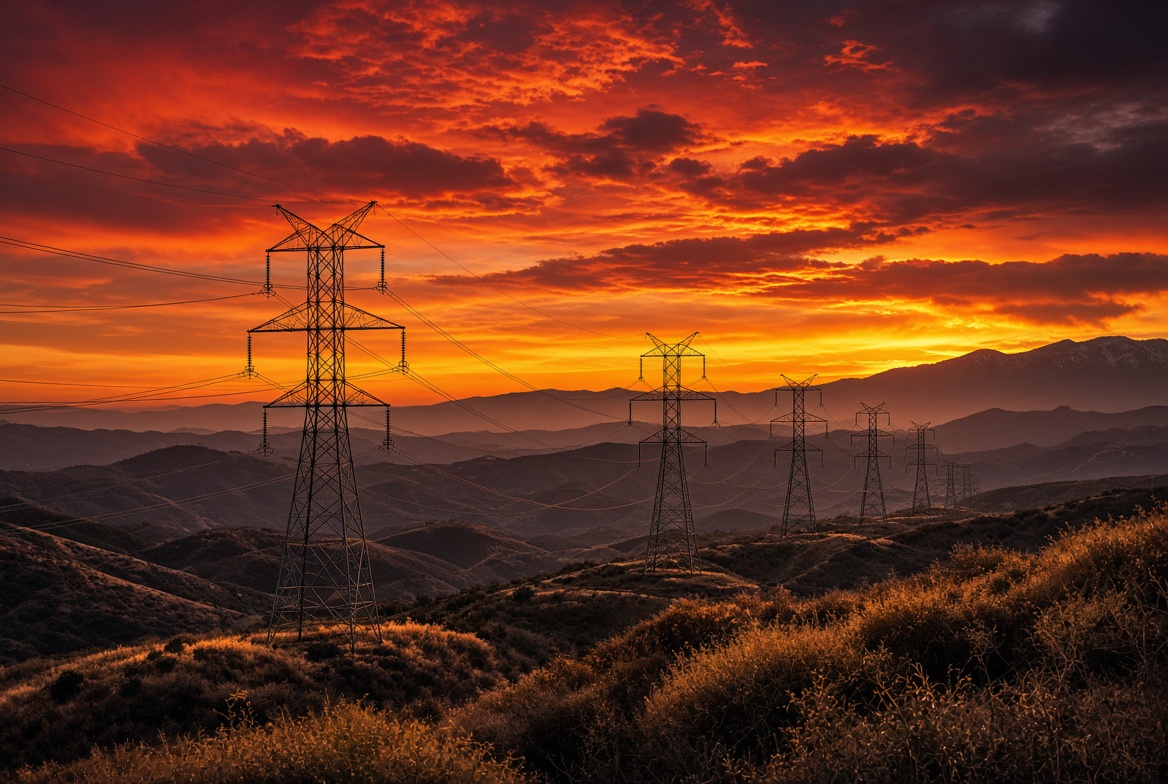
Pacific Gas and Electric is warning customers that it may implement Public Safety Power Shutoffs (PSPS) starting Friday afternoon, October 9, 2026, and extending through the weekend into Monday as dry, gusty winds raise wildfire risk across parts of Northern and Central California.
Local reporting citing PG&E notifications puts the potential scope at about 12,200 customers across 17 counties. The largest concentrations are in Shasta County (approximately 6,797 customers) and Tehama County (approximately 2,351). Other counties under watch include Alameda, Butte, Colusa, Fresno, Glenn, Kern, Kings, Lake, Merced, Napa, San Benito, San Joaquin, San Luis Obispo, Solano, and Yolo. Some counties have very small footprints—reports note as few as three customers in San Benito and five in San Joaquin. KCRA reported that the watch covers parts of 13 counties Friday and Saturday, expands to 17 on Sunday, and contracts to eight on Monday.
PG&E’s meteorology team is tracking westerly winds with gusts of 30–45 mph on Saturday (up to about 55 mph in the Northern Sierra) and northerly winds affecting the Sacramento Valley on Sunday, combined with low humidity and dry fuels. The elevated fire-weather window is expected to run from Friday afternoon through Monday. The company has stated that a PSPS “is one of many layers of wildfire protection which PG&E deploys as a measure of last resort” and that the decision “is not taken lightly.” Customers were notified by text, phone, and email on Thursday. As of Thursday afternoon, PG&E’s outage center showed the system largely intact (roughly 99.9% of customers with power), with the PSPS still listed as possible rather than executed. Actual de-energization depends on real-time observations and can be narrower than the initial watch.
How often PG&E imposes these shutoffs
PSPS events are weather-driven and concentrated in high fire-threat districts (CPUC Tier 2 and Tier 3 areas). Frequency and scale have fallen sharply since the large 2019 events that followed the Camp Fire and PG&E’s bankruptcy.
A PG&E briefing presented to the California Public Utilities Commission summarized year-over-year impacts as follows:
- 2019: 8 events, about 2,014,000 customers de-energized, average outage duration around 45 hours, restoration averaging 17 hours.
- 2020: 6 events, about 653,000 customers.
- 2021: 5 events, about 80,400 customers.
- 2022: 0 events.
- 2023: 2 events, about 5,099 customers.
- 2024: 6 events, about 50,476 customers.
- 2025: 4 events, about 17,972 customers de-energized; average duration about 32 hours and restoration averaging 5 hours. Notification before de-energization reached 99.6%.
A September 12–14, 2026 event de-energized 12,068 customers across 10 counties after mitigations avoided shutoffs for roughly another 14,000 in the initial scope. PG&E and local agencies have long noted that events can occur several times per year in high-risk terrain, though improved sectionalizing, undergrounding, and forecasting have reduced both the number of customers affected and restoration times relative to 2019. Outages can still last from under a day to multiple days depending on damage found during post-event patrols.
California’s electricity mix
California Energy Commission QFER data for 2025 in-state generation (total 205,132 GWh) show:
- Natural gas: 73,750 GWh (36.0%)
- Solar (PV + thermal): 55,528 GWh (27.1%)
- Large hydro: 24,125 GWh (11.8%)
- Nuclear: 17,575 GWh (8.6%)
- Wind: 15,172 GWh (7.4%)
- Geothermal: 10,908 GWh (5.3%)
- Small hydro: 3,417 GWh (1.7%)
- Biomass: 4,226 GWh (2.1%)
- Coal: 244 GWh (0.1%)
In-state solar, wind, geothermal, biomass, and small hydro together account for roughly 43–44% of in-state generation; adding large hydro and nuclear pushes zero-carbon sources well above half of in-state output. These figures exclude imports, which remain a material share of California consumption, and they exclude most behind-the-meter rooftop solar. Natural gas remains the largest single in-state source and the primary flexible resource for evening ramps.
Other states and weather-driven outages
Proactive, utility-initiated de-energization for wildfire risk is most developed in California (PG&E, Southern California Edison, and San Diego Gas & Electric). SDG&E, for example, initiated PSPS events in early October 2026 tied to heat, low humidity, and Santa Ana winds, later issuing all-clears as conditions eased. Similar tools exist at a smaller scale in parts of the West.
Nationwide, the larger volume of weather-related customer outages comes from reactive storm damage rather than planned shutoffs. Climate Central’s review of major outages (affecting at least 50,000 customers or 300 MW) from 2000–2023 found about 80% were weather-related. The states with the most such events were Texas (210), Michigan (157), California (145), North Carolina (111), and Ohio (88). Severe weather, winter storms, and tropical cyclones dominated; wildfire-related events (including PSPS) were a small share overall but concentrated in recent years and in the West.
EIA reliability data show the longest 2024 interruptions in states hit by hurricanes: South Carolina customers averaged nearly 53 hours without power after Helene, with North Carolina and Florida also heavily affected. Hurricane Beryl left millions without power in Texas. Multi-year rankings of outage hours often place Gulf and Southeast states (Louisiana, Mississippi) and some Northeast states (Maine) at the top because of tropical systems, ice, and thunderstorms. California’s distinctive feature is the deliberate, advance shutoff in fire weather; most other states experience unplanned outages when lines are already damaged.
Check out the World’s Greatest Podcast Show Notes at EnergyNewsBeat.co or EnergyNewsBeat.com. And subscribe to: The Energy News Beat Substack.
- FOX40, “Wind gusts, low humidity could prompt power shutoffs across 17 counties,” Oct. 8, 2026: https://fox40.com/news/local-news/public-safety-power-shutoffs-possible-wind-humidity/
- CBS Sacramento, “PG&E warns of possible power shutoffs across California starting Oct. 9,” Oct. 8, 2026: https://www.cbsnews.com/sacramento/news/pge-possible-power-shutoffs-starting-oct-9/
- KCRA, “MAP: PG&E plans power shutoffs across parts of California,” Oct. 8, 2026: https://www.kcra.com/article/pge-power-shutoffs-parts-of-california-oct-9-12/74085631
- Bloomberg, “PG&E Warns of Possible Weekend Power Cuts Amid Windy Weather,” Oct. 8, 2026: https://www.bloomberg.com/news/articles/2026-10-08/pg-e-warns-of-possible-weekend-power-shutoffs-amid-windy-weather
- PG&E Outage Center / PSPS status: https://pgealerts.alerts.pge.com/ and https://www.pge.com/en/outages-and-safety/safety/community-wildfire-safety-program/public-safety-power-shutoffs.html
- PG&E CPUC safety-culture briefing (PSPS year-over-year impacts, 2019–2025): https://www.cpuc.ca.gov/-/media/cpuc-website/divisions/safety-policy-division/meeting-documents/pge-2026-cpuc-safety-culture-briefing_082026_final.pdf
- CPUC-filed PG&E September 2026 PSPS post-event materials (12,068 customers de-energized): https://docs.cpuc.ca.gov/PublishedDocs/Efile/G000/M621/K038/621038724.PDF
- California Energy Commission, Electric Generation Capacity and Energy (2025 QFER in-state generation): https://www.energy.ca.gov/data-reports/energy-almanac/california-electricity-data/electric-generation-capacity-and-energy
- EIA, “Hurricanes in 2024 led to the most hours without power in the United States in 10 years”: https://www.eia.gov/todayinenergy/detail.php?id=66744
- Climate Central / PreventionWeb summary of weather-related major outages 2000–2023: https://www.preventionweb.net/news/weather-related-power-outages-rising
- SDG&E PSPS updates, early October 2026: https://www.sdgetoday.com/news/psps-conditions-have-passed-customers-no-longer-risk-public-safety-power-shutoffs
Figures on customer counts and county lists reflect utility notifications as reported on October 8, 2026, and remain subject to revision as forecasts and field conditions change.