


The Telegraph reports that NESO, the government-owned system operator — not listed National Grid — confirmed a £1 billion top-up to its working-capital facility after a windy, expensive autumn. Official figures put October balancing costs at £740 million and the unpaid remainder at £1.22 billion. That facility changes when households pay, not whether they pay.
If you pay an electricity bill in Great Britain, you are already paying for a grid that cannot always carry cheap wind to where the demand is. On a windy day, the system operator pays some turbines to switch off and pays other plants — often gas stations in the south — to fire up on the other side of a bottleneck. Those balancing costs are collected through a charge called BSUoS, and they land on final demand: the suppliers, and the customers behind them.
On Nov. 20, 2026, The Telegraph reported that NESO had confirmed a “time-limited extension of a working capital facility from £700 million to £1.7 billion.” The interest rate, tenor, and expiry remain unpublished.
This is not a grant, and it is not a bailout of National Grid plc. NESO is the government-owned system operator, wholly owned by the Secretary of State since Oct. 1, 2024. It is not allowed a commercial overdraft, so the government already provides a working-capital loan facility under the Energy Act 2023. The cost still comes back through regulated charges. A larger facility changes when ratepayers pay. It does not change whether they pay.
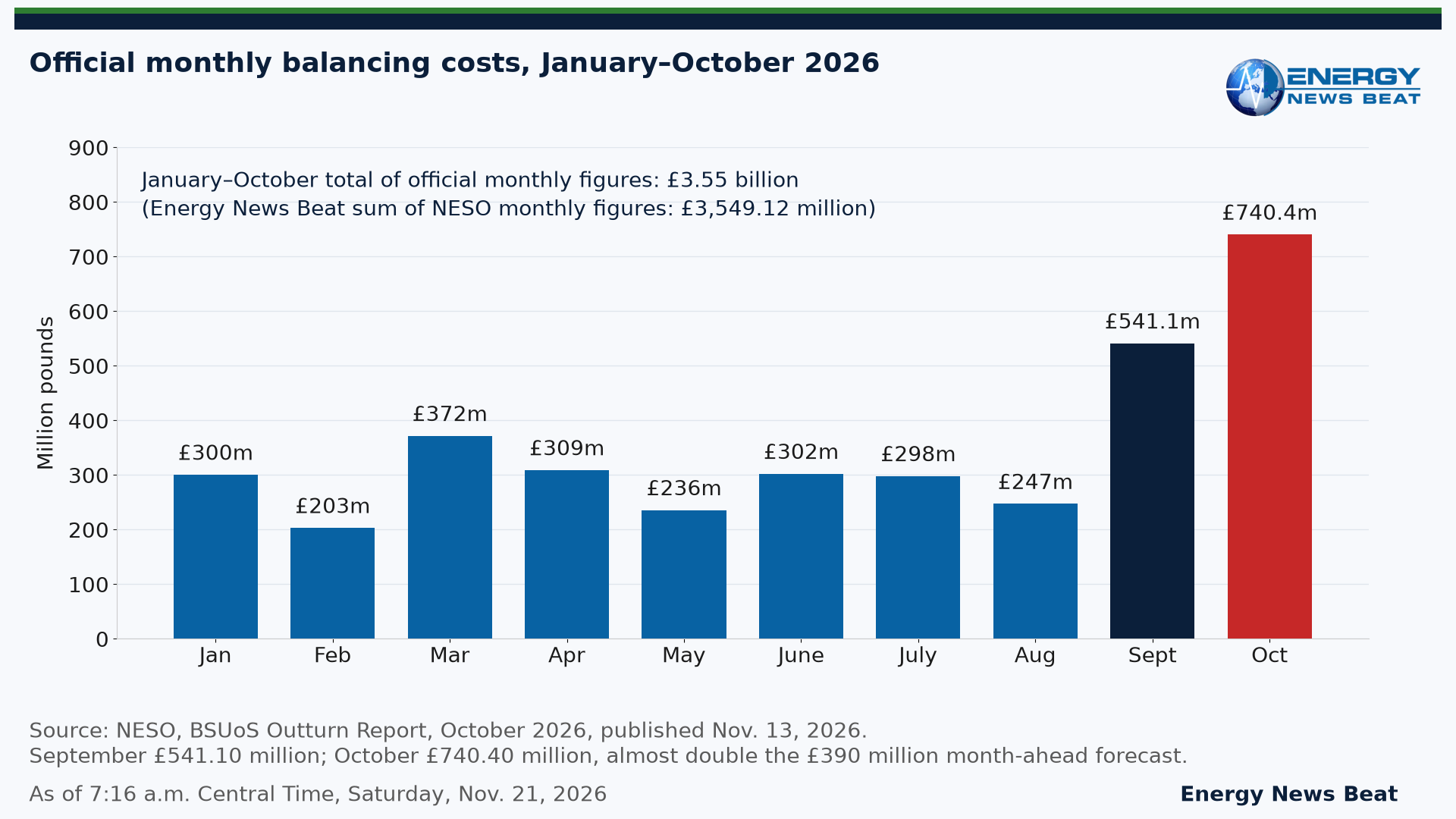
NESO’s official October balancing costs were £740.40 million, including about £511 million of constraint costs. From January through October 2026, those official monthly totals already add up to £3.55 billion. The Telegraph also described balancing costs of “£2bn this year,” up from “£1.5bn in 2025” — not NESO’s balancing total, though close to NESO’s constraint costs since April, about £2.1 billion. As of Nov. 19, NESO was £1.221 billion under-recovered. The plan is to recover the gap in 2027.
Not a bailout of National Grid
NESO is a public corporation, not the listed transmission company that builds and owns most of the England-and-Wales high-voltage wires. National Grid Electricity Transmission, SP Energy Networks, and SSEN Transmission capitalise those assets under Ofgem’s price controls. Mixing the two is how a working-capital story turns, wrongly, into a listed-utility rescue.
The Energy Act 2023 gives the Secretary of State a financial-assistance power. The July 2026 NESO framework document, approved with the Treasury, says NESO is otherwise “wholly funded by regulated network charges.” Because NESO cannot take a commercial overdraft, the government provides a working-capital facility; the detailed terms sit in a separate, unpublished agreement. Ofgem’s NESO Financial Handbook already says interest on that facility is recovered in charges. The rate on the extension is not published.
A NESO spokesman told The Telegraph: “We have agreed an extension to our working capital arrangements, allowing current balancing tariffs to remain unchanged and providing predictability for suppliers and their customers for the remainder of the charging year.” By late October, NESO had told industry that the under-recovery exceeded the facility then in place, and that it was not planning a mid-year reset of the current tariff. A reset tool exists — a proposed top-up, CMP475, still awaits Ofgem — but NESO has tried to avoid it, because a sudden jump can leave suppliers funding costs until the next quarterly price cap catches up. If The Telegraph’s reported extension is right, it is a larger cash-flow bridge, not a write-off.
A windy, expensive autumn — and a clash of figures
NESO’s October outturn, published Nov. 13, put balancing costs at £740.40 million — almost double the £390 million month-ahead forecast. September had already been expensive, at £541.10 million. NESO’s October split was about £511 million of constraints and about £229 million of other balancing costs. The operator pointed to high wind, low demand, network limits, and wholesale power at £145 a megawatt-hour.
Add NESO’s official monthly totals from January through October and calendar-year 2026 is already £3.55 billion. That figure is Energy News Beat arithmetic from NESO’s published table, not a NESO headline, and it is why The Telegraph’s “£2bn this year” should not be read as total balancing costs. No NESO series matches the “£1.5bn in 2025” figure.
The structural path is steeper if the wires stay late. Mike Thompson, NESO’s chief economist, wrote on Nov. 12 that thermal constraint costs were £2.0 billion in 2025/26 and are forecast at £3.9 billion in 2027. If Clean Power 2030 generation arrives and reinforcements are not accelerated, he put 2030 thermal constraints at £6.8 billion to £7.7 billion. The National Audit Office in September put 2025-26 constraint costs at £1.9 billion and said they could reach as much as £7.8 billion by 2030 without concerted action.
The unpaid remainder, and a 2027 true-up
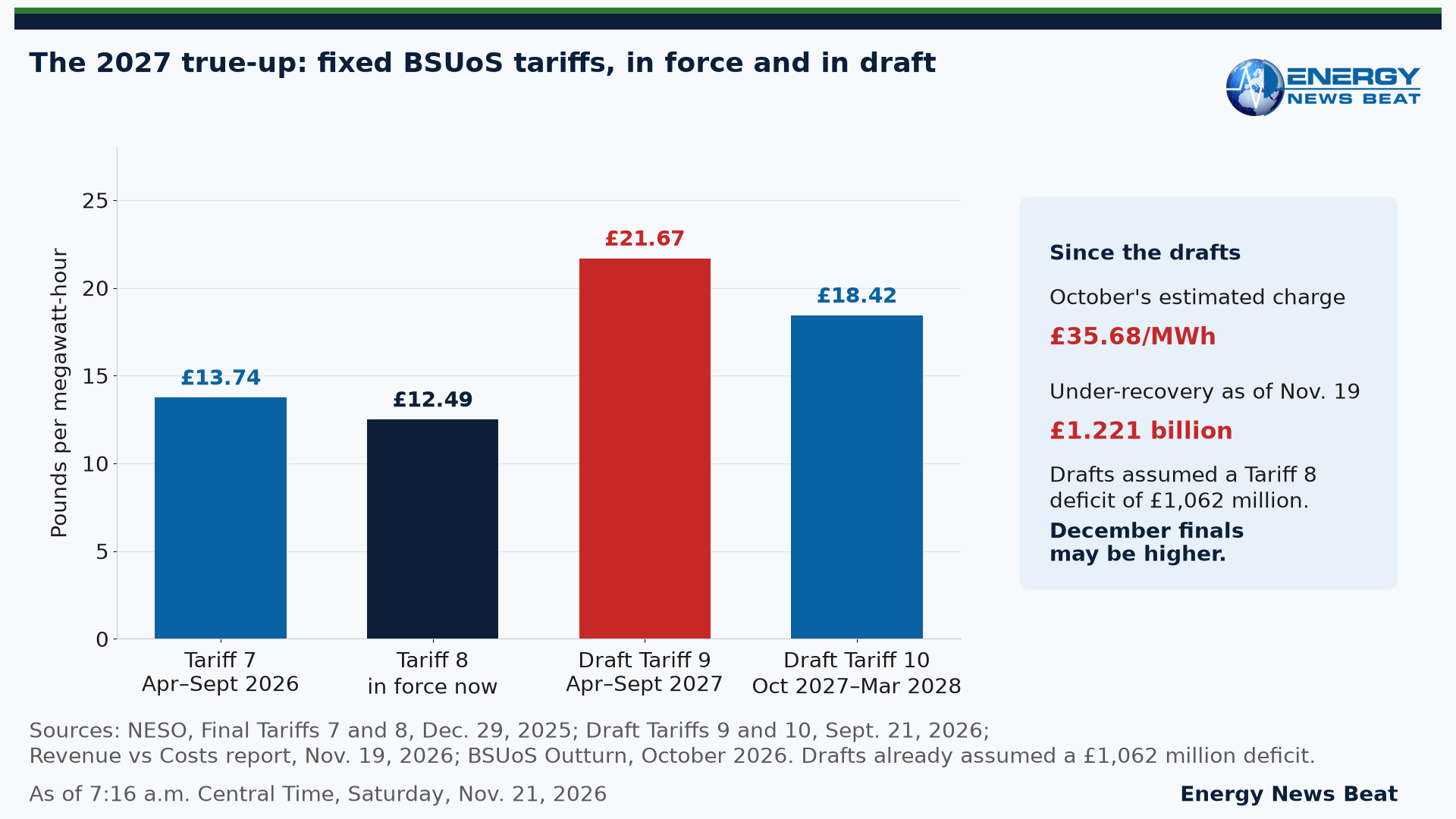
The current winter tariff, Tariff 8, runs from October 2026 through March 2027 and is set at £12.49 per megawatt-hour. October’s estimated BSUoS charge was £35.68 per megawatt-hour. That gap is what drained the facility.
NESO’s Revenue versus Costs report, dated Nov. 19, showed an under-recovery of £1,220.95 million — £1.221 billion, up from about £795 million five weeks earlier.
Draft Tariffs 9 and 10, published in September for April 2027 through March 2028, already jump to £21.67 and £18.42 per megawatt-hour — 58 percent and 48 percent above this year’s comparable rates — to recover a then-forecast Tariff 8 deficit of £1,062 million. The live deficit is already larger. Final tariffs are due in December and may be higher still. NESO’s stated plan is not to reopen Tariff 8, but to start collecting the remainder from April 1, 2027.
That is a delayed true-up. If the government facility has been enlarged, it is the cash that covers the gap until the tariff catches up. Bill payers, not taxpayers, remain on the hook. U.S. readers will recognise the physics: in ERCOT and other U.S. markets, cheap remote generation without enough transmission shows up as congestion costs and, later, transmission charges — still on ratepayers. Energy News Beat’s companion article on who pays for Texas’s 765-kV backbone asks the same question. A loan changes when the money is collected. It does not change who owes it.
What it means for a household bill
This winter’s official typical dual-fuel Direct Debit price cap is £1,723 a year through Dec. 31, 2026, set by Ofgem on Aug. 26. Networks make up 24 percent of that mix. Ofgem tied the October cap rise to higher wholesale gas prices, not this facility.
Households are already under pressure. In Ofgem’s February–March 2026 affordability survey, 40 percent of consumers were “keeping up but struggling” with their energy bills, and 4 percent were behind on energy payments.
The structural fix is more wires, and those have a bill cost too. In its December 2025 RIIO-3 final determinations, Ofgem pointed to £10.7 billion of upfront electricity-transmission funding inside a prospective pipeline of more than £70 billion, and said network charges are expected to rise around £108 by 2031 if all prospective transmission investment is needed, of which £30 is the extra investment “to upgrade ET grid capacity to meet new demands and reduce constraint costs.” The National Audit Office later reported a related Ofgem comparison — an estimated £60 increase by 2030, with a £30 overall saving against higher constraint costs if projects are not accelerated. Those wrappings should not be blended into one number. In 2026, bills are paying for the lag. In 2027 they will also pay back the deferred remainder.
Consumer and Investor Views
Consumer View. For a typical household on the default tariff, this story will not show up as a line item called “Treasury loan.” It will show up later, in the 2027 price cap and in fixed deals priced after December’s final tariffs. The current cap is already £1,723 a year through Dec. 31. Four in ten customers, by Ofgem’s last official pulse, were keeping up but struggling. The unpaid £1.221 billion is not disappearing. It is being parked until the tariff can catch it.
Investor View. This facility is not a loan to National Grid plc, and it does not, by itself, change that company’s credit story. NESO has no private credit rating and no private-sector borrowing. The linked investor question is the regulated transmission-build and the path of constraint costs — Ofgem’s RIIO-ET3 package, with a £10.7 billion baseline and more than £70 billion of prospective electricity-transmission spend. For suppliers, the near-term risk is a late jump in Final Tariffs 9 and 10, or a sudden Tariff 8 reset, that squeezes margins until the price cap is updated. Not investment advice.
Timeline
Key dates for the NESO working-capital facility, official balancing costs, and the 2027 tariff true-up. Times are Greenwich Mean Time where a clock time is given.
Oct. 1, 2024. The Department for Energy Security and Net Zero takes 100 percent of the former NGESO. NESO starts as a public corporation with a government working-capital facility.
Dec. 4, 2025. Ofgem’s RIIO-3 final determinations set a £10.7 billion electricity-transmission baseline, inside prospective investment of more than £70 billion.
Dec. 15 and 29, 2025. Final Tariffs 7 and 8 are set at £13.74 and £12.49 per megawatt-hour.
July 14, 2026. An updated NESO–DESNZ framework document is published. Facility terms remain in a separate, unpublished agreement.
July 20, 2026. Ofgem defers its decision on CMP475, a proposed mid-year tariff reset with a top-up toward a neutral working-capital position. The decision is still pending.
Aug. 26, 2026. Ofgem sets the October–December 2026 typical Direct Debit price cap at £1,723; networks are 24 percent of the mix.
Sept. 10 and 21, 2026. Draft Tariffs 9 and 10 are set at £21.67 and £18.42 per megawatt-hour, already recovering a forecast £1,062 million Tariff 8 deficit.
Sept. 11, 2026. The National Audit Office puts 2025-26 constraint costs at £1.9 billion, and says they could reach as much as £7.8 billion by 2030 if upgrades lag.
Oct. 28 and Nov. 4, 2026. NESO tells industry, in Operational Transparency Forum answers, that the under-recovery exceeds the facility then in place, and that no Tariff 8 reset is planned.
Nov. 12, 2026. NESO puts 2025/26 thermal constraints at £2.0 billion, the 2027 forecast at £3.9 billion, and the 2030 un-accelerated range at £6.8 billion to £7.7 billion.
Nov. 13, 2026. The October outturn puts balancing costs at £740.40 million.
Nov. 19, 2026. The Revenue versus Costs report shows an under-recovery of £1,220.95 million. The Telegraph says NESO confirmed a facility extension this day. Ofgem opens a Phase 1 connections-delay inquiry.
Nov. 20, 2026, 8:00 a.m. GMT. The Telegraph article is published.
Nov. 25, 2026. Ofgem is due to announce the January–March 2027 price cap.
December 2026. Final BSUoS Tariffs 9 and 10 are due.
March 31, 2027. Tariff 8 ends. NESO’s present plan is to start recovering the deficit from April 1, 2027.
Caveats and Criticism
The central reporting hole is that the £700 million to £1.7 billion figures have not been published in a public official document, though NESO confirmed the extension to The Telegraph. The terms sit in an unpublished agreement. No Treasury, DESNZ, or National Wealth Fund press notice was found as of the morning of Nov. 21, 2026, and no confirming FT, Reuters, BBC, or City AM story was found either.
Figures here come from The Telegraph’s reporting and from official NESO, Ofgem, and National Audit Office documents. The standfirst’s “obsession with net zero” line comes from Reform UK energy spokesman Richard Tice, quoted by The Telegraph. Draft Tariffs 9 and 10 will be replaced by finals in December, and Ofgem’s next price-cap decision is due Nov. 25. The 2030 constraint figures are official scenarios, not a promise of a single future total.
Stu’s Take
Britain did not just discover that unpaid wind and missing wires cost money. October’s official balancing bill was £740 million. Through October, the official monthly totals already add up to £3.55 billion. The system operator — the government-owned one, not listed National Grid — was £1.221 billion under-recovered by mid-November. If The Telegraph is right, the Treasury widened the overdraft. That is a timing instrument, not a gift.
The question is the same one we asked about Texas’s 765-kV backbone: who pays, and when. Draft 2027 tariffs already jump 58 percent and 48 percent, and the live deficit is larger than the figure those drafts assumed. Households on a £1,723 cap, with four in ten already keeping up but struggling, will not see a Treasury line on the bill. They will see the true-up. A loan changes when ratepayers pay. It does not change whether they pay.
Sources
Primary and contemporaneous sources, with access dates. The Telegraph article is paywalled; its facility-size figures are attributed. Accessed Nov. 21, 2026.
- Jonathan Leake, “Grid operator handed £1bn Treasury loan to meet soaring wasted wind costs,” The Telegraph, published Nov. 20, 2026, 8:00 a.m. GMT. Paywalled. Accessed Nov. 21, 2026. https://www.telegraph.co.uk/business/2026/11/20/grid-operator-handed-1bn-treasury-loan/
- The Telegraph, author page for Jonathan Leake, Energy Editor, confirming the Nov. 20, 2026, article. Accessed Nov. 21, 2026. https://www.telegraph.co.uk/authors/j/jk-jo/jonathan-leake/
- National Energy System Operator, regulatory finance page, explaining that NESO cannot take a commercial overdraft and that the government provides a working-capital facility. Accessed Nov. 21, 2026. https://www.neso.energy/about/operational-information/regulatory-finance
- Department for Energy Security and Net Zero, National Energy System Operator (NESO) Framework Document, updated July 14, 2026, approved by HM Treasury, including paragraphs 20.2 and 21.1–21.2. Accessed Nov. 21, 2026. https://www.gov.uk/government/publications/national-energy-system-operator-framework-document/national-energy-system-operator-neso-framework-document
- NESO Framework Document, PDF, July 2026. Accessed Nov. 21, 2026. https://assets.publishing.service.gov.uk/media/6a5136ca9e9c95844ae64d18/neso-framework-document-july-2026.pdf
- NESO, BSUoS Outturn Report, October 2026, published Nov. 13, 2026: balancing costs £740.40 million; total BSUoS £808.15 million; estimated charge £35.68/MWh; constraints about £511 million; other about £229 million; month-ahead forecast £390 million; wholesale power £145/MWh; and the official January–October monthly series. Accessed Nov. 21, 2026. https://www.neso.energy/document/390226/download
- NESO, Fixed Tariff Revenue vs Costs report, dated Nov. 19, 2026: under-recovery £1,220.95 million; revenue £12,431.87 million; costs £13,652.81 million. Accessed Nov. 21, 2026. https://www.neso.energy/document/280681/download
- NESO, Balancing Services Use of System (BSUoS) charges page. Accessed Nov. 21, 2026. https://www.neso.energy/industry-information/charging/balancing-services-use-system-bsuos-charges
- NESO, BSUoS Forecast Report — December 2026, published Nov. 13, 2026, data as at Nov. 12: under-recovery £1,181.94 million. Accessed Nov. 21, 2026. https://www.neso.energy/document/390221/download
- NESO, BSUoS Forecast Report — November 2026 (document 388856): mid-October extract of under-recovery £794.96 million, about £795 million. Accessed Nov. 21, 2026. https://www.neso.energy/document/388856/download
- NESO, Final BSUoS Tariffs 7 and 8, Dec. 29, 2025: Tariff 7 £13.74/MWh (April–September 2026); Tariff 8 £12.49/MWh (October 2026–March 2027). Accessed Nov. 21, 2026. https://www.neso.energy/document/375086/download
- NESO, Draft BSUoS Tariffs 9 and 10, Sept. 21, 2026 (drafts dated Sept. 10): Tariff 9 £21.67/MWh; Tariff 10 £18.42/MWh; then-forecast Tariff 8 deficit £1,062 million. Accessed Nov. 21, 2026. https://www.neso.energy/document/387326/download
- Mike Thompson, NESO chief economist, “A Balancing Act — Part 3: Projections,” Nov. 12, 2026: 2025/26 thermal constraints £2.0 billion; 2027 forecast £3.9 billion; 2030 un-accelerated range £6.8–7.7 billion; earlier Clean Power advice £6.6–7.8 billion; 16 percent of the 2027 forecast attributed to reinforcement outages. Accessed Nov. 21, 2026. https://www.neso.energy/news/balancing-act-part-3-projections
- National Audit Office, “Delays to electricity grid upgrades risk higher bills,” Sept. 11, 2026: constraint costs £1.9 billion in 2025-26; up to £7.8 billion by 2030 without concerted action; £70 billion electricity-transmission upgrade; network-charge comparison of £60 by 2030 and a £30 overall saving. Accessed Nov. 21, 2026. https://www.nao.org.uk/press-releases/delays-to-electricity-grid-upgrades-risk-higher-bills/
- Ofgem, NESO Financial Handbook, October 2024, on recovery of working-capital-facility interest through charges (LEGWCF / ESOIt). The rate on the extension is not published. Accessed Nov. 21, 2026. https://www.ofgem.gov.uk/sites/default/files/2024-10/NESO_Financial_Handbook.pdf
- NESO, Operational Transparency Forum Q&A, published Nov. 19, 2026, including Oct. 28 and Nov. 4 answers that the under-recovery exceeded the facility then in place and that no Tariff 8 reset was planned. Accessed Nov. 21, 2026. https://www.neso.energy/document/386596/download
- NESO, CMP475 Draft Final Modification Report, July 10, 2026: a proposed mid-year fixed-tariff reset and facility top-up. The “Implementation 31 July 2026” date in that report is the proposed timetable. Accessed Nov. 21, 2026. https://www.neso.energy/document/384181/download
- Ofgem, Authority update on CMP474 and CMP475, July 20, 2026: “We have decided to delay our original timetable for making decisions on CMP474 and CMP475.” Accessed Nov. 21, 2026. https://www.ofgem.gov.uk/sites/default/files/2026-07/Authority-update-on-CMP474-and-CMP475.pdf
- NESO, CMP475 modification page: “Modification status: Concluded – Pending Decision.” Accessed Nov. 21, 2026. https://www.neso.energy/industry-information/codes/cusc/modifications/cmp-475-amendment-bsuos-tariff-reset-process
- NESO Data Portal, Constraint Breakdown Costs and Volume, 2026-2027 resource, updated Nov. 18, 2026. Energy News Beat sum for April 1–October 31, 2026: all constraint categories £2,099.66 million, about £2.1 billion; thermal constraints £1,893.10 million. This series is not the same as the October outturn constraint split (£511 million). Accessed Nov. 21, 2026. https://www.neso.energy/data-portal/constraint-breakdown
- Ofgem, “Energy price cap will rise 4% in October 2026,” Aug. 26, 2026, cap period 17a, Oct. 1–Dec. 31, 2026: typical dual-fuel Direct Debit household £1,723 a year; networks 24 percent of the cost mix. Accessed Nov. 21, 2026. https://www.ofgem.gov.uk/press-release/energy-price-cap-will-rise-4-october-2026
- Ofgem, Summary of changes to the energy price cap, 1 October to 31 December 2026. Accessed Nov. 21, 2026. https://www.ofgem.gov.uk/sites/default/files/2026-08/Summary-of-changes-to-energy-price-cap-1-October-to-31-December-2026.pdf
- Ofgem, RIIO-3 Final Determinations, electricity transmission, gas distribution, and gas transmission, Dec. 4, 2025: £10.7 billion upfront electricity-transmission funding; prospective investment of more than £70 billion; network charges expected to rise around £108 by 2031, of which £30 is additional ET investment to meet new demands and reduce constraint costs. Accessed Nov. 21, 2026. https://www.ofgem.gov.uk/decision/riio-3-final-determinations-electricity-transmission-gas-distribution-and-gas-transmission-sectors
- Ofgem, RIIO-3 Final Determinations overview PDF, December 2025. Accessed Nov. 21, 2026. https://www.ofgem.gov.uk/sites/default/files/2025-12/RIIO-3-Final-Determinations-overview.pdf
- Ofgem, Consumer Impacts of Market Conditions Survey, Wave 7, fieldwork Feb. 18–March 16, 2026, published Oct. 14, 2026 (updated Oct. 23, 2026): 40 percent “keeping up but struggling” with energy bills; 4 percent behind on energy payments. Accessed Nov. 21, 2026. https://www.ofgem.gov.uk/research/consumer-impacts-market-conditions-survey-february-march-2026
- Ofgem, “Grid connections delays inquiry: Phase 1 projects,” Nov. 19, 2026. Accessed Nov. 21, 2026. https://www.ofgem.gov.uk/news/grid-connections-delays-inquiry-phase-1-projects-drive-delivery-and-accountability
Key Excerpts
The Telegraph, Nov. 20, 2026, attributed to NESO. “Neso confirmed its request for extra cash on Thursday, saying it had struck a ‘time-limited extension of a working capital facility from £700m to £1.7bn’.”
NESO spokesman, quoted by The Telegraph, Nov. 20, 2026. “We have agreed an extension to our working capital arrangements, allowing current balancing tariffs to remain unchanged and providing predictability for suppliers and their customers for the remainder of the charging year.”
Richard Tice, Reform UK energy spokesman, quoted by The Telegraph, Nov. 20, 2026. “This is entirely due to Labour’s obsession with net zero that is making everyone poorer and killing jobs.”
NESO–DESNZ framework document, July 2026, as cited on GOV.UK. NESO is otherwise “wholly funded by regulated network charges.”
Mike Thompson, NESO chief economist, Nov. 12, 2026. “Work to reduce constraints tomorrow can temporarily increase them today.” Thermal constraint costs were £2.0 billion in 2025/26 and are forecast at £3.9 billion in 2027; the un-accelerated 2030 range is £6.8 billion to £7.7 billion.
National Audit Office, Sept. 11, 2026. Constraint costs “totalled £1.9 billion in 2025-26, and could increase up to £7.8 billion by 2030 without concerted action.” The “£70 billion upgrade to the electricity transmission grid” is “critical to avoid large rises in consumers’ bills.”
Ofgem, RIIO-3 Final Determinations, Dec. 4, 2025. For a dual-fuel domestic consumer with average use, network charges are expected to rise around £108 by 2031, of which £30 is “the substantial additional investment needed to upgrade ET grid capacity to meet new demands and reduce constraint costs.”
Ofgem, Consumer Impacts of Market Conditions, Wave 7, fieldwork February–March 2026. 40 percent of consumers were “keeping up but struggling with their energy bills,” and 4 percent were behind on energy payments.
NESO Operational Transparency Forum Q&A, industry question #3552, dated Sept. 23, 2026. Industry participants asked whether NESO could fund a deficit above the working-capital facility and whether Tariff 8 would be reopened, and warned that “allowing BSUoS under-recovery to build up means future users have to subsidise past ones” and that “electrification for decarbonisation is directly penalised.” These are forum questions, not named consumer-advocate quotations.