

Democrats won both chambers, but the White House still holds the veto pen. We ran the override math, checked how past split governments got deals done, and lined up the energy fights that matter for prices: tax credits, permitting and LNG.
By Energy News Beat | Nov. 4, 2026 | Results as of mid-morning Central
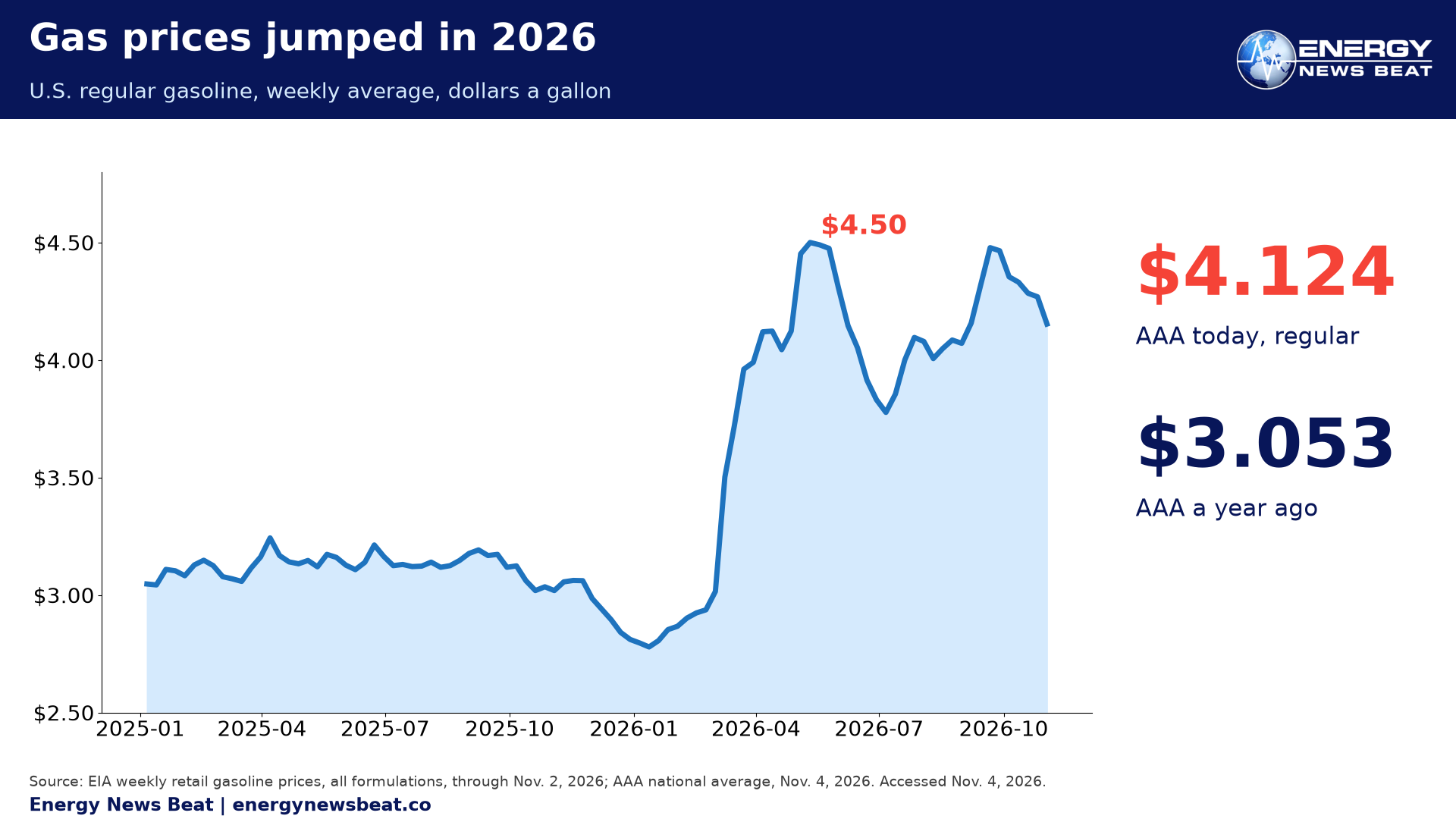
If you filled up this morning, you paid an average of $4.124 for a gallon of regular, according to AAA. A year ago it was $3.053. Diesel is $6.275, up from $3.694. Voters noticed, and on Tuesday they handed Democrats both chambers of Congress. So the question at the kitchen table is a fair one: does a Democratic Congress make that number go down, go up, or do nothing at all? Here is what we can verify this morning, and what we cannot.
What was actually called
The Associated Press projects Democrats will control both the House and the Senate. Ballotpedia and Politico report Democrats flipped seven Senate seats, in Kansas, Iowa, Texas, Ohio, Maine, North Carolina and South Carolina, while holding Georgia and Michigan; The Guardian shows them gaining more than two dozen House districts.
The counts are still moving. As of about 9 a.m. Eastern, The Guardian had the Senate at 54 Democrats, counting two independents, to 44 Republicans, with 33 of 35 races called. Ballotpedia, as of 1:30 a.m. Eastern, had the same Senate split and a House majority of at least 231 to 141; the Guardian later had the House at 228 to 139 with 367 seats called. Many House seats remain uncalled, so the final House margin is not known.
Two Senate races are open. In Mississippi, Democrat Scott Colom led Sen. Cindy Hyde-Smith by 43 votes, 462,821 to 462,778, with about 44,000 ballots left, per WDAM. In Alaska, AFP had Democrat Mary Peltola ahead of Sen. Dan Sullivan 48.2 to 47.9 percent with 74 percent counted, but the lead has changed hands overnight in other outlets’ counts. Alaska uses ranked-choice voting, and a result may take weeks.
The veto math
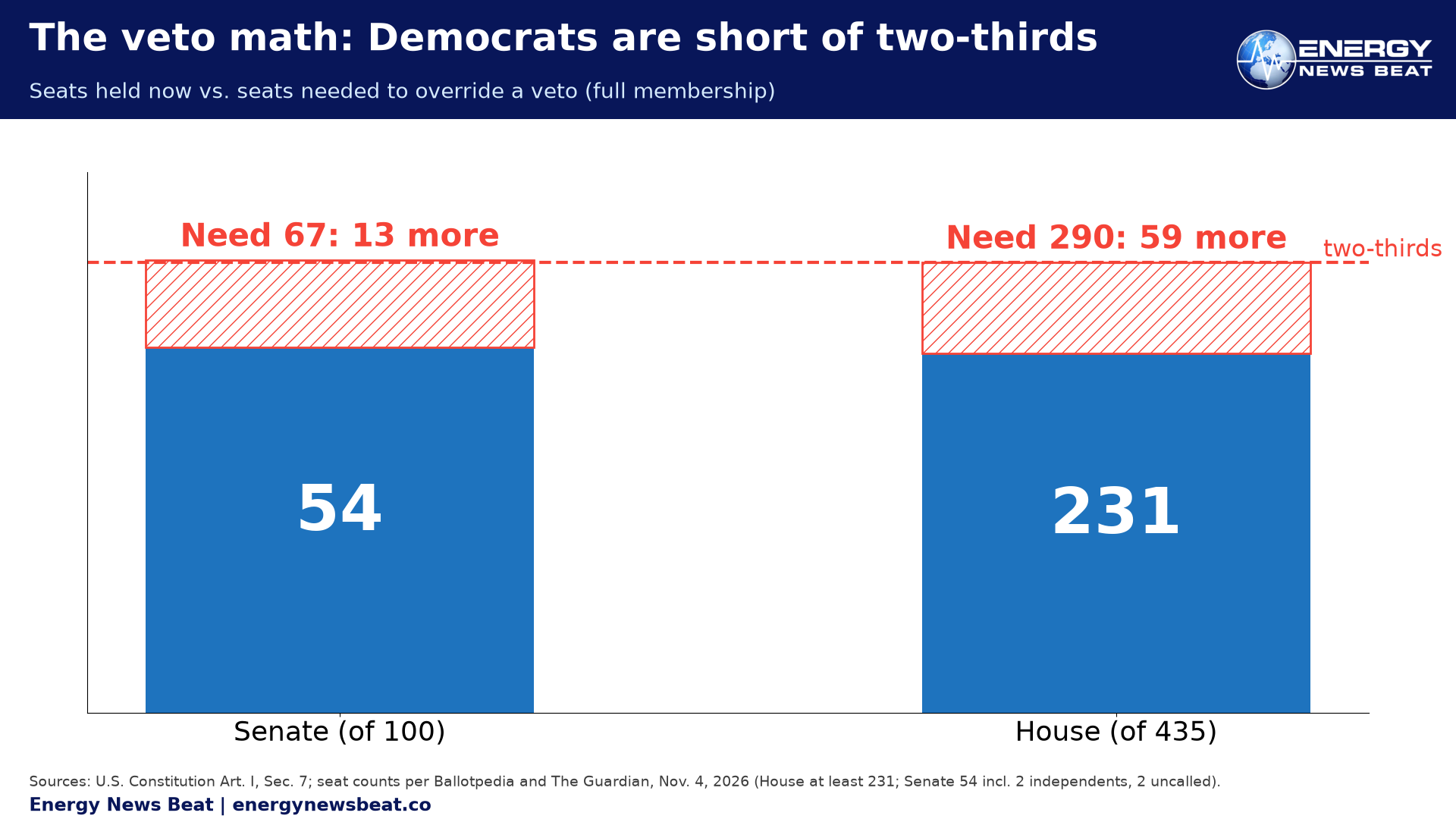
Here is the number that matters most. Under Article I, Section 7 of the Constitution, Congress overrides a veto only with two-thirds of those present and voting in each chamber. With every seat filled and every member voting, that is 67 senators and 290 House members.
Democrats have 54 Senate seats now and 56 at most. They would need at least 11 Republicans, and 13 at the current count, to override. In the House, with at least 231 seats, they would need about 59 Republicans. President Trump knows it. He told CBS News “I think they’re gonna want to work with me. Otherwise I’d just veto everything and they’re not gonna want that.
History backs him up on the odds. Per the Senate’s veto table, Trump issued 10 regular vetoes in his first term and Congress overrode one. In this term he has vetoed two bills, and neither was overridden. President Obama was overridden once in 12 vetoes and President Biden never in 13.
Gridlock or deals? What 2011 and 2019 tell us
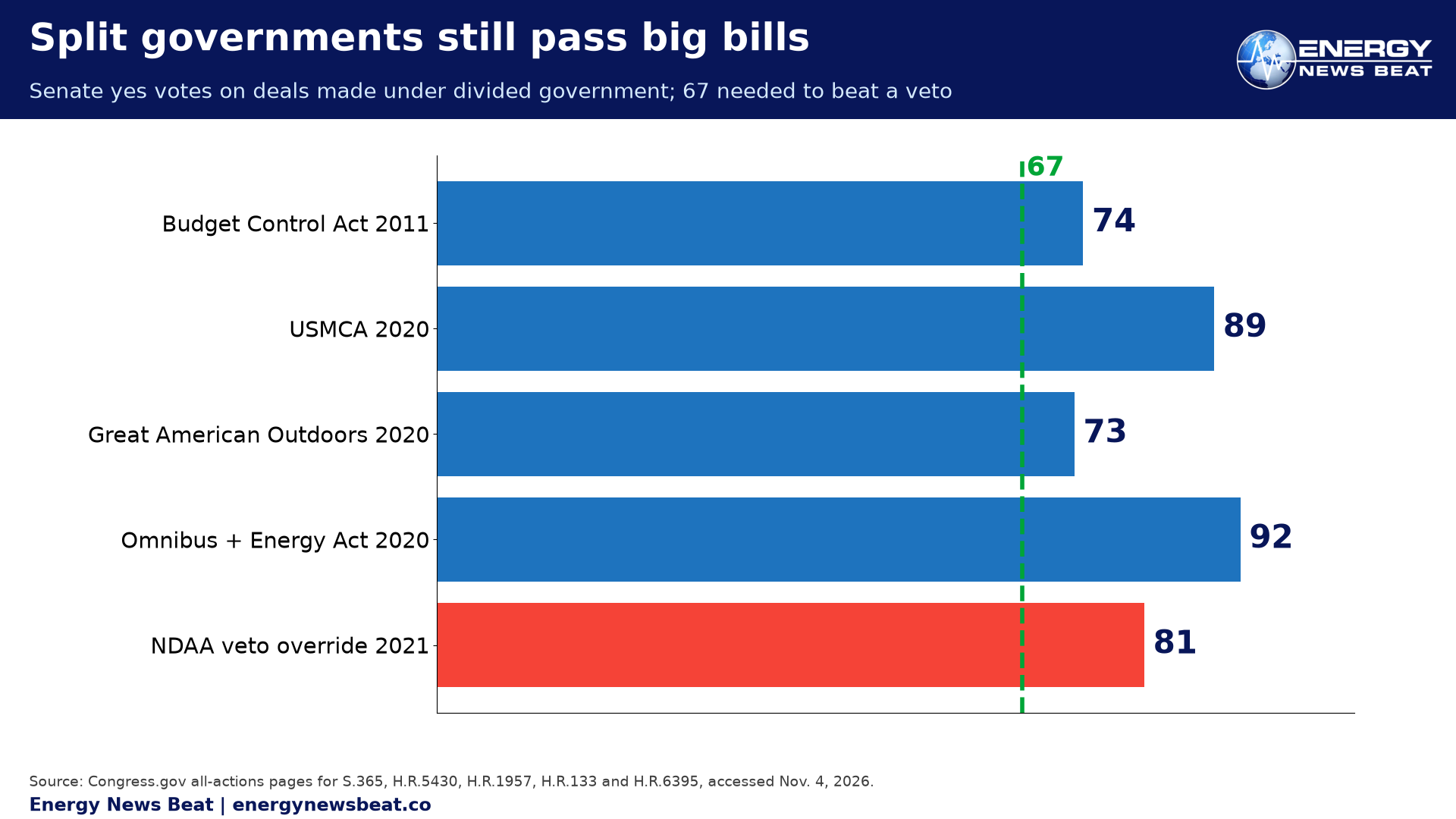
Divided government has not meant zero laws. In 2011, with a Republican House, a Democratic Senate and President Obama, the debt-ceiling standoff ended in the Budget Control Act, which passed the House 269 to 161 and the Senate 74 to 26 and was signed Aug. 2, 2011.
The closest match to today is 2019 and 2020: a Democratic House, a Republican Senate and President Trump. On Dec. 18, 2019, the House impeached him. The next day, the same House passed the USMCA trade deal 385 to 41, and it became law in January 2020. That August, Trump signed the Great American Outdoors Act, which cleared the Senate 73 to 25 and the House 310 to 107.
The biggest energy law of that era rode on a spending bill. The December 2020 omnibus, which passed the Senate 92 to 6, carried the Energy Act of 2020 as Division Z, plus an HFC phasedown and carbon-capture provisions, and tax extenders including the wind production credit through 2021 and the 45Q carbon-capture credit through 2025. Days later, Congress overrode Trump’s veto of the defense bill, 322 to 87 in the House (roll call 253) and 81 to 13 in the Senate. That is what it takes: a must-pass bill with big Republican support.
The lesson for energy is that deals happen when they ride on must-pass bills and draw large bipartisan margins. Stand-alone partisan bills mostly die at the veto.
The IRA credits: what is already gone
The 2025 One Big Beautiful Bill Act, Public Law 119-21, rewrote the Inflation Reduction Act. Per the IRS, the new and used EV credits ended for vehicles bought after Sept. 30, 2025. The home efficiency and rooftop solar credits ended for work after Dec. 31, 2025. For wind and solar farms, IRS Notice 2025-42 says the main credits end for projects placed in service after Dec. 31, 2027, unless construction began by July 4, 2026.
That July 2026 date has passed, so the wind and solar cliff is already set unless Congress changes the law and Trump signs it. Senate Democratic Leader Chuck Schumer has vowed to restore clean energy credits, Axios reports, but Axios also calls some IRA restoration ideas “largely symbolic” for now. One analyst told DW, “It’s not going to be anything at the scale of the IRA.” The likelier openings are narrower: home efficiency, the manufacturing credit that largely survived, and advanced nuclear.
Permitting: the deal that could move first
The one energy bill with real momentum is permitting reform. The House passed the SPEED Act 221 to 196 in December 2025; it sits in a Senate committee. In the Senate, a bipartisan package negotiated with the White House, the American Affordability and Jobs Act, could see votes as early as Nov. 9, ENR reports. It would shorten environmental reviews and the window for lawsuits, and require data-center developers to pay the power costs of running their facilities. The two bills would still have to be reconciled.
That makes the lame-duck session, before new members are sworn in, the window to watch. Axios reports that some House progressives think they can get a better deal next year, while backers see almost no chance of a more liberal bill Trump would sign. Unions, the American Petroleum Institute and contractor groups back the bill; some environmental groups and Rep. Rashida Tlaib, who called it a “gift to big oil and big tech,” oppose it.
LNG export approvals
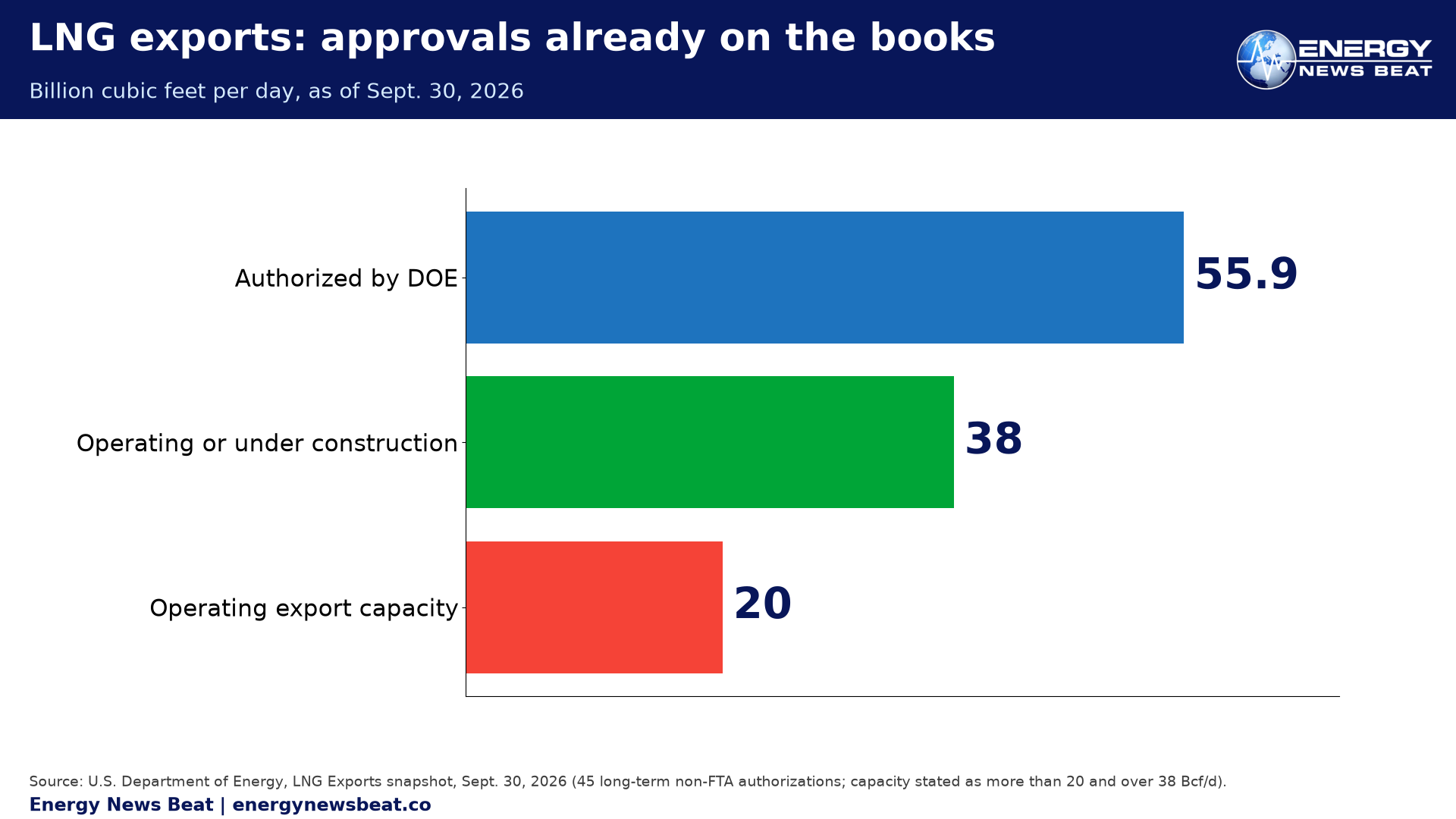
LNG export approvals sit with the Department of Energy under the Natural Gas Act, not with Congress. As of Sept. 30, DOE had issued 45 long-term authorizations to export to any allowed country, totaling 55.9 billion cubic feet a day. U.S. export capacity is more than 20 Bcf a day, and over 38 Bcf a day is operating or under construction. A Democratic Congress can hold hearings and use spending bills, but it cannot reverse those approvals without a law Trump would sign or Congress could pass over his veto.
What it means for your prices
Gasoline follows crude oil, refining and taxes far more than any bill Congress passes. EIA weekly data show regular averaged about $2.94 in late February 2026, then jumped to $3.96 by late March and peaked at $4.50 the week of May 11. Grist and Axios both tie voter anger to those prices, and Grist also points to the war with Iran. As of Nov. 4, the AAA
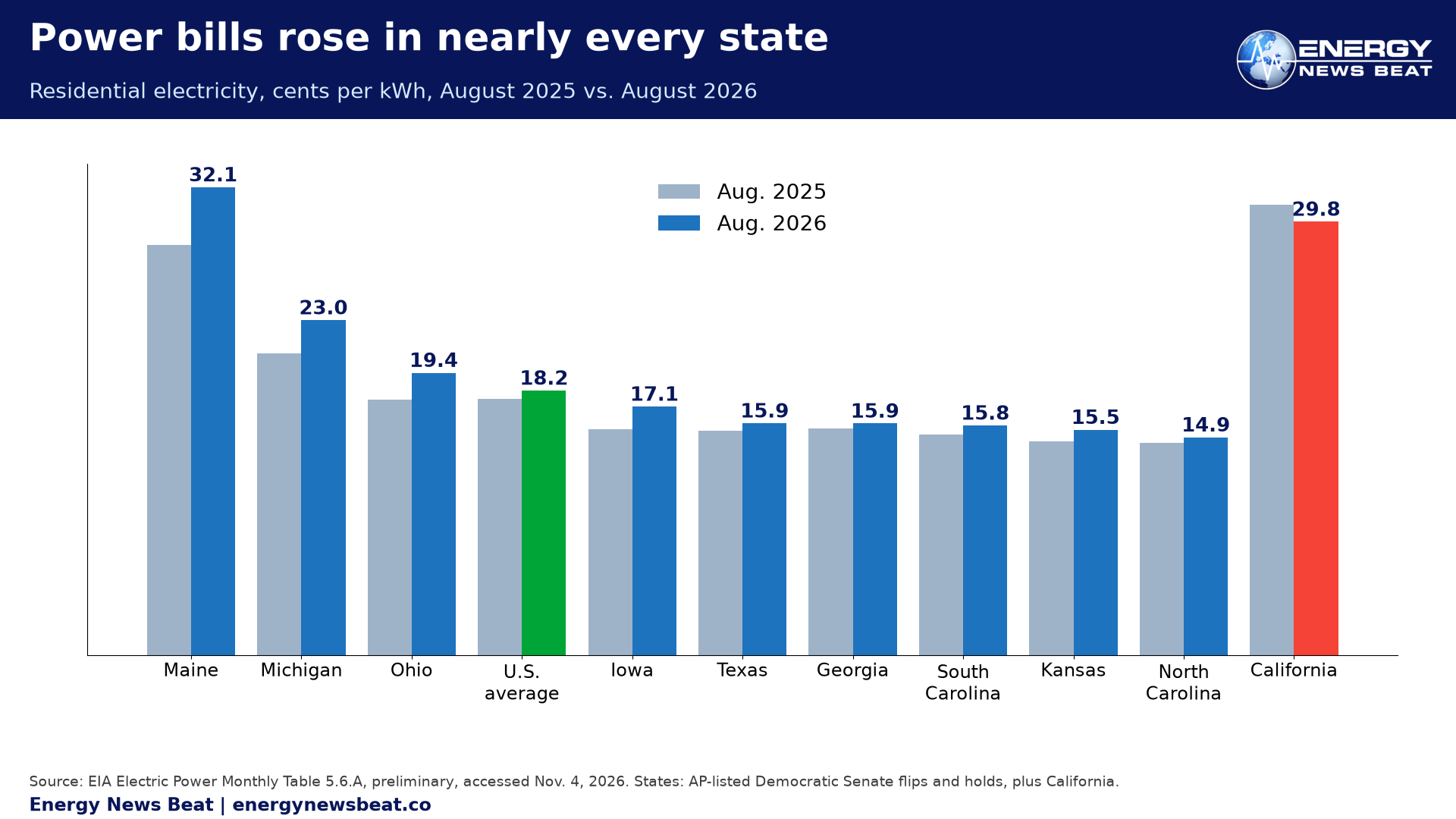
Power bills are rising almost everywhere. In August, U.S. residential electricity averaged 18.16 cents a kilowatt-hour, up from 17.57 a year earlier, per EIA. In the states where Democrats flipped Senate seats, Maine rose from 28.14 to 32.11 cents, Ohio from 17.55 to 19.38 and Iowa from 15.48 to 17.06. California, at 29.75 cents, was still among the highest in the nation, but it was down from 30.92.
How consumers and investors are reading it
For households, the near-term watch list is data-center cost rules, any affordability package from the House, and whether a spending deal restores bill-help or efficiency money. Axios reports Democrats plan an affordability agenda with energy as a key pillar, but no detailed energy plan has been released.
For investors, the bigger risk is not new law but new uncertainty. Wind and solar developers face a 2027 placed-in-service deadline that only a signed law can move. LNG and pipeline developers face more oversight hearings, but DOE approvals stand. One commentary, citing MIT research, argues permitting, not tax credits, is the binding limit on how fast new power can be built (The Rebuild). Industry groups told Congress in October that permitting reform can “help improve energy affordability” (ENR).
Caveats and criticism
Control of Congress is an AP projection, and seat counts will change as votes are counted. Two Senate seats are uncalled. None of the new members takes office until January. Party-line comparisons of state prices show correlation, not cause: fuel mix, weather, wildfire liability and grid rules all matter. Critics on the left say the permitting bill weakens environmental review; critics on the right say any return of the IRA credits will raise federal spending and bills. Neither side has bill text from the new majority yet.
Accountability series: what we will track
This piece continues the Energy News Beat accountability series that began with our Texas election story ([ARTICLE LINK]). We will track every energy vote by the new majority and compare it to what was promised. See the section titled Appendix, part F, for the list.
| STU’S TAKE
Opinion. Every number is linked to its source. This is my view. I believe blue policies raise prices for consumers, and I have said so for years. The best-documented example is California. The state’s own Energy Commission estimated as of January 2026 that two climate programs add about 42 cents to a gallon, and its Legislative Analyst, using 2025 data, names greenhouse gas programs among the reasons residential power has run close to double the national rate. In August, California paid 29.75 cents a kilowatt-hour, about 64% above the 18.16 national average (EIA). To be fair, the same EIA table shows power prices rising in red and blue states alike this year, and California’s fell. Washington did not set those numbers on its own. And we need to dive into why. Was it less demand? Fewer people, and we will dive into the numbers. Here is what I will be watching. With 54 seats, Democrats cannot override a veto without at least 11 Republicans, and 13 at today’s count. So the real test is whether they deal on permitting, LNG and grid costs, or pass message bills that die on the President’s desk. We will score every vote. So our Energy News Beat Political watch just became more valuable for consumers as we are not going to get the real information from mainstream.
|
Appendix
Sources, verbatim excerpts, data tables and methodology for this article. Results are as of mid-morning Central, Nov. 4, 2026, unless noted.
A. Sources, with links and access dates
All accessed Nov. 4, 2026.
- Politico Playbook, After the flood, Nov. 4, 2026, 6:31 a.m. EST. Link
- Office of the Clerk, U.S. House, Roll Call 253, H.R. 6395 veto override, Dec. 28, 2020: 322-87. Link
- AP, Democrats win US House and Senate, taking full control of Congress, updated 12:57 a.m. MST Nov. 4, 2026. Link
- The Guardian, US midterm elections 2026 full results, read about 9:10 a.m. EST Nov. 4, 2026. Link
- Ballotpedia News, Democrats win U.S. House and Senate majorities, 1:30 a.m. EST Nov. 4, 2026. Link
- CBS News, Trump congratulates Democrats in election night call with CBS News, Nov. 4, 2026. Link
- WDAM, 43 votes separate Hyde-Smith and Colom after Election Day, 7:33 a.m. CST Nov. 4, 2026. Link
- AFP via The Economic Times, Mississippi cliffhanger, Alaska count continues in US Senate races, Nov. 4, 2026. Link
- U.S. Constitution, Article I, Section 7 (Constitution Annotated, Congress.gov). Link
- U.S. Senate, Vetoes, 1789 to present (summary table). Link
- Congress.gov, S.365 (112th), Budget Control Act of 2011, all actions. Link
- Congress.gov, H.Res.755 (116th), impeaching Donald John Trump, all actions. Link
- Congress.gov, H.R.5430 (116th), USMCA Implementation Act, all actions. Link
- Congress.gov, H.R.1957 (116th), Great American Outdoors Act, all actions. Link
- Congress.gov, H.R.133 (116th), Consolidated Appropriations Act, 2021, including Division Z, Energy Act of 2020. Link
- Congress.gov, H.R.6395 (116th), NDAA for Fiscal Year 2021, veto and override actions. Link
- IRS, FAQs for modification of sections 25C, 25D, 25E, 30C, 30D, 45L, 45W and 179D under P.L. 119-21. Link
- IRS Notice 2025-42, Sections 45Y and 48E beginning of construction. Link
- Congress.gov, H.R.4776 (119th), SPEED Act, all actions. Link
- Engineering News-Record, Senate leaders tee up vote on permitting reform after midterms, Nov. 3, 2026. Link
- Axios, Democrats win chance to take on energy costs, Nov. 4, 2026. Link
- Grist, What a historic blue wave midterm means for climate action, Nov. 4, 2026. Link
- DW, US Democrats link energy bills to Trump climate policy, 2026. Link
- The Rebuild (Tahra Hoops), The Permitting Window Is Closing, 2026, summarizing MIT CEEPR commentary (commentary). Link
- U.S. Department of Energy, LNG Exports snapshot, data as of Sept. 30, 2026. Link
- EIA, Weekly U.S. regular all formulations retail gasoline prices, through Nov. 2, 2026. Link
- AAA, national average gas prices, price as of Nov. 4, 2026. Link
- EIA Electric Power Monthly Table 5.6.A, average price by state, data for August 2026 (preliminary). Link
- California Energy Commission, Estimated Gasoline Price Breakdown and Margins, updated Oct. 15, 2026. Link
- California Legislative Analyst Office, Residential Electricity Rates in California, Jan. 2025. Link
B. Primary excerpts
A bill “shall be presented to the President… If he approve he shall sign it, but if not he shall return it… If after such Reconsideration two thirds of that House shall agree to pass the Bill, it shall be sent… to the other House, by which it shall likewise be reconsidered, and if approved by two thirds of that House, it shall become a Law.” (U.S. Constitution, Art. I, Sec. 7) Link
“I think they’re gonna want to work with me. Otherwise I’d just veto everything and they’re not gonna want that.” (President Trump to CBS News, election-night phone call, Nov. 4, 2026) Link
“Just 43 votes separate Cindy Hyde-Smith and Scott Colom… An estimated 44,000 votes are left to be counted.” (WDAM) Link
“In Alaska, Democrat Mary Peltola was ahead of Republican Dan Sullivan 48.2 percent to 47.9 percent, with 74 percent of votes counted.” (AFP) Link
“On passage Passed by the Yeas and Nays: 221 – 196 (Roll no. 356).” … “Received in the Senate and Read twice and referred to the Committee on Environment and Public Works.” (H.R.4776, Dec. 18, 2025) Link
“The credit will not be allowed with respect to any vehicle acquired after September 30, 2025.” (30D and 25E) … “The credit will not be allowed for any expenditures made after December 31, 2025.” (25D) (IRS) Link
The termination applies to “applicable wind and solar facilities the construction of which begins after July 4, 2026” and that are “placed in service after December 31, 2027.” (IRS Notice 2025-42) Link
“DOE has issued a total of 45 long-term LNG authorizations for any country in the world not prohibited by U.S. law or policy, in a cumulative amount of 55.9 billion cubic feet per day (Bcf/d), as of September 30, 2026.” (DOE) Link
He “has vowed to restore clean energy tax credits, while pledging ‘systematic protection for consumers from rising prices.’” (Axios on Sen. Schumer) Link
“It’s not going to be anything at the scale of the IRA.” (Adrian Deveny, Climate Vision, to DW) Link
“Modernizing the nation’s permitting system can help improve energy affordability, strengthen economic competitiveness, unlock investment and restore confidence…” (industry letter, Oct. 21, per ENR) … Rep. Tlaib called the bill a “gift to big oil and big tech.” (ENR) Link
C. Data tables, with as-of dates
C1. Congressional control and open Senate races, as of mid-morning Central, Nov. 4, 2026
| Race | Result | Status | Source |
| U.S. Senate control | Democrats, 54 (incl. 2 independents) to 44, 2 uncalled | AP projection; counts per Guardian and Ballotpedia | AP; Guardian; Ballotpedia |
| U.S. House control | Democrats, at least 231 to 141 (Ballotpedia); 228 to 139 (Guardian) | AP projection; many seats uncalled | Ballotpedia; Guardian |
| Mississippi Senate | Colom (D) 462,821 / Hyde-Smith (R) 462,778 | Uncalled; about 44,000 ballots left | WDAM |
| Alaska Senate | Peltola (D) 48.2% / Sullivan (R) 47.9%, 74% counted | Uncalled; ranked choice; outlets differ on margin | AFP |
C2. Veto override math, full membership
| Chamber | Democratic seats now | Two-thirds | Republicans needed |
| Senate | 54 | 67 | 13 |
| House | 231 | 290 | 59 |
| Senate, if Democrats win both open seats | 56 | 67 | 11 |
C3. Divided-government precedents (Congress.gov)
| Measure | Senate | House | Source |
| Budget Control Act, Aug. 2011 | 74-26 | 269-161 | Congress.gov |
| Impeachment, Art. I, Dec. 18, 2019 | n/a | 230-197-1 | Congress.gov |
| USMCA, House Dec. 19, 2019; law Jan. 29, 2020 | 89-10 | 385-41 | Congress.gov |
| Great American Outdoors Act, Aug. 2020 | 73-25 | 310-107 | Congress.gov |
| Omnibus with Energy Act of 2020, Dec. 2020 | 92-6 | 359-53 and 327-85 | Congress.gov |
| NDAA FY2021 veto override, Dec. 28, 2020 and Jan. 1, 2021 | 81-13 | 322-87 | Congress.gov; House Clerk |
C4. Clean energy credit end dates under P.L. 119-21
| Credit | Ends for | Source |
| 30D new and 25E used EV credits | Vehicles acquired after Sept. 30, 2025 | IRS |
| 25C home efficiency credit | Property placed in service after Dec. 31, 2025 | IRS |
| 25D rooftop solar and home clean energy | Expenditures after Dec. 31, 2025 | IRS |
| 30C EV charger credit | Property placed in service after June 30, 2026 | IRS |
| 45Y and 48E for wind and solar | Placed in service after Dec. 31, 2027, unless construction began by July 4, 2026 | IRS Notice 2025-42 |
C5. AAA national averages, dollars a gallon, read Nov. 4, 2026
| As of | Regular | Diesel |
| Current | 4.124 | 6.275 |
| Yesterday | 4.149 | 6.287 |
| Week ago | 4.247 | 6.350 |
| Month ago | 4.370 | 6.343 |
| Year ago | 3.053 | 3.694 |
C6. Residential electricity, cents per kWh (EIA Table 5.6.A, preliminary)
| State | August 2026 | August 2025 | Change |
| Maine | 32.11 | 28.14 | +14.1% |
| Michigan | 22.99 | 20.73 | +10.9% |
| Ohio | 19.38 | 17.55 | +10.4% |
| U.S. average | 18.16 | 17.57 | +3.4% |
| Iowa | 17.06 | 15.48 | +10.2% |
| Texas | 15.91 | 15.40 | +3.3% |
| Georgia | 15.90 | 15.55 | +2.3% |
| South Carolina | 15.76 | 15.16 | +4.0% |
| Kansas | 15.47 | 14.65 | +5.6% |
| North Carolina | 14.95 | 14.59 | +2.5% |
| California | 29.75 | 30.92 | -3.8% |
C7. LNG exports, Bcf a day, as of Sept. 30, 2026 (DOE)
| Measure | Bcf a day |
| Authorized by DOE | 55.9 |
| Operating or under construction | over 38 |
| Operating export capacity | more than 20 |
D. Methodology
- Race calls and control: reported only where AP or a named major outlet said so. Seat counts are from The Guardian (about 9:10 a.m. EST) and Ballotpedia (1:30 a.m. EST) on Nov. 4, 2026, and will change. Times converted to Central where stated.
- Override thresholds: two-thirds of members present and voting under Art. I, Sec. 7. We use full membership (67 of 100, 290 of 435) as the planning case; absences and vacancies lower the number. Republicans needed equals threshold minus Democratic seats, assuming every Democrat and independent votes to override.
- Precedent votes are taken from Congress.gov all-actions pages for each bill. Veto counts are from the Senate veto summary table.
- Gasoline: EIA weekly U.S. regular retail price, all formulations, downloaded Nov. 4, 2026, latest week Nov. 2, 2026. AAA national averages read Nov. 4, 2026 (page marked price as of 11/4/26).
- Electricity: EIA Electric Power Monthly Table 5.6.A, residential, August 2026 and August 2025, cents per kilowatt-hour, preliminary. States shown are those AP lists as Democratic Senate flips or holds, plus California for comparison. Alaska and Mississippi are omitted from the chart as uncalled.
- LNG: DOE snapshot data as of Sept. 30, 2026; the article rounds operating capacity to the stated more than 20 Bcf/d and operating or under construction to over 38 Bcf/d.
- Quotes are taken from the linked outlet or document; Trump remarks are as reported by CBS News.
E. Could not verify
- AP’s own seat tally for each chamber; the AP article text available to us did not include a count. Seat counts come from The Guardian and Ballotpedia.
- The final House margin. Network seat projections were not verified at the source and are not used.
- The Alaska Senate margin. Overnight reports conflicted on who led and by how much; the article uses the AFP figure of 48.2 to 47.9 percent with 74 percent counted.
- The full text of the Bloomberg analysis that inspired this piece; it was not fetched and is not quoted.
- A report that Trump signed a License to Drill Act as P.L. 119-134 on Oct. 20, 2026. Found only on an aggregator; not confirmed on Congress.gov, so it is not used.
- The Senate permitting bill number and its final text; ENR reports the package and a possible Nov. 9 vote, and we did not read the bill text.
- DOE’s claim of 22.3 Bcf/d of non-FTA approvals since January 2025, reported in search summaries; not read at the source and not used.
- The 2007 to 2008 precedent of a Democratic Congress with a Republican president; not researched for this piece.
F. Series: future accountability pieces
- Lame-duck permitting vote: how every senator voted, and what the final text does on data-center costs.
- The House affordability package: what is in it on gas and power bills, and what it would cost.
- Any IRA credit restoration bill: votes, veto and override tally.
- Appropriations: energy, LIHEAP and efficiency money in the next spending deal.
- LNG oversight hearings and DOE authorizations, quarterly.
- Price tracker: AAA gas and EIA power prices, monthly, against what was promised.
