

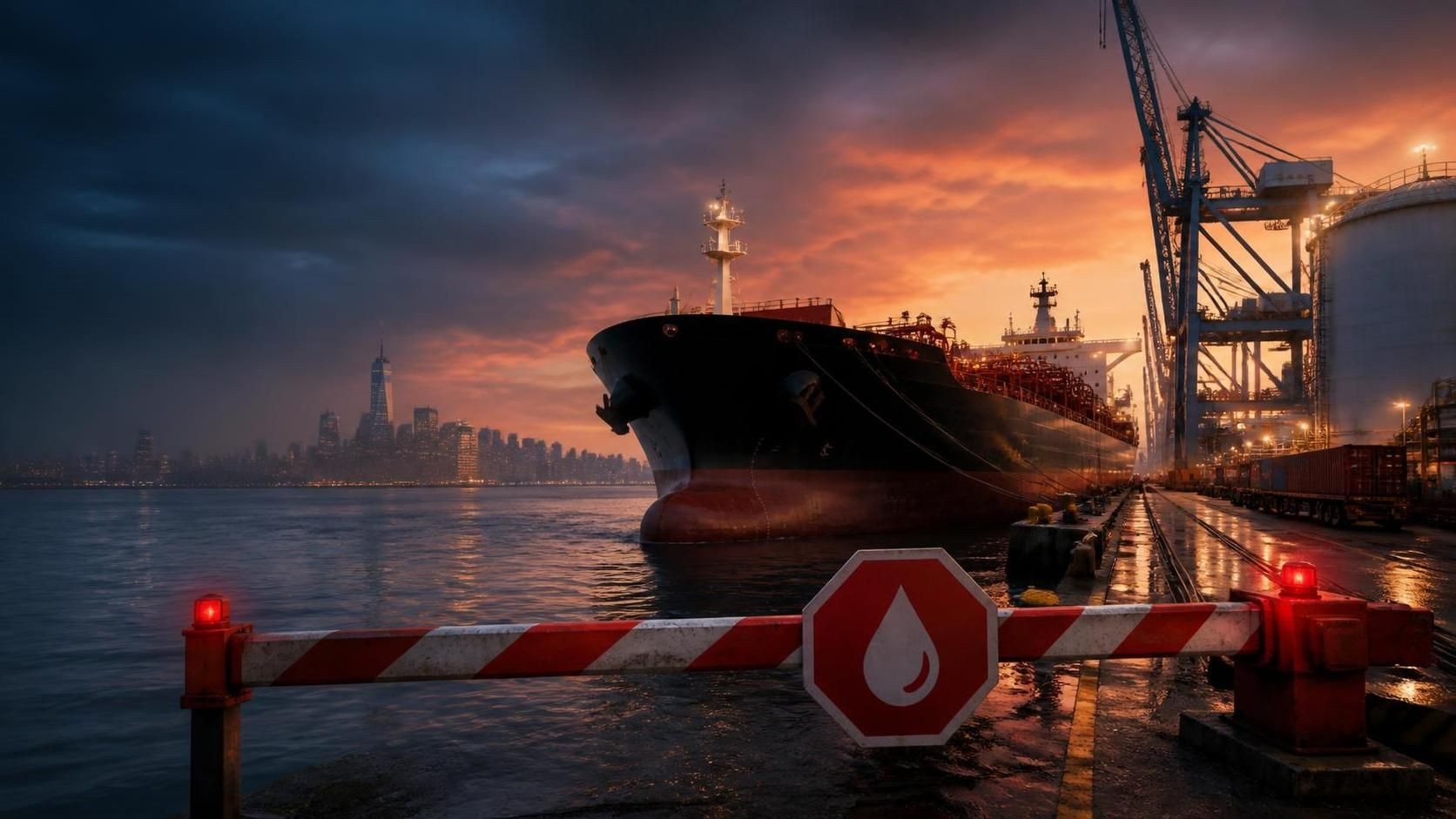
New Jersey Governor Mikie Sherrill has formally warned the state’s port and terminal operators against accepting Russian diesel cargoes authorized under a Trump administration deal, arguing the imports violate a 2022 federal statute and could expose businesses and individuals to substantial civil and criminal penalties.
In a November 2 letter to operators, Sherrill stated that “purchasing or unloading the illegal Russian fuel currently bound for the east coast of the United States at the urging of the Trump Administration would likely subject businesses and individuals to harsh penalties, both civil and criminal.” She urged operators to “turn away any tanker” and pledged that New Jersey would use “every available legal and regulatory tool” to prevent its ports, businesses, and infrastructure from facilitating the trade.Nj
The warning follows an October 9 announcement by President Donald Trump of an agreement with Russian President Vladimir Putin under which Russia would supply diesel to U.S. and global markets. Trump stated on Truth Social that Russia would immediately supply over 300,000 tons, with additional volumes in November and thereafter. The same day, the Treasury Department’s Office of Foreign Assets Control (OFAC) issued General License No. 135, authorizing transactions related to the sale, delivery, offloading, or importation (including into the United States) of Russian-origin diesel fuel through April 7, 2027, under certain sanctions regulations.Clydeco
Legal Conflict Over the 2022 Ban
At the center of the dispute is the Ending Importation of Russian Oil Act, enacted by Congress in April 2022 after Russia’s full-scale invasion of Ukraine. The law bans importation of products of the Russian Federation classified under Chapter 27 of the Harmonized Tariff Schedule (which includes diesel) “in a manner consistent with any implementation actions issued under Executive Order 14066.”
The statute provides a specific pathway to lift the ban: the President must certify (among other conditions) that Russia has agreed to withdraw its forces from Ukraine, following required congressional consultation and review. Sherrill’s letter asserts that no such certification has been made and that OFAC’s general license does not grant “blanket authority” to waive the statutory prohibition. She further argues that the license, as a significant foreign-policy action regarding Russia, requires a congressional review process under 22 U.S.C. § 9511 that has not occurred.Nj
Sherrill cites 19 U.S.C. § 1595a(b), under which participants in an illegal importation can face a penalty equal to the value of the goods, with a five-year statute of limitations. She warns that operators could face “millions of dollars in penalties long after Trump has left office.”
The Trump administration and Treasury maintain that the license complies with applicable law and is intended to ease tight global diesel supplies and high U.S. prices. Diesel has been trading near multi-year highs amid refining disruptions linked to Ukrainian strikes on Russian facilities, broader market tightness, and other geopolitical factors. AAA data cited in reporting put the national average near $6.29 per gallon in early November.Oilprice
Tankers and Practical Impact
Multiple reports indicate Russia has dispatched diesel tankers toward the United States, with at least one (the Malta-flagged Agioi Fanendes carrying roughly 40,000 metric tons) potentially bound for the Port of New York and New Jersey around November 7. New Jersey hosts the largest petroleum import and distribution hub on the U.S. East Coast, making the state’s stance operationally significant even if other ports remain open.Roi-nj
Industry voices have downplayed the volume’s impact. A Phillips 66 executive recently told analysts that available Russian distillate is “a drop in the bucket” relative to offline refining capacity.
Broader Context and Political Framing
Sherrill, a Democrat and Navy veteran, has framed the issue in terms of financing Putin’s war in Ukraine, Russian support for Iran (amid ongoing U.S. hostilities with Iran), and failure to lower costs for American consumers. Her earlier comments to the Financial Times described Trump’s deal with Putin as “corrupt and illegal.”FT
The move occurs against the backdrop of the November 3 midterm elections and elevated energy costs. Critics of the New Jersey action view it as state-level resistance to a federal effort aimed at increasing supply and easing prices. Supporters see it as upholding a clear congressional ban that the executive branch cannot unilaterally override without meeting statutory conditions. Bipartisan skepticism of the diesel deal has also surfaced among some senators, who have questioned its legality relative to the 2022 Act.Oilprice
Whether Sherrill’s letter will successfully deter operators remains to be seen; it relies primarily on warnings of federal liability rather than a direct state shutdown order. The episode highlights ongoing tensions between federal energy and sanctions policy, statutory limits on executive authority, and the practical leverage of major coastal states over fuel logistics.
Appendix: Sources and Links
- OilPrice.com / ZeroHedge summary: https://oilprice.com/Energy/Energy-General/New-Jersey-Moves-to-Block-Trumps-Russian-Diesel-Imports.html
- Official New Jersey Governor’s Office statement and full letter text (Nov. 2, 2026): https://www.nj.gov/governor/news/2026/20261102a.shtml
- Financial Times (Oct. 29, 2026): “New Jersey governor threatens to block delivery of Russian diesel cargoes” – https://www.ft.com/content/3d9ac5af-d6c7-48f8-a5b4-7b3b22cc243d
- Bloomberg: “NJ Governor Warns Ports Against Russian Diesel Allowed by Trump”
- Reuters: “New Jersey governor warns ports against accepting Russian diesel”
- CBS News: “New Jersey’s governor warns ports against accepting Russian diesel”
- Related OilPrice analysis of legal risks: “Trump’s Russian Diesel Is a Legal Hot Potato With a Five-Year Fuse”
- Legal commentary on OFAC General License 135 and the Ending Importation of Russian Oil Act (Clyde & Co and others)