


The oil market is no longer one price. It is a map.
Javier Blas put the new arithmetic on the table in Bloomberg Opinion on September 21: hiring a Very Large Crude Carrier from the Persian Gulf to Asia has jumped twelvefold in a few months to a record $1.1 million a day. Translate that hire into barrels and the freight bill from inside Hormuz to Asia is now more than $22 a barrel, up from about $2 a barrel a year ago.
That single number changes how refiners buy crude. It also explains why the price on a futures screen and the price a refinery actually pays are drifting apart — and why gasoline and diesel at the pump will keep telling a local story even if paper Brent slides back toward $85 to $95.Stu Turley has been saying it on the Energy News Beat podcast for months: energy security starts at home, and energy dominance is displayed through your exports. High tanker rates are the bill for ignoring that sentence.
Confirming the numbers
The Blas figures are not an outlier. They sit on top of a week of Baltic Exchange prints that the industry had never seen.
The benchmark TD3C route — a 270,000-tonne VLCC from the Arabian Gulf to China, conventionally Ras Tanura to Ningbo — first cleared $1 million a day on September 14 at about $1.035 million. It was assessed near $1.099 million on September 15 and about $1.2125 million on September 17.
Fixtures inside the Gulf have been reported at Worldscale 1350, still more than $1 million a day.
The same ships on safer water are expensive, just not Hormuz-expensive. Blas cites about $338,000 a day from the Gulf of Mexico to Asia, up 400 percent year-on-year, and about $486,000 a day from West Africa to China, up nearly 500 percent. The 20-year pre-war average was $29,900 a day. The world VLCC fleet is only about 925 ships.
The Wall Street Journal, working from Windward data, put Hormuz-loading freight at about $26 a barrel — roughly a quarter of the crude’s value. Clarksons had global average VLCC earnings near $651,000 a day last week.
A standard VLCC lifts roughly 2 million barrels. A $1.1 million daily time-charter equivalent over a conventional Arabian Gulf–China round voyage of about 40 days is about $44 million of freight, or $22 a barrel. That is the Blas conversion. It checks.
Voyage days are the other half of the math. The laden TD3C leg is about 21 to 25 days. A U.S. Gulf–China haul is on the order of 50-plus days one way and about 90 days round trip. West Africa to China is roughly 34 days laden. Every time an Asian refiner swaps a Saudi cargo for a U.S. or West African cargo, a scarce ship is tied up far longer. That is why rates outside Hormuz exploded even though those voyages never enter the strait.
Why a $120 local barrel can beat cheaper Saudi oil
Paper crude is not $120 today. On September 21, ICE Brent futures were near $101–$102 and WTI near $93–$94. The 52-week high on Brent futures is about $126. Physical barrels have already printed the $120 world the screen only visits. In mid-September, with futures around $106–$109, Dated Brent was reported near $122, Oman near $121, and Murban near $131. EIA’s Europe Brent spot assessment was $121.18 on September 17 and $130.80 on September 15.
That is the point. The relevant price is not the front-month quote. It is FOB plus freight plus war-risk plus time.
Work a simple delivered comparison for an Asian refinery:
|
Source
|
Illustrative FOB / screen
|
Freight to Asia
|
Extra cost of time / risk
|
Delivered ballpark
|
|---|---|---|---|---|
|
Arab Gulf, loading inside Hormuz
|
$100–$120 FOB
|
$22–$26/bbl
|
War-risk and ship-to-ship delays
|
$125–$150+
|
|
Arab Gulf, loading outside Hormuz
|
Physical grades already marked up
|
$8–$11.50/bbl
|
Smaller war premium
|
Still well above the screen
|
|
U.S. Gulf / WTI-linked
|
~$94–$120
|
~$15–$22/bbl on recent fixtures
|
Longer voyage, no Hormuz premium
|
Can undercut delivered Gulf crude
|
|
West Africa
|
Atlantic Basin pricing
|
High daily rate, fewer days than U.S. Gulf
|
No Hormuz transit
|
Competitive into China
|
|
North Sea into Europe
|
Local
|
Short-haul
|
Almost no VLCC bill
|
Winning European bids
|
One mid-September reconstruction put a Hormuz-loading barrel into China at $149 to $166 once war-risk cover was added, while a Gulf of Mexico barrel landed at $123 to $126. Murban at Fujairah was $131 the same week Brent futures were $106. The extra $25 was the price of a barrel that can actually be shipped.
So yes: a $120 barrel sitting near the refinery, or a $120 Atlantic barrel with a cleaner voyage, can be cheaper than a “cheaper” Saudi cargo that burns three extra weeks of a million-dollar ship. Location is now a bigger line item than grade.
Blas already sees the behavior. European refiners are bidding up the North Sea to avoid the tanker. Asian refiners have been stretching for U.S., West African, Brazilian and Guyanese barrels for the same reason. Japan buying more U.S. crude instead of Middle East crude is not a preference. It is voyage math. Those longer hauls then tighten the fleet again.
Choke-point producers will have to discount
If freight from Ras Tanura is $22 to $26 a barrel and freight from the U.S. Gulf or West Africa is lower on a delivered basis, Gulf exporters do not get to keep last year’s Official Selling Price psychology.
They have two choices. Hold the FOB price and lose the cargo. Or cut the FOB price until the delivered barrel clears against Midland, WTI Houston, Bonny, Johan Sverdrup, or whatever is sitting closer to the buyer.
That is already how this market has traded in 2026. When Hormuz risk premia exploded in March, Dubai and Murban physical differentials went to record premiums — above $60 a barrel in the most violent weeks — because those were the barrels Asia could not replace. When a reopening framework was discussed in June, Dubai, Oman and Murban flipped into discounts within days, and Atlantic barrels opened arbs into Europe and Asia. ADNOC even rewired offshore-grade pricing off Dubai instead of Murban so medium-sour cargoes would not price themselves out of Asia.
High tanker rates give nearby barrels pricing power and force choke-point barrels to compete on netback. Saudi, Iraqi, Kuwaiti and Iranian export economics become a function of who will still enter Hormuz, who will accept a ship-to-ship transfer in the Gulf of Oman, and how much FOB discount is required to beat a U.S. or African cargo after 40 versus 90 ship-days.
The paper market can look “cheap” while Gulf producers are still giving ground. That is not a contradiction. It is two prices.
The screen can fall. The refinery invoice will not.
Consumers and politicians watch Brent. Refiners watch delivered crude, product cracks, and clean-product freight.
A slide in futures toward $85–$95 is plausible if demand breaks, if more Atlantic and Western Hemisphere barrels keep substituting for Gulf crude, or if workarounds chip away at the worst Hormuz bottleneck. None of that equalizes physical delivery.
What stays uneven:
Location differentials. North Sea barrels into Northwest Europe, WTI and WCS into U.S. plants, Murban and Oman into Asia, and anything still loading inside Hormuz will not reconverge to one global number while a VLCC costs seven figures a day.
The crack spread. The shortage is as much refined product as crude. The U.S. diesel crack set records above $106 a barrel on September 1 and printed an intraday high near $108. The ICE gasoil crack hit about $79 a barrel. A year ago those diesel margins were in a more normal $15–$25 range. Gasoline cracks have been closer to $44, which is why diesel and gasoline are no longer moving together.
Refinery utilization. U.S. plants have been running near 97–98 percent. Distillate stocks have been running well below the five-year average and, on some seasonal comparisons, at multi-decade lows. There is almost no spare still to squeeze.
Product shipping on top of crude shipping. If the country does not refine, it does not just pay crude freight. It pays product-tanker freight, insurance, and the crack that already embeds the global diesel shortage. Gulf net exports of diesel and gasoil in August were reported at just over a quarter of their pre-war level. Russian seaborne diesel has been hammered by refinery strikes. Europe shut roughly 30 refineries between 2009 and 2024 and now imports the shortage.
That is why a lower global crude quote can coexist with expensive diesel in California, expensive gasoil in Northwest Europe, and punishing import bills in countries that closed or never built refining capacity. The pump is a local market. The futures pit is a conversation.WSJ made the political version of the same point this week: fewer ships slow deliveries and record freight squeeze refiners, which can keep fuel prices high even if crude falls — an ugly setup heading into U.S. midterms.
Energy security starts at home. The freight market just priced it.
New Tanker Build Orders
Turley’s line is not a slogan in this tape. It is a netback.
Energy security starts at home means crude, refining, pipelines, product storage, and a tanker slate that does not have to roll the dice at Hormuz to keep trucks moving. The United States can still load Gulf Coast crude and run a large refining system. That is why WTI can sit below Brent and still look expensive at the pump: the crack, not the screen, is running the show.
Energy dominance is displayed through exports: the countries that can put barrels and molecules on the water — crude, diesel, gasoline, jet — set the clearing price for everyone who cannot. When VLCC rates are $1 million a day, the exporter closest to the buyer wins twice: once on freight, again on days of ship time.
The other side of that sentence is the policy that spent a generation treating refineries as climate liabilities instead of critical infrastructure. Europe’s closed plants are why a Russian drone campaign and a Gulf product shortfall show up so fast in European diesel. California’s thinning refining base is why a statewide diesel premium is not a mystery. Import-dependent markets without conversion capacity now pay the crude, the crack, and the product freight.
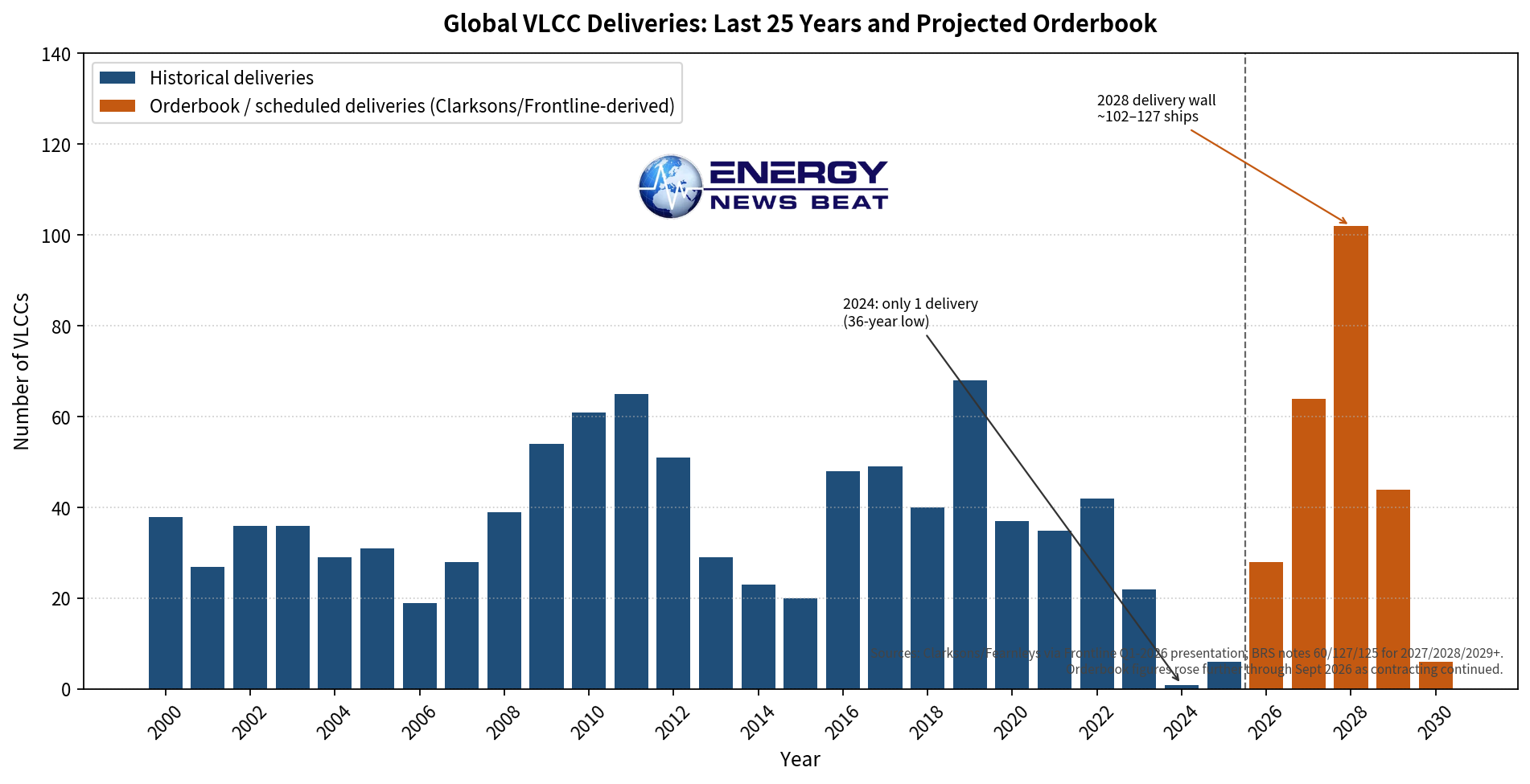
Blas traces part of the tanker squeeze to the same mindset. Years of “peak oil demand” talk suppressed VLCC orders. 2022 saw the fewest supertanker deliveries in three decades. The fleet then split between the sanctioned dark fleet and the commercial fleet. When the war started, workarounds — longer U.S.–Asia voyages, ship-to-ship transfers outside Hormuz — raised ship demand even as some Gulf loadings fell. Underinvestment met geography, and geography sent the invoice.
Newbuildings are coming. Brokers already call 2026 the heaviest VLCC order year in half a century, with deliveries clustering in 2028–2029. That is tomorrow’s glut, not this winter’s diesel. Frontline’s Lars Barstad told Blas the current market is “likely not the new normal,” and then described the tailwinds that keep freight elevated anyway: strategic stockpiles and a post-war habit of buying farther from home. Both consume ships.
Until those ships exist, refiners will buy by location. Producers behind chokepoints will shade FOB prices to stay on the water. Paper crude can print $85 or $120. The barrel that matters is the one that arrives, and the fuel that comes out of the only refinery still standing near the customer.
That is the inflation shock Blas flagged. It does not require a $150 futures contract. It only requires a $1 million ship and a country that forgot how to refine.
Making Appendices Great Again
Check out the World’s Greatest Podcast Show Notes at EnergyNewsBeat.co or EnergyNewsBeat.com.
Subscribe to the Energy News Beat Substack: https://theenergynewsbeat.substack.com/
Appendix: Sources and links
Primary column
- Javier Blas, “The Next Inflation Shock: $1 Million-a-Day Oil Tankers,” Bloomberg Opinion, September 21, 2026. https://www.bloomberg.com/opinion/articles/2026-09-21/oil-market-the-1-million-a-day-oil-tanker-will-drive-inflation
- Full reprint of the Blas column: ThePrint, September 21, 2026. https://theprint.in/economy/1-million-a-day-oil-tankers-cost-of-hiring-oil-tankers-has-spiralled-amid-west-asia-crisis/3048529/
Tanker rates and freight per barrel
- Bloomberg News, “Oil Tankers Earn $1 Million a Day as War Leaves Ship Shortage,” September 14, 2026. https://www.bloomberg.com/news/articles/2026-09-14/oil-tankers-earn-1-million-a-day-as-war-leaves-ship-shortage
- Energy Connects / Bloomberg reprint. https://www.energyconnects.com/news/oil/2026/september/oil-tankers-earn-1-million-a-day-as-war-leaves-ship-shortage/
- Sada Elbalad / Alphaliner, “VLCC Tanker Rates Surpass $1 Million/Day for First Time,” September 21, 2026. https://see.news/vlcc-tanker-rates-surpass-1-millionday-for-first-time
- Splash247, “Tanker boom breaks every historical benchmark,” September 15, 2026. https://splash247.com/tanker-boom-breaks-every-historical-benchmark/
- OilPrice.com, “Tanker Rates Smash $1 Million a Day as Oil Shipping Crisis Deepens,” September 16, 2026. https://oilprice.com/Energy/Crude-Oil/Tanker-Rates-Smash-1-Million-a-Day-as-Oil-Shipping-Crisis-Deepens.html
- Wall Street Journal via Mint, “A shortage of oil tankers is threatening to keep gas prices high,” September 21, 2026. https://www.wsj.com/business/energy-oil/a-shortage-of-oil-tankers-is-threatening-to-keep-gas-prices-high-66b2675a
- Crypto Briefing, “Crude oil shipping costs surge 258% in two months to $23.59 per barrel,” September 19, 2026. https://cryptobriefing.com/crude-oil-shipping-costs-surge-258-percent/
- Data 4 Thought / Eric Pachman, “VLCC Time Charter Rates, Updated Weekly,” September 14, 2026. https://www.data4thepeople.com/p/supertanker-rates/
- Xinde Maritime News, “$862,150 a Day: VLCC Rates Set Another Record,” September 11, 2026. https://www.xindemarinenews.com/news/2098327758360031234
- Xinde Maritime News, “VLCCs top $1m a day — but what price is TD3C actually discovering?” September 15, 2026. https://www.xindemarinenews.com/news/2099699485518344193
- AXIA Shipping Intelligence, Week 38 2026 (TD3C $1,212,503/day). https://www.axia-snp.com/
- 36Kr / Sinolink, “Oil Shipping Market Prices Surge Tenfold in Half a Year,” September 20, 2026. https://eu.36kr.com/en/p/3991581777607427
- Breakbulk News, “Million Barrel Suezmax Rates Surge as Hormuz Crisis Reshapes Tanker Trade,” September 21, 2026. https://breakbulk.news/million-barrel-suezmax-rates-surge-as-hormuz-crisis-reshapes-tanker-trade/
- QC Intel, “AG-China VLCC tanker rates at record levels, quoted $1 million/day,” September 14, 2026. https://www.qcintel.com/article/ag-china-vlcc-tanker-rates-at-record-levels-quoted-1-million-day-72911.html
Voyage days and logistics
- Shipfinex, “VLCC Ships Explained: Size, Capacity & Cost (2026).” https://www.shipfinex.com/blog/vlcc-ships
- Xinde Maritime News, “Four Million Barrels in a Two-Ship Relay,” August 28, 2026. https://www.xindemarinenews.com/news/2093160005433032706
- Ed Finley-Richardson on voyage-day comparisons (TD3C 20.6 days vs US Gulf 53.1 days). https://x.com/ed_fin/status/1675590793526951936
Crude prices and physical differentials
- Investing.com Brent historical data, September 21, 2026. https://jp.investing.com/commodities/brent-oil-historical-data
- Investing.com WTI historical data, September 21, 2026. https://hk.investing.com/commodities/crude-oil-historical-data
- Countryeconomy / Europe Brent spot series (EIA-style), September 2026. https://countryeconomy.com/raw-materials/brent
- GuruFocus WTI, September 21, 2026. https://www.gurufocus.com/economic_indicators/4510/oil-price
- Oxford Institute for Energy Studies, Oxford Energy Forum 149, May 2026 (Dubai/Murban physical blowout). https://www.oxfordenergy.org/wpcms/wp-content/uploads/2026/05/OEF-149.pdf
- Reuters, “Middle East crude slips into discounts as U.S.-Iran deal lifts supply outlook,” June 17, 2026. https://www.reuters.com/business/energy/middle-east-crude-slips-into-discounts-us-iran-deal-lifts-supply-outlook-2026-06-17/
- OilPrice.com, “UAE Rewrites Offshore Oil Pricing To Capture Asian Markets,” July 2, 2026. https://oilprice.com/Energy/Crude-Oil/UAE-Rewrites-Offshore-Oil-Pricing-To-Capture-Asian-Markets.html
- Hellenic Shipping News, “The Arb View: Atlantic Basin barrels come into play,” June 8, 2026. https://www.hellenicshippingnews.com/the-arb-view-atlantic-basin-barrels-come-into-play/
Diesel, gasoline, cracks, and refining
- Bloomberg, “Diesel Margins Surge to Highest on Record as Supply Tightens,” September 1, 2026. https://www.bloomberg.com/news/articles/2026-09-01/diesel-margins-surge-to-highest-on-record-as-supply-tightens
- Transport Topics / Bloomberg, “Diesel crack spread surges to record $106 a barrel,” September 1, 2026. https://www.ttnews.com/articles/diesel-crack-spread-record
- Energy News Beat, “Diesel Crack Spread Hits Record Highs as the Global Downstream Market Is Hit by Drones and Oil Shortages,” September 3, 2026. https://energynewsbeat.co/diesel/diesel-crack-spread-hits-record-highs-as-the-global-downstream-market-is-hit-by-drones-and-oil-shortages/
- Energy News Beat, “US Diesel Crack Spread Hit an All-Time High. What’s Next?” August 19, 2026. https://energynewsbeat.co/diesel/us-diesel-crack-spread-hit-an-all-time-high-whats-next/
- SONAR / FreightWaves, “Why Diesel Is Outpacing Gas in 2026.” https://gosonar.com/freight-market-blog/why-diesel-is-outpacing-gas-in-2026-and-winter-could-make-it-worse
- American Action Forum, “U.S. Diesel Prices Hit Record High,” September 11, 2026. https://www.americanactionforum.org/insight/u-s-diesel-prices-hit-record-high-factors-and-implications/
- Moneycontrol Pro, “Distillate Dilemma,” September 21, 2026. https://www.moneycontrol.com/news/business/economy/moneycontrol-pro-panorama-distillate-dilemma-14034533.html
- ABC News Australia, “Diesel ‘crack spread’ filling oil refiners’ coffers,” September 18, 2026. https://www.abc.net.au/news/2026-09-18/diesel-crack-spread-filling-oil-refiners-coffers/107159068
Energy security framing
- Energy News Beat podcast notes, “Oil Ignores Prices Ignore Physical Costs,” July 31, 2026 — “Energy Security Starts at Home.” https://energynewsbeat.co/enb-podcast/oil-ignores-prices-ignore-physical-costs-10-big-stories-on-the-energy-news-beat-standup/
- Energy News Beat / The Nemeth Report, “Energy Security Crisis 2026! Stu Turley on Oil, Renewables & Geopolitical Risks,” June 2026. https://energynewsbeat.co/energy-news-beat-publishers-note/energy-security-crisis-2026-stu-turley-on-oil-renewables-geopolitical-risks/
- Energy News Beat Standup, “U.S. Fuel Crisis Status, Next Steps and Impact to Consumers,” September 18, 2026. https://energynewsbeat.co/enb-daily-show/u-s-fuel-crisis-status-next-steps-and-impact-to-consumers-2/
- SUERF Policy Brief No. 1441, Anderl & Nava, “Oil on the water: When shipping turns oil shocks into inflation shocks,” 2026. https://www.suerf.org/wp-content/uploads/2026/05/SUERF-Policy-Brief-1441_Anderl-Nava.pdf
Article prepared for Energy News Beat from market data current as of September 21, 2026. Futures prices move intra-day; physical differentials and Baltic TCEs move with fixtures. The freight-per-barrel figures above use published broker and exchange assessments plus a standard 2-million-barrel VLCC cargo.
