
WTI is hovering near $89 after a sharp September unwind from above $100. Brent is still the more stubborn benchmark, recently trading in the mid-to-high $90s after spending stretches of the month above $100. The market is no longer pricing a clean “Hormuz victory.” It is pricing a split world: more crude is moving again, China is refusing to chase expensive barrels, and the real shortage sits downstream in refining and diesel.
That is why crude can fall without fuel prices following it down.
China is the lid on the crude rally
Bloomberg reported today that China’s crude comeback is losing steam as the Iran war enters its eighth month. High prices and limited Iranian supply are too expensive for private refiners. Energy Aspects cut its China import estimate by 440,000 barrels a day to 9.2 million bpd. FGE trimmed its fourth-quarter forecast to 9.3 million bpd from 9.9 million.
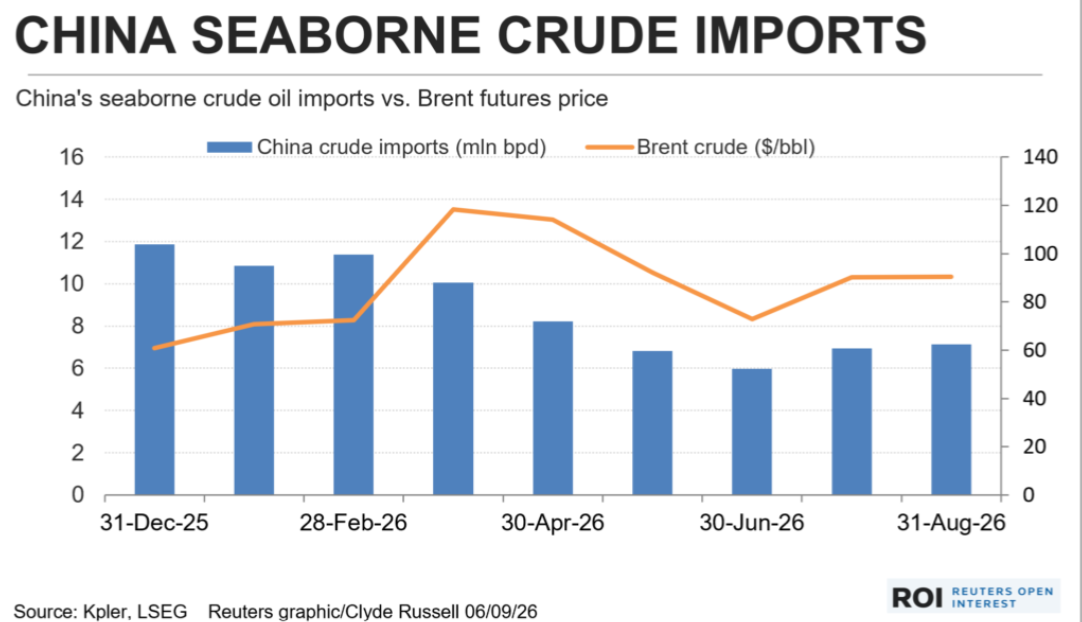
That is a large swing for the world’s top buyer. Before the war, China routinely imported well above 11 million bpd. June shipments collapsed toward 7.1 million bpd, the lowest in nearly a decade. August recovered to about 8.9 million bpd on customs data, and tanker trackers later put September around 7.2 to 7.8 million bpd depending on the source. The rebound is real. It is also incomplete.
China is shopping for cheaper oil, not oil at any price. Iranian barrels that once fed teapot refiners have been squeezed by the U.S. blockade. Russian crude has filled some of the gap, but not enough to restore prewar runs. Goldman Sachs expects only about 600,000 bpd of incremental Chinese imports in the fourth quarter versus the third, leaving volumes still millions of barrels a day below year-ago levels.
Kpler put the point bluntly: Chinese refiners are not rebuilding inventories because domestic demand is weak, margins are compressed, and crude stocks remain high. That pullback is why prompt crude has not melted up even though the Middle East is still short of a full recovery.
The China import-versus-price picture is the market’s safety valve:
If Trump is “winning” Hormuz, why is oil still this high?
Javier Blas asked the same question in Bloomberg Opinion today. U.S. allies’ crude exports through the strait and bypass routes have recovered to about 80% of prewar levels. Iran’s own exports have collapsed toward zero. A few months ago that would have been treated as a major American win. Brent still spent much of September above $100. Blas’s punchline inside the White House: if this is winning, what would losing look like?
The answer is that crude flow and product availability are no longer the same market.
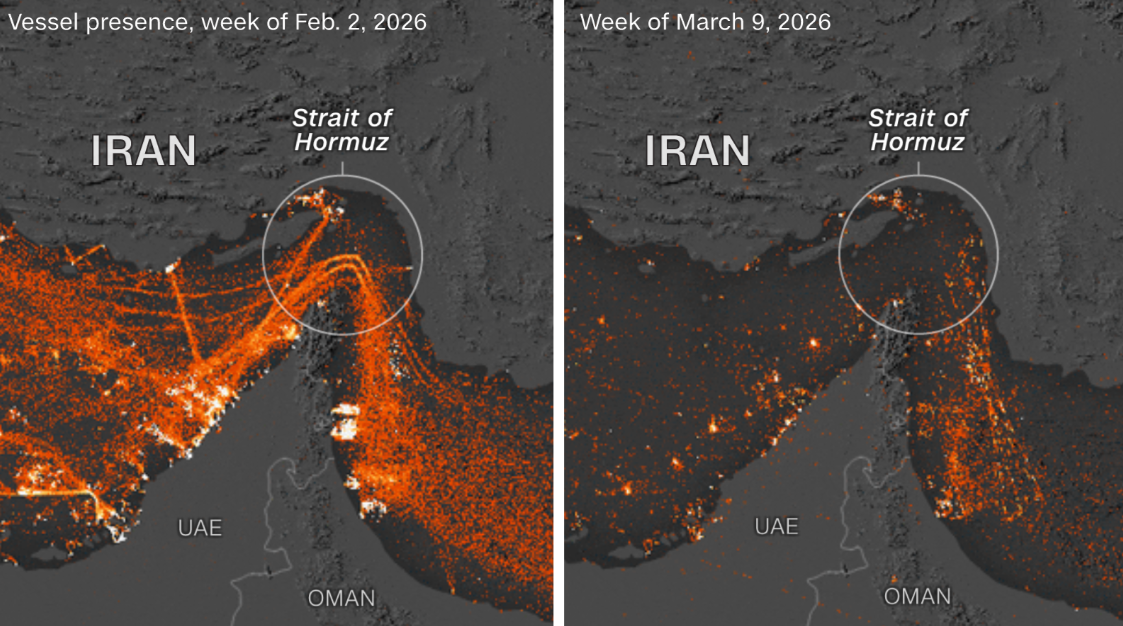
Hormuz is more open than it was in the spring. It is not normal. Middle East exports remain millions of barrels a day below the prewar pace. Iran is effectively off the water. Russian refineries are still being hit. Gulf product exports, especially diesel and gasoil, remain a fraction of February levels. The IEA has described global refinery runs well below last year, with product and LPG exports from the Gulf still deeply impaired.
The satellite contrast from earlier in the war still explains the scar tissue in prices:cnn.com
Crude can move. Distillate cannot be conjured at the same speed.
The shortage is refining, not just barrels
This is the part of the story crude headlines keep missing.
Global nameplate capacity still looks ample on paper. Usable capacity does not. Middle East plants have been damaged, logistically stranded, or starved of export outlets. Russian throughput has fallen to multi-decade lows after drone strikes and an export ban that pulled diesel off the water. U.S. and European plants are already running near practical maximums, around 95% to 97% utilization. There is almost no spare conversion capacity left to answer a winter distillate call.
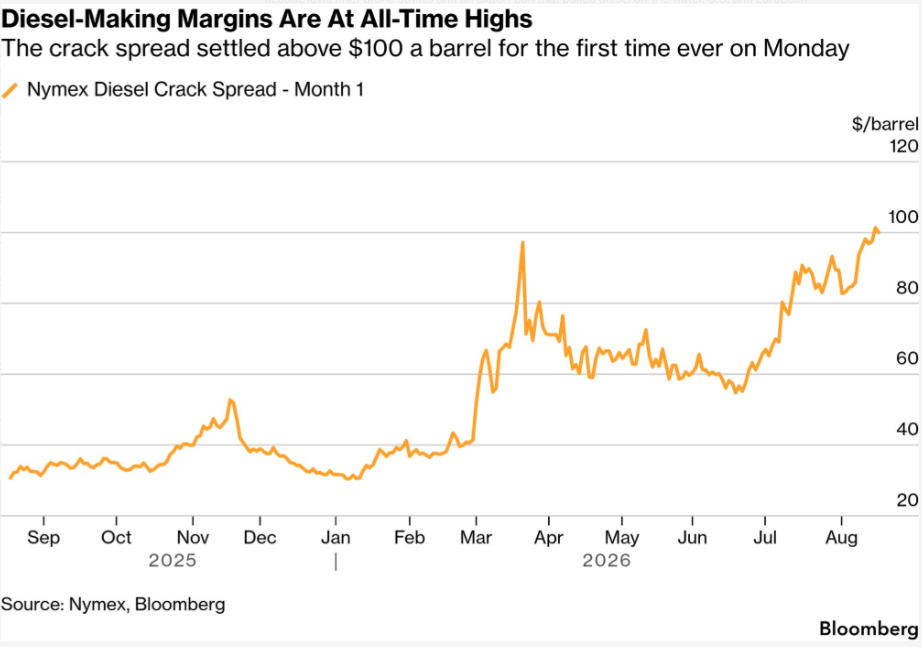
That is why diesel cracks exploded while crude chopped. The Nymex diesel crack printed above $100 a barrel for the first time. European diesel cracks have also cleared $100 against North Sea crude. In a normal market, a $90 WTI barrel would have already started to cool pump prices. In this market, the machine that turns crude into diesel is the scarce asset.
Reuters and the EIA both see the tightness lasting. U.S. distillate inventories are forecast to drop below 100 million barrels and stay below the five-year low through much of 2027. European ARA stocks have been well below the five-year average. Singapore distillate inventories are closer to prewar levels than to last year’s cushion. A global diesel shortage into 2027 is no longer a fringe view.
New refining capacity cannot fix this winter. Net additions this decade are slow. Closures in Europe and the U.S. removed conversion units just as the barrel got lighter and middle-distillate demand stayed stubborn. Greenfield projects take years. Expansions now skew toward petrochemical integration, not a flood of extra diesel. Demand destruction is the only fast valve left.That destruction is already visible in China: weaker road fuel demand, an accelerating EV fleet, export curbs, and refiners cutting runs rather than paying up for crude. It is starting to show up elsewhere as $6-a-gallon U.S. diesel and record European trucking costs force fleets to idle miles.
Analysts are not calling a clean spike from here
The Street is not unified, but the center of gravity has shifted from “$120 or bust” to “high and sticky, with a ceiling unless China comes back hard.”EIA’s September STEO: Brent around $90 in the second half of 2026, then down toward $74 in 2027 as flows normalize and inventories rebuild.
- Standard Chartered recently raised 2026 averages to $92 Brent and $86 WTI, arguing the Middle East security premium is now structural.
- Kpler lifted its 12-month North Sea Dated forecast to $81, not $110, because China remains the reason prices are not higher.
- Goldman sees only a modest Chinese Q4 rebound. Energy Aspects and FGE just cut the China recovery they had been modeling for late 2026.
- OPEC still talks a more resilient demand path. The IEA is more cautious and has marked 2026 demand lower on high prices and disrupted supply chains.
The honest read: WTI can stay near $90 without a new spike if China keeps rationing barrels. It can also lurch higher if Hormuz tightens again or if Chinese stockpiling finally returns into a thin product market. The upside is geopolitical. The cap is Beijing’s bid.
So will WTI stay $90?
Probably in a range, not a moonshot.A $85–$95 WTI band fits the current balance: recovering but incomplete Gulf crude flows, Iranian barrels still missing, China buying only on dips, and diesel remaining the true shortage. A sustained move back above $100 WTI would likely need either a fresh Hormuz shock or a decisive Chinese restocking campaign. A slide through the low $80s would likely need a real ceasefire plus visible product-stock rebuilds.
Oil is still moving. That is the bull case for “not $150.” China is still price-sensitive. That is the bear case for “not a straight-line spike.” Diesel is still tight, and new refining capacity is too slow to matter this winter. That is why fuel inflation can stay painful even if the WTI screen looks almost reasonable.
The crude market is no longer just a barrel-counting exercise. It is a refining-capacity market with a Chinese bid that only shows up when the price is cheap enough. Until one of those two things changes, $90 WTI is less a destination than a parking spot.
Making Appendices Great Again
Check out the World’s Greatest Podcast Show Notes at EnergyNewsBeat.co or EnergyNewsBeat.com.
Appendix: Sources
Primary articles
- Bloomberg News, “China Oil Comeback Loses Steam as Iran War Drags On,” Sept. 30, 2026: https://www.bloomberg.com/news/articles/2026-09-30/china-crude-comeback-loses-steam-as-iran-war-enters-eighth-month?srnd=phx-industries-energy
- Javier Blas, “Why Is Oil at $100 If Trump Is Winning the Battle in Hormuz?” Bloomberg Opinion, Sept. 30, 2026: https://www.bloomberg.com/opinion/articles/2026-09-30/why-is-oil-at-100-if-trump-is-winning-the-battle-in-hormuz
Prices and market data
- GuruFocus WTI / oil price series: https://www.gurufocus.com/economic_indicators/4510/oil-price
- Twelve Data WTI historical: https://twelvedata.com/markets/382560/commodity/wti-usd/historical-data
- FRED / EIA WTI Cushing: https://fred.stlouisfed.org/series/DCOILWTICO
- Investing.com Brent futures historical: https://www.investing.com/commodities/brent-oil-historical-data
- EIA Short-Term Energy Outlook, September 2026: https://www.eia.gov/outlooks/steo/
China demand and imports
- Reuters, Asia crude imports September 2026: https://www.reuters.com/commentary/reuters-open-interest/asias-crude-oil-imports-hit-post-iran-conflict-high-september-remain-weak-2026-09-23/
- SCMP, China’s crude imports rising again: https://www.scmp.com/economy/china-economy/article/3368047/chinas-crude-imports-are-rising-again-what-will-mean-oil-prices
- Reuters, China June imports near 10-year low: https://www.reuters.com/business/energy/chinas-june-oil-imports-hit-near-10-year-low-amid-iran-war-2026-07-14/
- Columbia CGEP, how China managed lower imports: https://www.energypolicy.columbia.edu/how-china-is-managing-lower-oil-imports/
- OilPrice / Goldman on weak China imports: https://www.oilmonster.com/article/goldman-sachs-expects-china-crude-imports-to-remain-weak-amid-high-oil-prices-/8619
- OilPrice, China imports set to rebound / hunt for supply: https://oilprice.com/Latest-Energy-News/World-News/Chinas-Oil-Imports-Set-to-Rebound-as-Refiners-Hunt-for-New-Supply.html
- NYT, China sitting on full tanks: https://www.nytimes.com/2026/06/21/business/china-oil-iran.html
Refining tightness and diesel
- Reuters, global diesel shortage into 2027: https://www.reuters.com/business/energy/global-diesel-shortage-likely-last-into-2027-storage-tanks-drain-2026-09-21/
- AFPM, global diesel crunch: https://afpm.org/newsroom/blog/what-refiners-are-doing-about-global-diesel-crunch
- S&P Global / OGJ, refined product tightness: https://www.ogj.com/general-interest/economics-markets/news/55405149/sp-global-refined-product-tightness-deepens
- Logistics Viewpoints / IEA refining constraint: https://logisticsviewpoints.com/2026/09/29/the-global-refining-network-is-becoming-a-logistics-chokepoint/
- RBN Energy, crack spreads at records: https://rbnenergy.com/daily-posts/analyst-insight/crack-spreads-soar-record-highs-despite-higher-crude-prices
- Bloomberg, diesel margins top $100: https://www.bloomberg.com/news/articles/2026-08-18/diesel-margins-top-100-a-barrel-to-reach-record-high-as-supply-crunch-grows
- Price Group Energy Report, diesel crack over $100: https://blog.pricegroup.com/2026/09/28/the-revenge-of-the-crack-the-energy-report-09-28-2026/
- Stillwater Associates, record cracks: https://stillwaterassociates.com/low-tanks-high-margins-why-product-cracks-are-at-records-and-how-long-they-are-likely-to-last/
- Kpler, delicately balanced middle distillates: https://www.kpler.com/blog/delicately-balanced
Analyst forecasts
- Reuters poll, analysts dial down forecasts: https://www.reuters.com/business/energy/poll-analysts-dial-down-oil-forecasts-hormuz-reopening-eases-supply-concerns-2026-06-30/
- Kpler, raised crude forecast to $81: https://www.kpler.com/blog/higher-floor-hard-ceiling-why-we-have-raised-our-crude-forecast-to-81-bbl
- OilPrice / Standard Chartered forecast hike: https://oilprice.com/Energy/Energy-General/Oils-New-Normal-Is-Higher-Prices.html
- OPEC vs IEA vs EIA 2026-27 comparison: https://gomarkets.com/en/articles/opecs-optimist-the-ieas-pessimist-who-should-traders-believe
Hormuz visuals and shipping
- CNN, shipping through Hormuz since war began: https://www.cnn.com/2026/04/29/world/iran-war-gulf-hormuz-shipping-maps-intl-vis
- Al Jazeera, ships through Hormuz: https://www.aljazeera.com/news/2026/4/14/how-many-ships-have-passed-the-strait-of-hormuz-and-how-many-were-attacked