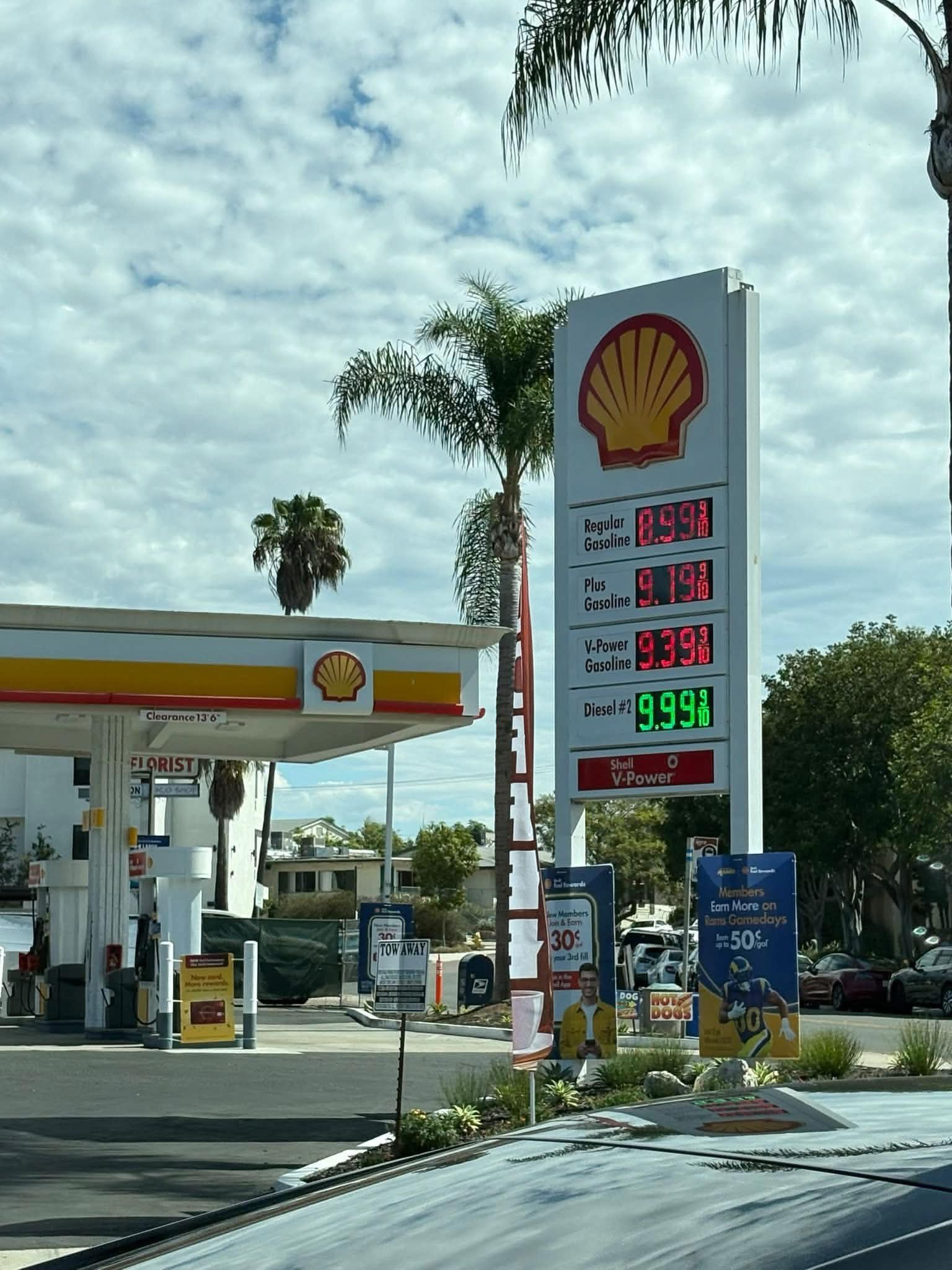
Crude is moving again through the Strait of Hormuz. The fuel Americans actually buy is not. That is the gap David Blackmon flags in his October 7 Forbes piece, “Oil Is Flowing Again But Gasoline, Diesel Prices Aren’t Cooperating,” and the data behind it explain why pump prices remain stuck near records even as headlines about recovered oil flows multiply.
As of October 7, AAA puts the U.S. national average for regular gasoline at $4.37 a gallon and diesel at $6.30. Diesel set an all-time high of $6.53 on September 22. A year earlier those averages were about $3.12 and $3.68. California diesel touched $8.44 in late September. Gasoline has eased a few cents in the past week; diesel has not returned anywhere near pre-war levels.
The crude recovery is real. Market-intelligence firm Kpler, cited by The Wall Street Journal on October 5, put the seven-day average of crude cargoes clearing Hormuz at 10.3 million barrels a day, or 76 percent of the pre-war baseline. Saudi crude exports reached about 7 million barrels a day in September, roughly double August, with loadings on both the Gulf and Red Sea sides. Vitol chief Russell Hardy has estimated roughly 12 million barrels a day of crude and 2 million of refined fuels are now leaving the Gulf under U.S. Navy escort and ship-to-ship transfers.
Refined products tell a different story. Product cargoes through the strait were only about 1.3 million barrels a day, 11 percent of total flows, versus more than 20 percent before the war that began in late February. The reason is physical. Missile and drone strikes have taken refineries offline across Saudi Arabia, Kuwait, the UAE, Iraq and elsewhere. Andy Lipow of Lipow Oil Associates put the distinction plainly to the Journal: consumers do not buy crude; they buy gasoline, jet fuel and diesel. Asian refiners in China, Japan and South Korea are holding most of their output at home. Ukrainian strikes continue to cut Russian product exports. The United States, already running refineries near 95–97 percent of capacity and exporting more than a million barrels a day of distillate, has become one of the few large remaining suppliers. U.S. distillate stocks are expected to stay below the 2021–2025 range through most of the forecast horizon.
Freight is compounding the squeeze. ING Research, using Clarksons data, reports average global crude-tanker earnings above $500,000 a day in early October—about ten times the 2025 average—with Suezmax and VLCC rates higher still. The Ras Tanura-to-Rotterdam voyage that cost about $2 a barrel in 2025 exceeded $35 a barrel in September. Kpler has recorded Middle East Gulf VLCC freight near $32 a barrel, with daily earnings above $1 million on some fixtures. Product-tanker earnings have roughly tripled. Combined with European diesel crack spreads running about 2.5 times last year’s average, ING estimates the freight-and-margin stack can add more than $0.50 to the base price of a liter of diesel. Vitol’s Hardy has called the charter market “pretty parabolic” and warned that inefficient dark transits and waiting time are tying up hulls, so the shortage of ships is global, not only a Hormuz problem. New VLCC deliveries that could ease the fleet tightness are mostly a 2028–29 story.
Official forecasts of lower prices exist, and they can be partly substantiated—for crude more than for diesel, and for 2027 more than for this winter.
The EIA’s October 6 Short-Term Energy Outlook raised its 2026 Brent average to about $96–$98 a barrel and its fourth-quarter call to $105, then sees Brent averaging $84 in 2027 as Middle East shut-ins ease (the agency puts remaining shut-in production near 2.7 million barrels a day by early 2027) and inventories rebuild. On products, EIA expects U.S. retail diesel to stay above $6 a gallon in October, then average about $4.50 in 2027, with the 2026 annual average near $5.19. Gasoline is forecast to average about $3.91 in 2026 and just under $3.60 in 2027. Those paths assume Hormuz transit continues to improve and that Saudi and Kuwaiti refineries can raise distillate exports. Goldman Sachs, by contrast, expects diesel and jet crack spreads to average more than $40 a barrel in 2027—more than double the long-run norm of around $20—because roughly 2 million barrels a day of Middle East refining capacity remains offline and non-China capacity is still contracting. A Dallas Fed survey of oil and gas executives found nearly half expect diesel prices to take more than four quarters to return to 2025 levels. Saudi Aramco’s CEO has said inventory rebuilding could take up to two years. Energy Secretary Chris Wright has said diesel may have peaked a few weeks ago, while crude remains near $100 because Hormuz is still a conflict zone.
The substantiated part is the direction, not the timing. Crude flows at three-quarters of baseline, plus China’s reduced import pull, have kept flat prices from the $200 scenario Hardy has flagged if the shuttle collapses. That supports a gradual decline in the crude component of the pump price into 2027 if the waterway stays open and damaged fields return. The unsubstantiated part is any near-term relief at the diesel pump. Product flows are still a fraction of normal, Gulf refineries are damaged, U.S. plants have almost no spare capacity, inventories are thin, heating season is arriving, and record tanker rates are embedding an extra several dollars a barrel into delivered fuel. A G7 discussion of emergency stock releases, including products, could shave something on the order of 25 cents a gallon off diesel temporarily, Lipow has estimated, without creating new refining capacity. An export ban, still floated in Congress ahead of the November midterms, would do the opposite: Gulf Coast refiners that cannot place barrels would cut runs and tighten gasoline and jet as well as diesel.
Relief, on the evidence now in hand, is a 2027 story for diesel and a slower second-half-2026 into 2027 story for gasoline—and only if refinery repairs proceed, Hormuz escorts hold, Russian product losses do not worsen, and policymakers do not close the export valve that is currently balancing an already short global market. Until those conditions are met, the crude that is flowing again will keep failing to show up as cheaper fuel at the pump.
David Blackmon and Stu Turley will be interviewing Larry Schweikart live at 1:00 Central to talk about this very issue. Live YouTube Feed is Below.

Check out the World’s Greatest Podcast Show Notes at EnergyNewsBeat.co or EnergyNewsBeat.com. And subscribe to: The Energy News Beat Substack.
David Blackmon, “Oil Is Flowing Again But Gasoline, Diesel Prices Aren’t Cooperating,” Forbes, October 7, 2026.
https://www.forbes.com/sites/davidblackmon/2026/10/07/oil-is-flowing-again-but-gasoline-diesel-prices-arent-cooperating/
Wall Street Journal, “Oil Is Flowing From Hormuz Again—Just Not the Kind the World Needs Most,” October 5, 2026 (Kpler flow data, Lipow comments, price records).
https://www.wsj.com/business/energy-oil/diesel-strait-of-hormuz-e1940e50
Archive: https://archive.is/2026.10.06-013335/https://www.wsj.com/business/energy-oil/diesel-strait-of-hormuz-e1940e50
AAA Fuel Prices, national averages as of October 7, 2026 (regular $4.367, diesel $6.302; diesel record $6.528 on September 22, 2026).
https://gasprices.aaa.com/
U.S. Energy Information Administration, Short-Term Energy Outlook, October 6, 2026 (Brent, gasoline and diesel forecasts; distillate inventories).
https://www.eia.gov/outlooks/steo/
Petroleum products section: https://www.eia.gov/outlooks/steo/report/petro_prod.php
Reuters, “US EIA hikes oil price forecasts again as Iran war drains global stockpile,” October 6, 2026.
https://www.reuters.com/business/energy/us-eia-hikes-oil-price-forecasts-again-iran-war-drains-global-stockpile-2026-10-06/
ING Think, Rico Luman, “Record-breaking tanker rates pile pressure on already high fuel prices,” October 2026 (Clarksons earnings, Ras Tanura–Rotterdam freight, diesel cost impact).
https://think.ing.com/articles/record-breaking-tanker-rates-pile-pressure-on-high-fuel-prices/
Kpler, “VLCC freight may have peaked, but Hormuz keeps the floor high,” October 2026.
https://www.kpler.com/blog/vlcc-freight-may-have-peaked-but-hormuz-keeps-the-floor-high
Kpler, “Higher floor, hard ceiling: why we have raised our crude forecast to $81/bbl,” October 2026.
https://www.kpler.com/blog/higher-floor-hard-ceiling-why-we-have-raised-our-crude-forecast-to-81-bbl
IBTimes / Goldman Sachs comments, “Oil Flows Are Recovering But Diesel is Likely To Continue Being Expensive For a While,” October 7, 2026.
https://www.ibtimes.com/oil-flows-are-recovering-diesel-likely-continue-being-expensive-while-heres-why-3808277
Financial Times, Vitol CEO Russell Hardy on tanker shortage and Hormuz flows, October 2026.
https://www.ft.com/content/95db1fbd-4e1f-45cf-b678-c40635f59197
Financial Times, “US oil industry warns diesel prices will not return to normal for a year” (Dallas Fed survey), September 30, 2026.
https://www.ft.com/content/0d74d66a-a9ee-4c22-83ab-9df6452117de
Atlantic Council, Ben Cahill, “No quick fixes for the squeeze on refined products,” September 9, 2026.
https://www.atlanticcouncil.org/blogs/energysource/no-quick-fixes-for-the-squeeze-on-refined-products/
American Fuel & Petrochemical Manufacturers, “What refiners are doing about the global diesel crunch,” September 28, 2026.
https://afpm.org/newsroom/blog/what-refiners-are-doing-about-global-diesel-crunch
David Blackmon, “Dear Congress: Don’t Make America’s Diesel A Hostage To Your Election Year Politics,” Daily Caller, September 23, 2026.
https://dailycaller.com/2026/09/23/opinion-diesel-prices-congress-farmers-truckers-david-blackmon/
Wall Street Journal, “A shortage of oil tankers is threatening to keep gas prices high,” September 21, 2026.
https://www.wsj.com/business/energy-oil/a-shortage-of-oil-tankers-is-threatening-to-keep-gas-prices-high-66b2675a