

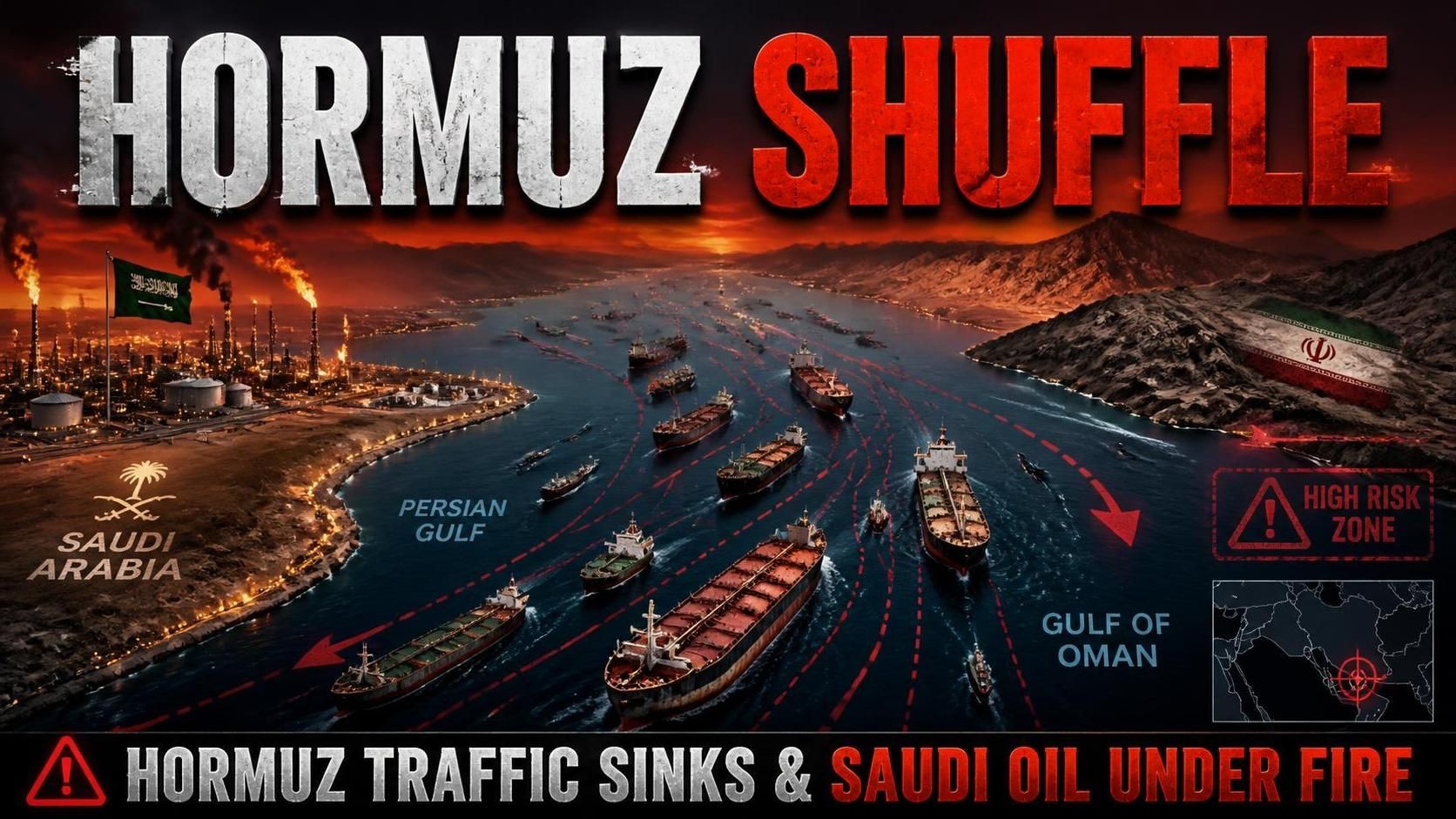
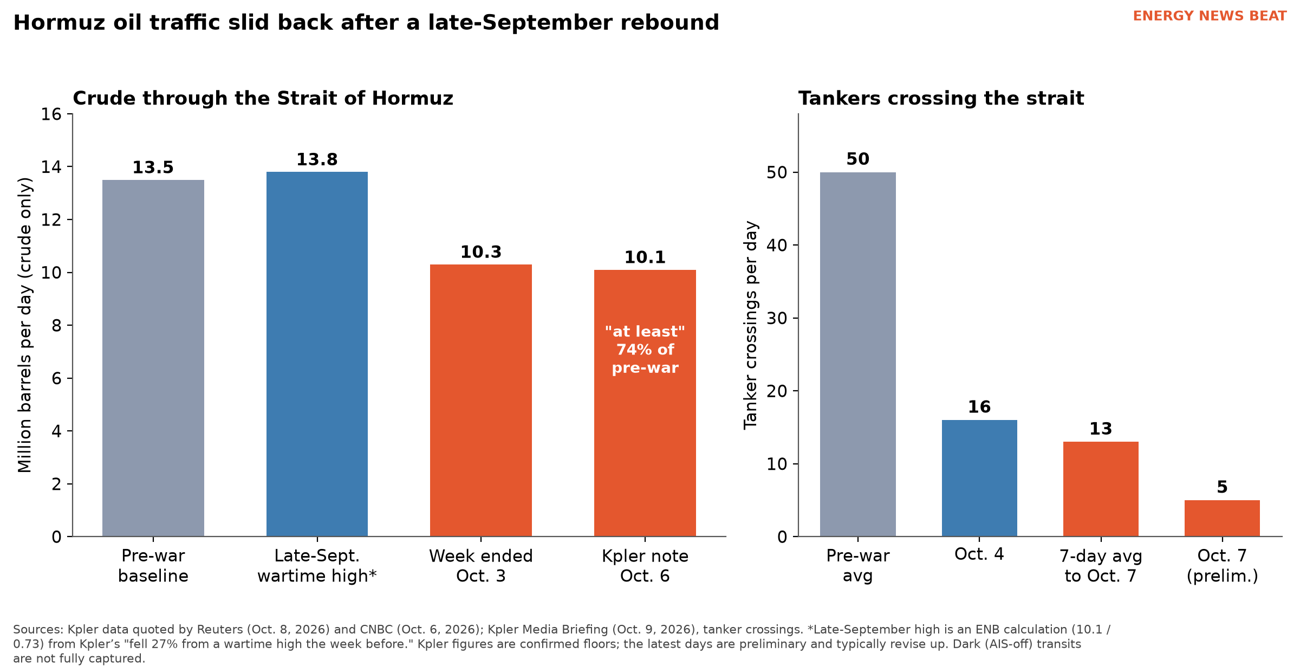
Crude moving through the Strait of Hormuz fell 27% in a week, to at least 10.1 million barrels a day, as tanker attacks picked up and Yemen’s Houthis warned everyone who works at a Saudi oil site. Here is what has actually been hit, what is only claimed, and how much oil can still get out another way.
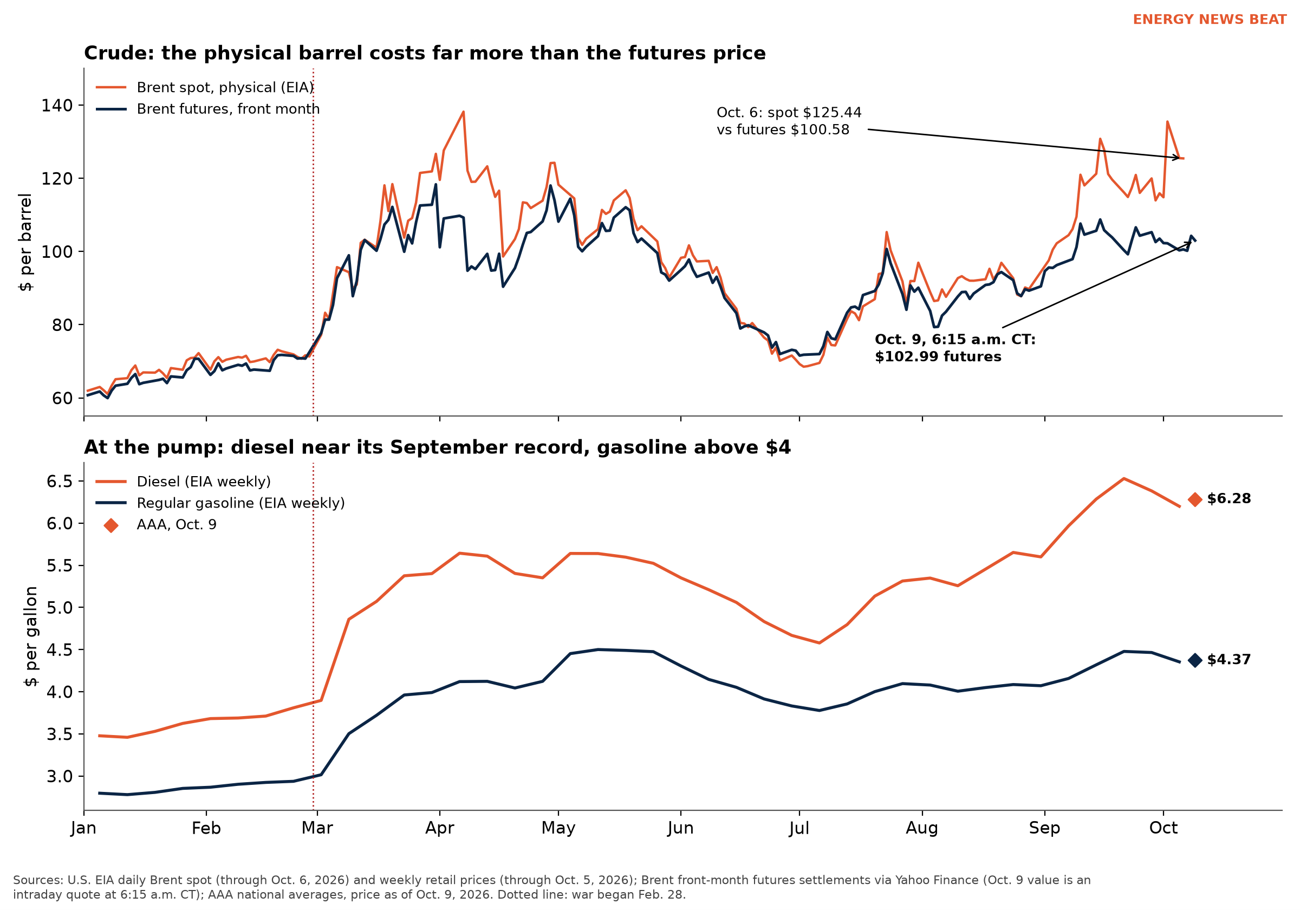
If you fill a pickup or run a truck, you already know this story. A gallon of regular averaged $4.37 this morning, up from $3.11 a year ago, and diesel averaged $6.28, about 25 cents below the record of $6.53 set on Sept. 22. Georgia truck driver Lloyd Smith told Atlanta News First he fills up every other day for $1,400 to $1,500, and that fleets around him are parking trucks and laying people off. The American Farm Bureau told the White House that “farmers and ranchers cannot postpone harvest or simply stop using diesel when prices rise” (AFBF).
Those prices come down to two places: a narrow strait off Iran and a string of oil plants across Saudi Arabia. Both had a rough week. Overnight, posts on X said a new wave of strikes had set Saudi Arabia’s Abqaiq plant on fire, with satellite pictures. As of 6:40 a.m. CT, Oct. 9, 2026, ENB could not confirm a new wave of attacks this morning. No Saudi, Aramco or coalition statement mentions Abqaiq, and no credible newsroom has published or verified the images. What is confirmed is serious enough: missiles at Riyadh on Thursday, a refinery fire on Oct. 3, a pipeline station hit on Oct. 4, and a Houthi warning to every Saudi oil worker.
| Stu’s Take
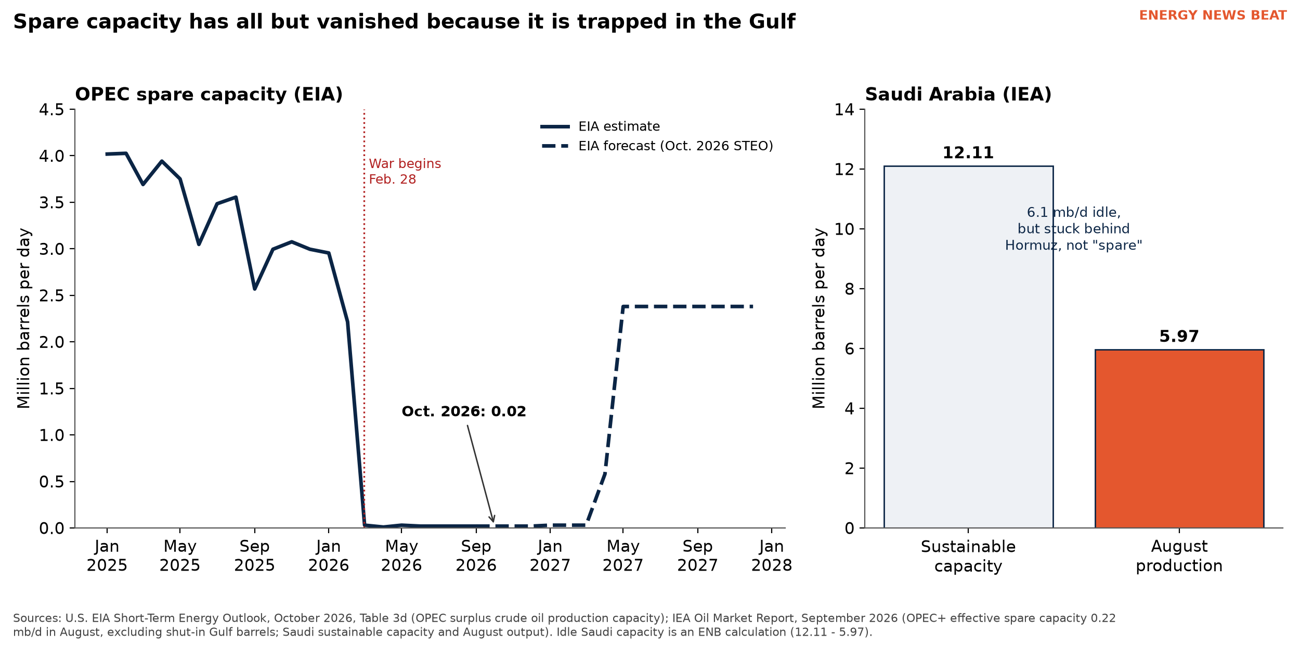
The number I’m watching is 27%. That’s how far crude moving through Hormuz fell in one week, to at least 10.1 million barrels a day, according to Kpler. Saudi Arabia’s East-West pipeline is moving 5.8 million barrels a day to the Red Sea, and in total about 6.7 million barrels a day of crude is leaving from ports outside the strait. But it is still only about half of the 13.5 million that used to go through Hormuz. What bothers me is how thin the cushion is. EIA puts OPEC spare capacity at 0.02 million barrels a day this month, and our Strategic Petroleum Reserve is at 283 million barrels. When the Houthis say they will go after Saudi oil facilities they have not hit before, every rumor moves the market. I’m treating the Abqaiq reports as claims until Riyadh or a real newsroom backs them up. If you buy diesel for a farm or a fleet, watch the IEA meeting next week. |
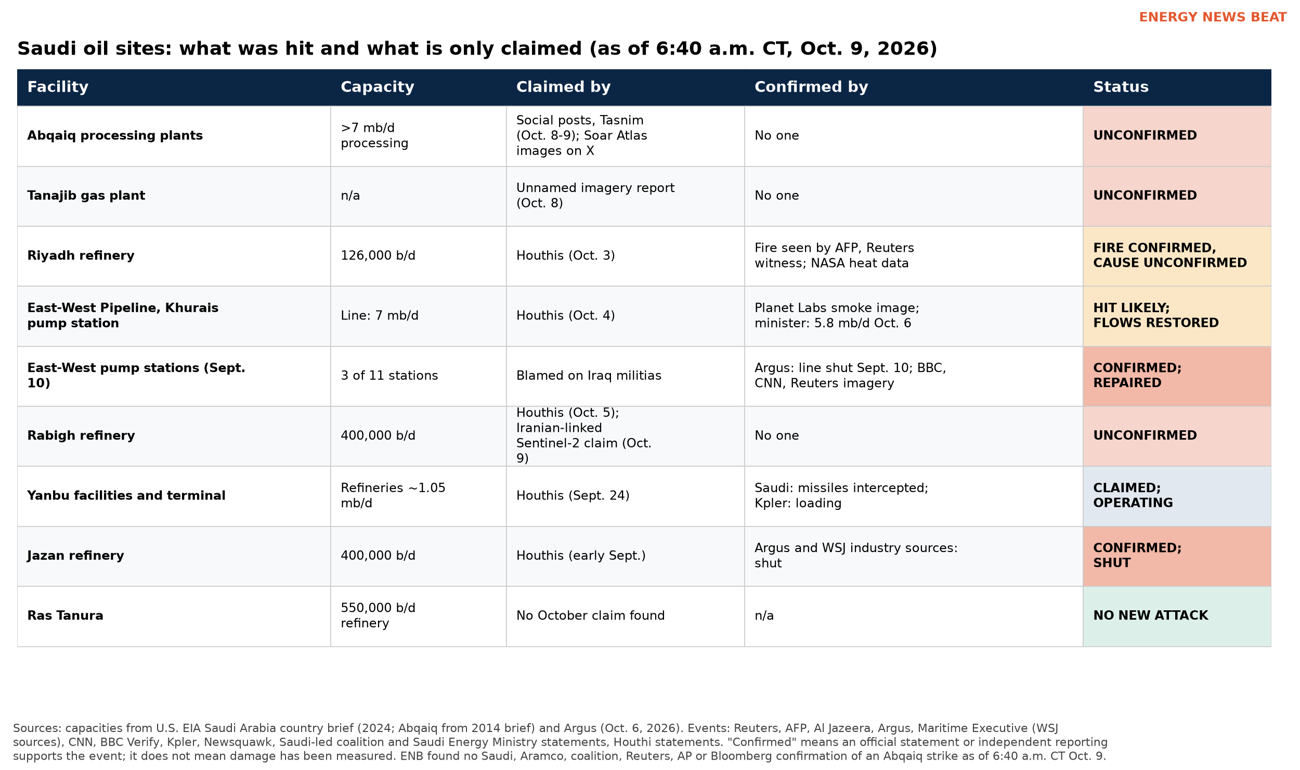
What was actually hit, and what is only claimed (as of 6:40 a.m. CT, Oct. 9, 2026)
We sorted reports by who is saying it: official statement (Saudi government, Aramco or the coalition), independent reporting (a news agency saw or verified it) or claim by the attacker.
Abqaiq (claim, unverified). Abqaiq is the plant that processes more than 7 million barrels a day of Saudi crude. The reports started with social-media posts and a flash from Hamer Intel, which published at 9:09 a.m. CT Thursday citing “initial reports.” Market wire Newsquawk carried a headline about satellite images showing smoke at Abqaiq and the Tanajib gas plant, without naming the image source, and noted it might be smoke from earlier. At 2:22 a.m. CT today, Newsquawk carried a report from Iran’s Tasnim news agency of a “massive fire” there (Newsquawk). ENB found no formal Houthi statement naming Abqaiq; the Saudi Energy Ministry’s X account posted only conference news Thursday.
Abqaiq update, as of 6:40 a.m. CT Oct. 9 (all unverified). ENB found no Saudi, Aramco, coalition, Reuters, AP or Bloomberg confirmation of a strike on Abqaiq. The Abqaiq images circulating are Soar Atlas imagery dated Oct. 8 (example post); no newsroom has verified them, and some accounts sharing them suggest the flaring may be precautionary. Iranian-linked outlets are also pushing a claim that Sentinel-2 images show damaged fuel tanks at Petro Rabigh (StoryChase aggregation). That claim is also unverified.
Thursday, Oct. 8 (confirmed). The coalition said it intercepted two ballistic missiles aimed at Riyadh and one at Khamis Mushait; falling debris damaged a kindergarten and a clinic (Al Jazeera; Al Arabiya). A Saudia plane was heavily damaged by fire while parked at Riyadh’s airport, three people briefed on the matter told Reuters (Middle East Online/Reuters). A day earlier, on Oct. 7, Saudi Arabia’s General Authority of Civil Aviation said attacks on the Abha and Riyadh airports on Oct. 6–7 killed three people and injured 36: two killed and 28 injured at Abha, one killed and eight injured in Riyadh (Al Jazeera; BBC). Houthi military spokesman Yahya Saree warned “all employees, experts and engineers working at all Saudi oil facilities” to stay away from likely targets (Argus).
Oct. 3–5 (mixed). A fire at the 126,000 barrel-a-day Riyadh refinery on Oct. 3 was seen by an AFP journalist (SBS/AFP) and showed up in NASA heat data (Türkiye Today). The coalition called Houthi claims “misleading” (Al Jazeera). On Oct. 4 the Houthis claimed a hit near Khurais. A Saudi energy source told AFP “the pipeline stopped again” after “big damage” to a pumping station (AFP). Two days later the energy minister said, “As of this morning, we are back to 5.8mn b/d” (Argus). The Houthis’ Oct. 5 claim of a fire at the 400,000 barrel-a-day Rabigh refinery has no Saudi confirmation (Business Recorder).
Earlier damage (confirmed). Drones hit three of the East-West line’s 11 pumping stations on Sept. 10 (Argus; Reuters), and the Jazan refinery has been shut since early-September attacks, according to Argus and industry sources cited by the Wall Street Journal (Argus; Maritime Executive). A Sept. 24 Houthi claim against Yanbu ended with the coalition saying it shot the missiles down (Al Jazeera), and Kpler shows Yanbu still loading (Kpler).
The satellite pictures: what holds up
Real satellite evidence exists, but for the earlier attacks. A Planet Labs image distributed by AFP shows black smoke near the Khurais pumping station on Oct. 4 (CNA/AFP). NASA’s FIRMS fire map caught heat over the Riyadh refinery on Oct. 3. CNN used Planet Labs and Airbus images to show fires at two pumping stations in September, and BBC Verify showed major damage to one.
The Abqaiq pictures are different: as noted above, they are unverified Soar Atlas images, and Pakistan’s Dawn ran a headline about them with no image credit or story text that we could find. Until a credible provider or newsroom publishes and checks them, treat them as claims.
Corrections to early reports
- “A new wave hit Saudi oil this morning.” Not confirmed as of 6:40 a.m. CT, Oct. 9, 2026. The Abqaiq reports are a Tasnim claim and unverified X images (above).
- “The East-West pipeline is down.” It stopped briefly on Oct. 4, according to AFP’s Saudi source. Bloomberg sources said it was running normally on Oct. 5 (Market Briefs), and the minister put it at 8 million barrels a day on Oct. 6.
- “Hormuz traffic just fell another 27%.” It is the same drop. Our Oct. 6 article used Kpler’s 3 million barrels a day for the week ended Oct. 3. Kpler’s later note put it at at least 10.1 million, a floor that gets revised. Both are about 74% to 76% of pre-war levels.
- “Aramco shut Abqaiq on July 27.” Saudi Arabia’s defense ministry said that day’s drones from Iraq were intercepted, with no damage reported (The National).
- “22 million barrels went through Hormuz last night alone.” President Trump posted that figure (Guardian). Kpler’s data shows all oil clearing Hormuz averaged about 9.9 million barrels a day over the week to Oct. 7.
Hormuz traffic (as of Oct. 7 data)
Kpler counted just seven commodity ships crossing the strait on Tuesday, the fewest since July 23, and 10 on Wednesday. Before the war about 125 large ships a day passed through (Reuters via The Hindu). For tankers alone, Kpler’s preliminary count fell from 16 on Oct. 4 to five on Oct. 7, against a pre-war average of 50 (Kpler).
Why the drop? The naval-run Joint Maritime Information Center counted six confirmed attacks between Oct. 3 and Oct. 6 (Maritime Executive). On Wednesday a tanker was hit about 51 nautical miles north of Qatar’s Madinat ash Shamal, well west of the strait, UKMTO reported (Reuters via Al Arabiya). Kpler’s newest days usually revise up 1.5 to 2 times (Kpler).
How many escape routes are left?
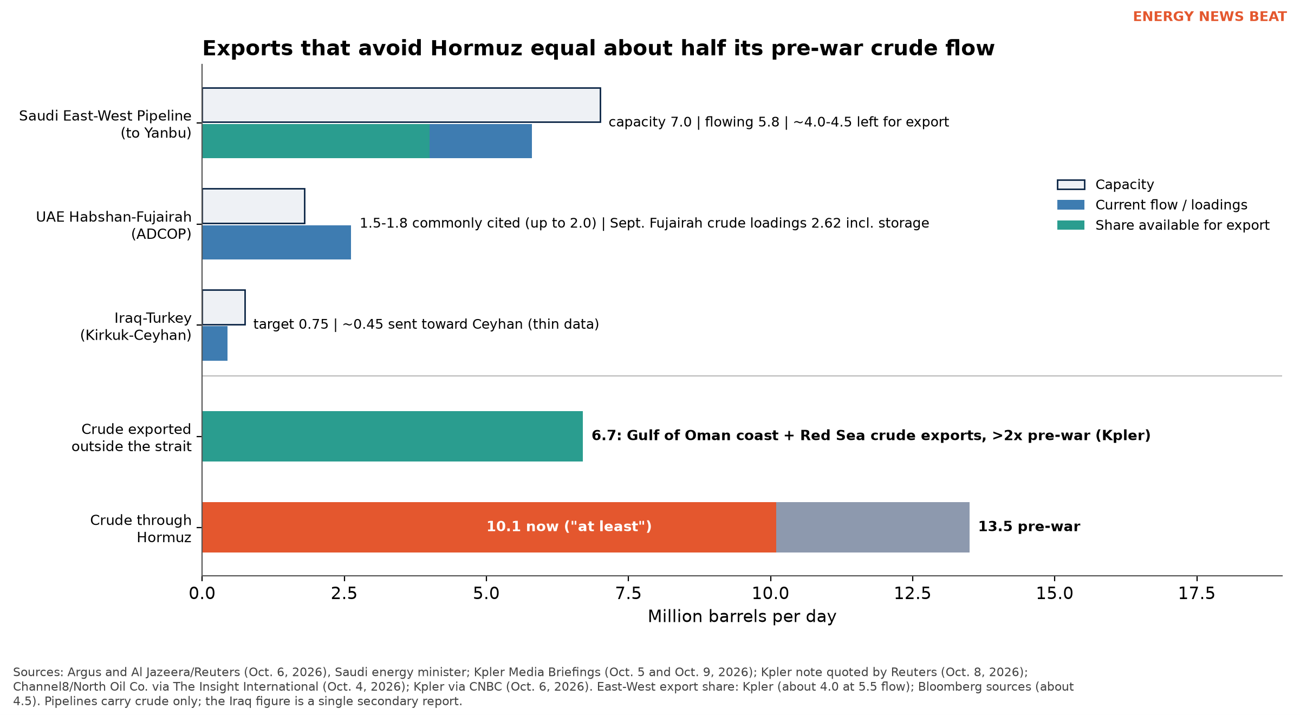
Three, and they are running near capacity. Saudi Arabia’s East-West pipeline can carry 7 million barrels a day to Yanbu on the Red Sea and was moving 5.8 million on Oct. 6. Saudi refineries along the way take part of that, leaving roughly 4 million to 4.5 million barrels a day for export (Kpler; Market Briefs). The UAE’s Habshan–Fujairah line is usually rated at 1.5 million to 1.8 million barrels a day. Fujairah loaded a record 2.62 million barrels a day of crude in September by drawing on storage (Kpler). Iraq’s pipeline to Ceyhan, Turkey is reported at about 450,000 barrels a day, a figure from one secondary report.
Add it up and Kpler says crude exports from the Gulf of Oman coast and the Red Sea hit 6.7 million barrels a day, more than double pre-war levels. That is a big achievement, and it is about half of the 13.5 million barrels a day that crossed Hormuz before the war (ENB calculation).
Spare capacity and emergency barrels
In a normal crisis, Saudi Arabia would simply pump more. Not this time. EIA estimates OPEC spare capacity fell from 2.96 million barrels a day in January to 0.02 million in October. The IEA put OPEC+ effective spare capacity at 0.22 million in August. Saudi Arabia can sustain 12.11 million barrels a day but produced 5.97 million in August (IEA). The rest is stuck behind Hormuz. Aramco CEO Amin Nasser has called global reserves “scarily thin” (Politico).
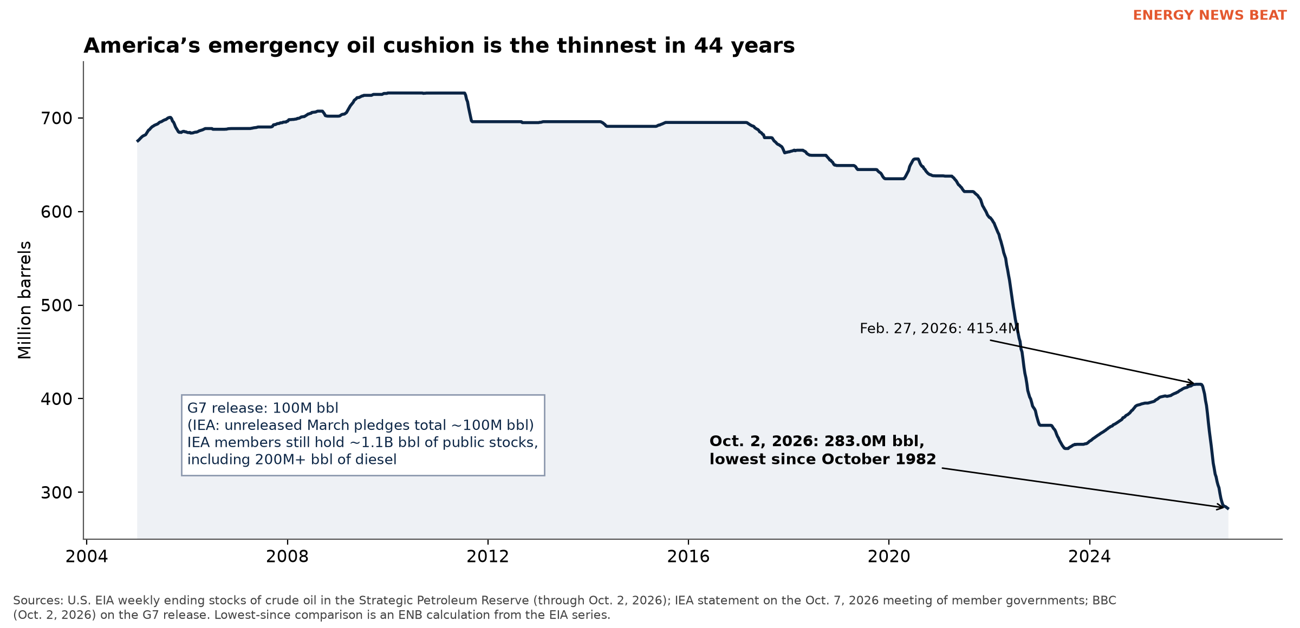
That leaves government stockpiles. The U.S. Strategic Petroleum Reserve held 283.0 million barrels on Oct. 2, down 132.5 million since Feb. 27 and the lowest since October 1982 (ENB calculation). The G7 agreed on a 100 million barrel release. The IEA says members still hold about 1.1 billion barrels of public stocks, including more than 200 million barrels of diesel (IEA), and its governing board meets Oct. 14–15 (Reuters).
What it means at the pump (as of 6:15 a.m. CT)
Brent futures traded at $102.99 at 6:15 a.m. CT, down 1.2% after Thursday’s 4% jump, and WTI at $90.80. Physical crude costs much more than the futures price: EIA’s spot price for physical Brent was $125.44 on Oct. 6, almost $25 above the futures settle (ENB calculation). This winter, EIA expects diesel to stay above $6 a gallon in October and households using heating oil to spend about 21% more (EIA).
Consumers and investors
Consumers. Diesel is the pain point. It moves food, freight and harvests, and it costs $2.60 a gallon more than a year ago, up 71%, while gasoline is up $1.26 (AAA; ENB calculation).
Investors. The CBOE oil volatility index ended at 48.4. The energy fund XLE rose 3.0%, and tanker owner Frontline jumped 6.0%. Supertanker rates on the Middle East–China route hit a record of about $1.33 million a day on Oct. 5. Bank of America’s Francisco Blanch sees Brent at $95 to $120, and up to $150 if major infrastructure is damaged (NBC News). Sparta Commodities’ Aaron Kildow warned of “explosive upside if pieces of energy infrastructure are targeted again” (Sparta). On policy, Trump said the U.S. will not attack Iran before the Nov. 3 midterms (NBC News), and Treasury sanctioned 17 tankers in Iran’s shadow fleet.
What to watch
- Any Saudi Energy Ministry, Aramco or coalition statement on Abqaiq, and any newsroom-verified imagery.
- Kpler’s revised Hormuz counts for Oct. 6–8, which usually come in higher.
- The IEA governing board, Oct. 14–15, and the details of its diesel release (Reuters).
- Saudi Arabia’s truce stance: an AFP regional source said Riyadh rules one out for now (Dhaka Tribune/AFP).
More from Energy News Beat: Iran’s tanker attacks keep pump prices high; Cheap at the dock, costly at the refinery; $1.3 million a day: freight meets the physical barrel. A downloadable data file with every chart’s figures and the full source list accompanies this article.
Check out the World’s Greatest Podcast Show Notes at EnergyNewsBeat.co or EnergyNewsBeat.com. And subscribe to: The Energy News Beat Substack.
Appendices
At Energy News Beat we Make Appendices Great Again. Times are U.S. Central (CT) unless noted. Fast-moving items are current as of 6:40 a.m. CT, Oct. 9, 2026. Source types: official statement (government, company or coalition), independent reporting (news agency or newsroom), claim by attacker, data provider, market data, and unverified reports.
Appendix A. Sources (titled and dated)
Appendix B. Key figures
| Item | Figure | Source |
| Crude through Hormuz, latest Kpler note | At least 10.1 mb/d; down 27% from the prior week’s wartime high; 74% of pre-war | Reuters via The Hindu |
| Crude through Hormuz, week ended Oct. 3 | 10.3 mb/d vs. 13.5 mb/d pre-war (76%) | ENB, Oct. 6 |
| Implied late-September high | About 13.8 mb/d (10.1 ÷ 0.73) | ENB calculation |
| Commodity vessels crossing | 7 (Tue. Oct. 6, lowest since July 23); 10 (Wed.); >20/day Sun.–Mon.; LSEG: 8 Tue.; pre-war ~125 large vessels/day | Reuters via The Hindu |
| Tanker crossings | 16 (Oct. 4) → 5 (Oct. 7, preliminary); 7-day avg 13 vs. 50 pre-war | Kpler |
| Total Hormuz Clearance, all oil, 7-day avg | 9.94 mb/d to Oct. 7 vs. 17.13 baseline (−42%); 11.55 to Oct. 3; preliminary days settle 1.5–2x higher | Kpler Oct. 9; Kpler Oct. 5 |
| Crude exports outside the strait | 6.7 mb/d (Gulf of Oman coast + Red Sea), more than 2x pre-war | Reuters via The Hindu |
| Attacks on shipping | JMIC: six confirmed attacks Oct. 3–6; Guardian: at least 12 attacks on tankers in week to Oct. 5 | Maritime Executive; Guardian |
| East-West Pipeline | Capacity 7 mb/d; 5.8 mb/d Oct. 6; 3 of 11 pumping stations damaged in Sept. | Argus; Al Jazeera/Reuters |
| East-West exportable at Yanbu | About 4.0 mb/d (Kpler, at 5.5 mb/d flow); about 4.5 mb/d (Bloomberg sources) | Kpler; Market Briefs |
| Habshan–Fujairah (ADCOP) | 1.5–1.8 mb/d commonly cited, up to 2.0; Sept. Fujairah crude loadings 2.62 mb/d (record) | Kpler |
| Iraq–Turkey | About 0.45 mb/d toward Ceyhan; target 0.75 mb/d (thin) | The Insight International |
| OPEC surplus capacity (EIA) | 2.96 mb/d (Jan. 2026) → 0.02 mb/d (Oct. 2026); Middle East 0 through Mar. 2027 | EIA STEO |
| OPEC+ effective spare (IEA) | 0.22 mb/d (Aug.); Saudi sustainable capacity 12.11 vs. Aug. output 5.97 mb/d | IEA OMR |
| U.S. SPR | 282.983M bbl (Oct. 2); 415.4M (Feb. 27); lowest since Oct. 1982 | EIA; ENB calculation |
| Emergency stocks | G7: 100M bbl release; IEA members ~1.1B bbl public stocks incl. >200M bbl diesel; board Oct. 14–15 | BBC; IEA; Reuters |
| AAA national averages, price as of Oct. 9 | Regular $4.3718 (yesterday $4.3612; week ago $4.3961; year ago $3.1106); diesel $6.2785 (week ago $6.3726; year ago $3.6761); diesel record $6.5276 (Sept. 22, 2026) | AAA |
| EIA weekly retail, Oct. 5 | Regular $4.354; diesel $6.199; residential heating oil $6.042 | EIA; EIA; EIA |
| Brent and WTI futures | Brent $102.99 at 6:15 a.m. CT Oct. 9 (prior settle $104.28, −1.24%); WTI $90.80 ($91.49, −0.75%) | Yahoo Finance; Yahoo Finance |
| Physical Brent spot vs. futures | $125.44 vs. $100.58 (Oct. 6); gap $24.86 | EIA; ENB calculation |
| Market risk, Oct. 8 close | OVX 48.4; XLE +3.0%; Exxon +2.7%; Chevron +3.1%; Frontline +6.0% | Yahoo Finance; XLE; FRO |
| Tanker costs | TD3C record ~$1.33M/day (Oct. 5); war risk 6–10% of hull, up to $20M per VLCC voyage | Gulf Insider; The Business Standard |
| Airport casualties | GACA (Oct. 7): Oct. 6–7 attacks killed 3 and injured 36 (Abha 2 killed, 28 injured; Riyadh 1 killed, 8 injured) | Al Jazeera; BBC |
Appendix C. Attack and claim tracker (as of 6:40 a.m. CT, Oct. 9, 2026)
| Facility | Capacity | Event | Claimed by | Confirmed by | Status / as of | Sources |
| Abqaiq processing plants (Eastern Province) | More than 7 mb/d crude processing; most Saudi crude passes through it | Oct. 8-9: social posts and a Hamer Intel flash (published 9:09 a.m. CT Oct. 8) said Houthi missiles hit it; Newsquawk carried Tasnim’s “massive fire” report (2:22 a.m. CT Oct. 9); Soar Atlas imagery dated Oct. 8 on X shows flaring/hot spots, possibly precautionary | Social media accounts; Iran’s Tasnim. ENB found no formal Houthi claim naming Abqaiq | No one: no Saudi, Aramco, coalition, Reuters, AP or Bloomberg confirmation; no newsroom-verified imagery | UNCONFIRMED (6:40 a.m. CT Oct. 9) | Hamer Intel; Newsquawk; Newsquawk; Saudi MoE on X |
| Tanajib gas plant (Gulf coast) | Not verified | Oct. 8 imagery report: fire seen | Newsquawk headline; image source not named | No one | UNCONFIRMED (6:40 a.m. CT Oct. 9) | Newsquawk |
| Riyadh refinery (south of Riyadh) | 126,000 b/d | Oct. 3 fire. Houthis claimed missile and drone strike; claimed fresh damage Oct. 8 (Tasnim imagery) | Houthis (Yahya Saree on X); Tasnim for Oct. 8 imagery | Fire: AFP journalist, Reuters witness, NASA thermal data. Coalition called the attack claim “misleading”. No damage report | FIRE CONFIRMED; cause and damage unconfirmed (Oct. 4 (AFP/Al Jazeera); Oct. 8 claim unverified) | SBS/AFP; Türkiye Today; Al Jazeera; Newsquawk |
| East-West Pipeline pumping station near Khurais | Pipeline: 7 mb/d capacity | Oct. 4 attack; AFP’s Saudi energy source: “big damage and the pipeline stopped again” | Houthis (claimed Khurais and Riyadh sites, Oct. 4) | Planet Labs image (via AFP) shows a black smoke plume near the station Oct. 4. Bloomberg sources: line normal Oct. 5. Energy minister: 5.8 mb/d morning of Oct. 6 | HIT LIKELY; any halt was brief; flows restored per minister (Oct. 6 (minister)) | AFP; CNA; Market Briefs; Argus |
| East-West Pipeline pumping stations (Riyadh and Medina regions) | 3 of 11 stations damaged, one badly (Argus sources) | Sept. 10 drone strikes | Saudi Arabia blamed Iran-backed militias in Iraq | Saudi Energy Ministry; BBC Verify, CNN, Reuters satellite imagery | CONFIRMED; shut Sept. 10 (Argus); Kpler shows zero flow Sept. 11-22; restarted (Oct. 6) | Argus; Reuters; CNN; BBC |
| Rabigh refinery (Red Sea coast) | 400,000 b/d | Oct. 5 Houthi claim of a “precise and direct” strike causing fire. Oct. 9: Iranian-linked outlets claim Sentinel-2 images show damaged fuel tanks at Petro Rabigh | Houthis (Saba); Iranian-linked outlets (Sentinel-2 claim) | No Saudi confirmation; no newsroom has verified the Sentinel-2 claim. Saudi Foreign Ministry condemned attacks on civilian facilities generally | UNCONFIRMED (6:40 a.m. CT Oct. 9) | Iran International; Business Recorder; StoryChase |
| Yanbu Aramco facilities and terminal (Red Sea) | Refineries 220,000 + 400,000 (SAMREF) + 430,000 (YASREF) b/d; main bypass export port | Sept. 24 Houthi claim | Houthis | Coalition: six missiles toward Taif and Yanbu intercepted; no damage reported. Kpler: Yanbu and Muajjiz loaded about 45M bbl Sept. 17-Oct. 4 | CLAIMED; Saudi says intercepted; terminal operating (Oct. 5 (Kpler)) | Al Jazeera; Kpler |
| Jazan (Jizan) refinery (south) | 400,000 b/d | Early Sept. attacks on southern energy sites | Houthis | Energy Ministry (Sept. 8): fires and halts at unnamed southern sites; Argus and WSJ industry sources (via Maritime Executive): Jazan refinery shut | CONFIRMED; refinery shut (Oct. 6 (Argus)) | Reuters; Argus; Maritime Executive |
| Ras Tanura refinery and terminal (Gulf coast) | 550,000 b/d refinery; main Gulf export terminal | No October incident found. March 2: drone attack shut refinery. March 4: Reuters sources said the complex was struck by a projectile; Defense Ministry called it an attempted drone attack with no damage | n/a | Defense Ministry; Reuters (unnamed sources) | NO NEW ATTACK FOUND (6:40 a.m. CT Oct. 9) | Reuters; Straits Times/Reuters; Gulf Times/QNA |
| Ghawar field area | Largest Saudi field | Oct. 1-6: social posts and Fars said fire | Social media; Iran’s Fars | None. Aramco CEO (Oct. 5): “our system is intact” | UNVERIFIED (Oct. 6) | Roic AI |
| Abha and Riyadh (King Khalid) airports (not oil sites) | n/a | Oct. 6-7 attacks: Abha 2 killed, 28 injured; Riyadh 1 killed, 8 injured | Houthis (Yahya Saree) | GACA statement Oct. 7: 3 killed, 36 injured (via Al Jazeera, BBC) | CONFIRMED (Oct. 7 (GACA)) | Al Jazeera; BBC |
| King Khalid International Airport, Riyadh (not an oil site) | n/a | Oct. 8: Saudia plane heavily damaged by fire while parked at a terminal | Houthis said they struck the airport | Three people briefed on the matter (Reuters); Reuters-verified video of smoke and flames. GACA and Saudia did not comment | CONFIRMED (plane fire); cause per sources: shrapnel from interception or projectile (Oct. 8 (Reuters)) | Middle East Online/Reuters; Dawn |
Appendix D. Satellite imagery log
ENB does not reproduce copyrighted satellite images. Each entry links to the publisher. Imagery shows smoke, heat or damage at a point in time; it does not show who fired or how much capacity was lost.
| Provider | Outlet | Date | Link | What it shows | Verification |
| NASA FIRMS (VIIRS) and NOAA-20 VIIRS true color | Türkiye Today; NASA Worldview | Oct. 3, 2026 | NASA FIRMS; NASA Worldview; Türkiye Today | Thermal hot spots and a dark smoke plume over the Riyadh refinery | Authentic public data; shows heat and smoke, not cause or damage |
| Planet Labs PBC | AFP (caption carried by CNA) | Oct. 4, 2026 | CNA/AFP | Black smoke plume near the Khurais pumping station of the East-West Pipeline | Credible provider and newsroom; shows smoke, not extent of damage |
| Kpler (satellite imagery) | Kpler on X | Oct. 4, 2026 | Kpler on X | Two tankers berthed at Yanbu; three at Muajjiz, all available berths | Data provider; shows terminals operating |
| Planet Labs PBC; Airbus (before image Feb. 15) | CNN | Sept. 10-11, 2026 | CNN | Fire at Al Dhekra pumping station; extensive fire damage at Al Mesba’ah station | Newsroom-verified |
| Satellite image (provider not named in text) | BBC Verify | Sept. 15, 2026 | BBC Verify | Major damage at an East-West pumping station; hangar damage at King Khalid Air Base | Newsroom-verified |
| Satellite analysis | Reuters | Sept. 17, 2026 | Reuters | Three East-West pumping stations damaged | Newsroom-verified |
| Soar Atlas (imagery platform), as attributed on X | X accounts; amplified by Iranian outlets | Dated Oct. 8, 2026 | Example X post; Example X post | Flaring and several hot spots at Abqaiq; some posts also cite Tanajib gas plant | UNVERIFIED. Not published or verified by a credible newsroom. Flaring can be precautionary and does not prove a strike |
| Not named | Tasnim (via Newsquawk) | Reported Oct. 8, 2026 | Newsquawk | Claimed fresh damage at Riyadh Aramco facilities including a destroyed fuel tank | UNVERIFIED claim by Iranian state-linked outlet |
| Sentinel-2 (claimed) | Iranian-linked outlets (aggregated by StoryChase) | Claimed Oct. 9, 2026 | StoryChase | Claimed damage to fuel storage tanks at Petro Rabigh | UNVERIFIED claim; no newsroom or provider verification found |
| Not named | Dawn (headline only) | Oct. 9, 2026 | Dawn | “Satellite images show a fire at Saudi Arabia’s Abqaiq oil facility” | UNVERIFIED; no image credit or text found |
Appendix E. Escape routes and spare capacity
| Route | Measure | Million b/d | Source |
| Saudi East-West Pipeline (Petroline) to Yanbu | Capacity | 7.00 | Argus (Oct. 6); EIA: 5 mb/d, temporarily expandable to 7 |
| Saudi East-West Pipeline (Petroline) to Yanbu | Flowing, morning of Oct. 6 (energy minister) | 5.80 | Al Jazeera/Reuters; Argus (Oct. 6) |
| Saudi East-West Pipeline (Petroline) to Yanbu | Available for export after Red Sea refineries | 4.00 | Kpler (Oct. 5, at 5.5 mb/d flow; Bloomberg sources: about 4.5) |
| UAE Habshan-Fujairah (ADCOP) | Commonly cited capacity | 1.65 | Kpler (Oct. 9): 1.5-1.8 commonly cited; up to 2.0 |
| UAE Habshan-Fujairah (ADCOP) | Fujairah crude loadings, Sept. record (incl. storage draw) | 2.62 | Kpler (Oct. 9) |
| Iraq-Turkey (Kirkuk-Ceyhan) | Sent toward Ceyhan, early Oct. (thin evidence) | 0.45 | Channel8/North Oil Co. via The Insight International (Oct. 4) |
| Iraq-Turkey (Kirkuk-Ceyhan) | Agreed one-year target | 0.75 | Same source |
| All bypass routes (crude) | Gulf of Oman coast + Red Sea crude exports (Kpler) | 6.70 | Kpler note Oct. 6 via Reuters |
| Strait of Hormuz | Pre-war crude through strait | 13.50 | Kpler via CNBC (Oct. 6) |
| Strait of Hormuz | Crude through strait, latest Kpler note | 10.10 | Kpler via Reuters (Oct. 8) |
| Spare-capacity or stock measure | Figure | Source |
| OPEC surplus capacity, Oct. 2026 (EIA) | 0.02 mb/d; forecast 0.58 (Apr. 2027), 2.38 (May 2027) | EIA STEO |
| OPEC+ effective spare capacity, Aug. 2026 (IEA) | 0.22 mb/d | IEA OMR |
| Saudi idle capacity behind Hormuz | About 6.1 mb/d (12.11 − 5.97, Aug.) | IEA OMR; ENB calculation |
| Gulf output shut in (IEA, Sept. report) | More than 10 mb/d | IEA OMR |
| Expected shut-ins (EIA) | 4.5 mb/d in 4Q26 → 2.7 mb/d in 1Q27 | EIA STEO |
| Aramco CEO on capacity | “our system is intact”; 12 mb/d available within days (reported) | Roic AI |
| IEA collective action | ~325M bbl released under March 2026 action; ~100M bbl pledged but not yet released | IEA |
| U.S. SPR | 282.983M bbl, Oct. 2 | EIA |
Appendix F. Data gaps and conflicting figures
- Abqaiq: no official statement, no formal Houthi claim found, no newsroom-verified imagery as of 6:40 a.m. CT, Oct. 9, 2026. The image source in Newsquawk’s headline was not named; Dawn’s item had no text or credit we could access.
- 1 vs. 10.3 mb/d: different Kpler windows (note dated Oct. 6 vs. week ended Oct. 3) and Kpler’s “at least” floor. Both describe the same decline, not two.
- Kpler preliminary data: the latest days (Oct. 6–7) typically settle 1.5–2x higher; tanker counts of 5 per day are likely to be revised up. Dark (AIS-off) transits are not fully counted.
- East-West restart timing: Argus says the line was shut Sept. 10; Kpler shows zero flow Sept. 11–22. The energy minister said flows restarted “within five or six days of the big attack” (Argus).
- East-West exportable volume: Kpler about 4.0 mb/d (at 5.5 mb/d flow) vs. Bloomberg sources about 4.5 mb/d.
- Riyadh refinery: a fire was witnessed; the coalition called Houthi claims “misleading.” No damage or output figure has been published.
- Iraq–Turkey flows: one secondary report citing North Oil Co.; not confirmed by Iraqi or Turkish officials in sources ENB reached.
- ADCOP capacity:5–1.8 mb/d commonly cited, up to 2.0; September Fujairah loadings exceeded that by drawing on storage.
- Trump’s “22 Million Barrels, last night alone” post is inconsistent with Kpler’s daily data; ENB found no data source for it.
- Physical vs. futures Brent: EIA spot (physical Dated Brent) runs through Oct. 6 only; futures are front-month, which roll on different dates.
- Not used: RBOB gasoline futures (inconsistent prior-settle data across feeds); claims of a Ghawar fire (Fars and social posts only); a speech by the Aramco CEO we could not retrieve in full.
- Saudi truce stance rests on an unnamed AFP regional source.
- Ras Tanura, March 4: Reuters’ headline says the complex was “struck again by unknown projectile,” citing sources, while the Defense Ministry called it an attempted drone attack with no damage. Both accounts are shown; no October incident was found.
- Petro Rabigh Sentinel-2 claim (Oct. 9): pushed by Iranian-linked outlets; no provider or newsroom verification found.
- Newsquawk time for the Tasnim Abqaiq headline: the page is stamped 07:22 UTC (2:22 a.m. CT).
- Not used: an X post claiming a new Khurais fire with a detection time later than the post itself.
