

After the $58 billion Coterra merger, a $4.2 billion South Texas sale buys time—not a full reset—in a $90-plus oil market.
Hat tip to Reese Energy Consulting and Steve Reese for highlighting this, and we will be covering this on a podcast with him soon.
Devon Energy’s February all-stock combination with Coterra Energy closed in May and is now drawing sharper investor scrutiny over pace, debt, and what the company keeps. The latest answer from management is a $4.2 billion Eagle Ford exit announced October 8, aimed at concentrating capital in the Delaware Basin while oil prices remain elevated on Middle East supply risk.
The deal itself was straightforward on paper. Devon and Coterra announced the merger on February 2, 2026. Coterra holders received 0.70 Devon shares for each Coterra share, implying an equity value of roughly $21.4–$21.5 billion and a combined enterprise value of about $58 billion. Devon shareholders ended up with approximately 54 percent of the company and former Coterra holders about 46 percent. The companies targeted $1 billion in annual pre-tax synergies by year-end 2027 and pointed to pro forma production above 1.6 million barrels of oil equivalent per day, including more than 550,000 barrels of oil and 4.3 billion cubic feet of gas, anchored by roughly 750,000 net acres in the core of the Delaware Basin. Clay Gaspar stayed CEO. The combined company kept the Devon name, put headquarters in Houston, and retained a major Oklahoma City presence. Stockholders of both companies approved the deal on May 4; it closed May 7—94 days after announcement.
Investor patience has been thinner than the closing timeline. In a LinkedIn post this week titled “Devon’s Dilemma,” Steve Reese of Reese Energy Consulting noted that the combination created one of the largest independents in the Delaware sweet spot, then immediately raised the clock on debt reduction and non-core sales in the Marcellus, Eagle Ford, Anadarko, and Powder River. Reese also flagged Devon’s May federal lease win—largest bidder for 24 parcels totaling 16,297 net undeveloped acres in the New Mexico Delaware—as a “Permian First” signal that still left activists unsatisfied. In September, TOMS Capital, described as one of Devon’s top five holders alongside Kimmeridge, pressed the company to explore a sale of the entire enterprise and let a buyer handle the dispositions. Devon has not taken that path. Kimmeridge had already faulted the pace of asset sales in July and, according to Bloomberg, voted against directors and the compensation plan.
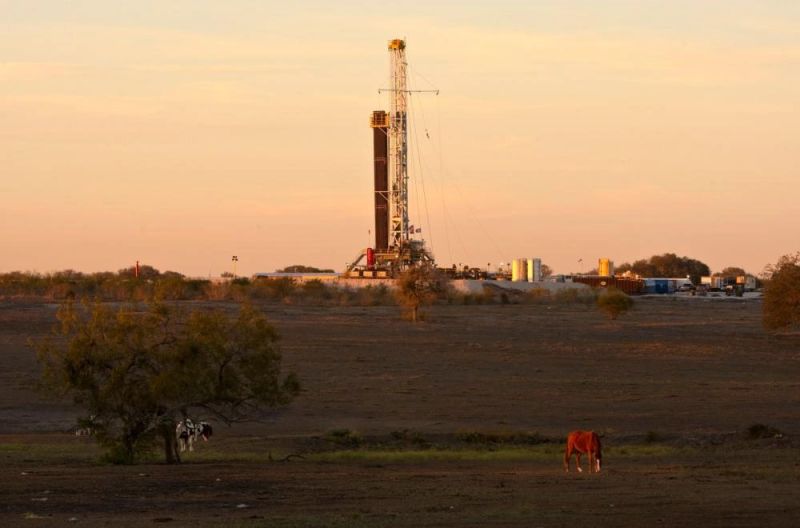
The Eagle Ford sale is the clearest portfolio move so far. Devon agreed to sell the position to Crescent Energy for $4.2 billion in cash. The package covers about 90,000 net acres in Karnes, DeWitt, and Gonzales counties, roughly 68,000 boe/d, and about 4 percent of Devon’s total production, with an effective date of July 1, 2026. Closing is expected by year-end or early 2027. CEO Clay Gaspar called the exit a direct result of the post-merger portfolio review, saying it improves go-forward capital efficiency and frees cash to accelerate buybacks and strengthen the balance sheet. Crescent, backed by KKR, expects substantial operating synergies on assets adjacent to its existing Eagle Ford position. Devon shares rose about 2 percent on the news; Crescent shares fell.
Second-quarter results, the first to include Coterra from the May 7 close, showed the cash-flow case that management is leaning on. Devon reported net earnings of $1.9 billion, or $2.03 per diluted share, and core earnings of $1.5 billion, or $1.57 per share. Operating cash flow was $3.7 billion; adjusted free cash flow was $1.7 billion after excluding $174 million of after-tax restructuring costs. Production averaged 1.359 million boe/d, near the top of guidance, with oil at 503,000 barrels per day. Capital spending of about $1.27 billion landed 2 percent below the midpoint. The quarterly dividend was raised 33 percent to $0.32 per share. Management said more than 350 synergy initiatives are identified and that roughly $600 million of the $1 billion run-rate target should be captured during 2027. The company also retired debt and funded a $2.6 billion New Mexico federal lease acquisition with cash on hand.
Guidance keeps the emphasis on oil and capital discipline. Full-year 2026 oil is guided at 495,000–505,000 barrels per day and total volumes at roughly 1.36–1.40 million boe/d. Third-quarter oil is expected at 550,000–560,000 barrels per day, with total volumes of 1.66–1.69 million boe/d and capital of $1.4–$1.5 billion. Spending is set to ease in the fourth quarter as activity slows in selected units. Leverage is targeted below 1.0x net debt-to-EBITDAX. Third-quarter results are scheduled for November 5, when Devon has said it will update the outlook for the Eagle Ford sale.
The commodity backdrop is doing some of the work. WTI averaged about $97 per barrel in September and has traded in a roughly $90–$100 range amid Middle East flow constraints. The EIA’s October Short-Term Energy Outlook forecasts Brent averaging $105 per barrel in the fourth quarter of 2026, assuming constrained Middle East exports and inventory draws, before easing in 2027. Higher realizations support the free-cash-flow and divestiture math; they also widen bid-ask spreads on remaining non-core packages, which is why some market participants argue against forcing a fire sale of the Marcellus, Anadarko, or Powder River positions.
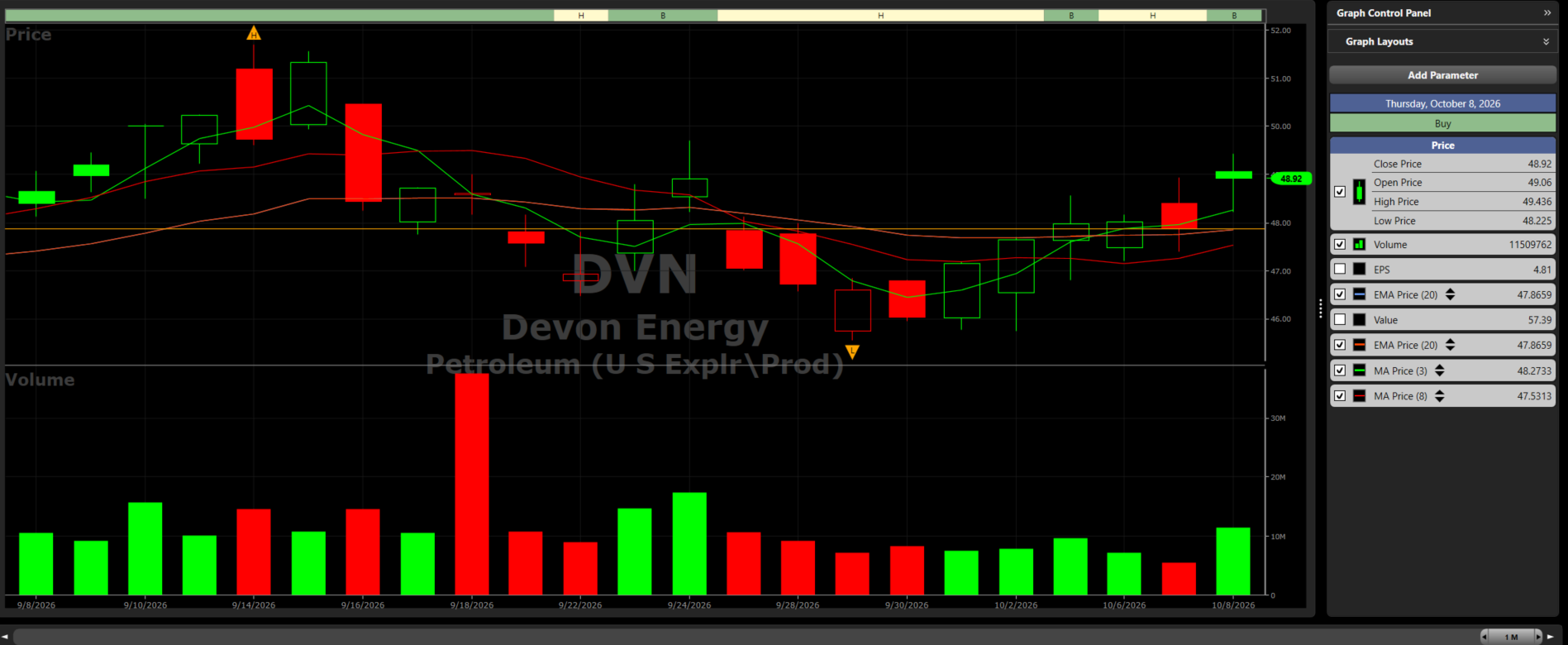
Analysts are constructive but not unanimous on timing. Consensus sits at Buy to Strong Buy across roughly 28–30 firms, with average 12-month targets clustered around $60–$62—about 23–30 percent above the roughly $49 share price after the Eagle Ford announcement. Recent moves include UBS lifting its target to $65 (Buy), BMO at $67 (Outperform), and Barclays at $60 (Buy). The bull case rests on Delaware inventory depth, synergy capture, buyback capacity from asset-sale proceeds, and torque to elevated oil prices. The caution is that activists still want faster non-core exits, integration costs are still running through the numbers, and any sharp oil pullback would test the “wait for better bids” stance.
The February deal is no longer a headline; it is an integration and capital-allocation test. The Eagle Ford sale shows Devon is willing to shrink to the Delaware core. Whether that satisfies holders who wanted a fuller portfolio reset—or a sale of the company—will show up in the next round of dispositions and in the November outlook.
Check out the World’s Greatest Podcast Show Notes at EnergyNewsBeat.co or EnergyNewsBeat.com. And subscribe to: The Energy News Beat Substack.
- Steve Reese, “Devon’s Dilemma,” LinkedIn (via https://lnkd.in/p/gXdehema): https://www.linkedin.com/posts/steve-reese-185a86_energy-permian-mergers-share-7514043985850626048-3eh0/
- Devon/Coterra merger announcement (SEC Exhibit 99.1, Feb. 2, 2026): https://www.sec.gov/Archives/edgar/data/1090012/000119312526032720/d75203dex991.htm
- Reuters, merger announcement (Feb. 2, 2026): https://www.reuters.com/legal/transactional/us-shale-producers-devon-coterra-merge-58-billion-deal-2026-02-02/
- WSJ, merger coverage (Feb. 2, 2026): https://www.wsj.com/business/deals/devon-coterra-to-merge-in-58-billion-deal-c6509a75
- GlobeNewswire / Devon IR, merger completion (May 7, 2026): https://www.globenewswire.com/news-release/2026/05/07/3290012/0/en/devon-energy-and-coterra-energy-complete-merger.html and https://investors.devonenergy.com/investors/press-releases/press-release-details/2026/Devon-Energy-and-Coterra-Energy-Complete-Merger/
- Devon Q2 2026 earnings release (SEC): https://www.sec.gov/Archives/edgar/data/1090012/000119312526332824/d359332dex991.htm
- Devon Q2 2026 earnings presentation: https://s2.q4cdn.com/462548525/files/doc_financials/quarterly/2026/q2/Q2-2026-DVN-Earnings-Presentation.pdf
- Devon IR, Q2 call materials and Q3 date: https://investors.devonenergy.com/investors/events-presentations/event-details/2026/Q2-2026-Earnings-Conference-Call/default.aspx
- OilPrice.com, Q2 profit summary: https://oilprice.com/Company-News/Devon-Posts-19-Billion-Q2-Profit-After-Coterra-Merger.html
- Reuters, Eagle Ford sale to Crescent (Oct. 8, 2026): https://www.reuters.com/legal/transactional/devon-energy-sell-eagle-ford-assets-crescent-energy-42-billion-2026-10-08/
- Houston Chronicle, Eagle Ford sale: https://www.houstonchronicle.com/business/energy/article/houston-oil-giant-devon-sells-4-2b-eagle-ford-22468565.php
- Bloomberg, Devon–Crescent talks/sale: https://www.bloomberg.com/news/articles/2026-10-08/devon-to-sell-4-2-billon-shale-oil-assets-to-crescent-energy
- Bloomberg, Kimmeridge on asset-sale pace (July 9, 2026): https://www.bloomberg.com/news/articles/2026-07-09/kimmeridge-faults-pace-of-devon-energy-s-asset-sale-efforts
- TipRanks, post-sale rating snapshot: https://www.tipranks.com/news/devon-energy-stock-rises-after-4-2b-asset-sale-to-boost-efficiency
- StockAnalysis.com, consensus targets: https://stockanalysis.com/stocks/dvn/forecast/
- MarketScreener, UBS target to $65: https://www.marketscreener.com/news/ubs-adjusts-price-target-on-devon-energy-to-65-from-63-keeps-buy-rating-ce785ddedb88f724
- EIA Short-Term Energy Outlook (Oct. 6, 2026): http://goo.gl/1ywm16
- FocusEconomics, WTI price context: https://www.focus-economics.com/commodities/energy/wti-crude-oil/
- OilPrice.com, deal and investor-return framing: https://oilprice.com/Energy/Crude-Oil/DevonCoterra-Deal-Signals-Investors-Still-Rule-the-Shale-Patch.html

