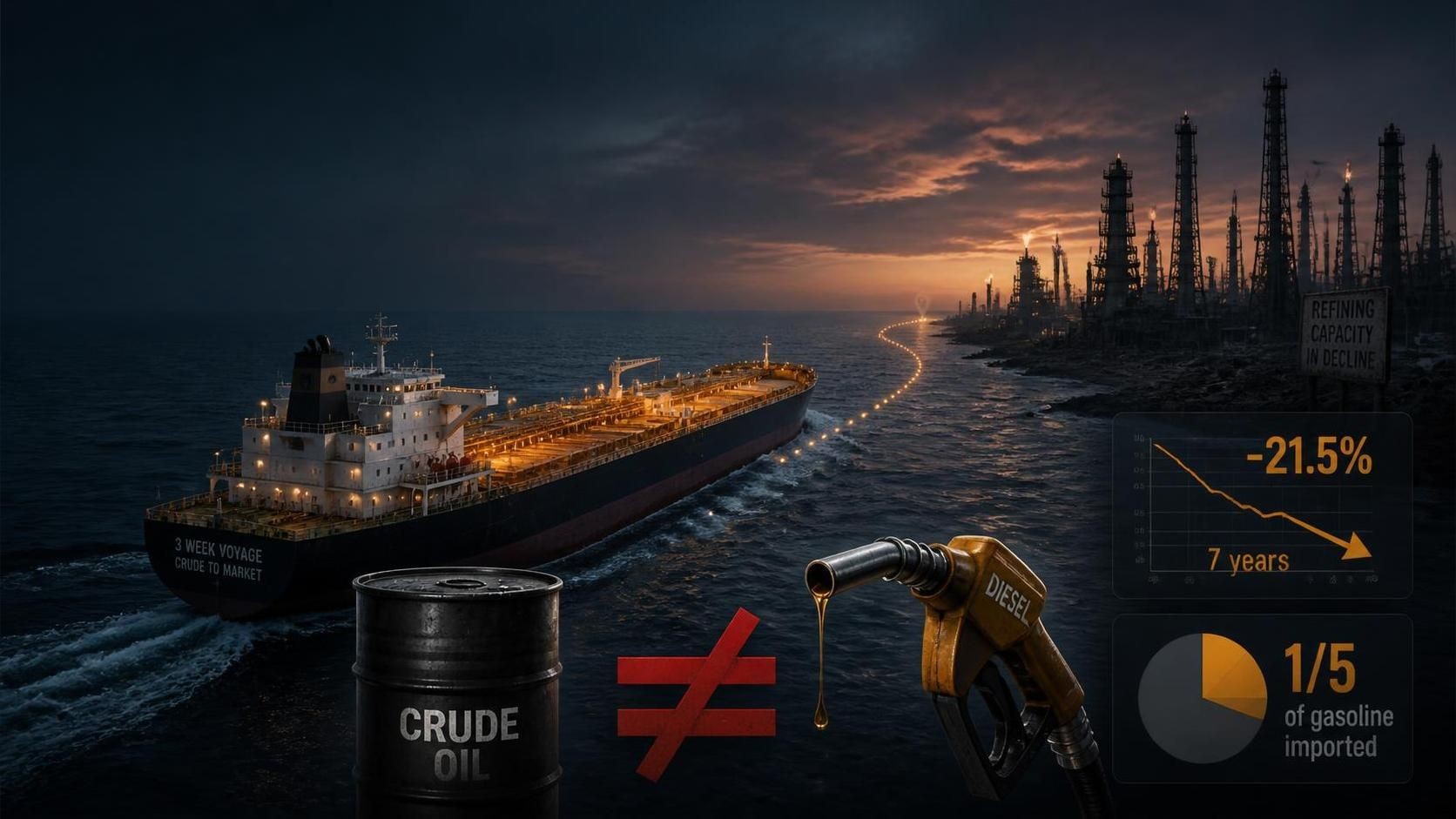
Europe’s refinery rethink is real, smaller than the headlines, and exactly the argument California needs to hear. The state cut 21.5% of its refining capacity in seven years, 64% of the entire national decline, and now buys a fifth of its gasoline across a three-week ocean voyage with no pipeline to fall back on.
By Energy News Beat | Oct. 31, 2026 | Council of the EU doc 14726/1/26 REV 1, read Oct. 30, 2026; EIA Refinery Capacity Report, 2019 and 2026 editions; FuelsEurope/Concawe Statistical Report 2026
On Oct. 28 the European Commission held its first high-level dialogue on oil refining. Energy Commissioner Dan Jørgensen and Defense Commissioner Andrius Kubilius co-chaired it, with NATO at the table beside refiners and technology providers — the first time this dialogue has put refining and defence at the same table.
Kubilius brought the frame, quoting Pershing on logistics: “defence without fuel is impossible.” Jørgensen brought the admission: “This is not just a matter of economic competitiveness. It is also a matter of security”. Six governments brought the sentence. In Council document 14726/1/26 REV 1, dated Oct. 28, Bulgaria, Czechia, Hungary, Italy, Poland and Slovakia wrote: “Security of crude oil supply and security of refined product supply are distinct challenges. Crude oil cannot substitute for diesel or aviation fuel without suitable processing capacity”.
That refutes the assumption under a decade of policy on two continents: that crude and diesel are interchangeable if you pay the freight. Closing that gap takes steel that cannot be conjured in the week it is needed.
What Europe announced, and what it did not
The direction came from above. The European Council of Oct. 15–16 welcomed the Commission’s intention to “develop a short-term framework to optimise the capacity and efficiency of EU refineries” — optimise, not expand: utilization, not new capacity. That language is the Council’s own: EUCO 14/26 of Oct. 16, 2026, paragraph 6, read in full in the published conclusions.
Here is what the headlines missed. Nothing was announced. No funding. No state-aid mechanism. No capacity target. No exemption. No plant reopened. No next step before early 2027. What emerged was a promise to assess industry proposals, a joint roadmap and support for a Refining Strategy — “a constructive start,” in FuelsEurope’s words.
Before a critic raises it, put the strongest counter-argument ourselves. Jørgensen: “The production of renewable liquid fuels has already compensated some of the reduction in Europe’s refinery capacity. The potential is significant”. Fair, and it does not survive the product slate: renewable diesel substitutes for what a hydrotreater can make, not for the distillation and coking that turn crude into middle distillates. Europe’s import dependence, by Bruegel’s count: 17 percent of diesel supply and 38 percent of jet supply are imported, and diesel imports grew twenty-five-fold since 1990. The Commission’s topic page still says the sector must “adapt to shrinking capacity”.
The capacity record: 21 percent, not 10
On Concawe’s numbers, Europe ran 72 refineries and 625.4 million tonnes a year in 2025 across the EU-27 plus the U.K., Norway and Switzerland. Against an implied 2009 base of 793.0 million tonnes, that is 167.6 million tonnes gone, or 21.1 percent; EU-27 alone, 66 refineries and 567.4 million tonnes. Count plants and it holds: 30 of roughly 100 refineries larger than 30,000 barrels a day closed or converted since 2009, which is where the “a quarter” line comes from.
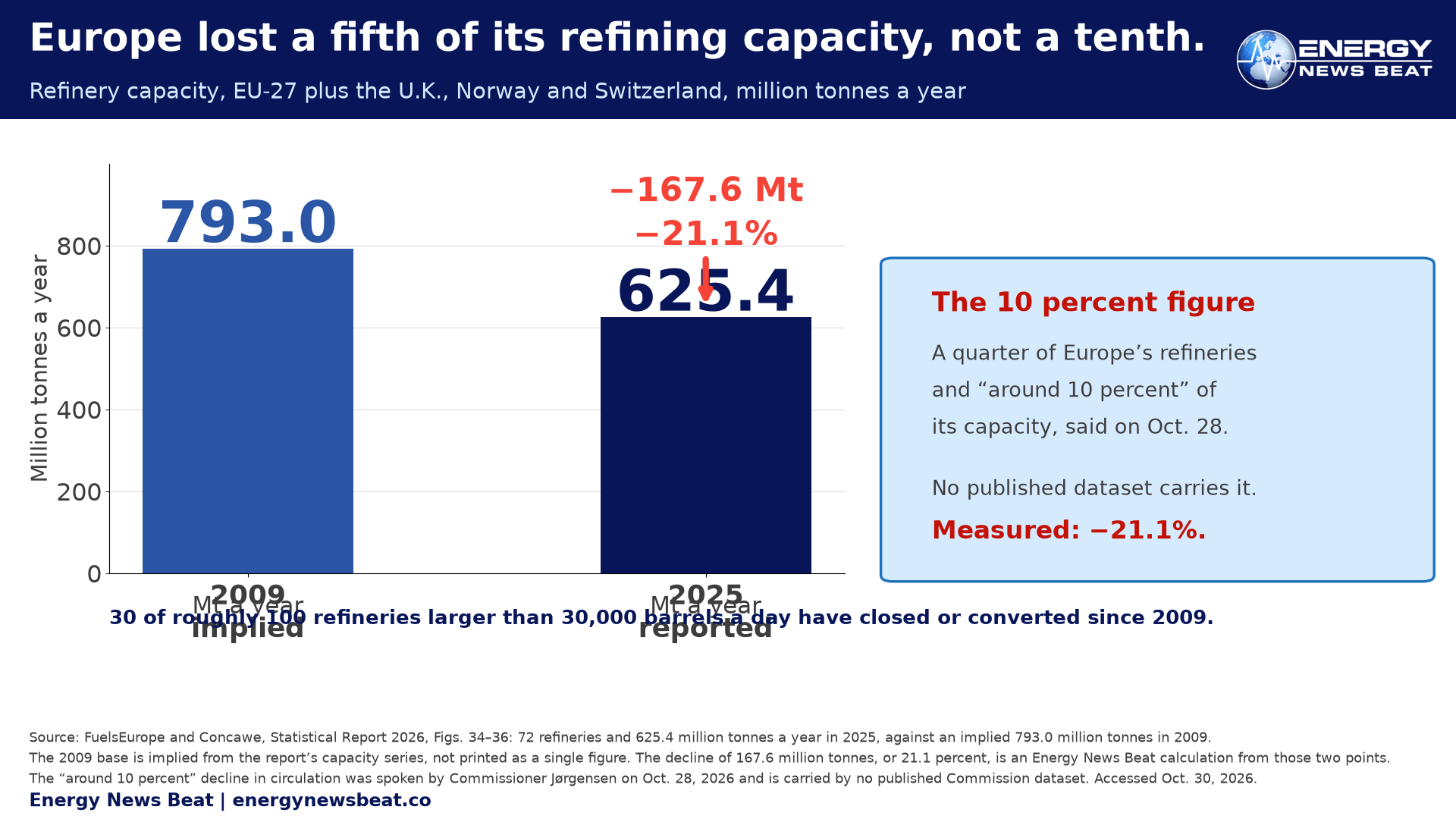
The number in circulation is smaller. Jørgensen said it out loud: “Over the last two decades, around a quarter of EU refineries were shut down, decreasing domestic refining capacities by around 10 percent”. Euronews reported the same attribution. It is the Commissioner’s spoken number, carried by no published Commission dataset — no annex, and Eurostat publishes no refinery counts at all. Set 10 against 21.1 for the same fleet and only one can be right; we use 21.1.
Six governments, and Italy’s arrival
14726/26 of Oct. 26 carried Poland, Czechia and Slovakia. REV 1 of Oct. 28 carries six, adding Bulgaria, Hungary and Italy, whose second-largest EU refining sector is 78.6 million tonnes across nine refineries, behind Germany. A G7 economy with a Mediterranean coast signing is bigger than three landlocked states objecting.
The second sentence worth keeping: “The pace of reductions in conventional capacity must reflect actual changes in demand, the availability of alternatives and the resilience of regional supply chains”. The redraft is the politics: Oct. 26 said “Closures primarily affect smaller refineries”; Oct. 28 said “Closures affect all types of refineries, creating, from the perspective of energy security, a strategic vulnerability in the system”.
What the six did not ask for matters as much: no moratorium, no capacity floor, no fund, no subsidy. The ask is “access to investment financing”, a door left ajar — as is the €27 billion NATO programme for storage and pipelines: defence logistics, not a refinery subsidy.
The squeeze that produced the meeting
The cracks explain the timing, and the windfall lands in the refinery, not the wellhead. Europe’s diesel barge crack averaged about $60 a barrel from Oct. 1 to Oct. 12, rose above $74 on Oct. 16 against a peak of $98.01 on Sept. 1, and jet blew out relative to diesel by $11.75 a barrel on Oct. 16 because, in S&P Global’s words, “Everyone in Europe is so focused on diesel”.
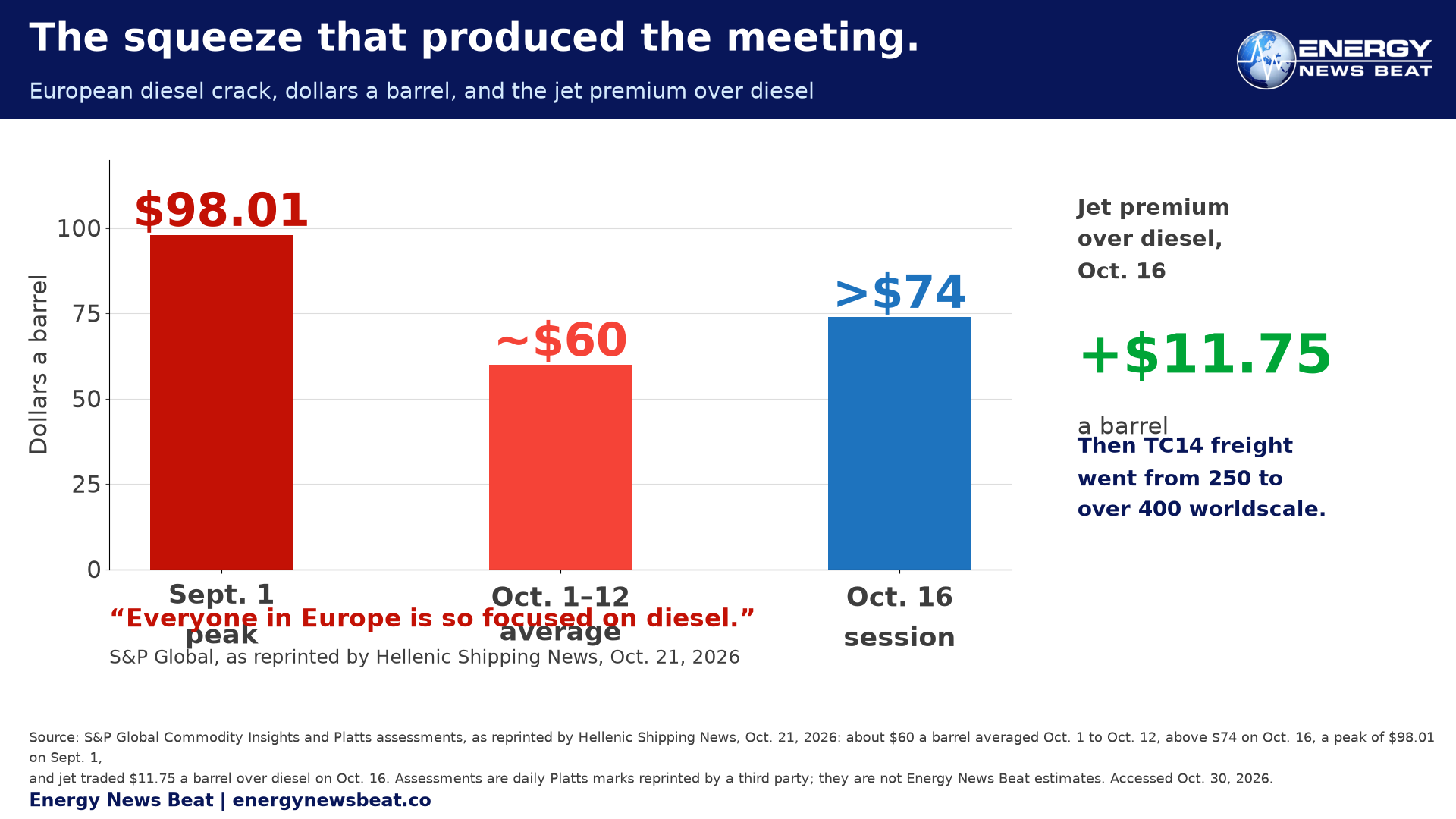
Logistics broke the arbitrage. The U.S. Gulf Coast supplied almost half of North West Europe’s diesel imports and TC14 freight went from about 250 to more than 400 worldscale. Europe tightened its own rules too, which is why the squeeze lands on the refinery and not the wellhead: from Jan. 21, 2026 imported product must be proven free of Russian crude, and Turkey’s diesel exports to the EU fell from 87,000 barrels a day to 45,000.
Two denominators. The Commission says EU refineries supply about 70 percent of jet and 85 percent of diesel consumed in Europe; Bruegel says 17 percent of diesel supply and 38 percent of jet supply is imported. The biggest money figure is the softest: Jørgensen said in Dublin on Sept. 29 that Europe paid more than €100 billion extra for energy this year, oil and gas, no method disclosed. The Associated Press dollarized it at $113.5 billion.
California: the cleanest number in the file
Two vintages of one EIA table, same definitions. California’s operable capacity was 1,909,671 barrels a calendar day on Jan. 1, 2019 and 1,499,171 on Jan. 1, 2026: 410,500 gone, or 21.5 percent, the count falling from 15 refineries to 12. The entire United States went from 18,802,435 to 18,160,493, down 641,942 or 3.4 percent.
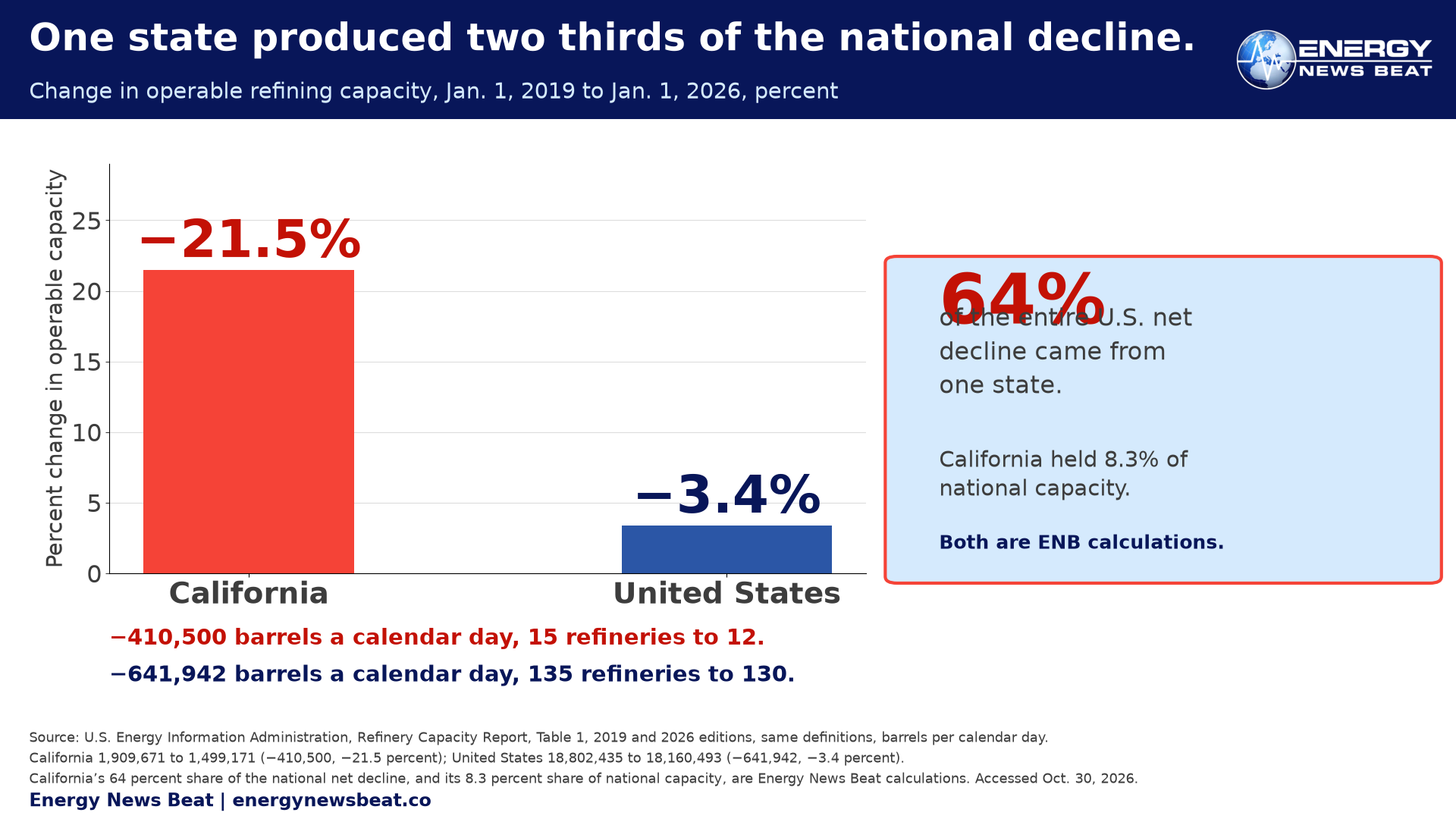
California accounted for 64 percent of the entire national net decline while holding 8.3 percent of national capacity — Energy News Beat calculations from published EIA figures. One state held a twelfth of the capacity and produced two thirds of the shrinkage.
One flag: EIA’s Jan. 1, 2026 table lists Marathon’s Los Angeles refinery — Carson and Wilmington together — at 365,000 barrels a calendar day, and it is running; a hydrocracker went down for planned work in October. The separate Phillips 66 Wilmington refinery, 139,000 barrels a calendar day, ceased crude processing on Oct. 16, 2025 and is gone from the 2026 count. The figure that runs generous is Benicia: its 145,000 barrels a calendar day are counted at Jan. 1, 2026, but Valero stopped refining there at the end of April. Of the twelve, seven with fluid catalytic cracking or alkylation still make gasoline.
The logistics are the problem, not the capacity
The state’s own energy agency: “There are no pipelines bringing fuel into the state.” Pipelines link its refining centres to Nevada and Arizona and only flow east. “Overseas supply can take three weeks”, and spikes “may last longer for Californians because resupply time is longer”.
19 percent of California gasoline supply came from imports in 2025, about 167,000 barrels a day. Through April 10, 2026 imports ran near 345,000 barrels a day, up 38 percent, with the state projecting 25 to 35 percent statewide, up to 50 percent in the north. India, South Korea and Taiwan supplied about two thirds of 2025 gasoline imports; Washington State, the backstop, supplies up to 45 percent normally and under 20 during outages.
Two refineries in Martinez is the fact that trips people, and it trips them in both directions. What closed and converted was Marathon’s Golden Eagle refinery at Martinez/Avon — 166,000 barrels a day on a stream-day basis, which EIA counts at 161,000 a calendar day and Marathon’s own 10-K calls Martinez, California, 161 mbpcd — which Marathon idled in 2020 and is converting to renewable diesel. What did not close is the Shell-built Martinez refinery next door: Shell sold it to PBF Energy for $960 million in February 2020, a $1.2 billion deal with the inventory, and PBF still runs it at about 157,000 barrels a day. EIA’s phrasing is right. So is the closure it records. The shorthand that gets it wrong is common enough that this article names both plants.
2025: a buyer search, a $200 million idea, $5.25 million for imports
California did try the European playbook, quietly. On July 23, 2025 Reuters reported exclusively that state officials had stepped in to find a buyer and talked to HF Sinclair. No sale resulted. On Sept. 9, 2025 Bloomberg reported that $80 million to $200 million of state funds would likely be earmarked for routine maintenance, the terms subject to change, attributed to people familiar with the talks; ABC7 carried it two days later. GasBuddy’s Patrick De Haan called the posture “an about-face and stepping in to keep refineries from shutting down.”
No bailout passed and no buyer emerged; Valero stopped refining at the end of April 2026. What the state paid for was the terminal. Under AB 113 it appropriated $5.25 million: $3.75 million for city services “as the Valero Benicia Refinery is used for Fuel Import Operations” plus $1.5 million community benefit, backing a standstill from Oct. 1, 2026 to June 30, 2027. The city voted Oct. 20 and will seek $7 million more.
Confronted with a refinery closure, the world’s fifth-largest economy spent $5.25 million to keep imported fuel moving and nothing to keep refining. You cannot order a refinery back to life when the owner is redeveloping and the state is paying for imports.
Washington is running the reversal Sacramento would not
We asked in October whether refineries can be reopened at all; the federal government is now attempting at national scale what California declined at state scale, after we argued the legal path to reopen a plant existed before the political will did. Presidential Determination No. 2027-01 was signed Oct. 22, 2026 and published Oct. 28 as FR Doc. 2026-22052 at 91 FR 68011, invoking section 303 of the Defense Production Act and waiving 303(a)(1)-(a)(6) under 303(a)(7). It is the second such determination this year: No. 2026-11, signed April 20 and published at 91 FR 21933, made the same findings and went to the Secretary of Energy. October’s goes to the Secretary of War. The Department of Energy’s announcement of the same day names No. 2026-11 in error; the Federal Register prints No. 2027-01. The money is up to $150 million of DPA Title III authority against $1 billion appropriated.
Energy Secretary Chris Wright: “After 17 years of Democrat leaders enacting energy subtraction policies that led to the closure of refineries and more expensive refined oil products, the Trump Administration is taking action to expand our nation’s refining capacity and strengthen our energy security”. Argus reported that the Department of Energy is canvassing essentially every refinery shut in the last decade, and that Wright told the outlet Benicia was “a tough challenge,” citing the business environment in the state. That second attribution is Argus’s, not the department’s.
Then the industry answered, on the record, the same day the determination was signed. On the Oct. 22 earnings call, Valero general counsel Rich Walsh described his own idle plant: “safely idle and has been since April. And we have no plans to restart it”. Of the talks: “none of those efforts actually materialized anything”. A restart would mean “reinventory it. You would have to restaff it. You would have to undertake a rather extensive turnaround”.
Chief executive Lane Riggs: “It would be very difficult for them to help the prompt situation”, and “the idea that there is these refineries that you can just sort of walk in and put the lights on and they are going to start running is not exactly the case”.
The constraint is arithmetic. $150 million across Benicia’s 145,000 barrels a calendar day is about $1,034 a barrel a day — in the range of a preserved-shutdown restart, against Delaware City, $220 million to buy and $125 million to $150 million to overhaul 182,200 barrels a day, about $1,950 all in, and Limetree Bay at $2.7 billion overhaul for 210,000 barrels a day as reported by Reuters. Washington’s cheapest barrel is not a restart: it is Delek’s expansion at Tyler, Texas, to 74,000 barrels a day.
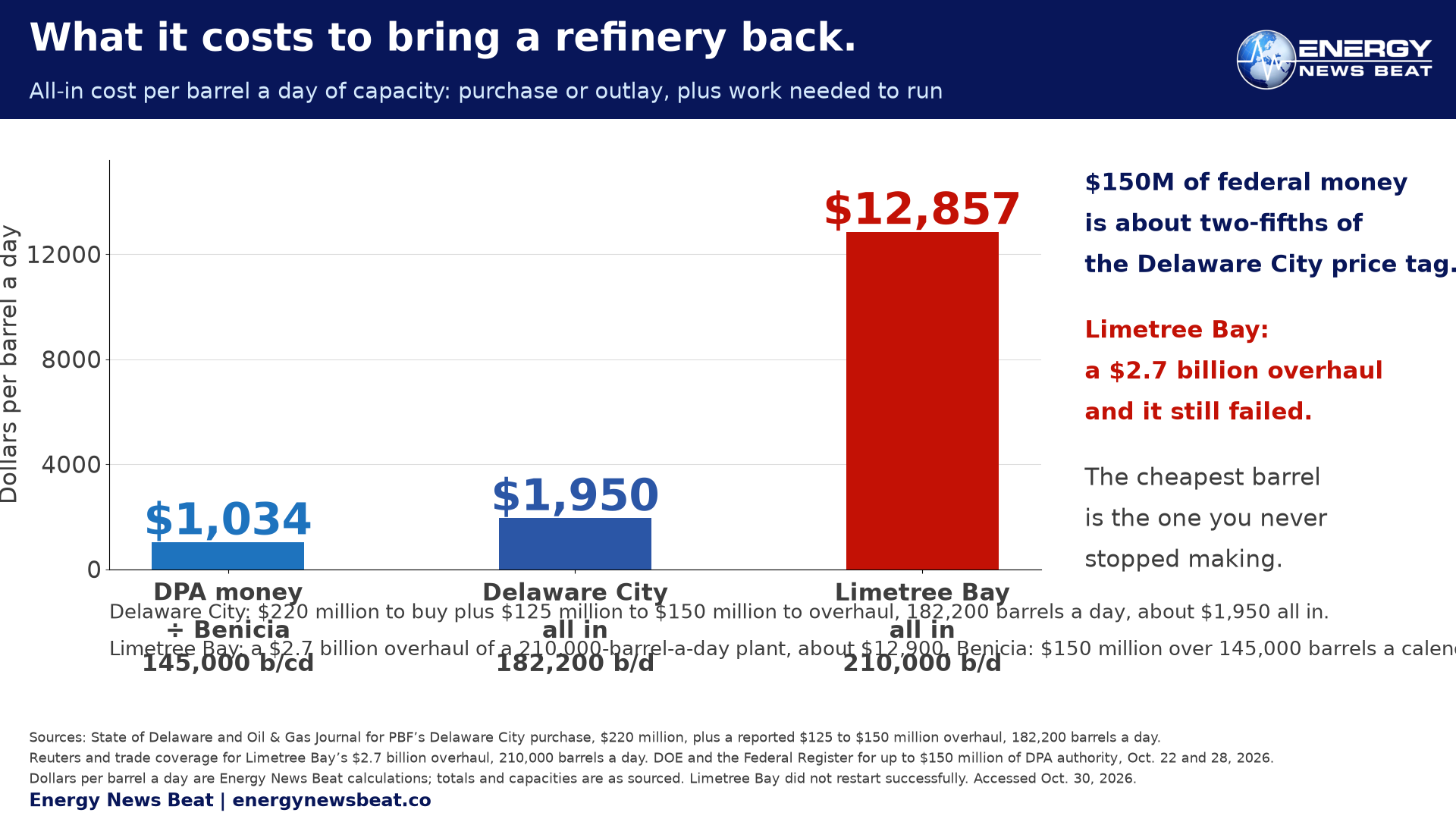
The private-sector answer
The market’s response was not to reopen a refinery but to build the pipeline that should have existed. On Aug. 11, 2026, Phillips 66, Kinder Morgan and HF Sinclair announced a final investment decision on an approximately 900-mile new-build line from Borger, Texas to Phoenix, reversing Kinder Morgan’s SFPP West Line and Phillips 66’s Gold Pipeline, initial capacity of 230,000 barrels a day, targeted for 2029 “subject to receipt of all permits and regulatory approvals.”
Hold 230,000 next to Giannini’s threshold: the import volume needed to fully offset both California closures is 283,000 barrels a day, where the modelled price effect goes to zero. Western Gateway is almost exactly that number, in private capital rather than subsidy. FID is not steel in the ground, but it is the first structural answer to a state with no inbound fuel pipeline.
Consumer and investor views
For a household the question is not the average price but the tail. A state importing a fifth of its gasoline across three weeks of ocean has no shock absorber when a tanker is late; heating oil in New England hit a record $6.05 a gallon in the week of Oct. 29 with about half of households on oil. For an investor the signal is capital and time: a restart is a multi-hundred-million-dollar bet on a 30-year asset in a market where demand is projected to fall 0.5 to 2 percent a year. Delaware City worked because PBF bought a preserved plant cheaply and had it running within sixteen months. Valero’s “no plans to restart it” outweighs the federal money because the owner decides.
The honest counter-case
Start with the tax bill, the strongest part of the other side. In the week of Oct. 26, California regular averaged $5.888 against $4.269 nationally, a premium of $1.619, diesel at $8.155 against $6.352. The comparison has to be built carefully, because the national average already contains every other state’s gasoline tax. EIA puts California’s state taxes and fees at 70.9 cents a gallon against a 33.3-cent average across states, so the excess levy is about 37.6 cents. Add the Low Carbon Fuel Standard at about 17 and Cap-and-Invest at about 25, plus the sales tax those programmes and the rest of the pump price carry at the state’s 2.25 percent average — about 11 cents on a taxable base near $5.07, though it is a derivation rather than a published line item — and California policy explains roughly 91 cents of the $1.619, or 56 percent. The other 71 cents is CARBOB, marine freight and the cost of being isolated, which is more than this article claimed the last time we ran these numbers. We had it at 70 percent; that version double-counted, charging California’s full excise against an average that already held everyone else’s.
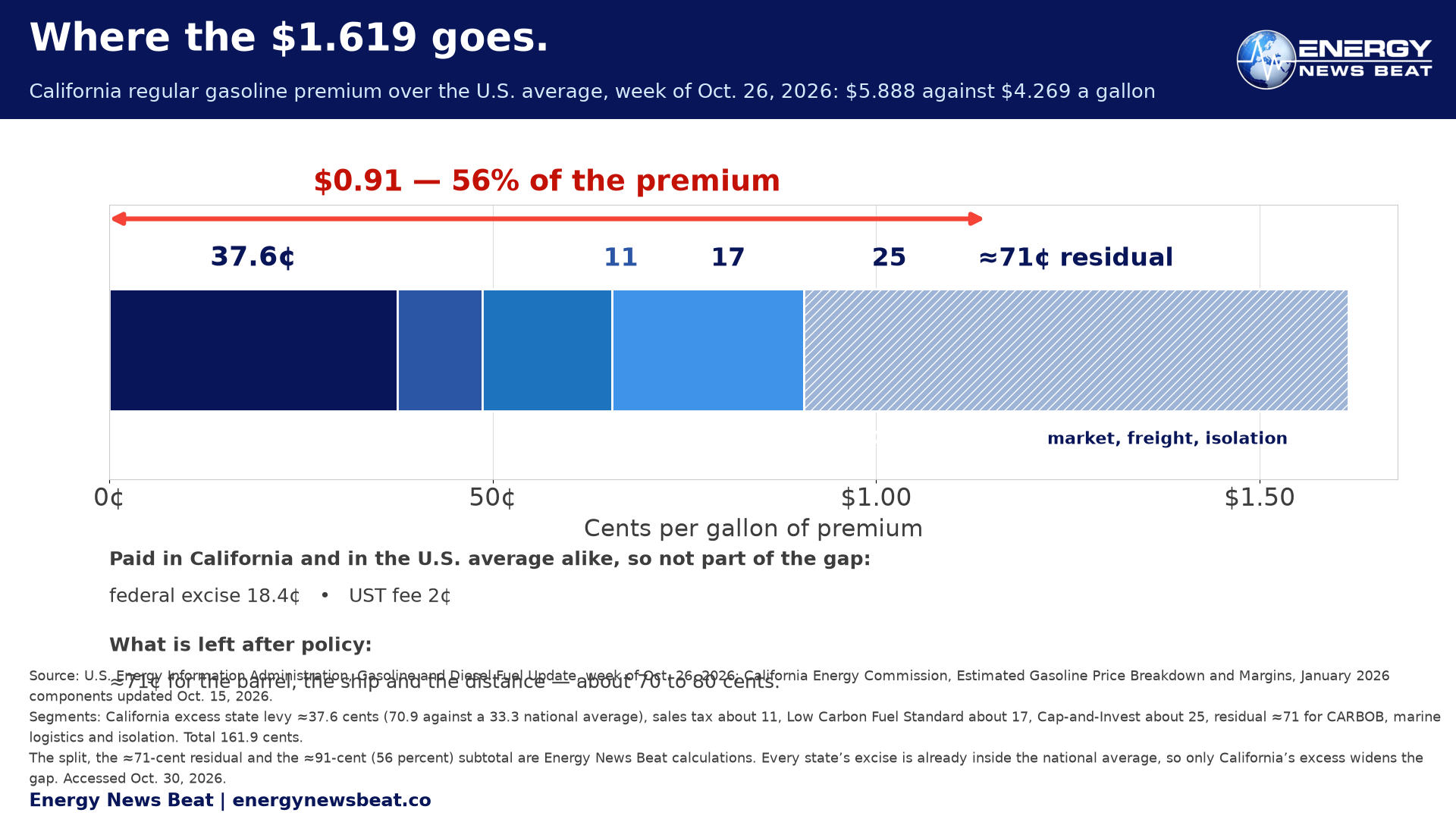
The Institute for Energy Research makes it structurally: “producing crude oil or hosting refineries does not, by itself, make a state’s gasoline cheaper once taxes and the refining region are accounted for”. Pennsylvania lost 335,000 barrels a day when Philadelphia Energy Solutions shut in 2019 and a Democratic governor refused state money to restart it. Washington State, with a clean fuel standard, a fuel-inclusive cap and a county-level ban on new refineries, still runs 648,200 barrels a calendar day.
The price dispute is narrower than it sounds. Giannini’s four scenarios at a $4.56 reference run from a $1.23 increase to a 63-cent decrease, with zero in the middle, depending on how much import capacity answers the closures; Stanford’s Mahoney and Cummings put the effect between “negligible” and “15 cents/gallon as a conservative upper bound,” conditional on streamlined permitting. The gap is an assumption about logistics, not the data, and permitting decides it.
The moral hazard objection comes from that same paper: subsidizing Valero could produce “significant overpayments” and “a vicious cycle where additional financially viable refineries threaten shutdowns to extract their own subsidies”. No American state, blue or red, runs a refinery keep-open subsidy; California’s money went to imports.
Europe’s counter-case deserves its best number: the Commission says EU refineries still supply about 85 percent of the diesel and 70 percent of the jet consumed in Europe, a genuine strength claim. What does not stand is the implication that Europe reversed. We could find no major European refinery that has restarted crude processing after a full closure; North Macedonia’s OKTA is under assessment, a restart “just one of the options”; Italy’s ISAB was a distressed-but-running rescue, 51 percent sold to Ludoil.
Easy to announce, hard to execute
Europe reopened a question it had closed, in a room with NATO in it, and put security ahead of emissions in the reasoning without spending a euro or reopening a plant. California ran the only American version of that experiment and failed in a documented way: a buyer search that found nobody, a maintenance package never enacted, $5.25 million that went to imported fuel. The reversal is easy to announce and hard to execute, and the cheapest barrel is the one you never stopped making.
| STU’S TAKE
Opinion. Every number is linked to its source. Europe did not reverse its refinery phase-down. It reopened a question it had spent twenty years closing, and it did it in a room with NATO in it, which tells you what changed. Six governments, including Italy, signed a sentence that could have been written in Sacramento: crude cannot substitute for diesel or aviation fuel without suitable processing capacity. That is not a policy. It is an admission, and admissions are how reversals start. We should be precise about what it is worth. Nothing was announced: no fund, no target, no exemption, no reopened plant, and no next meeting until early 2027. Europe has not restarted a single closed refinery. What it has done is stop pretending the closures were free. California is the only American state that has run this experiment, and it ran it in 2025. It went looking for a buyer and found none. It discussed $200 million and appropriated nothing. Then it paid $5.25 million to keep imported fuel moving through the site, because a terminal was cheaper than a refinery. That is seven years in one line item: 21.5 percent of the state’s capacity gone, 64 percent of the national decline, a fifth of its gasoline arriving across three weeks of ocean. We are not going to win this on the average price, and we should stop trying. About 56 percent of California’s premium is taxes and carbon programmes the voters chose — and that is counting only the state’s excess levy, not the whole 61.2 cents every other state also charges. Say so, then ask the question that survives the concession: what happens in the week a tanker does not arrive? A state with no inbound fuel pipeline and seven gasoline-making refineries has one answer, and it is three weeks long. Washington is now attempting at federal scale what Sacramento would not do at state scale, and Valero’s answer was that the plant is safely idle and it has no plans to restart it. That is the lesson. The reversal is easy to announce and hard to execute, and the cheapest barrel is the one you never stopped making.
|
Check out the World’s Greatest Podcast Show Notes at EnergyNewsBeat.co or EnergyNewsBeat.com. And subscribe to: The Energy News Beat Substack.
Appendix
Sources, verbatim excerpts, data tables, methodology notes and corrections for “Six Governments Just Admitted You Can’t Substitute Crude for Diesel”. Every figure in the article resolves to one of these entries. Where a number is an Energy News Beat calculation it is labelled as one here and in the text.
A. Sources (all accessed Oct. 30, 2026)
- Council of the European Union, doc. 14726/1/26 REV 1, Oct. 28, 2026 (non-paper: information from six member states, AOB item for the Energy Council of Oct. 29, 2026; four pages, no annex)
- Council of the European Union, doc. 14726/26, Oct. 26, 2026 (original three signatories)
- European Commission, DG Energy, “Commission launches High-Level Dialogue with the European oil refining sector,” Oct. 28, 2026
- European Commission, statement 26/2278, Oct. 28, 2026
- European Commission, DG Energy, European refining topic page
- Euronews, “Europe needs more oil refineries to weather energy shocks, EU warns,” Oct. 28, 2026
- Anadolu Agency, report on the Oct. 28 refining dialogue and Commissioner Jørgensen’s remarks
- European Council conclusions, EUCO 14/26, Brussels, Oct. 16, 2026, paragraph 6 (refinery capacity and efficiency)
- FuelsEurope and Concawe, Statistical Report 2026, refining capacity and closure series, Figs. 34–36
- Bruegel, “Europe must prepare for a possible oil supply crunch,” 2026
- S&P Global Commodity Insights and Platts diesel and jet assessments, as reprinted by Hellenic Shipping News, Oct. 21, 2026
- Kpler, analysis of the diesel arbitrage and TC14 freight, 2026
- NATO, North Atlantic Council news release, “North Atlantic Council approves NATO funding for upcoming years, agrees fuel supply chain plan,” July 22, 2026
- Associated Press, report on European energy import costs, Sept. 29, 2026
- Reuters, report on Indian diesel exports and the EU ban on Russian-crude-derived product, Jan. 27, 2026
- S. Energy Information Administration, Refinery Capacity Report, Table 1, as of Jan. 1, 2019
- S. Energy Information Administration, Refinery Capacity Report, Table 1, as of Jan. 1, 2026
- S. Energy Information Administration, Gasoline and Diesel Fuel Update, week of Oct. 26, 2026
- S. Energy Information Administration, Today in Energy, on West Coast refining, July 10, 2024
- S. Energy Information Administration, Today in Energy, on West Coast refining, July 9, 2025
- California Energy Commission, “What drives California’s gasoline prices”
- California Energy Commission, Estimated Gasoline Price Breakdown and Margins, January 2026 components updated Oct. 15, 2026
- California Energy Commission, California’s Oil Refineries reference page
- Giannini Foundation of Agricultural Economics, University of California, ARE Update 29(3), “Can imports stabilize California gasoline prices?”
- Neale Mahoney and Mark Cummings, Stanford Institute for Economic Policy Research, analysis of the Valero Benicia closure, June 20, 2025
- Institute for Energy Research, “The Pacific Premium,” July 2026
- Presidential Determination No. 2027-01, FR Doc. 2026-22052, 91 FR 68011–68012, signed Oct. 22, 2026 and published Oct. 28, 2026
- S. Department of Energy, “Energy Department to Use Defense Production Act Funding to Restart American Refinery and Expand Capacity,” Oct. 22, 2026
- Argus Media, report on the Department of Energy refinery restart canvass, Oct. 2026
- Valero Energy Corp., third-quarter 2026 earnings call transcript, Oct. 22, 2026 (Motley Fool)
- Phillips 66, “Western Gateway reaches final investment decision,” Aug. 11, 2026
- Reuters, “Rare move: California steps in to find buyer for Valero refinery to avoid closure,” July 23, 2025
- Bloomberg News, Nathan Risser and Eliyahu Kamisher, “Between $80 Million and $200 Million Would Likely Be Earmarked for Routine Maintenance Work for San Francisco-Area Plant Under Deal,” Sept. 9, 2025, read through the Transport Topics reprint of the Bloomberg text (bloomberg.com is paywalled)
- ABC7 News (KGO), Suzanne Phan, report carrying the Bloomberg account of $80 million to $200 million in maintenance support discussed for Benicia, and interviewing Patrick De Haan, Sept. 11, 2025
- The Benicia Bridge, report on the AB 113 agreement and the fuel-import standstill, Oct. 2026
- State of Delaware, “PBF Energy Holdings restarts Delaware City refinery,” 2010
- Oil & Gas Journal, “PBF restarts Delaware City refinery,” 2010, and trade coverage of Limetree Bay
- PBF Energy, “PBF Energy completes acquisition of Martinez refinery, creates West Coast system,” Feb. 2020
- Revised Code of Washington 70A.535.005, clean fuel program, legislative findings
- Hydrocarbon Processing, “Pennsylvania governor says state won’t use tax dollars to restart refinery,” July 2019
- MIA News Hub (North Macedonia), “Mickoski orders an assessment of restarting the OKTA refinery,” Oct. 21, 2026
- Hydrocarbon Processing, “Ludoil takes control of ISAB refinery in Italy, plans €1.3 billion investment,” Sept. 2026
- American Petroleum Institute, PADD 5 gasoline imports chart and analysis
- Portland Press Herald, “Maine heating oil prices hit another record high,” Oct. 29, 2026
- Energy News Beat, “The Diesel Reckoning: Why Refineries Trump Politics,” Oct. 8, 2026
- Energy News Beat, “Diesel Crisis: Can America Reopen Refineries Before Energy Security Collapses,” Oct. 22, 2026
- Energy News Beat, “Big Oil’s Windfall Is in the Refinery,” Oct. 27, 2026
- Energy News Beat, “Could the DPA Reopen Benicia?” Oct. 21, 2026
B. Verbatim excerpts
Council of the European Union, doc. 14726/1/26 REV 1, Oct. 28, 2026, signed by Bulgaria, Czechia, Hungary, Italy, Poland and Slovakia: “Security of crude oil supply and security of refined product supply are distinct challenges. Crude oil cannot substitute for diesel or aviation fuel without suitable processing capacity.” [CONSREV] Link
The same document: “The pace of reductions in conventional capacity must reflect actual changes in demand, the availability of alternatives and the resilience of regional supply chains.” [CONSREV] Link
The same document, on closures: “Closures affect all types of refineries, creating, from the perspective of energy security, a strategic vulnerability in the system.” [CONSREV] Link
Doc. 14726/26, Oct. 26, 2026, the drafting the six later replaced: “Closures primarily affect smaller refineries.” [CONSINIT] Link
Energy Commissioner Dan Jørgensen, Oct. 28, 2026: “This is not just a matter of economic competitiveness. It is also a matter of security.” [COMMST] Link
Jørgensen, Oct. 28, 2026, the counter-argument in his own words: “The production of renewable liquid fuels has already compensated some of the reduction in Europe’s refinery capacity. The potential is significant.” [ANADOLU] Link
Jørgensen, Oct. 28, 2026, the disputed capacity figure: “Over the last two decades, around a quarter of EU refineries were shut down, decreasing domestic refining capacities by around 10 percent.” [COMMST] Link
Defence Commissioner Andrius Kubilius, Oct. 28, 2026, quoting Pershing: “defence without fuel is impossible.” [COMMDLG] Link
European Commission topic page on refining, current at Oct. 30, 2026: the sector must become more flexible and “adapt to shrinking capacity.” [COMMTOP] Link
Euronews, Oct. 28, 2026, on what the Commission is actually doing: its “immediate focus appears to be identifying measures that could increase production from facilities already operating in Europe.” [EURONEWS] Link
Council ask, doc. 14726/1/26 REV 1: member states request improved “access to investment financing.” No moratorium, capacity floor, fund or subsidy is requested. [CONSREV] Link
Presidential Determination No. 2027-01, FR Doc. 2026-22052, 91 FR 68011–68012, signed Oct. 22, 2026 and published Oct. 28, 2026, invoking section 303 of the Defense Production Act. [FEDREG] Link
Energy Secretary Chris Wright, Oct. 22, 2026: “After 17 years of Democrat leaders enacting energy subtraction policies that led to the closure of refineries and more expensive refined oil products, the Trump Administration is taking action to expand our nation’s refining capacity and strengthen our energy security.” [DOE] Link
Valero general counsel Rich Walsh, third-quarter 2026 call, Oct. 22, 2026, on the Benicia refinery: “safely idle and has been since April. And we have no plans to restart it.” [VALEROTR] Link
Walsh, on the state and federal entreaties: “none of those efforts actually materialized anything.” [VALEROTR] Link
Walsh, on what a restart would require: “reinventory it. You would have to restaff it. You would have to undertake a rather extensive turnaround.” [VALEROTR] Link
Valero chief executive Lane Riggs, Oct. 22, 2026: “It would be very difficult for them to help the prompt situation.” [VALEROTR] Link
Riggs, on the policy premise: “the idea that there is these refineries that you can just sort of walk in and put the lights on and they are going to start running is not exactly the case.” [VALEROTR] Link
GasBuddy petroleum analyst Patrick De Haan, interviewed by ABC7 (KGO), Sept. 11, 2025, on California’s posture: “an about-face and stepping in to keep refineries from shutting down.” ABC7’s own interview, not a Bloomberg quotation; Bloomberg does not quote him. [ABC7] Link
Mahoney and Cummings, Stanford SIEPR, June 20, 2025, on the price effect: “negligible” to “15 cents/gallon as a conservative upper bound,” conditional on streamlined permitting. [MAHONEY] Link
Mahoney, on the subsidy risk: “significant overpayments” and “a vicious cycle where additional financially viable refineries threaten shutdowns to extract their own subsidies.” [MAHONEY] Link
Institute for Energy Research, “The Pacific Premium,” July 2026: “producing crude oil or hosting refineries does not, by itself, make a state’s gasoline cheaper once taxes and the refining region are accounted for.” [IER] Link
California Energy Commission, on inbound fuel logistics: “There are no pipelines bringing fuel into the state.” [CECCOST] Link
California Energy Commission, on resupply: “Overseas supply can take three weeks,” and price spikes “may last longer for Californians because resupply time is longer.” [CECCOST] Link
S&P Global, as reprinted by Hellenic Shipping News, Oct. 21, 2026: “Everyone in Europe is so focused on diesel.” [SPH] Link
Phillips 66, Aug. 11, 2026, on the Western Gateway in-service date: “subject to receipt of all permits and regulatory approvals.” [P66WG] Link
North Macedonia, Oct. 21, 2026, on OKTA: a restart is “just one of the options.” [OKTA] Link
C. Data tables
C1. European refining capacity and refinery count by country, 2025
| Country | Refineries | Capacity, Mt/yr | Country | Refineries | Capacity, Mt/yr |
| Austria | 1 | 9.7 | Lithuania | 1 | 9.7 |
| Belgium | 2 | 32.0 | Netherlands | 5 | 59.7 |
| Bulgaria | 1 | 5.8 | Poland | 2 | 29.2 |
| Croatia | 1 | 4.6 | Portugal | 1 | 11.3 |
| Czechia | 2 | 7.9 | Romania | 3 | 11.9 |
| Denmark | 2 | 8.7 | Slovakia | 1 | 5.3 |
| Finland | 1 | 10.3 | Spain | 8 | 70.6 |
| France | 6 | 57.4 | Sweden | 3 | 19.8 |
| Germany | 11 | 98.7 | EU-27 total | 66 | 567.4 |
| Greece | 4 | 24.9 | Norway | — | 10.4 |
| Hungary | 1 | 7.7 | Switzerland | — | 3.2 |
| Ireland | 1 | 3.6 | United Kingdom | — | 44.4 |
| Italy | 9 | 78.6 | EU-27 + UK + NO + CH | 72 | 625.4 |
Source: FuelsEurope and Concawe, Statistical Report 2026, Figs. 34–36. Norway, Switzerland and the United Kingdom are shown for the total only; the report does not break their counts in the table used here. Italy’s 78.6 million tonnes across nine refineries is the second-largest sector in the EU-27, behind Germany at 98.7 and ahead of Spain at 70.6; the Netherlands is fourth at 59.7 and France fifth at 57.4.
C2. Operable refining capacity, California against the United States, two EIA vintages
| Measure | Jan. 1, 2019 | Jan. 1, 2026 | Change | Percent |
| California, barrels a calendar day | 1,909,671 | 1,499,171 | −410,500 | −21.5% |
| California, refinery count | 15 | 12 | −3 | −20.0% |
| United States, barrels a calendar day | 18,802,435 | 18,160,493 | −641,942 | −3.4% |
| United States, refinery count | 135 | 130 | −5 | −3.7% |
| California share of national capacity | 10.2% | 8.3% | −1.9 pts | — |
| California share of the national net decline | — | — | 64% | — |
Source: EIA Refinery Capacity Report, Table 1, 2019 edition and 2026 edition, same definitions in both. EIA publishes the capacity totals; the changes, percentages and both share measures are Energy News Beat calculations. The 2026 table lists Marathon’s Los Angeles refinery, Carson and Wilmington together, at 365,000 barrels a calendar day, and it is operating; a hydrocracker went down for planned work in October 2026. The refinery that ceased crude processing on Oct. 16, 2025 is the separate Phillips 66 Wilmington plant, 139,000 barrels a calendar day, which is absent from the 2026 count. The figure that runs generous is Benicia, counted at 145,000 barrels a calendar day on Jan. 1, 2026 although Valero stopped refining at the end of April 2026.
C3. California gasoline premium decomposition, week of Oct. 26, 2026 (cents a gallon)
| Component | Cents | In the gap? | Note |
| California regular, retail average | 588.8 | — | $5.888 a gallon |
| U.S. regular, retail average | 426.9 | — | $4.269 a gallon |
| Premium to be explained | 161.9 | — | $1.619 a gallon |
| California state taxes and fees | 70.9 | — | EIA, as of Jan. 1, 2026 |
| Average state taxes and fees, all states | 33.3 | — | EIA, as of Jan. 1, 2026 |
| California excess levy | ≈37.6 | yes | 70.9 minus 33.3 |
| Low Carbon Fuel Standard | ≈17 | yes | CEC January 2026 components |
| Cap-and-Invest | ≈25 | yes | CEC January 2026 components |
| Sales tax | ≈11 | yes | 2.25% on the taxable retail base (588.8 less 18.4 federal excise, 61.2 state excise, 2.0 UST = 507.2) ≈ 11.4 cents; a derivation, not a published line item |
| Subtotal, state policy | ≈91 | — | ≈56% of the premium, ENB calculation |
| Residual: CARBOB, freight, isolation | ≈71 | yes | ENB calculation |
Sources: EIA Gasoline and Diesel Fuel Update, week of Oct. 26, 2026; EIA, state taxes and fees as of Jan. 1, 2026, which puts California at 70.9 cents a gallon against a 33.3-cent average across states and a revised national average of 33.3; California Energy Commission price breakdown, January 2026 components updated Oct. 15, 2026. Federal excise (18.4 cents) and the Underground Storage Tank fee (2.0) are excluded from this table, and so is every other state’s levy, because all of them are already inside the $4.269 national average that the premium is measured against. Counting California’s full state levy against that average would charge it twice for the tax every state pays. The excess-levy method here instead isolates the amount by which California’s own taxes exceed the national average, which is the only part of the levy that widens the gap. The subtotal, the residual and the roughly 56 percent share are Energy News Beat calculations on a single vintage of components; they are not a time series and should not be compared with earlier decompositions that used different component values.
C4. The price effect of the California closures: four Giannini scenarios at a $4.56 reference price
| Scenario | Change per gallon | What has to be true |
| No import response | +$1.23 | Closures are not offset by imports; in-state supply clears |
| Partial response | +$0.63 | Imports arrive but logistics and freight absorb part of the shock |
| Full offset | $0.00 | Import capacity fully replaces the 283,000 barrels a day lost |
| Over-supply | −$0.63 | Import capacity exceeds the loss and competes down the price |
Source: Giannini Foundation of Agricultural Economics, University of California, ARE Update 29(3). The closures modelled total 283,000 barrels a day. Compare Mahoney and Cummings, Stanford SIEPR, June 20, 2025, who put the effect at “negligible” to “15 cents/gallon as a conservative upper bound,” conditional on streamlined permitting. The two differ on an assumption about import logistics, not on the underlying capacity data; permitting is the variable that decides which is right.
C5. The Council signatory diff, Oct. 26 to Oct. 28, 2026
| Document | Date | Signatories | Language on closures |
| 14726/26 | Oct. 26, 2026 | Poland, Czechia, Slovakia | “Closures primarily affect smaller refineries” |
| 14726/1/26 REV 1 | Oct. 28, 2026 | Bulgaria, Czechia, Hungary, Italy, Poland, Slovakia | “Closures affect all types of refineries, creating, from the perspective of energy security, a strategic vulnerability in the system” |
Sources: doc. 14726/26 and doc. 14726/1/26 REV 1. Italy is the addition that matters: 78.6 million tonnes a year across nine refineries, the second-largest refining sector in the EU-27 behind Germany. Neither document requests a moratorium, a capacity floor, a dedicated fund or a subsidy; the operative ask is “access to investment financing.”
D. Methodology notes
Scope discipline. Four different measurements appear in this article and none is blended with another. European capacity is in million tonnes a year, because that is the only unit any official European source publishes. U.S. national capacity is in barrels per calendar day, from one EIA table. California state capacity is in barrels per calendar day from the same table, which is a state total and not a plant figure. Single-refinery throughput — Benicia’s 145,000 barrels a calendar day, Golden Eagle’s 166,000 barrels a stream day (161,000 a calendar day), PBF Martinez’s roughly 157,000 a stream day (156,400 a calendar day) — is a fourth measurement entirely, and a plant’s nameplate is not its run rate. Every time the article changes scope it names the scope.
The 64 percent calculation. California’s decline of 410,500 barrels a calendar day divided by the national net decline of 641,942 equals 63.9 percent, rounded to 64. The denominator is the net change, not the sum of all state declines; states that added capacity offset states that lost it. The 8.3 percent share of national capacity is 1,499,171 divided by 18,160,493, using the Jan. 1, 2026 vintage for both. Both are Energy News Beat calculations from published EIA figures. EIA does not publish either ratio.
The Council conclusions. The Oct. 16, 2026 conclusions were read from the Council’s published PDF, EUCO 14/26, in full; paragraph 6 is quoted in the body from that document.
The 21.1 percent calculation. Concawe reports 625.4 million tonnes a year for 2025 and the report’s own series implies a 2009 base of 793.0 million. The difference is 167.6 million tonnes, which is 21.1 percent of the base. The 2009 figure is implied from the report’s capacity series rather than printed as a single headline number, and the article says so. The “around 10 percent” figure that circulates is the Commissioner’s spoken number of Oct. 28, 2026; no published Commission dataset, annex or Eurostat series carries it, and Eurostat does not publish refinery counts or distillation capacity at all.
The decomposition vintage. The California premium decomposition uses CEC’s January 2026 component values as updated Oct. 15, 2026, applied to the retail prices of the week of Oct. 26, 2026. Component values and retail averages are from different release dates within the same autumn; the residual absorbs any drift between them. This is a single-vintage snapshot, not a series, and the roughly 71-cent residual should be read as a band of about 70 to 80 cents rather than a measurement.
Restart economics. The dollars-per-barrel-a-day figures in Chart 4 and in the text are Energy News Beat calculations that divide a named dollar total by a named capacity. They are not estimates of what any specific restart would cost. Delaware City is the only case here with a documented purchase price, a documented overhaul range and a documented capacity; Limetree Bay is a capital figure reported through trade coverage of Reuters; and the $150 million DPA figure is an authorization ceiling, not a commitment to Benicia or to any other plant.
Evidence labels. In this appendix, [PRIMARY] marks a document read directly: a Council document, a Federal Register notice, an agency page, a company release, an earnings-call transcript. [PRESS] marks a figure that reached us through an outlet’s reporting, including the paywalled Reuters and Bloomberg material carried by other outlets and the Platts assessments reprinted by Hellenic Shipping News. Nothing marked [PRESS] in the research file has been promoted to [PRIMARY] in the article, and where a figure exists only through press attribution the text says so.
E. What we could not verify
Reproduced from the research file so the gaps are on the record rather than buried. Nothing in the article depends on any item below.
- Any published European Commission dataset containing the “roughly 10 percent” capacity figure. The number itself is in the Commission’s own statement 26/2278, the transcript of Commissioner Jørgensen’s Oct. 28 remarks, and Euronews attributes it to the Commission. What does not exist is a published Commission dataset, annex or statistical series carrying it, and Eurostat publishes neither refinery counts nor distillation capacity. The article therefore treats it as the Commissioner’s spoken number and corrects it on the merits.
- Any Eurostat series counting refinery closures or refining capacity. Eurostat does not appear to publish refinery counts or distillation capacity at all, so it is not cited for either.
- A plant-by-plant European closure register with capacities for all roughly 30 closures since 2009. The country totals are solid; the named-plant list is partial and is described as partial in the text.
- Any IEA or OPEC primary document quantifying European refinery closures. Both report capacity and runs rather than closure registers.
- An EU-27-only capacity figure in barrels a day from any official source. Every official European figure is in tonnes. No barrel conversion of European capacity is used in this article.
- Any adopted revision to the Oil Stocks Directive. No text exists as of Oct. 30, 2026.
- A 2026-specific Industrial Emissions Directive compliance cost for a European refinery. All located figures date from 2014 to 2016 and none is presented as a current number.
- Any EU funding instrument, state-aid mechanism or capacity target for refinery upgrades announced at the Oct. 28 dialogue. The absence is corroborated across the Commission’s own materials, the industry readout, Euronews, Agence Europe and 2eu.brussels, and is reported as a finding rather than a gap.
- The S&P Global original of the Oct. 21 diesel-crack story. The publisher’s site returned HTTP 403; the verbatim Hellenic Shipping News reprint was used and is cited as a reprint.
- A clean euro split of the €100 billion energy import bill between crude, refined products and gas. Eurostat aggregates crude and condensates, so no defensible split exists. The figure is given as a total, attributed to the Commissioner by name and date, with no method disclosed, and the Associated Press dollar figure is used where dollars are needed.
- The body of the Associated Press article itself. The headline and the “more than $113 billion” figure came from search results rather than the article text.
- The full text of the Reuters July 23, 2025 exclusive on California’s search for a Benicia buyer. The article is paywalled; the headline, date, the HF Sinclair detail and the “no sale resulted” outcome come from press reporting and are attributed as such.
- The Bloomberg story of Sept. 9, 2025, read through the Transport Topics reprint of the Bloomberg text; bloomberg.com itself is paywalled. The figure is attributed in Bloomberg’s own words to people familiar with the talks, which is why it stays a press figure rather than a primary one.
- A single credible per-gallon estimate of the cost of import dependence. It does not exist in defensible form. The only two credible figures are conditional: 13 to 15 cents a gallon in transport cost, and a range of zero to $1.23 depending on the import response.
- Any U.S. state, blue or red, with a refinery keep-open subsidy, capacity target or protection mechanism. The absence appears genuine as of Oct. 30, 2026.
- A verified closure date for the Portsmouth, New Hampshire refinery. The commonly repeated 1998 date does not hold up; no date is stated in this article.
- A verified count of California refineries forty years ago. The figure in circulation is unverified and is not used.
- Any documentation that California’s ACC II was modelled on the EU 2035 rule. None was found, and no such claim is made here.
- A published academic or consultancy estimate of the local crack-spread loss a region suffers from a refinery closure. None was located; the article makes no such estimate.
- Primary-source confirmation of the Limetree Bay $2.7 billion figure. Reuters is paywalled and the figure came through trade aggregation, which the chart and the text both disclose.
F. What the source coverage got wrong
Three corrections carried in the reporting, stated on the merits. Each is a correction of a published number or framing, not a criticism of any outlet, and none of them names one.
- The 10 percent capacity figure. The widely carried line is that Europe shut around a quarter of its refineries and lost around 10 percent of its capacity. The first half is close to right — roughly 30 of about 100 plants larger than 30,000 barrels a day have closed or converted since 2009. The second half is not: the same fleet fell from an implied 793.0 million tonnes a year in 2009 to 625.4 million in 2025, which is 167.6 million tonnes, or 21.1 percent. A quarter of the plants cannot account for a tenth of the capacity when the plants that closed averaged close to the fleet average. The two numbers describe the same universe and cannot both be right. This article uses 21.1 percent and prints the 10 percent figure only beside it, with its origin.
- The three-country framing. Coverage of the Oct. 26 Council document described three member states — Poland, Czechia and Slovakia — asking Brussels to think again about refining. By Oct. 28 the same document, revised, carried six, and the addition was not another landlocked state: it was Italy, with the second-largest refining sector in the EU-27 at 78.6 million tonnes a year across nine refineries, behind Germany. The revised text also dropped the convenient claim that closures “primarily affect smaller refineries” and replaced it with the admission that closures “affect all types of refineries.” A three-country protest and a six-country statement including a G7 economy are different political facts.
- The Martinez attribution. A widely repeated formulation holds that “Marathon’s Martinez refinery closed in 2020.” It did close, and that is the point: the refinery EIA records as closing in Martinez in 2020 is Marathon’s own Golden Eagle plant, 161,000 barrels a calendar day by EIA’s count and 166,000 on a stream-day basis, which Marathon is converting to renewable diesel. The refinery that did not close is the one next door, which Shell built, Shell sold to PBF Energy for $960 million in February 2020, and PBF still runs at about 157,000 barrels a day. Marathon never owned it at any date. Two plants, two owners, two outcomes, one municipal name — and the shorthand that says “Marathon’s Martinez refinery did not close” gets the plant right and the fact backwards.