California Governor Gavin Newsom’s energy policy centers on: (1) Accelerating California’s transition to 100% clean electricity by 2045. (2) A zero-emission vehicle (ZEV) mandate is an energy policy that will require all new passenger cars and trucks sold in the state to be 100% zero-emission by 2035.
REALITY
While California aggressively mandates zero-emissions within the State of 40 million residents, 99.5% of the 8 billion people on Planet Earth do not live in California.
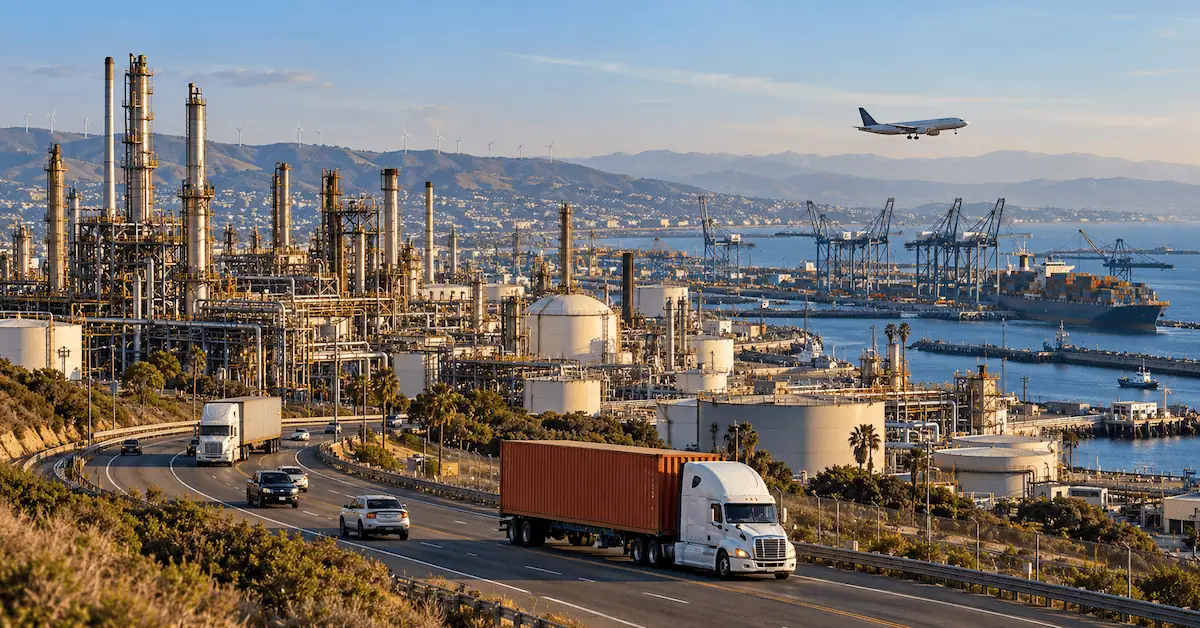
The state’s own refining and supply situation shows why the Governor’s policies are more fantasy than reality. The state functions as an energy island. The Sierra Nevada blocks pipeline connections to the rest of the country, making large-scale shipments of refined products from Gulf Coast refineries effectively impossible. Despite this geography, California’s economy—the fourth largest in the world—still demands roughly 58 million gallons of transportation fuel every day.
That transportation fuel demand total breaks down as:
- 37 million gallons of gasoline for more than 36 million vehicles
- 11 million gallons of jet fuel for the state’s major military installations and international airports,
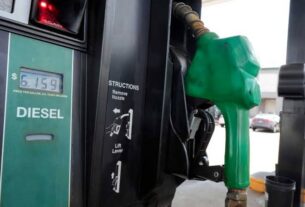
- 10 million gallons of diesel for trucking and construction.
In addition, ships calling at the Ports of Los Angeles, Long Beach, and Oakland require about 5.2 million metric tons of bunker fuel annually. The Port of Los Angeles alone saw almost 1,900 vessel arrivals in 2025; Long Beach handled over 10 million container units; Oakland adds further significant cargo and cruise traffic.
But planes, ships, trucks, and cars do not run on raw crude oil. They run on fuels that are refined from crude oil and are produced by the nation’s refineries. Those refineries also turn crude oil into thousands of other essential products demanded and purchased in the Golden State (and around the nation).
With in-state refineries in California continuing to close, how will the State support the supply chain demands?
- For 11 million gallons of aviation fuel per day for the State’s 30 military airports and 9 international airports?
- For the 10 million gallons of diesel per day to support trucks, construction equipment, and agricultural machinery?
- For the bunker fuel demands to support merchant ships for 3 of the busiest ports in America at Long Beach, Los Angeles, and Oakland?
Yet policies such as California’s low-carbon fuel standard are forcing refineries like the Martinez and Rodeo facilities to shift to biofuel production. Phillips 66 ended operations at its Los Angeles complex in late 2025, and Valero idled its Benicia refinery in 2026. These closures and conversions have reduced the state’s refining capacity by almost 20% in roughly the past year.
California only has 7 remaining refineries. With Phillips 66 Rodeo now a Renewable Energy Complex, only 6 are processing crude oil.
Southern California: (South Coast Air Quality Management District)
- Marathon Petroleum (Los Angeles)
- Chevron (El Segundo)
- PBF Energy (Torrance)
- Valero (Wilmington)
Northern California: (Bay Area Air Quality Management District)
- Chevron (Richmond)
- PBF Energy (Martinez)
California’s remaining refineries that process crude oil lack the capacity to produce the 58 million gallons of transportation fuel demanded daily. Compounding the problem, other operators have warned that the regulatory climate makes additional refinery closures likely.
Expanding access to affordable and reliable electricity and liquid transportation fuels and the thousands of products made from crude oil improves lives. But California’s policy approach takes a contradictory path by forcing refinery closures, even as demand remains high. The state’s mandated reliance on weather-dependent electricity like wind and solar compounds the issue, as the state’s utilities also have to build expensive backup, storage, and transmission.
Energy “REALITY” tells us that we need refineries to convert that useless black tar into usable transportation fuels and products:
- Planes, ships, trucks, and cars do not run on raw crude oil; they run on transportation fuels manufactured FROM crude oil by multi-billion-dollar refineries.
- Wind turbines and solar panels ONLY generate electricity, but CANNOT make any products or transportation fuels for life as we know it.
- The world is not dependent on raw natural fossil fuels BUT has become dependent on the products and transportation fuels MADE FROM oil, the same products and transportation fuels that Wind and Solar CANNOT make!
The world needs MORE REFINERIES to process that useless black tar into usable transportation fuels and products for life as we know it.
RELIABILITY
For billions of people living in developing countries, the greatest challenge is not achieving Net Zero. It is escaping poverty while gaining access to reliable energy, transportation, clean water, healthcare, education, and economic opportunity.
The global discussion should therefore begin with people—not simply with carbon.
For many families, daily life means cooking over wood, charcoal, crop residues, or animal dung in poorly ventilated homes. Indoor air pollution causes millions of premature deaths every year. Reliable electricity, clean cooking, refrigeration, sanitation, and transportation remain unavailable to many communities. These are immediate human problems.
Economic development has always depended on access to affordable and reliable energy. Every country that has escaped poverty has first developed the ability to produce food efficiently, transport goods, build industries, educate its people, and provide modern healthcare. Without electricity and transportation fuels, none of these become possible.
Before discussing Net Zero, the world should first ask how billions of people can achieve a decent standard of living without the transportation fuels and products made from crude oil that now support our materialistic society.
RESILIENCE
Regarding the resilience of maintaining the supply chain of diesel fuel to meet the demands of the world, it may take years to replenish the supply chain of diesel fuel.
With the recent wartime loss of Russian and Gulf refining capabilities and the loss of two California refineries and the probable closure of more California refineries, diesel fuel shortages may persist for years until damaged refineries are repaired or new refineries are built.
Unfortunately, the high impact of California’s relentless over-regulation on its in-State refineries will continue to reduce the production of diesel fuel and more and will perpetuate the unaffordability of all transportation fuels for years to come.
Every option for refineries to manufacture transportation fuels from raw crude oil must demonstrate reliability, affordability, feasibility, and acceptable environmental impact.
Please share this information with teachers, students, and friends to encourage Energy Literacy conversations at the family dinner table.
Click this Link to Sign up for Energy Literacy from Ronald Stein.